The Lumberjack


Students Serving The Cal Poly Humboldt Campus and Community Since 1929

Tag: Fulkerson hall

  • Polish Professor Melds Magic and Music

    Polish Professor Melds Magic and Music

    A dream of illusions and piano prowess with Igor Lapinski

    I know a little about magic. And by the end of Polish pianist and magician Igor Lapinski’s Feb. 22 show, I knew I had witnessed something good.

    “Your free will,” Lapinski said in an almost-cliché line that sounded much more convincing with his Polish accent and navy suit, “is just an illusion. A dream.”

    He then pulled a signed dollar bill out of an unopened kiwi.

    Lapinski interlaced illusions with piano pieces by Frédéric François Chopin, the Polish composer. Lapinski, originally from Poland, teaches as an assistant music professor at the University of Oklahoma.

    “He’s going to do something I think we haven’t seen in Humboldt,” music Professor Daniela Mineva and former teacher of Lapinski said before he took the stage. “I’ve been waiting 18 years to bring him here.”

    Hands, he said, are capable of both the sublime and the violent.

    The crowd of mostly older locals sat in a semicircle on the Fulkerson Recital Hall stage around Lapinski and his piano. Rather than have the crowd sit in the hall seats, Lapinski had chairs arranged around him for an intimate experience.

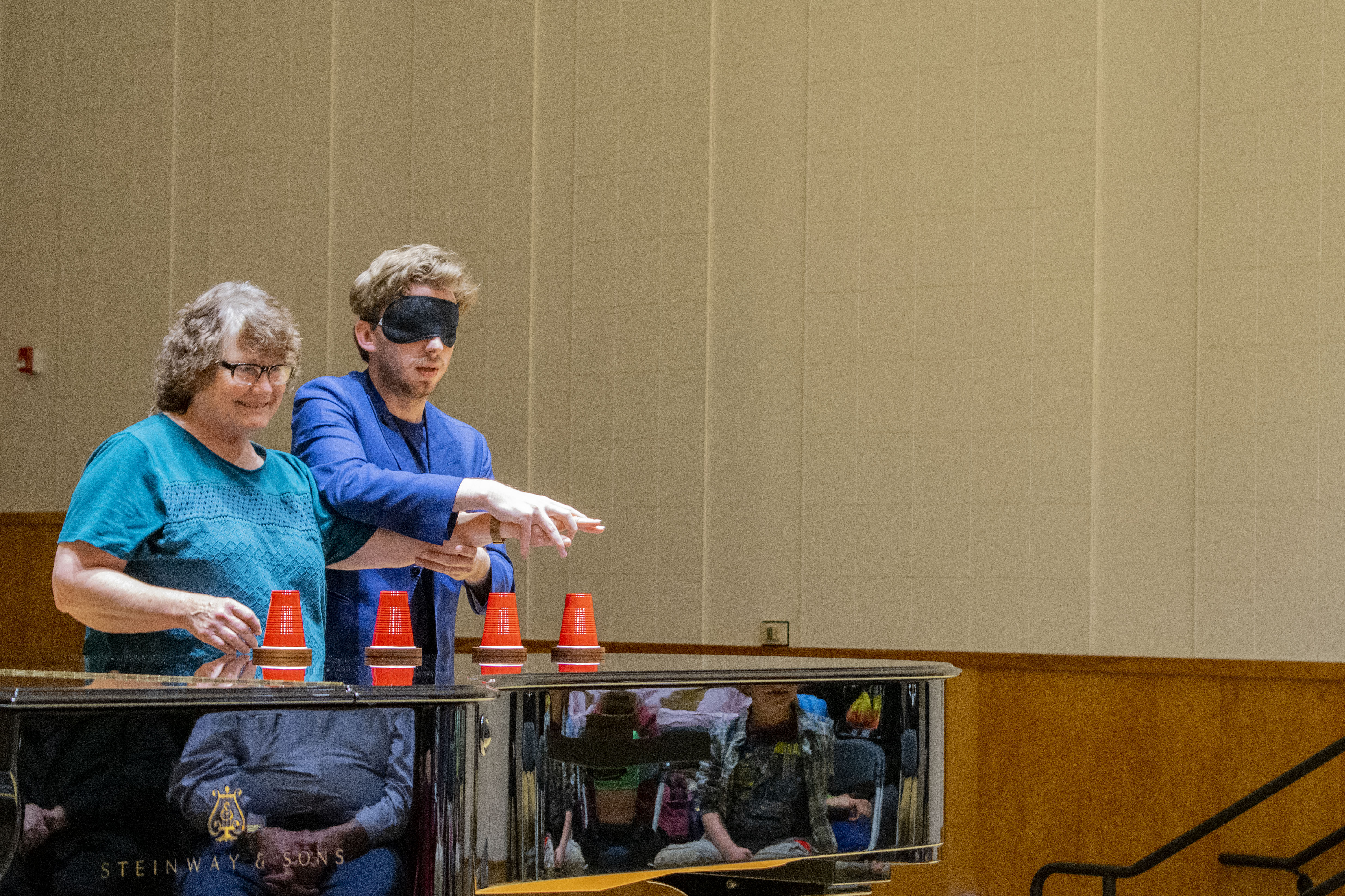
    Lapinski fluctuated between musical pieces of chaos and pieces of order. He rapped on “a haunting desire to belong.” In a three card monte-style routine with red solo cups and a single metal spike, he noted the opposing potentials within people.

    Hands, he said, are capable of both the sublime and the violent.

    He then shrugged off the thought and smashed his and an audience member’s hands down onto the cups in a game of Russian roulette.

    Multiple effects relied on the appearance and disappearance of letters—mostly written by Lapinski, with one supposedly written by his mother. The letters framed the performance in the idea of belonging, as Lapinski brought the audience along on an imaginary plane ride and read letters from home.

    I have to confess, because I know a bit about magic, I’m not a good judge of it. I spent about two of my teenage years learning magic tricks. I know the basics, and I can recognize standard sleight-of-hand moves.

    I’m no longer what magicians call a layperson. Even when I don’t know exactly how a trick is performed, it’s conceivable. It’s rare for me to see something inexplicable. But it does happen.

    Any attendee of Lapinski’s show can expect to exit with a smile on their face, or at least, a warm feeling in their mind. I can deduce how Lapinski performed his effects—but several of them I can only grasp loosely. For a layperson, his performance may be miraculous, not just puzzling.

    Magicians ultimately seek to produce miracles. The central argument of “Designing Miracles,” a well-regarded book by magician Darwin Ortiz, is that a magician should seek to produce an effect that doesn’t make the audience ask, “How do they do it?” Instead, the goal is, “How is that possible?”

    It’s slight, but this marks the difference between a trick and a miracle. A trick is a matter of deception that can be explained by a magician’s actions. A miracle is just that: pure magic that a magician merely facilitated. In the ideal, the performance transcends trickery and becomes magic.

    In the moments after Lapinski’s show, the audience agreed on his excellence.

    “He’s totally amazing,” a woman behind me said.

    “He’s a delight,” Mineva, the professor, said.

    “He’s hilarious,” a man beside me said. “He’s great.”

    At the very least, you can escape into a dream for just over 60 minutes. Lapinski finished with one last letter and one last piece by Chopin.

    “And so with this piece,” he said, “I wish you all a good night.”

    The night, indeed, was good.
  • Uproar over shiny new floor

    Uproar over shiny new floor

    Music department’s Fulkerson Recital Hall gets new floor

    By Sarahi Apaez

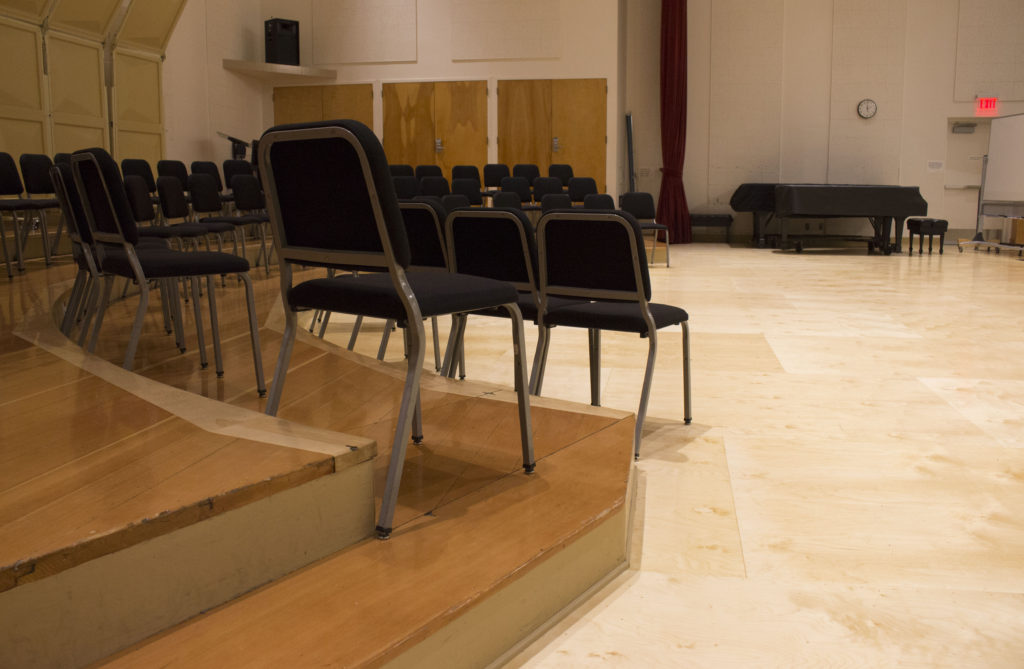
    The glare from the new floor in Fulkerson Recital Hall makes it hard for music students to read their music. The glossy plywood covering the stage alters the light and acoustics in the Hall this spring.

    Music student Telisha Moore has many complaints about the floor.

    “It’s super shiny and distracting when standing on the stage and it is very hard to read music,” Moore said. “It doesn’t really feel like a performance stage anymore.”

    This semester, students and faculty of the music department return from break to find big changes had been made to Fulkerson Recital Hall’s flooring.

    As of Jan. 16, Fulkerson Recital Hall’s old growth pine flooring has been changed to plywood as a temporary fix.

    With students walking in and out and equipment being moved back and forth, the Hall gets yearly damages. These damages include safety issues such as splintering.

    Professor Brian Post, who is currently filling in as interim chair of the music department alongside Professor Paul Cummings, expresses concerns over the many issues that have come with the temporary changes to the floor.

    At the end of every year, the floor is refinished, sanded down and gets a new coat of varnish on top, according to Post.

    Professor Brian Post looking down at the changes done to the floor. Photo by Sarahi Apaez

    At the end of 2016, Facilities Management realized that the floor was too old to refinish and could not be sanded down any further.

    In December, facilities management made final decisions to begin work on temporarily fixing the floor over winter break and would hold off complete replacement of the floor until a time when the stage is most open, according to Cummings.  

    Cummings biggest concern is when the temporary floor will be replaced with the permanent floor because the floor is almost always in use.

    Fulkerson Recital Hall is used around 12 hours a day. Classes use the recital hall  for rehearsals, it is used by center arts and even in the summer when HSU hosts music workshops. HSU hosts nationally recognized performers, speakers, and is a regional center for the arts. The community uses it as well as other departments on campus. The hall is meant to function as a community stage, as well as a department stage, according to Post.  

    Finding a time when the Hall is not in use is challenging. Times for the permanent replacement of the floor have not been set, due to how often the Hall is in use.

    “If we’re lucky, this repair process will be done by Fall 2017,” Post said.

    The music department had little knowledge to the extent of the changes that would be occurring in Fulkerson Recital Hall. According to Post and Cummings there was no communication about the floor being replaced between the Facilities Management and the Music Department.

    “You can imagine our shock when we came back from winter break and we opened that door and saw a floor that doesn’t meet any kind of basic standard for a university music department primary performance facility,” Cummings said. “All changes were done without consultation to the music department.”

    Professor Eugene Novotney is very familiar with Fulkerson hall as he spends 12 to 15 hours or more a week in the space. “I don’t think any consideration was given to how that gloss coated plywood floor altered the light and soundscape of the stage,” Novotney said.

    Novotney and his students struggle with the acoustics and the reflection of the bright floor daily. “The floor is very reflective both of light and sound,” Novotney said.

    The current acoustics in Fulkerson Recital Hall have been found to be hard for singers to work with. The Hall is in drastic need of attention from facilities management when it comes to the functionality and acoustic environment in order to be on a professional level said Novotney. The plywood floor that is currently in the room is an intermediate step towards a complete transformation that will occur in Fulkerson.

    Music student Amber Rausch says her class was full of sarcastic reactions when they were first exposed to what had happened to the floor.

    “Everyone was in shock on the first week of classes,” Rausch said. “The topic of the floor comes up in every class session.”