I am a person with mental illness. I have bipolar disorder and take my five medications every night. As a person with mental illness, I have mixed feelings about Prop. 1. I think it’s great that our state is finally doing something about homelessness. According to research done by UC San Francisco, over eight in ten homeless people in California struggle with serious mental illness and nearly two-thirds struggle with addiction. This proposition would increase treatment beds and increase care for people with addictions. I am unhappy that they are expanding involuntary treatment. Involuntary treatment is necessary under certain circumstances. I have been so delusional that I thought I was the Messiah, despite taking my medication. I didn’t think I needed as much care as I ended up getting. I credit involuntary treatment with saving me in certain situations. However, I am concerned that involuntary treatment will be overused.
It comes down to a very tricky dilemma. To what degree can a person, whose mind is impaired, make good choices for themselves? It’s a tricky line to walk. Often, we can’t make good choices for ourselves if we are severely ill, so we need to rely on others to do what is best for us. However, this inherently violates the rights of the mentally ill to a degree. Sometimes the current laws assume we can make choices for ourselves when the part of us that makes choices is impaired. Our current system doesn’t really know how to deal with this. Either they give us the freedom to make bad choices, or we have no choices at all.
It could be argued, though, that the situation really has become dire. I actually walked through Skid Row once, with company, and was shocked by the poverty. This makes me consider that maybe the situation with mental health has become so dire in our state that involuntary measures have become necessary.
At face value, Proposition 1 amends the Mental Health Services Act to offer more behavioral health services. This requires authorizing $6.38 billion in bonds. Meaning that the state sells this amount in bonds, which is how the government borrows money and repays it, plus interest over time. According to the Legislative Analyst’s Office, it would increase state costs to repay bonds, amounting to $310 million annually for 30 years. This also means that an annual $140 million of existing tax revenue for mental health, alcohol, and drug rehabilitation shifts from counties to the state government.
So what will Prop. 1 do? If voted in, it will make counties’ mental health care and substance use treatment services more focused on housing and personalized support. The money could go to building more facilities and housing for people with mental health, drug, or alcohol issues. If it’s not voted in, nothing will change.
Arguments for Prop. 1 emphasize the importance of finding solutions to the homelessness, mental health, and addiction crises, and Prop. 1 may be a step in the right direction. Arguments against Prop. 1 point out that the proposition is expensive and this is not the time for more government debt. It may also take away funding from current community-based mental health services funded by the Mental Health Services Act, taking almost a third of the annual funding dedicated by the act.
According to the California Voter guide, those in favor of Proposition 1 include California Professional Firefighters, CA Assoc. of Veteran Service Agencies, and National Alliance on Mental Illness–Ca. Those opposing Prop. 1 include Mental Health America of California, Howard Jarvis Taxpayers Association, and CalVoices.
Voting day is March 5. To register to vote, visit registertovote.ca.gov/
Cal Poly Humboldt may be faced with an $8 million budget deficit in the 2024-2025 school year.
At an Associated Students meeting on Feb. 9, Provost Jenn Capps and University Budget Office Director Amber Blakeslee gave a presentation on the university’s estimated budget and how they plan to address it.
Beyond Cal Poly Humboldt, the entire CSU system is faced with budget constraints. Each year, the state governor puts out a proposed budget for the CSU system. After months of discussion and advocacy, the governor publishes a revised budget in May, which is then finalized in June. Currently, the 2024-2025 proposed budget for California projects a $38 billion deficit. CSU campuses get most of their funds from the state budget and funds are distributed based on enrollment.
However, the governor and the CSU system have an agreement where their portion of state funding will increase by 5% every year, provided that the campuses continue meeting their student success outcomes. Because of the current deficit California is facing, the planned $240 million base increase will be delayed by a year and paid back retroactively. There is a chance that funding won’t be available for the 2025-2026 school year, so the CSU system is trying to redivide its funding among over-enrolled and under-enrolled schools.
“The system is sort of reshuffling, so for campuses that were under-enrolled, [that means] reducing the targets, which means reducing funding and shifting that to campuses that are above target,” Blakeslee said. “And so for our campus, we’re going to have our target reduced by 3% next year, which means 3% of the funding will pull back as well, so it’s about a $2 million impact to our campus that we need to navigate as part of budget planning.”
While the university’s revenue is increasing, expenses are increasing at a faster rate. For the 2024-2025 school year, the university is expecting funding from the state, the 6% tuition increase, enrollment, and California Polytechnic funding, totaling at $170 million. The deficit from compensation and benefits, financial aid, and other costs are estimated to reach $178 million.
Blakeslee described how budget planning for the campus looks at three different scenarios for enrollment, including a baseline scenario, the best case scenario, and worst case scenario. The baseline enrollment increase projected for next year is 2.6%.
“As a campus, we’re actively working toward ambitious growth,” Blakeslee said. “From a budget standpoint, we are conservatively planning but watching closely because we want to make sure that we are proactively supporting and growing capacity where needed as we realize the growth, but we also don’t want to spend it before it happens.”
Carla Ho’ā, the interim Chief Financial Officer and Vice President of Finance and Administration, emphasized the university’s priority being the student population and minimizing negative effects when making budget cuts.
“Financial resiliency is another aspect of this,” Ho’ā said. “It can be tempting at times to make short-term decisions that have long-term, and sometimes negative, consequences. [We’re] really needing to be thoughtful and looking out into the future and about the financial resiliency of the university for the long-term, like having sustainable decisions built into the process.”
When deciding where to allocate funds for Academic Affairs, Capps collaborates with the department heads of the colleges, the library dean, and other areas to share strategies and distribute funding. She said that the university hopes to provide more opportunities for student collaboration in the future.
“What has been asked in a lot of different spaces is, ‘Hey folks, could you share with the campus community what ideas you generate, what potential opportunities you might be going after, before you actually do it?’” Capps said. “So that you all know what we’re considering, what we’re thinking about, and potentially have a shot to weigh in.”
Capps also said that the University Resources and Planning Committee – a part of the University Senate with representatives from faculty, staff administration and students – is hoping to hold a public forum at least once a semester. The URPC has two seats reserved for student representation and is responsible for drafting a budget proposal for the university president.
The URPC budget recommendation will be finalized next April. The presentation encouraged students to provide input and engage with AS, administration, and other representative student communities. Several positions in AS are currently open, such as Environmental Sustainability Officer, Public Relations Officer, and college representatives. Elections for AS will be made public on March 6. For more information on the university budget and upcoming elections, you can visit the URPC and AS websites.
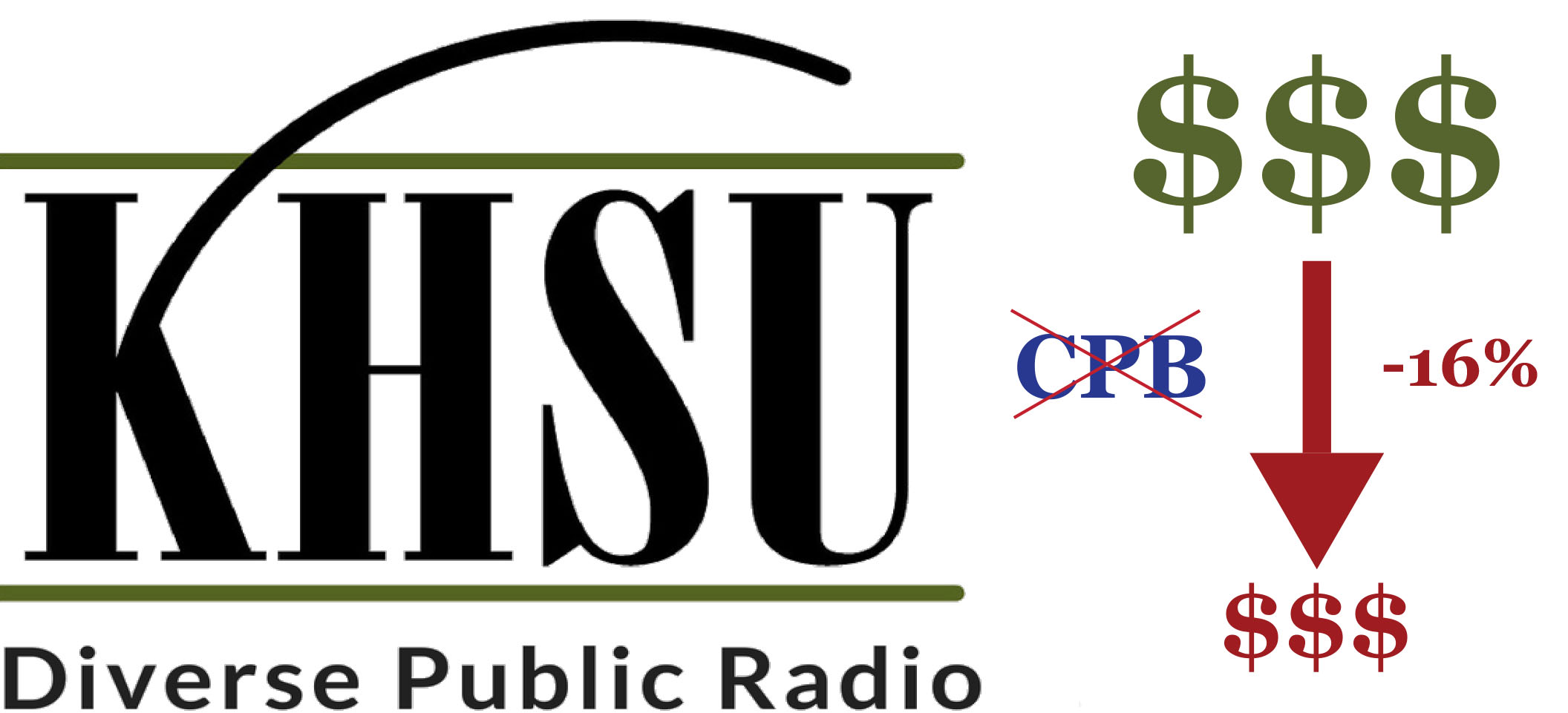
Humboldt State’s radio station, KHSU, is facing a 16 percent funding decrease under Donald Trump’s proposed 2018 Budget Outline.
KHSU has an annual operating budget of just over a million dollars. In 2016, KHSU received $175,061 in grants from the Corporation for Public Broadcasting. CPB is the largest source of funding for public radio. With the complete defunding of the CPB, KHSU would have to look elsewhere for funding.
Peter Fretwell, KHSU’s new general manager, was attracted to the position as general manager at KHSU due to it’s large community involvement.
“KHSU is near the top, if not the top of the most listened to stations in Humboldt county,” Fretwell said. “In my experience community involvement is important and I was attracted to Humboldt county and KHSU because of the deep community engagement.”
KHSU is a noncommercial, public radio station, supported by Humboldt State University. KHSU is largely community based on and acts to provide intellectual perspectives on local and national issues.
KHSU receives a large amount of their funding from donations from the community. In 2016 $336,289 was donated in listener support. It is this kind of support from the community that will be able to maintain KHSU’s ability to broadcast.
KHSU is a vital resource for the community. Humboldt is relatively cut off from the world and in the face of potential natural disaster, public radio would be vital for public service.
The recent budget outline, released on March 16, called for a complete cut to CPB funding. Similar stations with similar communal obligations all around the country face these cuts as well. Patricia Harrison, CPB’s president and CEO, outlined the importance of public media in a statement made after the budget outline was released.
“The elimination of federal funding to CPB would initially devastate, and ultimately destroy public media’s role in early childhood education, public safety, connecting citizens to our history, and promoting civil discussions,” Harrison said.
Fretwell has seen proposed cuts to CPB before and believes that, as before, the CPB will be able to retain its funding.
This website uses cookies to improve your experience. We'll assume you're ok with this, but you can opt-out if you wish. Cookie settingsACCEPT
Privacy & Cookies Policy
Privacy Overview
This website uses cookies to improve your experience while you navigate through the website. Out of these cookies, the cookies that are categorized as necessary are stored on your browser as they are essential for the working of basic functionalities of the website. We also use third-party cookies that help us analyze and understand how you use this website. These cookies will be stored in your browser only with your consent. You also have the option to opt-out of these cookies. But opting out of some of these cookies may have an effect on your browsing experience.
Necessary cookies are absolutely essential for the website to function properly. This category only includes cookies that ensures basic functionalities and security features of the website. These cookies do not store any personal information.
Any cookies that may not be particularly necessary for the website to function and is used specifically to collect user personal data via analytics, ads, other embedded contents are termed as non-necessary cookies. It is mandatory to procure user consent prior to running these cookies on your website.