Madison Lalica cracks open 400-million-year-old fossils
Madison Lalica is a junior botany major researching ancient fungi in fossilized plants over 400 million years old. She is filling in the blanks of the fungi fossil record with her unique research.
“Given their importance in current ecosystems, I support [that fungi] must have had such a fundamental role in ancient ecosystems,” Lalica said. “And that is what I’m trying to prove with fossil research.”
Lalica said she had the privilege to work with a huge box of rocks on loan from the Smithsonian Museum filled with fossilized plants. The fossils came to Humboldt State University by way of the Smithsonian, but they were collected in the 1960s by a paleo botanist named Francis Huber at a rock formation called Battery Point in Canada.
“We look at a bunch of plant fossils that are 400 million years old,” Lalica said. “They are preserved very beautifully and you can see all of their anatomical features.”
Graduate botanist Megan Nibbellink works alongside Lalica. She is focusing on the anatomy and relationships of the host plants, called zosterophylls. The Battery Point fossils are preserved in a unique geologic formation that serves to make really good fossils.
“It is a fluvial deposit,” Nibbellink said. “It was a bunch of pieces of fragments caught up in fine sediment at the end of a river. The reason why I like these fossils is because you can see the individual cells. And that’s also why Maddy is able to do what she does.”
When the host plants were buried by fine river sediments all those millennia ago, their form was preserved as the sediment solidified over millions of years. The fine particles, though, essentially printed the fossils in high resolution with so much detail that Lalica found what she was looking for: ancient fungi.
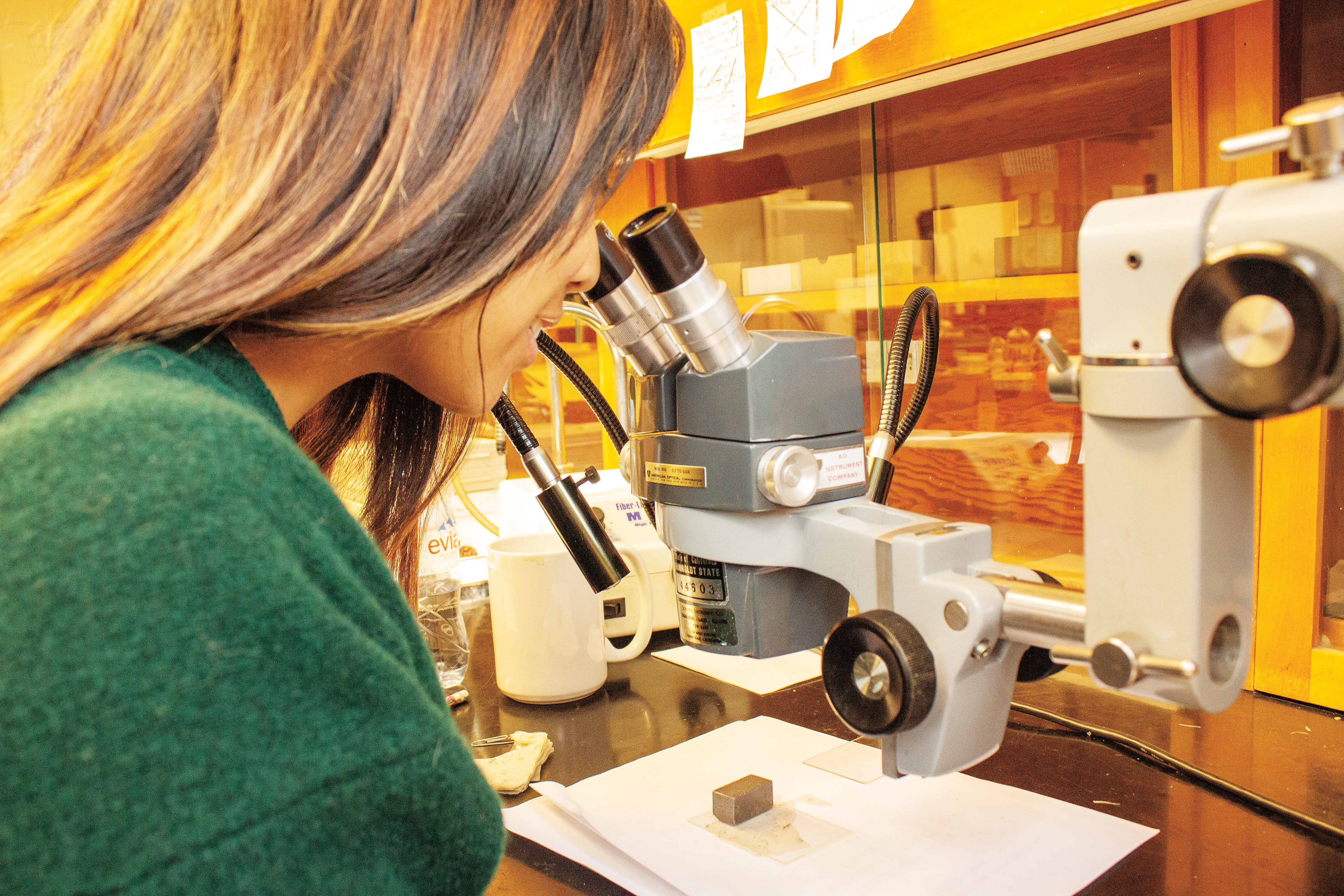
Lalica is scanning and investigating these plant fossils for any evidence of fungal material. Spores, fungal tendrils called hyphae and scars from fungal infection are some indicators she has found. Specifically, Lalica is working on identifying the fungi glomeromycota, a fungal group intimately symbiotic with plants today. She wants to learn how similar the ancient fungi are to modern fungi.
“Why do you want to know about extinct life, then, one might ask. And to be honest, it is a pretty philosophical pursuit I guess. In the most direct sense, learning about extinct lifeforms helps us understand how the living lifeforms that we see around today evolved.”
Alexandru “Mihai” Tomescu
“The plant and animal fossil record is really well understood,” Lalica said. “Like they have a pretty clear timeline of ‘This happened and then this happened,’ but for fungi it is so sparse and incomplete that they have no idea what goes before what.”
Lalica’s faculty advisor Alexandru “Mihai” Tomescu has made it his life’s work to figure out what goes before what. Tomescu explained that exploring the fossil record is important because fossils offer us the only way to look directly into life in the past.
Tomescu was Lalica’s botany professor before she had switched majors, but she said she fell in love with the world of paleobotany after his instruction. Showing interest in the subject, Lalica took the opportunity to begin her own research as soon as Tomescu offered her the chance.
“Why do you want to know about extinct life, then, one might ask,” Tomescu said. “And to be honest, it is a pretty philosophical pursuit I guess. In the most direct sense, learning about extinct lifeforms helps us understand how the living lifeforms that we see around today evolved.”
The 400 million year old specimens are interesting to Tomescu and his team of researchers because the plants themselves represent the first wave of vascular plants, or plants that move water through special tissues, that evolved on Earth. Vascular plants constitute nearly every modern land plant, so these ancestors are significant. Fungi, too, are significant to life on Earth and may have been part of its foundation.
“Fungi are probably, almost certainly I think, older than actual plants,” Tomescu said. “Fungi are a lot older. But because they’re just hyphae, since they’re flimsy, their fossil record is not that great.”
Tomescu has been recruiting undergraduate students to research these fossils in his lab. Tomescu explained that HSU hosts a botany program that attracts a lot of students, but also that the students are enthusiastic to participate in research. He said HSU has students who are interested in the grey areas. Lalica was one of those students.
Moving forward, Tomescu and Lalica are preparing to publish a paper about her year-long investigation into the fossils. This summer, she is presenting her research at the Botanical Society of America’s annual conference.
“It seems like in Humboldt opportunities are like, if you talk to the right person or if you become friends with the right person, it just kinda happens,” Lalica said, “And it just so happened that I fell into the world of paleobotany.”