The Lumberjack


Students Serving The Cal Poly Humboldt Campus and Community Since 1929

Tag: GI 2025

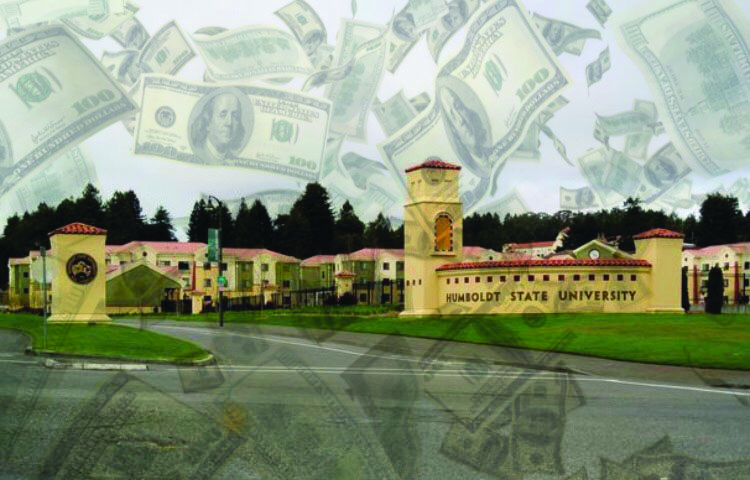
  • GI 2025 brings $1.1 million to HSU despite low enrollment 

    GI 2025 brings $1.1 million to HSU despite low enrollment 

    Lumberjacks score an additional $1.1 million over other CSUs

    HSU senate meeting brought attention to the challenges the university will be facing over the next six years. The Graduation Initiative (GI) for 2025 has the CSU system eyeing HSU. Recent University senate meetings show HSU has some major battles to win.

    Launched in 2016, GI 2025 looks to increase both student enrollment and retention by 10 percent or double what it was originally. However, HSU was recently allotted more money than other CSUs despite the under performance.

    “HSU is 18 percent below target enrollment,” Vice President for Academic Affairs Alexander Enyedi said. “However, HSU received a $1.1 million increase to the base budget amount received last year.”

    Recently, $436,000 from the GI 2025 funding has been directed to student employment at HSU. Following the housing crisis, faculty works on supporting students on a financial level in hopes of combating the steep housing situation.

    [perfectpullquote align=”right” bordertop=”false” cite=”Armando Peña” link=”” color=”” class=”” size=”18″]“The number one reason for low retention rates is alienation. If students do not have a home, they do not want to invest in their community.”[/perfectpullquote]

    Armando Peña, an ethnic studies major and double minor, was one of only four students in the senate meeting’s crowd. Peña voiced his frustration towards the lack of student involvement and his disappointment in HSU.

    “The number one reason for low retention rates is alienation,” Peña said. “If students do not have a home, they do not want to invest in their community.”

    Currently, HSU is battling a statistical war after a seven percent decrease in applications, enrollment and the freshman class population.

    “We have a retention rate goal of 80 percent, which means 80 out of 100 students come back for next semester,” Enyedi said. “Currently, HSU is at 71 percent (71 out of 100).”

    Beyond HSU, the community as a whole faces new change. Equity Arcata is a new involvement group consisting of local partnerships with a goal of racial equity.

    The group’s vision is to create a community comprised of successful and racially diverse members who support one another, tag lined “Ourcata.”

    The recent updates in the Josiah Lawson case catalyzed the emergence of Equity Arcata, who felt compelled to respond to the community.

    Lizzie Phillips from Equity Arcata spoke about future plans to release a mobile app, which will allow the reporting of hate incidents and track unsafe patterns within the community.

    “People want accountability and transparency in what’s happening,” Phillips said. “Equity Arcata wants holistic accountability and for people to feel safe.”

    Although HSU faces a mountain of challenges, the upward journey has already begun. GI 2025 set a goal for universities to have a six year graduation rate of 56 percent.

    HSU has already risen that statistic from 46 percent to 52 percent. With improvement on the horizon, Vice President for Academic Affairs Alexander Enyedi believes HSU can overcome the odds.

    “It was a reality in 2015, but we hit our enrollment target,” Enyedi said. “I think we can reach the ostentatious goal of 7604 [students enrolled].”

  • Bridging the gap

    Bridging the gap

    How HSU and Graduation Initiative 2025 are attacking low graduation rates

    Freshman Isabel Duplantier, is planning to graduate in four years, but the odds are stacked against her. According to a recent report, Humboldt State currently has a four year graduation rate of 22 percent. Duplantier, a journalism major, is determined to beat the odds.

    “My first semester was hard, because it took a lot of time adjusting,” Duplantier said. “But this semester I feel like I have figured out how I perceive myself and how others perceive me. I made it my home.”

    Duplantier’s troubles adjusting to HSU are not uncommon. They are the reason why such a low number of students graduate within four years. However, those numbers are not unique to HSU. The California State University system started Graduation Initiative 2025 in 2009 with the intent to “increase graduation rates for all CSU students while eliminating opportunity and achievement gaps.” It didn’t go into effect until 2016, but in that short amount of time progress has been made.

    “When we started GI 2025, our four-year graduation rate was 14 percent,” Lisa Castellino, Associate Vice President of Institutional Effectiveness at HSU, said. “So, we have gone from 14 to 22 percent.”

    By 2025, HSU is hoping to have a four-year graduation rate of 30 percent and a six year graduation rate of 56 percent. Castellino said that HSU had a six year graduation rate of 46 percent when the initiative started, but raised it to 52 percent two years ahead of schedule.

    “That’s a success story that the university should hold up,” Castellino said.

    Some of the contributing factors behind why students either tend to drop out or graduate in a longer amount of time can be complex. Students face a myriad of issues that range from housing and mental health to food insecurity.

    “I know a few freshmen that are having trouble with housing and financial aid,” Duplantier said. “I feel like the school could be better at giving them resources to figure that stuff out.”

    That is where GI 2025 comes in. There are six pillars to GI 2025 and all are aimed at breaking down barriers. The six pillars include: academic preparation, enrollment management, student engagement and well-being, financial support, data-driven decision making and removing academic barriers.

    [perfectpullquote align=”right” bordertop=”false” cite=”Lisa Castellino” link=”” color=”” class=”” size=”18″]“Peer mentoring is very effective, and it is a best practice in higher education.”[/perfectpullquote]

    In the 2017-2018 and 2018-2019 budget cycles, the state spent nearly $75 million a year on GI 2025. This year’s Governor Gavin Newsom announced the California budget would allocate $45 million for GI 2025. A cut of nearly $30 million, but the first time that it was officially a part of the California Budget Proposal. A part of the student engagement and well-being pillar is to “[foster] a strong sense of belonging on campus.” To do that Castellino said HSU is planning on expanding the “Oh SNAP!” program as well as others that have been successful.

    “Peer mentoring is very effective, and it is a best practice in higher education,” Castellino said. “We are looking to expand cultural pedagogy as well.”

    Part of the GI 2025 report points out achievement gaps for underrepresented minorities (URM) and Pell Grant recipients. URMs are defined as those who identify as Black, Latinx or American Indian. Pell Grant recipients are those who come from low-income backgrounds. The URM equity gap rate is 14 percent lower and the Pell Grant equity gap is 11 percent lower than their white, financially secure counterparts, meaning that individuals from these two groups graduated at lower rates than their peers.

    To help bridge that gap HSU announced they would be adding $435,000 for student jobs starting in fall 2019 and hiring a number of new tenure-track faculty members. The boost in student jobs is being implemented to “help students pay for college, enhance their skills to build their resume and engage with campus in new ways,” according to a recent announcement from the HSU news and information department.

    To reach her goal of graduating in four years, Duplantier said she will utilize some of the resources here on campus. So far she has used the writing center and a bit of of counseling from her advisor. Duplantier wants to waste little time in reaching her dreams.

    “Once I graduate, I’m hoping to design and write for some sort of magazine,” Duplantier said. “Maybe start up my own at some point.”