The Lumberjack


Students Serving The Cal Poly Humboldt Campus and Community Since 1929

Tag: Grades

  • The attendance trap: time to set grades free

    The attendance trap: time to set grades free

    by Jake Hyslop

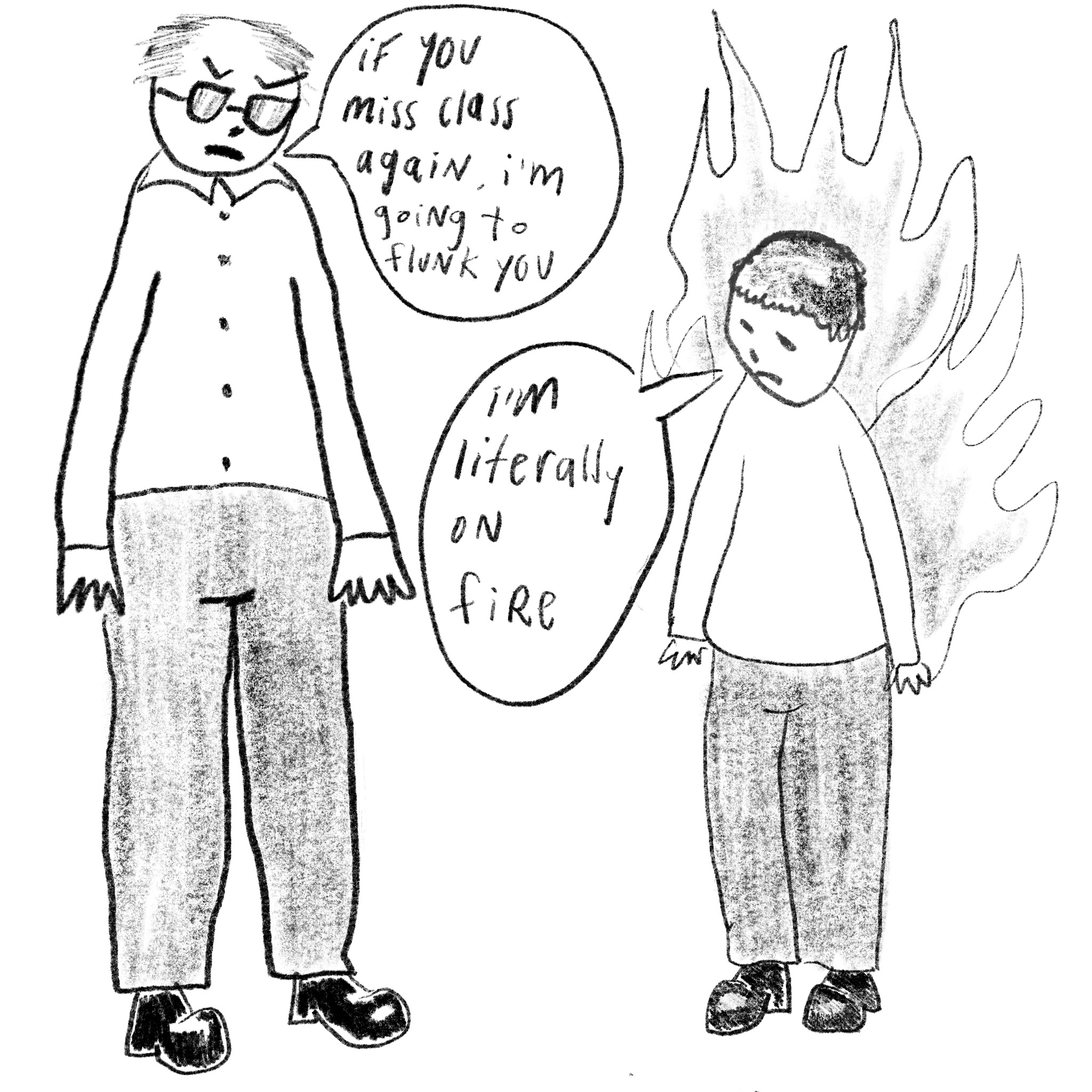
    Over a month into the semester, most of you are probably familiar with your professors and their grading policies by this point. Some require you to show up to every class to get a decent grade, while there are others who simply don’t care if you show up to class (spoiler alert: these are the cool professors).

    I stand very firmly in the belief that attendance should not factor into a student’s grades. They should be graded on their performance instead. 

    Maybe this is crazy, but if I miss two or three classes, yet demonstrate knowledge of the course materials by performing well on exams/essays/projects/you-name-it, I shouldn’t be punished. That A grade should stay an A. 

    Too often a class I’ve had has spent a week or two teaching something I already know fairly well (especially those classes that teach a broad range of practical skills in a major), but I am forced to sit through lectures bored to tears. I often think about the tens of things I could be doing instead, which are more often than not, assignments for other classes I could be using this valuable time for. 

    Allow me to introduce the concept of life. Life has this crazy habit of happening. It happens to you, to me, even to the professors here. When a professor has a wedding they plan to attend, or are feeling a little sick, they call off class. 

    Tell me then, why when I missed a class due to a personal loss, I was emailed a “sorry for your loss,” followed by a Canvas notification of my attendance grade being lowered by 7%? When I’m paying for my college credits, what valid reason is there for attendance affecting my grade? Professors don’t get paid based on class attendance, so the only person negatively affected when a student misses class is the student. 

    Let’s dig into how the supposed function of classroom attendance is to motivate students. I’m willing to bet money that mandatory attendance doesn’t motivate any student to do better in class. It sure doesn’t motivate me to do better in class. 

    A student should want to attend class. If a student is paying to take a class, they should be engaged by and with the course material, and that interest will intrinsically motivate the student to keep attending and learning. Requiring the student’s presence, and actively lowering the grade if not graced with their presence will extrinsically motivate the student to attend class. It will not motivate the student to learn. 

    Extrinsic motivation, like keeping a seat warm to satisfy an arbitrary requirement, doesn’t hold a candle to the intrinsic motivation of actually being interested in what’s being taught. Otherwise, self-motivation is taken away from the student and butchered in the slaughterhouse of butts-in-seats and vacant stares. 

    According to a 2010 report by the American Educational Research Association, while attending class can assist in getting better grades, mandatory attendance has a very small impact on how the students perform. 

    For all of you professors out there balking at the idea, slow down and take a deep breath. I promise you that most of us would attend the majority of our classes, just like usual. After all, it’s our money on the line. If you think that nobody will attend your class without graded attendance, chances are your class sucks and you should step it up. Make us want to come to class. If I’m able to accomplish the majority of your coursework well without paying a lick of attention to your lectures, they’re probably not all that engaging. 

    Oh, and participation grading is fine. After all, the professor has to keep track of students contributing. In the case of discussion-based classes, maybe offer students who miss class a discussion board on Canvas to post things on. 
    Stopping mandatory attendance puts the power and capacity to learn into the hands of the student. It restores that joie-de-vivre that graded attendance robs us of and allows us to feel like students, eager to learn instead of prisoners chained to our degrees.

  • A nuanced way of grading

    A nuanced way of grading

    By | Reza Sadeghzadeh

    Settling for a lower grade is frustrating when you’re trying to get the grade you want. It’s time to get rid of our old, outdated grading structure!

    There is a new way of grading that allows students to get the grade they deserve. It‘s called specification grading. The “specs” grading system has no ambiguities because students will know from the first day of class exactly what grade they will be getting. It sounds too good to be true, but this is how it works.

    The professor will tell their students the first day of class that they must successfully meet a set of specification proposed in the syllabus. For instance, to get an A, the student must write four essays, pass three exams, finish two projects and provide the class with one presentation. If a student could settle for a B, they will have to complete and pass fewer tasks. You get the idea.

    The professor will also give a token to every student so they can use it to redo an incomplete assignment. Additionally, the instructor will provide more assignments and exams than the amount required to get an A. Therefore; students have a chance to redeem themselves if they fail an assignment or test.

    Dr. John Meyer, a Politics professor at Humboldt State University, has experimented with this method of grading.

    “[I] very much liked it,” said Meyer. “It encouraged the class to focus on the things that matter.”

    Further, the students are inclined to apply themselves more in class since they know exactly what it takes to get the grade they want.

    “There’s something wrong with the way we’re grading that isn’t being talked about nearly enough,” said Dr. Linda Nielson, director of the Office of Teaching Effectiveness and Innovation at Clemson University. “Grades [only] account for 2.4% variance of career success.”

    Our current grading structure does not fully correlate with how much we learn. Sometimes the difference between a B+ and an A- comes down to the discretion of a professor. In other words, their final decision may be dogmatic and unfair.

    It is important for a learning institution to acknowledge all of its options. Now is the time to start talking about a new way of grading that will boost our education so we can focus more on learning than worrying about the uncertainty of our grades.

  • Student Strategies: Office Hours

    Student Strategies: Office Hours

    By | Onaja Waki

    There may be times when students need that extra one on one time with their professor for things like making up assignments and exams, discussing grades or getting clarity on homework or a project. These are the reasons professors offer their students office hours. Most professors and lecturers have the days and times on their syllabus. However, not all teachers abide by their assigned office hours which sometimes makes it a hassle for students to meet with their teacher.

    There are a few HSU professors that some students claim are hardly available during their office hours. However, when trying to get in contact with some of these professors for an interview they never responded.

    In addition to reaching out to some of the teachers who students feel aren’t always at their office hours, a lot of HSU teachers who are always at their designated office hours responded with confidence about their abidance to their listed times.

    Dan Faulk, a political science professor said that his students can always find him in Founders Hall room 118, and that he’s available even when his office hours are over.

    If you asked the teacher across the hall from me, you would discover that not only am I at my office for my office hours, but that I stay until way past my office hours, if there is a line of students outside my office door, or if students want to continue a conversation past normal office hours,” Faulk said. “My office hours are always right after class, so I am always in my classroom or at my office after class.”

    Spanish professor Anna Montoya said the most reliable way to set up a meeting with her is through phone or email, and that she is always open to working with students on times to meet. “The best way to get a hold of me is through email or phone,” Montoya said.“ I’m also open to setting up a time to meet.”

    Faulk and Montoya are some of the many professors here at HSU who abide by their office hours making it easier for students to meet with their teacher when needed. But for students who may experience the opposite with their professor, they can

    use some of these strategies students have used while on their academic journey here at Humboldt State:

    Samantha Pincus

    Major: Forestry Wildland Fire Management Major

    “I’ve found that emailing them with two different times during their office hours that I know I can meet up works and they’ll choose one,” Pincus said. “Even though it’s inconvenient to set up a meeting, it guarantees that they’ll be available.”

    College of The Redwoods Student Naiomi Leitu:

    Major: Nursing

    “I usually follow them after class and ask them to answer my questions right away,” Leitu said. “Or I email them on their personal email!”

    Yadi Cruz

    Major: Criminology and Justice Studies

    “Usually emailing them before showing up to their office hours, making an appointment with them, or asking them in person what time they’re going to be there,” Cruz said.

    Tre’von King

    Major: Business Management

    “I try emailing them ahead of time. Some teachers don’t go to their office hours because no one shows up,” King said. “If you let them know in advance then they know when and where to be.”

    Jhsiri Massey

    Major: Art Education

    “Email the shit out of them until it’s damn near annoying,” said Massey.

    Alby Alawoya

    Major: International Business

    “I’ve had that problem in the past and honestly I just called my teacher out in front of the class,” Alawoya said. “I also left a note on the door that said ‘students look up to you, and you’re example of keeping your word makes a difference.’ After that my professor sent an apology email to the entire class.”

    Treanna Brown

    Major: Criminology

    “I don’t have any strategies that could get them to show up to their office hours,” Brown said. “But I do think that they should make reasonable office hours. As students we aren’t as flexible as them. We work 9-5 jobs on top of however many units we have to take during the semester. Our campus is suppose to be the place where professors are more engaged but I don’t see that as much as I did my freshman year.”

    Cynthia Godinez

    Major: Psychology “I don’t think I’ve had that issue,” said Godinez. “All the professors I’ve had are good with meeting with students, and if they can’t make their office hours they’ll reschedule for another time. But I think a good strategy to prevent teachers from missing their office hours could be to just talk to them and suggest that they actually be there. Or maybe talk to someone that runs their department so they can figure out why that professor can’t make their office hours.”