The Lumberjack


Students Serving The Cal Poly Humboldt Campus and Community Since 1929

Tag: Green Campus

  • Green Campus Team shares resources on fun sustainability

    by Oden Taylor

    For Amber Chung, sustainability is everything. As an environmental science management major and the student leader of Cal Poly Humboldt’s Green Campus Team, Chung says she has been in love with the environment since she was a kid. 

    She said watching and reading “The Lorax” by Dr. Seuss opened her eyes as a child to the need for sustainability.  

    “I really saw for the first time like wow, like what we do literally does matter. It can change the whole environment like it did there,” Chung said. “Now that I’ve gotten older, I’ve realized that sustainability is such a wide concept, it has to be in everything for everything else to work. If you don’t center sustainability, you’re not really going to get anywhere with anything else, because it’s not going to last long term.”

    As a branch of the Office of Sustainability, the Green Campus Team is an organization that consists of five student employees and one staff advisor. Their goal is to encourage everyone on campus to center sustainability in everything they do.

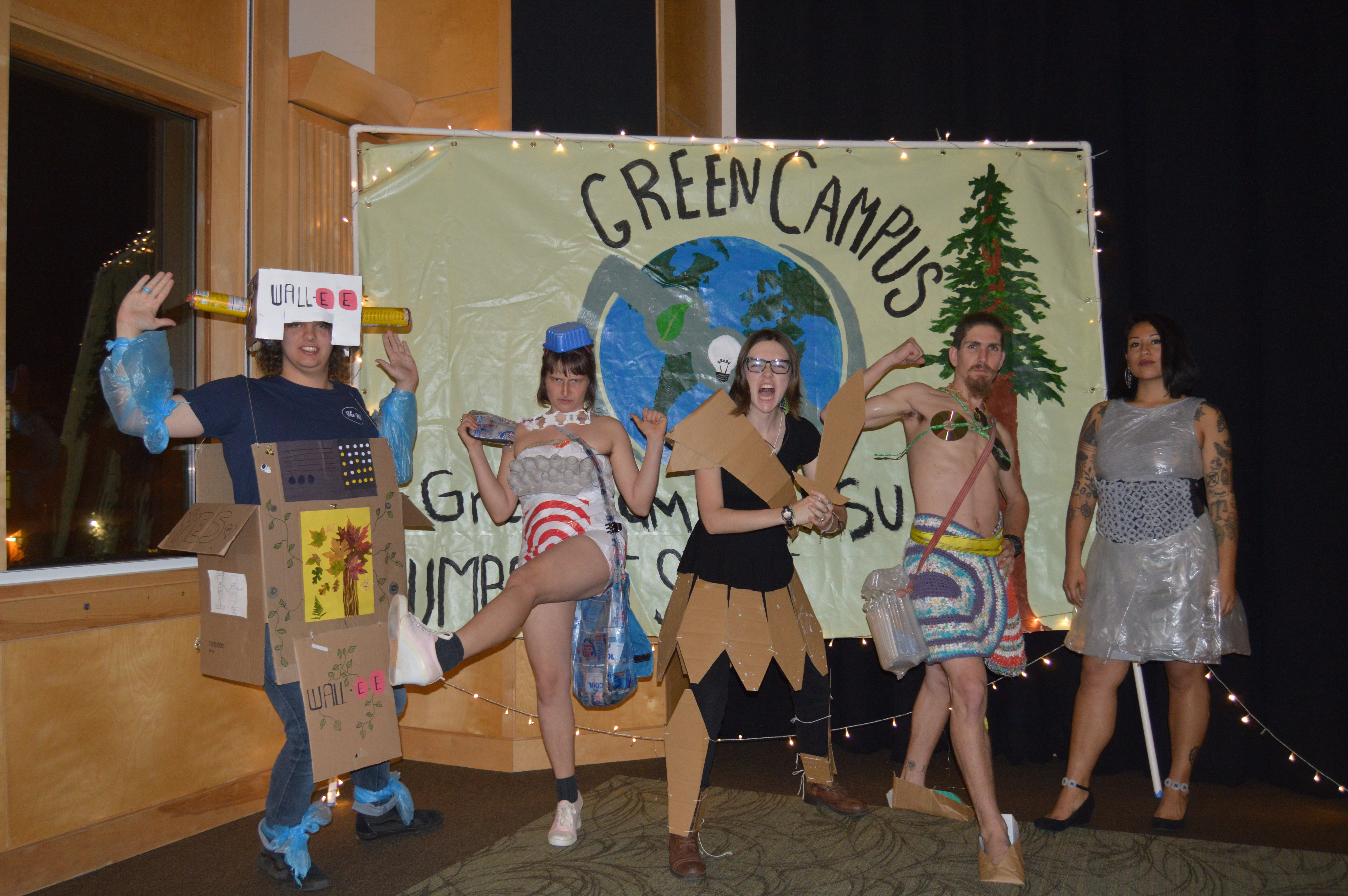
    The team provides educational materials and advice for groups on campus on how to be as sustainable as possible while still having fun. In the coming months the team will hold a “Trashion” show where students can create outfits out of trash or other items that were about to be thrown away and a “Weigh the Waste” event to educate the campus community about the effects of food waste.

    This semester the Green Campus Team will also relaunch the Green Workplace Assessment Program, including a new sub-program called the Peer To Peer Education Program. Advocates will talk to campus departments and educate them on sustainable practices so they can properly educate their peers. 

    They will also launch a student version of this program called Equal Reps, recruiting students that live on campus to educate others about living green. 

    “It would be great if students, before doing any sort of action, just considered the question and the idea of ‘how can what I’m doing be more sustainable?’” Chung said. “How can I do this in a different way?”

    Chung said this could mean many different things and will look different for everyone.  

    “It could mean completely changing what you’re doing. It could be evaluating if you have the capacity to do more sustainable actions because sometimes there just simply isn’t a possibility with other things you have going on,” Chung said.

    The Waste Reduction and Resource Awareness Program has brought back the paper towel composting project this semester. WRRAP also gives out composting buckets for on-campus residents, as well as finished compost to anyone who wants it. 

    “Students should keep an eye out for signs in the restrooms marking which bin is for paper towels and which is for other waste,” WRRAP said in an email to the Lumberjack. “This is a great help when we go to do our final sorting before placing the paper towels in the on-campus industrial composter.”

    Chung explained that when planning events the campus should account for sustainability rather than making adjustments later. Chung suggested that the administration should foster an open dialogue with the Office of Sustainability to ensure that they are making the best decisions for the school long-term.  

    “I think continuing to make sure that [the administration is] keeping sustainability at a forefront rather than an afterthought would be really important for the school,” Chung said. “Especially as we’re making so many big decisions with the new Cal Poly change.” 

    The Green Campus Team has compiled the Zero Waste Event Certification Checklist of different things to keep in mind when planning an event on campus. The checklist includes helpful sustainability tips, like serving food buffet style in reusable containers and ensuring promotional or advertising materials and decorations are reusable, recyclable or compostable. 

    The Green Campus Team is currently looking for another student employee as well as experiential interns and volunteers. To learn more follow the Green Campus Team on Instagram @greencampus_humboldt.
  • HSU’s 4th Annual Zero Waste Conference Recap

    HSU’s 4th Annual Zero Waste Conference Recap

    Waste Reduction & Resource Awareness Program hosts environmental event and educates community

    The Humboldt State Zero Waste Conference, hosted by the campus’ Waste Reduction Resource Awareness Program, taught students and community members how to reduce the amount of waste they produce in their daily lives. The week ended in a city proclamation that Nov. 15 would forever be Zero Waste Day.

    “WRAPP is all about serving students and providing students resources to make lifestyle changes,” Program Manager Amanda McDonald said. “It’s a slow and gradual process where it’s not like you can get rid of every plastic thing in your house at once, but you have to be committed to doing this over time.”

    A week of influential guest speakers, engaging activities and exciting happenings kept students active and engaged in reducing waste. These included a moving speech by Tedd Ward, the authority on Del Norte solid waste, Tinkertime on the quad and the extravagant Green Campus Trashion Show.

    The clothing industry is so detrimental. Fast fashion, in my opinion, is one of the worst industries for the environment. It not only deteriorates sense of commitment, but it also withholds your own sense of style. It’s good to upcycle clothes for a new purpose instead of sending them straight to the landfill.

    The Zero Waste Conference began with a banquet which set the tone for the rest of the week. A keynote speech by Alec Cooley shared the story about the origins of the Humboldt Campus Recycling Program, following closely by the Trashion Show.

    Eight students built magnificent costumes out of household waste. There was a Rob-box, sword wielding cardboard centurion, and the CD bikini-rocking Julian Palmisano. They each strut their stuff across the stage to show off what they made.

    “I think my grandma would be proud,” Palmisano said. “I did it for fun. It’s kind of a joke, really, and it’s a way to bring attention to the unprecedented degree of waste that is in this world.”

    In pursuit of constructive solutions, the following day was Tinker Time. WRRAP, CCAT and Green Campus showed students how to reduce their waste by upcycling recyclable items. Upcycling is the “reuse” part of the reduce, reuse, recycle phrase.

    During Tinker Time, WRRAP showed students how to upcycle their clothes into mason jar coozies and grocery bags. The Campus Center for Appropriate Technologies upcycled wood waste and oyster shells into wind chimes. At the coozie table, WRAPP Compost Site Intern Krissi Fiebig taught students how to cut up old clothes and sew them together for a more beneficial use.

    “The clothing industry is so detrimental,” Fiebig said. “Fast fashion, in my opinion, is one of the worst industries for the environment. It not only deteriorates sense of commitment, but it also withholds your own sense of style. It’s good to upcycle clothes for a new purpose instead of sending them straight to the landfill.”

    In 1964 the first plastic bag was made, and it was the beginning of this. One half of all of all plastic produced has been produced in the last thirteen years. Recycling is ineffective… It was not our decision which led to this. It was fractional distillation and oil refining.

    Finally, Ted Ward’s speech was a somber reminder of the modern state of the world. He said he felt as though he had failed as a waste manager. He reminisced about the day the first plastic bag was created and commented on how we ought to rename our modern era the “Plastocene,” cynically addressing the volume of plastic waste we produce.

    “We should coin this era the Plastocene instead of the Holocene because that is our legacy,” Ward said. “In 1964 the first plastic bag was made, and it was the beginning of this. One half of all of all plastic produced has been produced in the last thirteen years. Recycling is ineffective… It was not our decision which led to this. It was fractional distillation and oil refining.”

    The Zero Waste Conference finished up with Humboldt officially declaring Nov. 15 Zero Waste Day. The official proclamation reflects Humboldt County, the City of Arcata and our local community’s progress towards zero waste.

    “Now be it resolved that the Humboldt County Board of Supervisors joins Humboldt cities and business groups to recognize November 15, 2019 as Zero Waste Day,” the proclamation said. “A day each year we acknowledge the County’s waste reduction progress and urge residents to recommit efforts toward Zero Waste.”