The Lumberjack


Students Serving The Cal Poly Humboldt Campus and Community Since 1929

Tag: green energy

  • How a Local Clean Energy Microgrid Could Transform California

    How a Local Clean Energy Microgrid Could Transform California

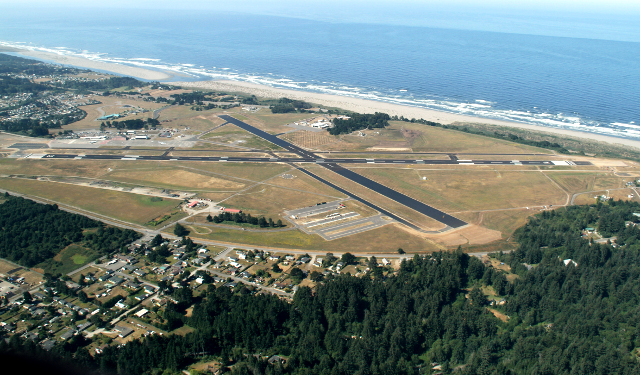
    A new project in Humboldt County is paving the way for clean energy operations throughout the rest of California. After two years of planning, construction of the Redwood Coast Airport Renewable Energy Microgrid is set to begin in April of this year.

    A microgrid is decentralized from the larger energy grid. It is able to become its own “island.” It ensures that power can be restored to a specific area during emergency situations even when the larger energy grid is down, such as during a public safety power outage. A notable component of the RCAM is that it is entirely run by renewable energy, operating off of solar power, making it even more appealing to the area.

    The prime contractor and lead technology integrator for this project is Humboldt State University’s very own Schatz Energy Research Center. The RCAM will be the first-ever multi-customer microgrid in Northern California.

    Environmental Science Professor Jack Murphy said that in his opinion, the clean energy microgrid is a great idea for two reasons.

    “The first is just that it contributes to the decarbonization of our electrical generation, and that’s good,” Murphy said. “Less carbon dioxide going into the atmosphere is good and humanity needs big clean energy projects ASAP. The second reason it’s a great idea is that the airport could be critically important during regional disasters such as tsunami or earthquake, and having a microgrid operable when the grid is down would be hugely important.”

    Another important goal of the RCAM project is to create a template for the construction of other clean energy microgrids across the state. By partnering with PG&E and the Redwood Coast Energy Authority, the microgrid will be an example for the rest of California of the policies, tariff structures, and operating procedures that are involved with a project like this.

    “The RCAM project has led to the development of PG&E’s recently proposed Community Microgrid Enablement Program,” David Carter, principal engineer for the Schatz Energy Research Center said. “CMEP creates a process and a path for other eligible communities to deploy front-of-the-meter, multi-customer microgrids that will provide resilience to critical facilities.”

    With the details of the successful project documented, other communities can use it as a technical guide for the construction of new microgrids. Reducing the use of fossil fuels in a state that has the second highest amount of annual carbon dioxide emissions in the entire country is an exciting step forward toward combating climate change. The RCAM project demonstrates that it is possible for a community microgrid to be powered by 100% renewable, solar energy.

    When asked about the work of the Schatz Energy Research Center, HSU alumnus Kyle Powell said that he is continuously inspired by the various sustainability efforts that come out of the university’s programs.

    “Humboldt State as a whole does a great job of promoting sustainability and clean energy throughout all of its programs,” Powell said. “It’s one of the main factors that brought me to the university, and it continues to influence my life on a daily basis.”
  • Wind Farm Under Scrutiny

    Wind Farm Under Scrutiny

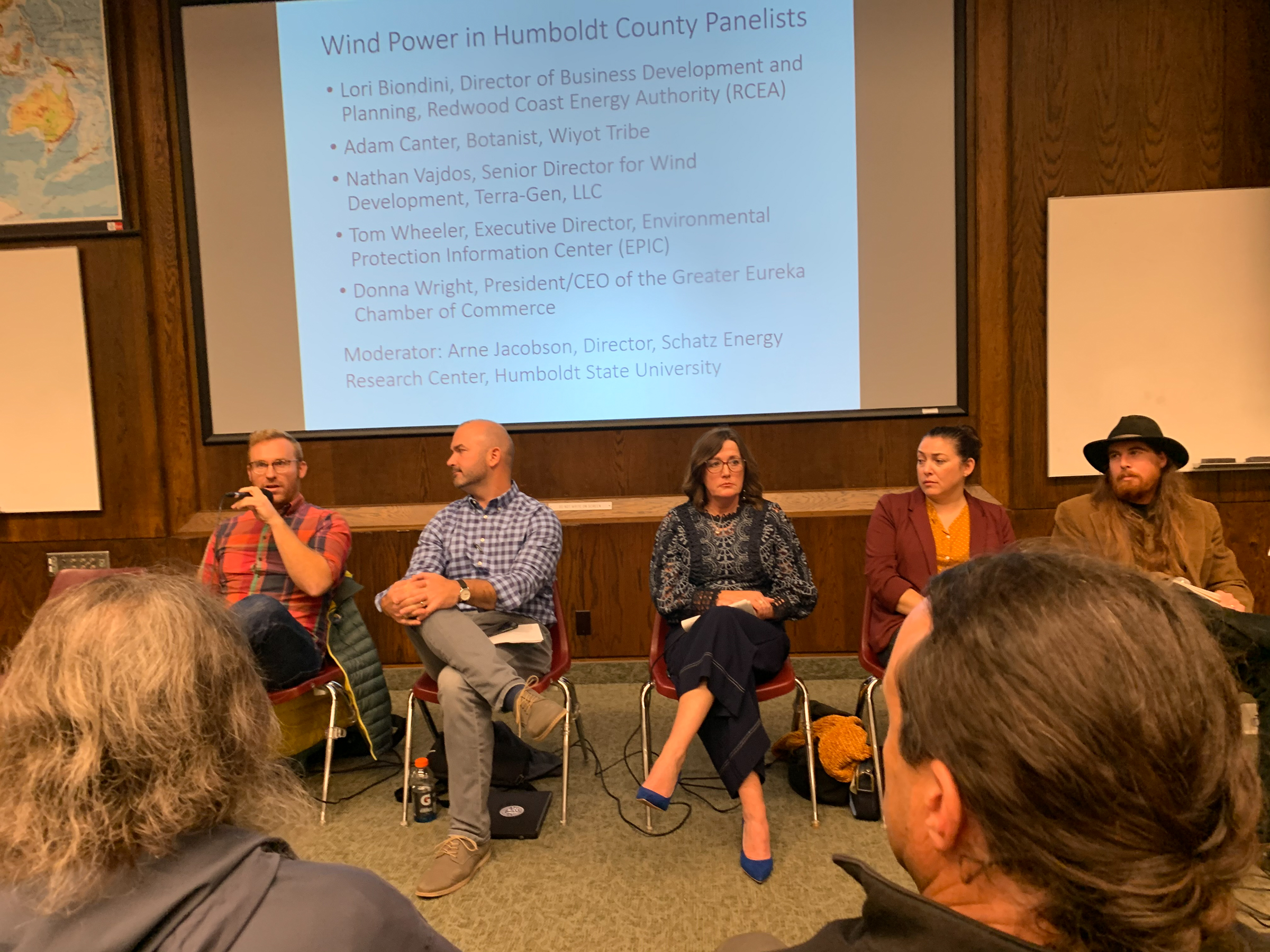
    A panel at Humboldt State University’s Sustainable Speakers Series weigh the pros and cons of the Humboldt Wind Energy Project

    As the global concern to act against climate change increases, Humboldt County is in a position to capitalize on an opportunity to establish a significant renewable resource.

    On Thursday, the Humboldt County Planning Commission votes on the wind energy farm developed by Terra-Gen. Terra-Gen, a Manhattan-based energy company, has proposed a wind farm to be built near Bear River, on Monument Ridge, above the city of Scotia.

    The Terra-Gen wind farm carries controversy for numerous reasons. The project will help achieve carbon emission-reduction goals and provide two million dollars in annual tax revenue for the county, but will impact wildlife, forest ecosystems and the Wiyot prayer site Tsakiyuwit.

    Arne Jacobson, director for Shatz Energy Research Center, said the proposed turbines will produce about 100 times less CO2 than burning fossil fuels.

    “From a climate change perspective, wind looks pretty good,” Jacobson said. “Whatever perspective we have on this particular project, I think one question we should be asking ourselves is what we want to do with that opportunity, because I think it’s there and I think we have the local ethic and the local talent to make that happen.”

    Lori Biondini, director of Redwood Coast Energy Authority, said the Terra-Gen wind project could be part of a solution to address RCEA’s goal of 100% renewable electricity in Humboldt County by 2025.

    “The Terra-Gen project is part of one scenario to reach our goals,” Biondini. “If it doesn’t get built, then we will come up with another scenario.”

    RCEA administers the community choice energy program, a program which allows communities to decide where their electricity comes from. It prioritizes local energy generation and generally more clean energy.

    “I think that one of the promises of community choice energy is that we get to make choices that are good to our entire community.” Biondini said. “Not further marginalize those that might not otherwise have had a seat at the table.”

    A crowd waits for Sustainable Speakers panel to begin. | Photo by Michael Weber

    Adam Canter, a botanist and representative of the Wiyot tribal council, defended the preservation of the land and disapproved of the Terra-Gen project. Canter cites ethnobotanical resources and culturally significant sites as reasons not to move forward with this project.

    “When we first heard about this project, there was this big pit that just kind of fell into our stomachs,” Canter said. “We thought when Shell came 10 years ago that no other company would come back and try to build a project here. But we were wrong.”

    Canter pointed out the cultural resource report for the site bound in a green, four-inch binder.

    “The representation of cultural diversity on this ridge is pretty magnificent,” Canter said. “We’re seeing evidence of Athabaskan peoples and the Wiyot-Algonquin peoples and really it should be listed on the National Register of Historic Places.”

    According to Canter, the area is also a high prayer site; a place where a large expanse of Wiyot ancestral territory is visible. Like the turbines obscuring the view, the Wiyot cultural heritage could be obscured too.

    Tom Wheeler, director for the Environmental Protection Information Center, said the proposed site is a questionable area to build a wind farm.

    “The representation of cultural diversity on this ridge is pretty magnificent. We’re seeing evidence of Athabaskan peoples and the Wiyot-Algonquin peoples and really it should be listed on the National Register of Historic Places.”

    Adam Canter

    According to guidelines set by the California Energy Commission and the California Department of Fish and Wildlife, the proposed site is “pristine.” Wheeler said the site has several rare and endangered species, including the rare Horay bat.

    Wheeler is still hopeful to keep the project, and said there is technology that can reduce some of the wildlife impacts. This, however, is only one mitigation measure to the several unavoidable cultural, environmental and wildlife impacts of the project.

    “I want this to be a better project and it’s not there,” Wheeler said. “At least not yet.”

    On Thursday, the final vote by Humboldt County’s Planning Commission will weigh impacts to Native American culture and environmental quality to the people’s interest in local, reliable energy.

    Aside from the benefit of reducing carbon emissions, allowing Terra-Gen to build the wind farm also comes with an economic and infrastructure benefit.

    Senior Director in Wind Development for Terra-Gen Nathan Vajdos said the company would be the second-largest taxpayer in the county, and could fund $14 million to Humboldt’s reliability network upgrades, with $1.3 million to the Humboldt substation.

    “As we charge our iPhones, we fill up our cars with gas, we’re having impacts.” Vajdos said. “Whether this project is built or not, we are having an impact in this room.”

  • Reduce, Reuse, Repurpose Recyclables

    Reduce, Reuse, Repurpose Recyclables

    Earn money. Many recycling plants in California offer trade-in programs where you can redeem money from the cash refund value (CRV) of plastic, glass and aluminum cans. The CRV amount for aluminum cans under 24 ounces and for glass and plastic bottles is $0.05. Containers larger than 24 ounces are redeemable for $0.10. Here in Humboldt you can take your bottles and cans to Humboldt Sanitation & Recycling in McKinleyville or the Eureka Recycling Center.

    Make something new. There are so much things that can be reused and transformed into something new. Milk cartons can become bird feeders and trash can become artwork. Locally, Scrap Humboldt offers hundreds upon thousands of recycled, slightly used and new items for sale to let your creativity soar. They host creation tutorials to show people how to turn something discarded into something useful again. You can also donate your clean recyclables to their Arcata location to add to their collection of items for repurposing.

    Clean them. Clean your recyclables before you toss them. Be mindful of the journey your recycling has yet to take in this consumerist chain. Besides knowing what is appropriate to recycle, it’s also important to properly prepare items before you recycle them. Cans should be rinsed clean, plastic caps should be discarded and wrappers should be torn off of containers.

    Compost. Compost what you can. Paper materials like cardboard and newsprint are great materials for creating new flower and produce beds. These items don’t have to end up in the trash or even the recycling bin. Paper is great for reducing decomposition stench from compost bins and the carbon in paper can help facilitate the breakdown of waste. Just be sure the paper you use in your compost doesn’t have glossy inks like magazine paper.

    Throw away the rest. You might be recycling things that aren’t recyclable. Plastics numbered with 3, 4 or 7 are sometimes not accepted by curbside recycling programs. Check your local recycling plant’s policies on what materials they accept and what they reject. Things like pizza boxes, aerosol cans, batteries and styrofoam are not recyclable. Throw items like these away or find a proper disposal. Here on campus there are several recycling hubs which offer bins for proper disposal of batteries, computer products and cellphones.

  • Microgrid is in the works

    Microgrid is in the works

    Schatz Energy Research Center at Humboldt State was awarded a $5 million grant. The money is going to be used to build a microgrid at the Arcata-Eureka Airport in Mckinleyville. Peter Lehman, director of Schatz, said he was overjoyed when the good news broke.

    “Everybody was high-fiving and hugging,” Lehman said. “It is a big deal for us, and a big win.”

    Lehman spent about three months working on a proposal for the grant with his colleagues.

    “It was really competitive,” Lehman said. “The California Energy Commission only funded one proposal out of ten. There was a lot of universities that didn’t get funded, and we did.”

    The microgrid will be composed of a 2.3-megawatt photovoltaic array, or solar power system, and cover nine acres.

    “It is one thing to have an idea, but it’s gotta be based in reality,” Lehman said. “First you have to conceive the idea, flesh out the idea and decide what partners need to be assembled. It’s not easy.”

    Redwood Coast Energy Authority, or RCEA, partnered with Schatz, matching $6 million in funds to help the project. Executive director of the RCEA Matthew Marshall is optimistic about the project.

    “We were waiting to hear back from the Schatz Center to see if they received the grant before submitting the application for the loan, but it’s now in the works,” Marshall said. “I’m optimistic.”

    The RCEA is financing the upfront costs of the project with a low-interest loan from the United States Department of Agriculture’s Rural Utilities Service.

    “We’ve got a goal to support the development of local solar projects,” Marshall said. “The project is pushing the envelope. It’s exciting being on the forefront.”

    In addition to generating green electricity, the microgrid will create jobs for locals.

    “Somebody has to pour the concrete, drive the post into the ground to mount solar panels and run the wires,” Lehman said.

    In an emergency situation, the airports and United States Coast Guard could run for hours off energy gained from the microgrid .

    “The airport and the Coast Guard are really important,” Lehman said. “The Coast Guard can’t fly if the airport doesn’t have electricity.”

    RCEA owns the solar array and PG&E owns the wires, but who gets paid what for the electricity produced? How do customers get charged for that?

    “It’s all new, its never come up before,” Lehman said. “We are going to be plowing some new ground trying to figure that out.”

    The project is expected to begin this summer. PG&E will do a number of tests after the completion of the first multi-customer microgrid.

    “PG&E is careful about what goes on their grid,” Lehman said. “There are a number of tests we will have to pass with them, looking over our shoulder to make sure that is it safe.”

    PG&E communications representative Ari Vanrenen said PG&E is committed to clean energy.

    “We are a community partner dedicated to building a better, more sustainable future for all Californians,” Vanrenen said. “This includes understanding and responding to the different needs of our customers and communities.”

    Once the microgrid is established, the Schatz Center will spend a year writing reports on how it works and share their findings.

    “Lessons we learn are going to be valuable for other people. That’s how progress happens in technology,” Lehman said . “You do things and try something. You tell people about it. The next time you build it, you are a little smarter and you do a better job.”