
The Lumberjack


Students Serving The Cal Poly Humboldt Campus and Community Since 1929

Tag: higher education

  • Out with the Old and in with the New at HSU

    Out with the Old and in with the New at HSU

    Several administrative changes at HSU suggest high turnover

    In the last three months, three Humboldt State University administrators jumped ship. A game of musical chairs has since taken place as staff have shuffled around to fill the gaps.

    Since November, HSU has appointed a new interim provost, interim college dean, Title IX coordinator, Student Health Center director and Human Resources staff recruitment manager.

    While it’s unclear how the changes will affect HSU, the shifts appear in line with data suggesting high turnover rates among college administrators.

    The changes began in November, when Provost and Vice President for Academic Affairs Alex Enyedi left HSU to become the 11th president of the State University of New York, Plattsburgh.

    Enyedi served as HSU’s provost and vice president of academic affairs since 2015 after leaving Western Michigan University, where he served as a biology professor and dean of the College of Arts and Sciences.

    Enyedi left WMU amid controversy as his contract expired despite a petition of support with 1,300 signatures, according to reporting from the North Coast Journal. Enyedi said he believed his contract was not renewed due to his requests for raises for female college employees. WMU pointed to enrollment declines and budget adjustments—familiar phrases for HSU—as the cause of his departure.

    “The turnover rate for deans or directors of education topped the list at 22%, while the rate for provosts sat second-highest, at 21%, according to the analysis. Presidents or chancellors came in third, at 18%.”

    Data from Higher Education Publications

    HSU announced Dean of the College of the Arts, Humanities and Social Sciences Lisa Bond-Maupin as interim provost on Nov. 26. While Bond-Maupin serves, HSU said it would search for the next provost.

    “There will be a national search for a new Provost, with opportunity for input and participation from individuals across campus,” the Nov. 26 announcement said. “Details of the search plan will be shared when they are finalized.”

    HSU then appointed Spanish Professor Rosamel Benavides-Garb to take Bond-Maupin’s place. Benavides-Garb previously served as associate dean of CAHSS and chair of the World Languages and Cultures program.

    On the same day as the Enyedi announcement, Nov. 20, HSU announced Executive Director of Student Health and Wellbeing Services Dr. Brian Mistler had resigned and taken the job as Chief Operating Officer of Resolution Care in Eureka.

    In Mistler’s place, Associate Vice President of Student Success Stephen St. Onge now leads the Student Health Center alongside Dr. Karen Selin and Dr. Jen Sanford. The Nov. 20 press release noted that the plans for the future of the SHC’s leadership would be revealed in January. In the meantime, the release made a promise to students.

    “In honoring HSU’s commitment to our students, we are looking into opportunities to expand hours and services for students starting the Spring 2020 semester,” the release said.

    HSU then announced the departure of Title IX Coordinator Marcus Winder on Dec. 5.

    “Marcus has been an invaluable team member and has served HSU, with his many years of experience, during a time of great change and uncertainty for Title IX departments across the country,” the release said.

    Taking Winder’s place is Human Resources Staff Recruitment Manager David Hickcox. Hickcox worked for HR and as an investigation officer for the Title IX Office for the last two and a half years, according to the release.

    Recruitment Manager Nicole Log, who, according to the release, has served HSU for five and a half years in the HR department, then took Hickcox’s place.

    Finally, Interim Director of Academic Resources Holly Martel got to remove the “interim” from her title on Nov. 18. Martel, who served as the interim director since 2017, has worked at HSU for 24 years in a variety of roles, from financial planning to personnel management.

    According to 2016 data from Higher Education Publications, a company that publishes college data in its online Higher Education Directory, college administrators experience high rates of turnover compared to other administrators.

    The turnover rate for deans or directors of education topped the list at 22%, while the rate for provosts sat second-highest, at 21%, according to the analysis. Presidents or chancellors came in third, at 18%.

    A summary of the analysis gave a variety of possible causes for the high rates.

    “When compared to other administrators, the cause for such high-level turnover can be linked to many diverse issues such as growing financial, faculty, Board and political pressures,” the summary said. “Also, traditionally colleges and universities have made leadership selections from within, minimizing risk.”

    However, the analysis did not list the administrative turnover rates with which it compared college administrative turnover rates. The Lumberjack has reached out to Higher Education Publications and will update this story online when we receive a response.

    Yet for a rough comparison, according to a Jan. 2020 report from the Bureau of Labor Statistics, the total separation rate (turnover) for all recorded employees—not just administrators—for Nov. 2019 was 3.7%.

    The Lumberjack has also reached out to HSU for comment. We received word that HSU Associate Vice President of Human Resources David Montoya and his team are gathering turnover data and will have a comment at a further date. We will update this story online when we receive said comment.

    An HSU memo sent out Jan. 21 revealed results from a spring 2019 Great Colleges to Work For survey conducted at HSU. The national survey, intended to inform institutions about workplace culture, sheds some light on the status of the HSU administrative staff.

    Across 15 categories, the HSU results came back most positive in the job satisfaction, compensation, pride and supervisors or department chairs categories. The results came back most negative in the senior leadership, policies and faculty, administration and staff relations categories.

    HSU will hold two presentations in Goodwin Forum, one on Jan. 24 and one on Feb. 4, to further discuss the findings with faculty and staff, according to the memo.
  • Rallies at the State Capitol for sufficient CSU funding

    Rallies at the State Capitol for sufficient CSU funding

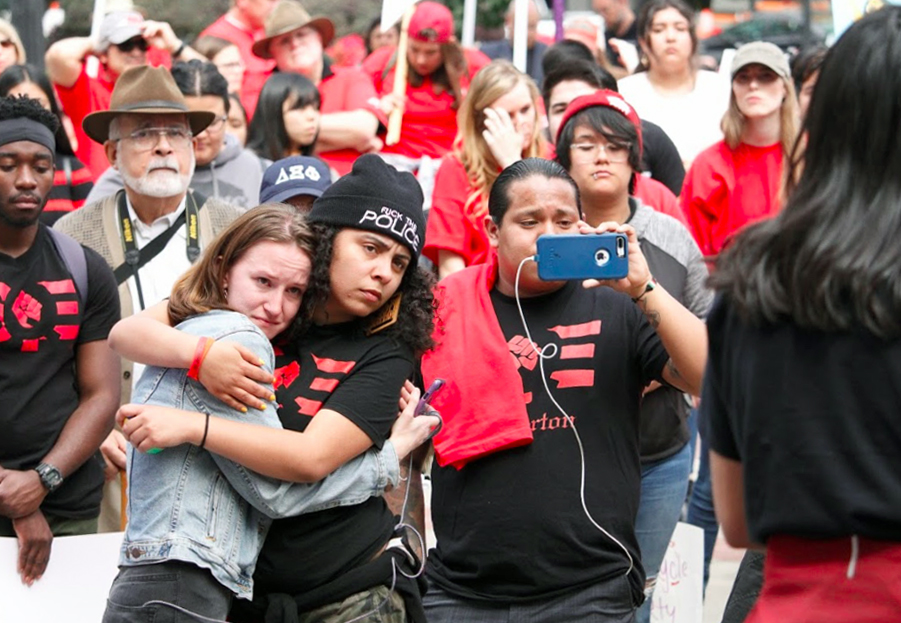
    Students, faculty and allies of the California State University system from all 23 campuses made the journey to the State Capitol to send Gov. Jerry Brown a message, it is time to fully fund the CSU.

    Video by Dajonea Robinson.

    Allison Rafferty is a biology major and was one of many students who came down on a bus from Humboldt State to join the demonstrations on April 4. Rafferty rode down to represent HSU and to call for funding for the CSU system.

    “I request Gov. Brown to consider opening the fund that he’s allocated for CSU,” Rafferty said. “The CSU requested money and Gov. Jerry Brown approved a third of that. Right now, they’re in revisions. In May, they’re going to post their revisions and in June, they’re going to propose the final budget that goes to a vote.”

    Rafferty hopes more funding will come through so people in her major and others will be able to get classes and graduate on time.

    HSU student warns others of the potential outcome of funding crisis. Photo by Dajonea Robinson.

    Jacqueline Delgado is also an HSU student. Delgado decided to come to the Capitol to stand in solidarity with everyone and to get justice for Josiah Lawson.

    “I’m also here to get [Justice for Josiah] and this unsolved murder to be recognized. It is an unsolved murder of a fellow student that was murdered a year ago in Humboldt County,” Delgado said. “The school and the county does not recognize that this happened. It has been an entire year that nothing has been happening and we’re trying to get this movement to be heard. We will no longer be silenced.”

    David Bradfield is the California Faculty Association representation chair and board of directors member who now lives in Humboldt County. Bradfield spent 34 years teaching music and digital media arts at CSU Dominguez Hills. Bradfield decided to take the trip down to the Capitol.

    “I care very deeply. I spent 34 years teaching at Dominguez Hills and I care very deeply about the mission that we do, the people that do that mission and the people that we serve,” Bradfield said.

    Reza Sadeghzadeh is a communications major at HSU. Sadeghzadeh traveled with his peers to the Capitol from HSU to express concern of the insufficient funds of the budget.

    “Since they cut the whole CSU budget, we’re going to see a tremendous negative effect on our campus. A lot of professors are being laid off, activities and cultural centers are being defunded, so it’s a very serious issue,” Sadeghzadeh said. “The governor really needs to understand that the students here and the students in the CSU are the future of the welfare of California. In order to thrive as a state, we need to take care of the foundation, which is the students.”

    HSU students not only stand in solidarity with fellow CSU peers during the rally, but demand justice for their fellow student. Photo by Dajonea Robinson.

    Elizabeth Phillips is a student on campus who also came down on the bus from HSU.

    “Students like me who need an education are about to be priced out of our education. Education is not for the people, it’s not supposed to be free. They don’t want us to get an education so we’re stuck working the remedial jobs,” Phillips said. “We need to see more people of color being a part of the faculty. The only way we’re going to get there is if we can afford to get in the door. I’m $25,000 in debt just from two years at HSU. That’s a lot of money, and for other students, I don’t want them to take on that burden. So I’m here for the future, and I’m here for me, now.”

    Phillips works for the Multicultural Center as the social justice summit co-coordinator. Phillips is also a part of a loose coalition of students who started the walkout for WASC to protest the budget cuts.

    “I worry that if we give the CSU full funding for free tuition, the students will get it for the first couple of years, but then after, people get greedy and start skimming the surfaces,” Phillips said. “I’m happy that we’re here, but I want people to keep a watch and understand we don’t need as many administrators as we have. We need more students and faculty, counselors–there’s other stuff that we need that we’re just not allocating our resources correctly. Everyone needs to watch out for the future.”

  • More like higher training!

    More like higher training!

    By | Reza Sadeghzadeh

    Let’s be honest and tell it like it is.

    Screen Shot 2017-10-14 at 2.23.51 PM.png

    The big corporations want the politicians to turn higher education into a factory that produces blue and white collar workers because the corporations need individuals that are trainable. But there is more to it!

    Programs like Humanities and Social Sciences are under attack by politicians like Marco Rubio, the person that said: “we need more welders and less philosophers.”

    The underlining message is that public schools should teach us less about the world and more about the working world.

    Donald Trump’s most recent presidential memorandum to the Secretary of Education will also reassure you that “it is critical that we educate and train our future workforce to compete and excel in lucrative and important STEM fields.”

    Read between the lines! Trump is trying to manage public school programs that teach students how to be obedient workers.

    In other words, the Trump administration is steering the working people away from courses that focus on critically thinking. They want to make sure that the 1% does all the thinking for us.

    To be fair, STEM students do have more career opportunities than students in other programs. But that should not make the other programs inferior to science, technology, engineering and math. It would be like comparing apples to oranges.

    These “soft” or interdisciplinary programs are just as important because they cultivate leaders with ethical decision-making abilities. But this notion would bring empowerment to the working class that would threaten the 1%.

    Knowledge is power. When the people become educated, they are more inclined to be critical of their surroundings, the public discourse and their history. As a result, the people start making impressive egalitarian changes in society.

    A perfect example of that is the current transformation of Columbus Day to Indigenous Peoples’ Day.

    Hopefully, you can see why the few people at the top would want to make sure that our education does not get out of line. Emphasizing STEM programs is a smart tactic on their part to deter us from gaining social consciousness.

    There is more to Trump’s job growth rhetoric and it is not just about increasing our nation’s gross domestic product. It is harder for politicians to manipulate the people when the people start thinking outside the box. With that said, I leave you with this question: Is Trump’s education plan undermining your intellectual autonomy?


  • Where’s our legal protection?

    Where’s our legal protection?

    By | Reza Sadeghzadeh

    There is a health center on campus for students, but there is no place on campus for students to go to when they have a legal issue.

    So many students have to deal with greedy landlords, careless employers and lousy customer service. If that’s not enough, some students are now facing racist immigration policies.

    We are here to receive a higher education and hopefully be able to build a career from the experiences we gain.

    Instead, some of us have to deal with external forces like housing and employment that spoil our learning ability.

    There is no plausible reason for a student to be homeless and the University ought to find the root of this problem. More likely than not, homeless students are financially capable of paying rent, but landlords discriminate against some applicants.

    The prejudice doesn’t stop there. It’s not just issues in our community, but throughout our nation. Our government’s approach towards immigration is not only racist, but it is also detrimental to our University due to our lack of diversity.

    We as a University must act now!

    One of our most powerful preemptive recourses in dealing with these external forces is establishing a legal center. We need a place on campus ready to help students with their legal issues so they can worry less and focus more on their academia.

    We live in an isolated area with limited legal services and it would cost students an arm and a leg to seek legal counseling.

    Luckily, there are some compassionate attorneys in our community who are willing to help. But it is our responsibility to create an organization so we can have access to legal services.

    The creation of a legal center should be one of the main goals of Associated Students and it is a bit disappointing that we have not created a mechanism that provides legal remedies for those in need.

    The time is now! We must act immediately to create a legal center for the sake of student success.