The Lumberjack


Students Serving The Cal Poly Humboldt Campus and Community Since 1929

Tag: history

  • Lessons from When the Spanish Flu Hit Humboldt in 1918

    Lessons from When the Spanish Flu Hit Humboldt in 1918

    Looking to the past to learn about the present pandemic

    There’s a saying that goes something like, “In order to prevent future mistakes, we should look to the past for guidance.” While this current pandemic may be new to all of us, humans have gone through this before. Some of the more recent pandemics include the SARS virus, the H1N1 virus, Ebola and HIV.

    The term pandemic is defined as something “occurring over a wide geographic area and affecting an exceptionally high proportion of the population.” Obviously, the current COVID-19 virus fits into this category. While some of the aforementioned pandemics did not enact a devastating, history-altering toll on Humboldt County, another pandemic did.

    From 1918 to 1920, the Spanish flu swept across America, resulting in an estimated 675,000 deaths according to the U.S. Department of Health and Human Services. The first official report of the Spanish flu in California was reported Sept. 27, 1918, just two weeks after an outbreak on the East Coast. By November 1918, the total cases throughout the state hit about 115,000—overwhelming doctors and government officials from north to south.

    One of three doctors that helped Spanish flu patients in the Ferndale area.

    Although Humboldt County sits in an isolated area protected by the “Redwood Curtain,” the area was soon amassed in its own troubles combatting the illness. Humboldt County had a population of about 37,000 people with Eureka holding around 12,000. The Spanish flu resulted in around 200 deaths (although it is thought to be much higher) and thousands grew ill.

    In 2012, Humboldt State alumnus and McKinleyville native Jeff Benedetti-Coomber wrote a detailed history of the impact the Spanish flu had on Humboldt County. For it, he was awarded the Charles R. Barnum History Award by HSU’s history department. For his research he scoured through old newspaper clippings for primary source documentation. He read academic analysis on how the Spanish flu affected the entire nation and he cited Matina Kilkenny, a researcher and local author for the Humboldt Historical Society who also wrote about the impacts the Spanish flu had on Humboldt County.

    What prompted Benedetti-Coomber to focus on the Spanish flu was its lack of local research. As his peers decided to look into European history, he decided to focus his attention on the effects locally.

    “I was walking through the graveyard in Arcata and noticed a family of graves, not necessarily related to the [Spanish] influenza but it got me thinking about what effects the flu may have had because it was around the same time,” he told me over the phone from his place in Los Angeles. “Once I started researching it I saw how it did affect the county and I was pretty amazed.”

    Benedetti-Coomber’s senior thesis, titled “Death In the Redwoods: The Effects of the Spanish Influenza on Humboldt County,” spans 30 pages and breaks down how each town dealt with the outbreak. He highlights what preventative measures seem to have worked and where officials, the public and the media went wrong and what they got right.

    “It’s just like today when you tell people to do something and they kind of resist. A lot of people had that with the Spanish influenza and it was a reason a lot of people died, because they didn’t take it seriously.”

    Jeff Benedetti-Coomber

    Some of the highlights from his research that still stand out to him are how Eureka initially closed all schools, which flooded the streets with children. They soon changed their minds and brought the kids back into the school to try to quarantine the children. Another nugget of research that sticks out in his mind has to do with masks and the public’s initial reluctance to wear them.

    “It’s just like today,” Benedetti-Coomber said, “when you tell people to do something and they kind of resist. A lot of people had that with the Spanish influenza and it was a reason a lot of people died, because they didn’t take it seriously.”

    When the Spanish flu hit Humboldt, the United States was in the middle of World War I and young men from Humboldt were signing up to join the war effort. There were war rallies and large gatherings of people throughout the towns in Humboldt in the fall of 1918 as the Spanish flu began to creep in.

    “Although the Great War was still the main focus in Humboldt County, more and more citizens were beginning to take notice of the spreading pandemic,” Benedetti-Coomber wrote.

    Some of the newspapers in Humboldt at that time seem to have downplayed the seriousness of the Spanish flu. Benedetti-Coomber points to an ad that was in the Humboldt Standard by Vicks VapoRub that was “disguised as an article… and it assured readers that the [Spanish flu] was ‘Nothing new simply the Old Grippe and la Grippe that was the epidemic in 1889-90.’”

    Benedetti-Coomber wrote that it is believed the Spanish flu was brought to Humboldt County by locals traveling to other parts of the state to help care for sick family members and then returning before symptoms started to show. By mid-October 1918, reports of the Spanish flu were starting to pop up in the local newspapers.

    “The Humboldt Times also reported that there were roughly 150 cases in Eureka by [Oct. 22] and hospitals were short staffed. Doctors were so busy they did not have the time to report new cases or treat the majority of their patients.”

    Jeff Benedetti-Coomber

    “The Humboldt Times and Humboldt Standard newspapers offered daily accounts of what was happening,” he said, adding that they also seemed to not care about the Spanish flu at first.

    On Oct. 12, 1918, four cases were reported in the Humboldt Times and those infected were quarantined in a “‘safe house’” on 8th Street where they could be quarantined and cared for,” Benedetti-Coomber wrote.

    At first, the mayor of Eureka downplayed the danger to the public, but two days later, five more people were infected. By Oct. 22, 1918 there would be more than 150 cases and one death.

    “According to the Humboldt Times, Mrs. Garber Dahle was the first person in Humboldt County to die from the deadly virus,” Benedetti-Coomber wrote. “The Humboldt Times also reported that there were roughly 150 cases in Eureka by [Oct. 22] and hospitals were short staffed. Doctors were so busy they did not have the time to report new cases or treat the majority of their patients.”

    Action to combat the Spanish flu across the county began to take root. Arcata was the first town to pass a requirement that all residents had to wear a mask while out in public, and by Nov. 7, 1918, the entire county was required to do so. Emergency hospitals were soon established across the county with some residents offering up their homes for the infected.

    Arcata escaped the pandemic with only four deaths, but the same can’t be said for Eureka and especially for the logging camps in the remote areas of the county. The number of cases grew in the urban areas, and by Oct. 23, 1918, the logging camps were left to fend for themselves.

    “Logging camps and small towns were informed by the newspapers and from local physicians that they would have to face the Spanish Influenza on their own as all of the county hospitals were completely full,” Benedetti-Coomber wrote while citing a Humboldt Times article titled “Influenza Increases Alarmingly in Two Days.”

    Young women wearing masks in Humboldt County.

    But one logging camp was able to escape the pandemic with no cases at all. In her article, “Missing Faces,” Matina Kilkenny reported how Carl Munther set up a quarantine system for his workers who decided to go into town. (Kilkenny’s article has a number of great photographs of life in Humboldt County during the Spanish flu.)

    “Munther required every person returning to camp… to stay four days in a tent he’d pitched some distance from the workers’ cabin,” Kilkenny wrote, adding that the returning workers were also required to work and eat separately from their peers. “Thanks to their boss, very few men chose to leave the Barrel Company camp and not one case of influenza occurred there.”

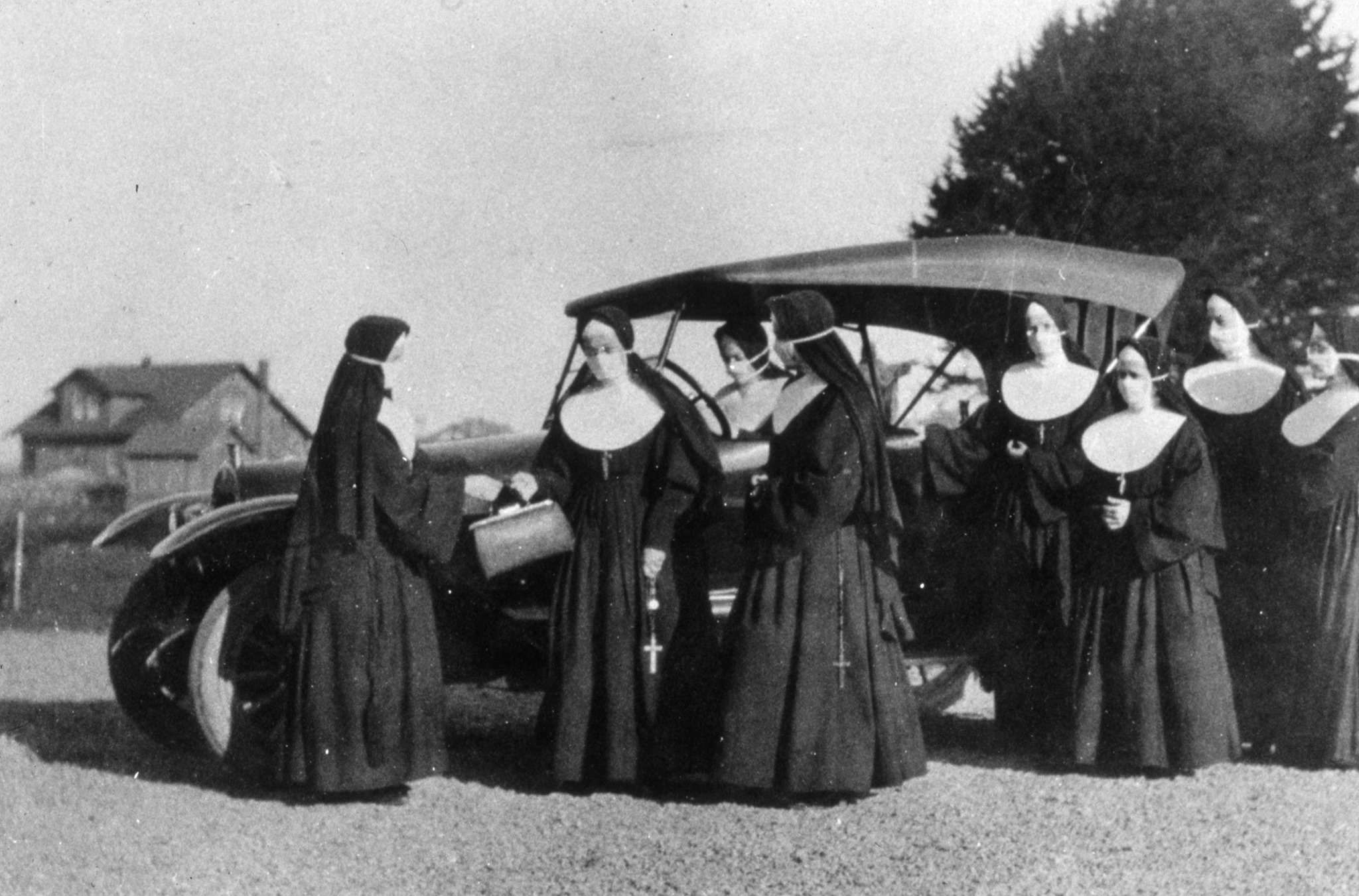
    Sisters of St. Joseph wearing masks during the Spanish flu. The sisters helped many patients in Humboldt from 1918-1920.

    Throughout her research, Kilkenny was able to find where a number of hospitals were set up across Humboldt. There was a Red Cross Hospital in Korbel, Arcata, Blue Lake and Eureka. Kilkenny also came across an interview between a member of the Sisters of St. Joseph of Orange in Eureka and a man named Brad Geagly. Kilkenny wrote the following:

    “[Mother Bernard] sent [the Sisters] out in twos, in cars provided by the Red Cross. She armed each Sister with a kit containing camphor and sweet oil, castor oil, and mustard plasters. Into the homes… the sisters came, arriving at seven o’clock and leaving at the end of a 12-hour shift, to be replaced by two other Sisters. They would attend first to the adults….They would bathe the delirious victims completely, rubbing their chests deeply with the camphorated oil. Mustard plasters would be applied, and then the sisters would wrap the sick tightly in whatever woolen material they could find; then they would tend the children. Once they had been bathed and medicated, the sisters turned to washing linens or cleaning house. They fed their charges warmed milk and broth prepared from the food furnished by the Red Cross.”

    Kilkenny noted that, generally, it was the poor who were admitted into the hospitals, while the more well-off were cared for in their homes. Because of this the actual tally for those infected and the deaths attributed to the Spanish flu is unknown. Kilkenny also points out how the Native American tribes were hit hard by the Spanish Flu as well.

    “Of the [11] Native Americans whose deaths are on record at the County Courthouse, five were from Table Bluff, two from Hoopa, one from Miranda, one from Orleans, one from Requa, and one was a laborer at Korbel,” Kilkenny wrote. She also noted evidence that many Native Americans often refused treatment by White settlers around this time period.

    Kilkenny was also able to find county death records from that time and noted that between Sept. 1, 1918 and April 1919, 175 Humboldt residents died with 91 of them between the ages of 20 and 40.

    And so what can we learn from this history?

    There is evidence that social distancing works by the example set by Carl Munther at his logging camp and how travel throughout the state can spread the virus. We can see how hospitals were eventually inundated with those infected with the Spanish flu and how staff were stretched thin. We can also see how it is important to get ahead of a pandemic and try to prepare as much as possible.

    Humboldt County seems to be doing just that. They have recently distributed around 30,000 pieces of personal protective equipment to first responders and medical staff across the county. Humboldt State chipped in and prepared 1,250 COVID-19 test kits. Also, as I’m sure you are aware, we are in a “shelter in place” order that was enacted to help stop the spread of the virus and to give medical staff the ability to fight the virus without being overwhelmed.

    Towns across Humboldt are also doing their part to help prevent an outbreak. Trinidad passed a moratorium on all short-term rentals and added some pretty forceful consequences to anyone who breaks it.

    “Over the course of the meeting, council members added some teeth to the resolution with language saying that a single violation may result in the City revoking a proprietor’s short-term rental license for up to a year,” the Lost Coast Outpost’s Ryan Burns recently reported, adding that the county may consider a similar measure.

    A stained glass piece by Humboldt artist Colleen Clifford.

    As this thing progresses, we are all going to have to make some sacrifices, but we’ll get through it. Help out the elderly and the immunocompromised if you can. Help out each other by not going out or attending pretty much any gathering of any number of people.

    Let’s all work together — but at least six apart — to help “flatten the curve.”
  • HSU Library Hosts Digitization Day

    HSU Library Hosts Digitization Day

    Humboldt State Special Collections offers the opportunity for community members to preserve their history

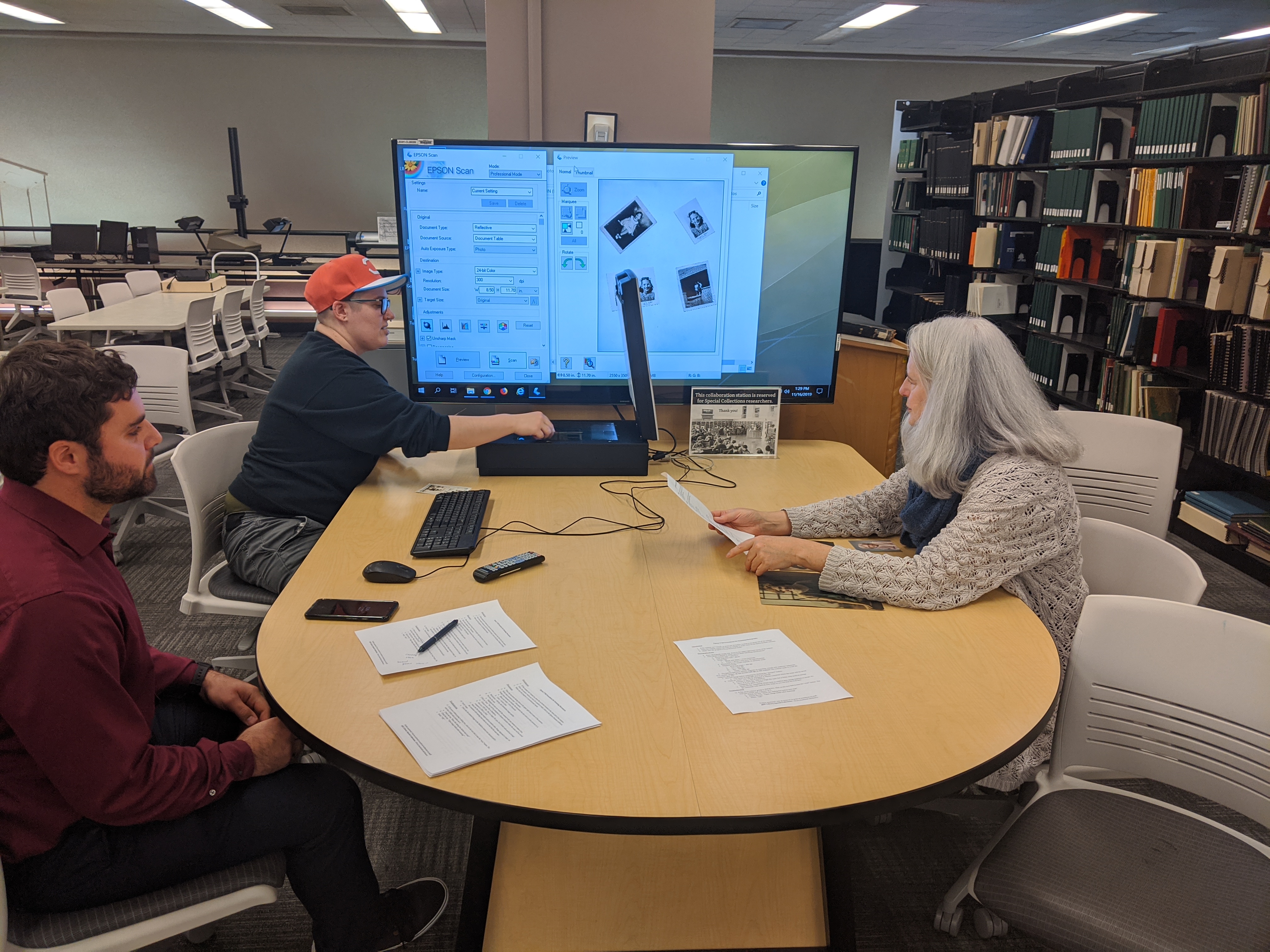
    On Saturday the HSU library played host to Humboldt History Digitization Day, an event that gave students, staff and community members the opportunity to take photographs and documents and save digital copies for free.

    Digital copies are a great way to save backups of personal documents and photos from deterioration. The cost of a photo scanner can get into the hundreds of dollars, and not everyone has an understanding of photoshop and other programs that can be used to crop and edit the digital copies.

    During this event, archivers were available to directly assist in the use of the scanner and photoshop courtesy of the libraries Special Collections division.

    Special Collections Instruction Librarian Louis Knecht was available to assist the public in digitizing their documents, as well as share some insight on the impact of archiving Humboldt history.

    Knecht saw the event as an opportunity to expand peoples’ digital literacy, as well as a way to archive history.

    “If you have any kind of family photos, or documents, that aren’t in digital form, digitize them. That’s your family history, you don’t want to lose that, that’s precious stuff.”

    Erin Sullivan

    “HSU is a center of technology in what is a relatively rural environment that is Humboldt County,” said Knecht.

    Erin Sullivan, an English professor at HSU, stopped by with a thick binder of her family history and was excited to start preserving the past. She had four generations of photographs, from Irish immigrants on her father’s side, to the pioneers on her mother’s side that were living on the plains.

    “If you have any kind of family photos, or documents, that aren’t in digital form, digitize them,” Sullivan said. “That’s your family history, you don’t want to lose that, that’s precious stuff.”

    She wasn’t afraid to learn the process, and was happy to share her appreciation of the assistance she was given.

    “I have never used any fancy digital equipment,” said. Sullivan. “I scan things for teaching purposes, but not high quality scanning.”

    Humboldt has benefitted from archiving history in the past, such as recording the protests of the Gasquet-Orleans road, whose inception began in the early 60s.

    “I think it takes away HSU as just relevant to students, staff and faculty,” said Knecht. “It opens the door to more community engagement.”

  • This week in sports history

    This week in sports history

    The San Francisco 49ers beat the Cincinnati Bengals 26-21 in Super Bowl XVI on Jan. 24, 1982. This was the first of San Francisco’s five total Super Bowl championships that they would win in the next 15 years.

    The first ever college basketball game was played on Jan. 27, 1894. The University of Chicago beat Chicago YMCA 19-11.

    Jan. 30 will mark the 10-year anniversary of Jacks head
    football coach Rob Smith’s hiring. Smith has earned the conference’s
    Coach of the Year award four times and guided Humboldt State University to national
    recognition since being hired in 2008.

  • As American as denial

    As American as denial

    By | Phil Santos

    Donald Trump was a champion of feminism and a hero of civil rights. It’s not hard to imagine that printed in history books 10 years from now. American society has woven plenty of lies into its mythology, so why wouldn’t they enshrine Donald? From complete falsifications to “unintended” misrepresentations, American history comes in many flavors and most of them are built upon an astounding foundation of denial.

    Denial is a primitive and childish defense mechanism that eases things in the short term. But it doesn’t bode well over time, so a country in denial is in trouble if it plans on being around for long. Denial is as American as apple pie and genocide. Whether it be the past, present or future, America has a problem accepting what was, what is and what will be.

    Recently, most of us celebrated Thanksgiving. Thanksgiving is a perfect embodiment of the historic denial which plagues the American memory. You probably grew up thinking that the pilgrims sat down and had a jolly feast with the Wampanoag to celebrate their merry coexistence. This is a lie which denies the genocidal founding of America. Thanksgiving draws its roots from a feast which celebrates the massacre of hundreds of Pequots. If this is the first time you’ve heard that then behold – this is the power of American denial.

    One could say that history has been accurately recognized because there have been several occasions when the government has apologized for historical events. But most of these apologies were insincere – one (addressed to Indigenous nations of the lower 48) was tucked into the 67th page of a congressional spending bill which was signed, but never spoken by former president Obama. The reluctance to apologize is just another symptom of denying what actually happened.

    The problem with denying the past is that it makes it easier to deny the present. You can’t know where you are if you don’t know where you came from. If you turn to various news outlets, you’ll find debates about whether or not racism is systemic. There is no debate. The genocide against Indigenous nations in North America was justified by the Doctorine of Discovery which considered Indigenous Peoples as less than human. The “founding fathers” participated in this genocide and crafted the Constitution which all U.S. law is derived from. So law itself is contaminated by racist sentiments which were originally meant to privilege white settlers. This is the law that governs contemporary society – denial of history is the only way anyone can argue that structural racism doesn’t exist with us today.

    America also has trouble recognizing what’s happening globally as well. Climate denialists reject the insurmountable evidence that the future is grim if climate change isn’t addressed. This is on a public and governmental level, which is astounding. To deny hard science in such a fashion delves into the realm of the psychologically impaired.

    Denial in the fashion I’ve outlined is never a healthy thing. I think that the present chaos which plagues America is the result of two hundred years of it. Denying our genocidal history, denying rampant racism, denying climate change – they all add up to a world wrought with conflict where common ground is sparse. If we were to have reconciliation, we first need truth. But truth and denial are exclusive – the choice is clear.


  • Celebrating Dia de Los Muertos

    Celebrating Dia de Los Muertos

    By | Charlotte Rutigliano

    As a little girl in México, MultiCultural Center Liaison Joselin Dorado would celebrate Día de Los Muertos by contributing to her school’s altar, and on Nov. 2, she would go on processions to the cemeteries with her mother or other family members to visit their late ancestors’ graves, take them flowers and spend time “eating with them.”

    Día de Los Muertos is a colorful celebration that dates back over 3,000 years, that is celebrated from Oct. 31 to Nov. 2. Día de Los Muertos, which translates to Day of the Dead, is a celebration of friends and family members who have passed away.

    According to Dorado, the “altares,” or “altars,” are one of the most traditional ways to honor late loved ones.

    “The altars include pictures of loved ones and Flores de cempasúchil (the Mexican marigold),” Dorado said. “The flowers are believed to attract their spirits because of their aroma.”

    Dorado said that altars might also include the favorite food or drink of the people being honored. If a child is being honored, the altar might have their toys. Candles are also placed on altars to help the spirits of loved ones find their way back to the light.

    Psychology major Carolina Gonzalez-Estolano said she is fortunate that she has never lost a family member or close loved one, but she still celebrates Día de Los Muertos.

    “Growing up, we would always go to events at cemeteries,” Gonzalez-Estolano said, “or we would go to family homes for dinner and celebrate the lives of loved ones.”

    According to Dorado, Día de Los Muertos has become more commercialized over the years, and traditional celebrations differ from town to town. It’s celebrated mostly in rural areas by the indigenous peoples of Mexico, while in the United States, Chican@s or the Latinx communities view the day as a take-back or connection to their roots.

    “Día de Los Muertos can have a deep significance,” Dorado said, “but it’s a tradition that gets lost in big cities (specifically talking about Mexico).”

    According to Gonzalez-Estolano Día de Los Muertos are often confused, though they are different holidays celebrated in different ways.

    “Nowadays, Halloween is associated with dressing up, scary things, candy, and trick or treating,” Gonzalez-Estolano said, “Día de Los Muertos is about remembering your loved one, appreciating them and the people they were.”

  • Stick it to the statue!

    Stick it to the statue!

    By | Philip Santos

    Don’t be silly. Smashing a statue will never change the past. What’s done is done; history is history, right? The problem with this sentiment is that which history is history depends on who you ask. If you ask an average citizen why the U.S. dropped two atomic bombs on civilians in Japan, their response would probably be: “To win the war.” Turn to someone else and they might say, “It was to send a message – that we will do this to you if we want to.” Those are two versions of an infamous event that are very different from one another, yet both can be true either separately or simultaneously.

    Statue1_Web.jpg
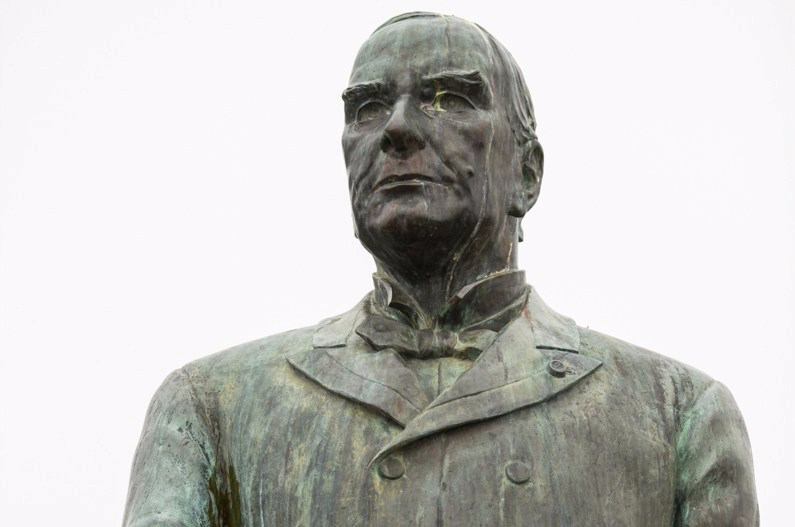
    The statue of former United States president William McKinley stands in the middle of Arcata Plaza. The statue was erected in 1906 and has been at the center of controversy. Photo credit: Diego Linares

    Statues memorialize people and events which will always remind us that one thing can have a variety of meanings. How do we reconcile the fact that the Founding Fathers are seen primarily as the harbingers of democracy by some, yet are simultaneously documented as perpetrators of genocide? I’m just a simpleton student working on my undergrad, but I think I have an idea: find a way to tell the truth. While truth is complicated, that is no justification for promoting a lie. And most statues are liars. A statue is lying when it’s preserved in a way which forwards a fraction of its historic context. Most statues meet this criteria. So how do we get a statue to tell the truth? We supplement the story by bolstering one-sided narratives with previously erased histories. Where there is a statue of George Washington, let it be known that he was also known as “town destroyer” by the Iroquois Confederacy. Where there is a statue of William McKinley, let it be known that he authorized the annexation of Hawaii, and Guam, and Samoa, and Puerto Rico.

    Statue3_Web.jpg
    The statue of former United States president William McKinley stands in the middle of Arcata Plaza. Photo credit: Diego Linares

    When we take the time to understand that history is complex, it becomes easier to understand the same is true of us. We are complex, more than simple terms like “racist” or “liberal.” Statues are no different, but unlike us they cannot speak for themselves, which is why we need to take the rest of history and stick it to the statue.

  • Act like a man

    Act like a man

    Reinforcing negative gender roles
    by|Domanique Crawford


    During Women’s History Month, there always seems to be a resurgence of  phrases circulating that hold the theme “act like a man.” These phrases express that woman should work to be more aggressive and rude rather than their usual sweet selves. These type of quotes are a disservice to both man and women.
    This kind of quote reinforces typical stereotypes facing males and females. That women are not as smart and as strong as men, that we are emotional homebodies. For men, these quotes install the idea that they always have to be in charge and always need to maintain strict control of their emotions.
    One of the popular quotes circulating the web is “look like a girl, act like a lady, think like a man, work like a boss.” I have no idea when this quote started popping up. However, when I first read it, it instantly made me angry. One of those moments when blood rushes to your eyes and your heart starts beating to such dizzying speeds that if you don’t calm down, you are likely to pass out. It took me a while to dissect every single reason this particular phrase irritated me. 
    I’m not even going to touch on the little girl remark because the heart attack would be imminent. As to the rest, act how you want to act and think for yourself. If someone hates you for it, then they are not worth your time. These type of negative comparisons reinforce the idea that you have to adhere to certain gender roles and ultimately defeats the point such phrases are trying to inspire; to encourage women to feel free to be themselves no matter the judgment we face. 
    Each decade, women seem to do more and more to become more “manly”. Back in the day, the focus was on obtaining the status man held not conforming or adhering to specific gender roles. For the generations of women, this meant different things. In the 1920’s, women worked for the right to vote. In WWII, women were sent to work in factories. Shortly after this time, women allowed to be enlisted personnel in the military and never have we, in any of these situations, allowed ourselves to be seen as anything other than women.
    Women changed how the world looks at work relations, family relations, reproductive rights, and human rights. Women have brought about stability in a world that seems to be forever changing. We should celebrate our past and present achievements and not get caught up in false equivalencies that are counterintuitive to our goals.