Crowded in a warmly lit apartment, I sat huddled over a great big steaming silver pot with my friends, Seamus Begley and Sam Kirby, as we waited in anticipation to brew another batch of beer.
Since the brewing process takes a few hours, we started early in the evening. Begley had gathered the four basic ingredients: malted barley, hops, yeast and water.
According to the the Youtube channel It’s Okay to Be Smart, the basic beer is any alcoholic beverage made from fermented cereal grains, usually preserved and flavored with hops. It was a good guide to start, but Begley and Kirby recommend reading books to master the process.
To begin, we mixed up a batch of wheat and barley, threw it into a giant tea-bag like grain pouch and set it to steep. This is mash. We were activating enzymes in the grain, which turn the grain starches into fermentable sugars. Within a piece of grain, enzymes are proteins which, when activated, accelerate the deconstruction of starch. A starch is a complex molecule which, when divided into its component bits, becomes a sugar called glucose. The glucose will turn into alcohol later.
The product of the steeped (not boiled) mash is a tea-like liquid called wort. Wort is essentially sugar water which will be the home and food for yeast. It also tastes delicious. We rinsed the grain sack to collect any residual glucose, drained the thing into our cooking pot and set it aside. We were left with a pot full of wort.
Wort, immediately after rinsing the grain pouch, was not as concentrated as we would like it. Ideally a wort is super saturated with sugar, meaning there is a really high ratio of sugar to water. Concentrating the sugars will make the wort tastier and nutritious for the yeast. To achieve this concentration, boil the wort between 15 to 90 minutes. Excess water evaporates and leaves behind concentrated sugar water. Boiling also provides an essential service to the beer making process, sanitation.
Sanitation is an essential part of brewing. The grain itself is covered in different bacteria and other yeast that eat sugar, but their byproducts taint the flavor of beer. We sanitized everything from the pots to the bottles to the stirring sticks with a chemical called Starsun, but diluted bleach works as well. Beyond that, boiling the wort kills off these other organisms. Sanitize, sanitize, sanitize.
During the boil, we add hops. If you drink beer, you’ve probably heard of hops, and if you drink IPA’s, you’ve definitely tasted hops. They’re the bitter, flowery, citrusy flavors in beer. Hops contribute to the flavor of beer, the shelf life of beer and the scent of beer. We had many options to choose from, but this particular batch of hops was grown by Begley’s grandmother.
Next, the beer needs cooled as quickly as possible so we could add the yeast without killing them. Yeast is a critical ingredient because it is a fermenter. Fermentation is the process when yeast converts to glucose in the wort to ethyl alcohol and carbon dioxide gas — giving the beer both its alcohol content and its carbonation. When the yeast are first added to the wort, Begley took a sample and measured its specific gravity using a hydrometer. The tool told Begley the density of sugar in the water, and how much alcohol would be created by yeast.
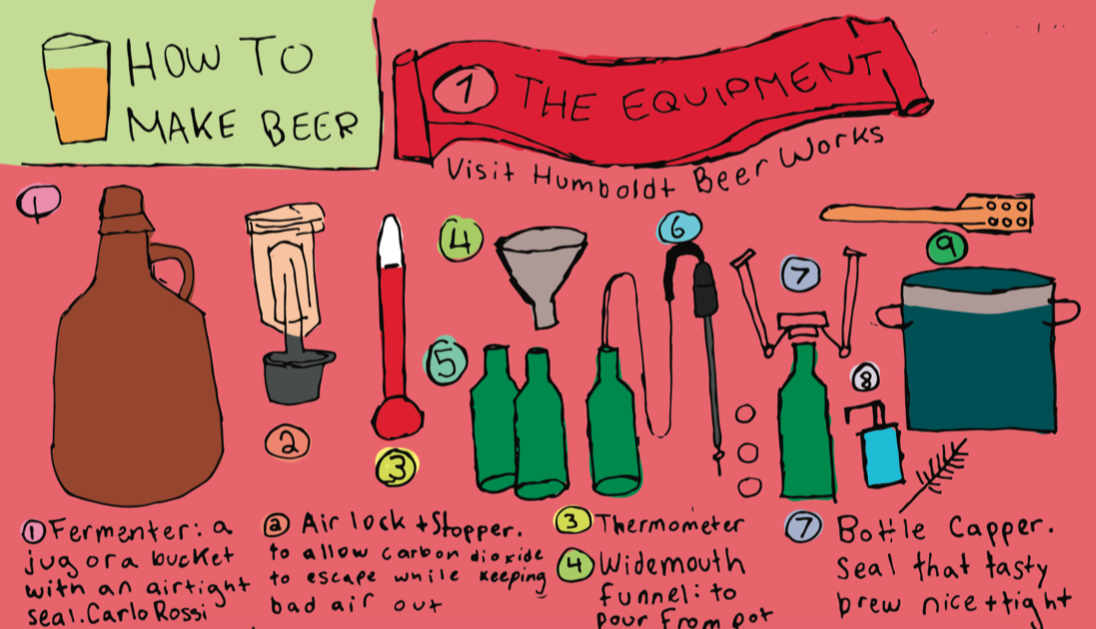
The yeast and wort mixture is then poured into a sanitized fermenter or carboy. An airlock is attached to the top of the fermenter to allow CO2 to escape from the bottle. The fermenter is then stored in a dark spot where the temperature is desirable for the yeast to do its thing. We left it there for a couple of weeks before bottling.
Once the fermentation was completely finished, we prepared to bottle. We poured the beer into a second sanitized jug, added a small amount of sugar and yeast for carbonation, and then siphoned the final beer mixture into bottles. The siphon is important because we didn’t want too much air in our beer. Finally, we crimped a sanitized cap on the bottles and let them sit for a couple more weeks.
After that tediously long wait, we popped them open and enjoyed the sweet, sweet product of our labor. It was definitely worth it.