The Lumberjack


Students Serving The Cal Poly Humboldt Campus and Community Since 1929

Tag: hops

  • Science Behind Brewing Beer

    Science Behind Brewing Beer

    Crowded in a warmly lit apartment, I sat huddled over a great big steaming silver pot with my friends, Seamus Begley and Sam Kirby, as we waited in anticipation to brew another batch of beer.

    Since the brewing process takes a few hours, we started early in the evening. Begley had gathered the four basic ingredients: malted barley, hops, yeast and water.

    According to the the Youtube channel It’s Okay to Be Smart, the basic beer is any alcoholic beverage made from fermented cereal grains, usually preserved and flavored with hops. It was a good guide to start, but Begley and Kirby recommend reading books to master the process.

    To begin, we mixed up a batch of wheat and barley, threw it into a giant tea-bag like grain pouch and set it to steep. This is mash. We were activating enzymes in the grain, which turn the grain starches into fermentable sugars. Within a piece of grain, enzymes are proteins which, when activated, accelerate the deconstruction of starch. A starch is a complex molecule which, when divided into its component bits, becomes a sugar called glucose. The glucose will turn into alcohol later.

    The product of the steeped (not boiled) mash is a tea-like liquid called wort. Wort is essentially sugar water which will be the home and food for yeast. It also tastes delicious. We rinsed the grain sack to collect any residual glucose, drained the thing into our cooking pot and set it aside. We were left with a pot full of wort.

    Wort, immediately after rinsing the grain pouch, was not as concentrated as we would like it. Ideally a wort is super saturated with sugar, meaning there is a really high ratio of sugar to water. Concentrating the sugars will make the wort tastier and nutritious for the yeast. To achieve this concentration, boil the wort between 15 to 90 minutes. Excess water evaporates and leaves behind concentrated sugar water. Boiling also provides an essential service to the beer making process, sanitation.

    Sanitation is an essential part of brewing. The grain itself is covered in different bacteria and other yeast that eat sugar, but their byproducts taint the flavor of beer. We sanitized everything from the pots to the bottles to the stirring sticks with a chemical called Starsun, but diluted bleach works as well. Beyond that, boiling the wort kills off these other organisms. Sanitize, sanitize, sanitize.

    During the boil, we add hops. If you drink beer, you’ve probably heard of hops, and if you drink IPA’s, you’ve definitely tasted hops. They’re the bitter, flowery, citrusy flavors in beer. Hops contribute to the flavor of beer, the shelf life of beer and the scent of beer. We had many options to choose from, but this particular batch of hops was grown by Begley’s grandmother.

    Next, the beer needs cooled as quickly as possible so we could add the yeast without killing them. Yeast is a critical ingredient because it is a fermenter. Fermentation is the process when yeast converts to glucose in the wort to ethyl alcohol and carbon dioxide gas — giving the beer both its alcohol content and its carbonation. When the yeast are first added to the wort, Begley took a sample and measured its specific gravity using a hydrometer. The tool told Begley the density of sugar in the water, and how much alcohol would be created by yeast.

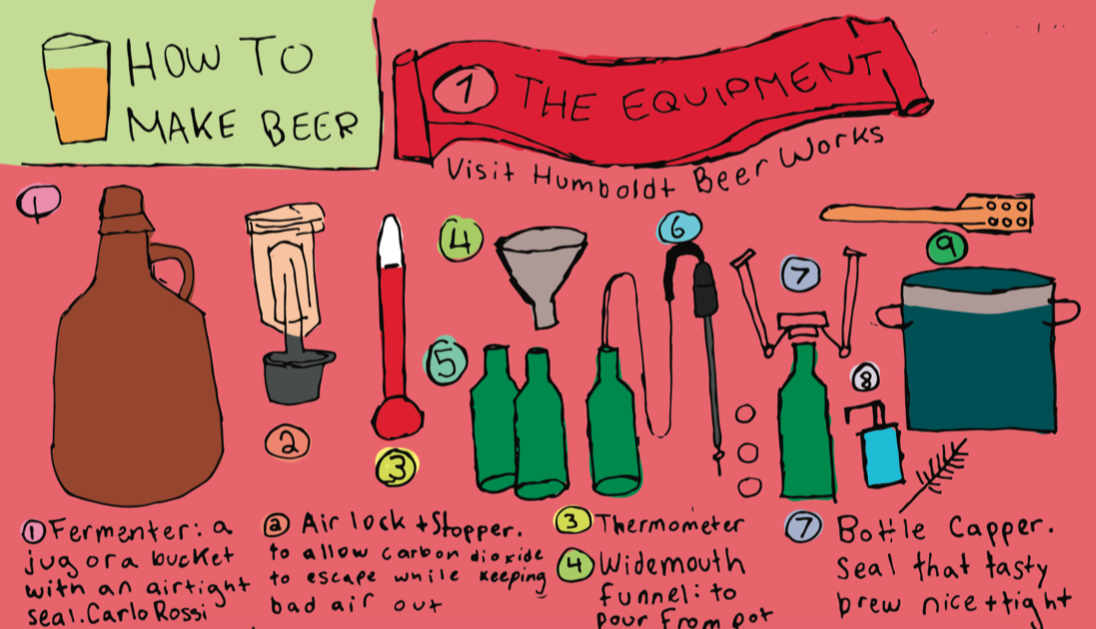
    The yeast and wort mixture is then poured into a sanitized fermenter or carboy. An airlock is attached to the top of the fermenter to allow CO2 to escape from the bottle. The fermenter is then stored in a dark spot where the temperature is desirable for the yeast to do its thing. We left it there for a couple of weeks before bottling.

    Once the fermentation was completely finished, we prepared to bottle. We poured the beer into a second sanitized jug, added a small amount of sugar and yeast for carbonation, and then siphoned the final beer mixture into bottles. The siphon is important because we didn’t want too much air in our beer. Finally, we crimped a sanitized cap on the bottles and let them sit for a couple more weeks.

    After that tediously long wait, we popped them open and enjoyed the sweet, sweet product of our labor. It was definitely worth it.
  • I like my water with barley and hops

    I like my water with barley and hops

    HSU alums sustainable farmhouse brewery

    By Carlos Olloqui

    The tap tilts forward. Fresh alcoholic refreshment begins to flow out. Twelve ounces later, you have yourself a glass of Humboldt Regeneration’s Red Jay craft beer.

    Pressey is the owner and brewmaster of Humboldt Regeneration Brewery and Farm, a sustainable farmhouse brewery.

    Humboldt Regeneration Brewery off Central Avenue in McKinleyville, California. Follow the “Beer to Go” sign | Carlos Olloqui

    “The concept built overtime,” Pressey said. “We are one of the first breweries in the country, and the first in California, to grow and malt our own grains since prohibition.”

    The wheat and barley they grow is floor-malted on site at their brew house located at the north end of McKinleyville, California. Humboldt Regeneration Brewery and Farm also grows their own grains and hops. They produce everything from seed to sip.

    “This was something that was pretty normal in the old days,” Pressey said. “But nowadays, the reason it’s not as normal is because a lot of the agriculture industries got scaled up after the Green Revolution. Everything became really mechanized.”

    Pressey grew up in Napa one of the biggest wine counties in California.

    “I worked in the wine industry during high school,” Pressey said. “During the summer time I’d bottle. My friends family owned the winery so, after I graduated, they ask me to stay on for crush. That’s when you actually make the wine.”

    He then moved to Humboldt County to attend College of the Redwoods before he transferred to Humboldt State University.

    “I was always interested in plants and sustainable agriculture,” Pressey said. “When I got to college I knew I needed a job to pay rent, so I basically just started applying at all the breweries here.”

    Humboldt Regeneration’s Red Jay craft beer | Carlos Olloqui

    In 2001, Pressey was hired on at Eel River Brewery as an assistant brewer.

    “I pretty much just got lucky with the timing, they needed someone,” Pressey said. “I started off just doing cellar work and night brewing, but I got trained up pretty fast.”

    Pressey graduated HSU in 2010 with a degree in environmental science, focusing on soils and alternative agriculture.

    He worked at Eel River Brewery for over seven years before trying to brew his own.

    “I just wondered why aren’t there truly local breweries anymore,” Pressey said. “Why aren’t people using local ingredients?”

    That was when he realized that it was because of the malting process. In comparison to some of these other beverages such as wine or cider, beer requires an intermediate step.

    “For wines and ciders you are just growing the raw ingredient, such as the grapes or the pear and apples,” Pressey said. “With beer, your growing barley and other grapes – but you can’t just make beer out of that.”

    Pressey began to put his degree to work and Humboldt Regeneration Brewery and Farm was born.

    Upon arrival at his brew house, after you take a left at the “Beer to Go” sign off Central Avenue, you’ll notice the some of the “sustainable” aspect of the operation. A barbecue grill turned into a roaster, solar panels on the side of the building, and a malting table which he built himself.

    Jacob Pressey speaking to a customer about his newest brew | Carlos Olloqui

    “We dry farm all our grains,” Pressey said. “This means you plant in the Spring and use the Spring rains. There’s no irrigation.”

    Humboldt Regeneration Brewery has been up and running since 2012. The operation is currently a two man team that consists of Pressey and his partner Matt Kruskamp.

    “I was a customer here, I used to come around here regularly when he first opened,” Kruskamp said. “I asked him if he needed an intern, I told him he wouldn’t have to pay anything since it was through HSU.”

    Kruskamp was hired on full time after he graduated in 2014.

    “It’s great to be such a big part of this and to be able to say I contributed so much of the ideas and effort towards it,” Kruskamp said.

    You can find over 100 different house recipes being filtered through the brewery Wednesday through Sunday from 11 a.m. to 7 p.m.. A new flavor comes out every week.

    Pressey transforms his labor into alcoholic beverages and serves it to a growing clientele. Sean von Devlin is one of the many fans of Humboldt Regeneration Brewery. He is amazed by Pressey’s passion for the product.

    “The beer is great, I used to live just across the street. It truly epitomizes the local handmade blue collar mindset,” von Devlin said. “I have spoken with Jacob only a few times and he always is excited to share his story. It amazes me to see how everything operates.”

    Humboldt Regeneration’s weekly beers on tap | Carlos Olloqui

    Humboldt Regeneration is not only Humboldt’s first locally grown beer, they also offer a community supported brewery program. This program gives community members the opportunity to purchase shares that will allow them to a free weekly growler fill-up.

    “I have a new beer come out every week, you can miss weeks and not lose your credit,” Pressey said. “We fill our growlers on a bottling machine. They are fully carbonated, just like a store-bought beer.”

    The principle is simple, sustainability.

    “Right now we are just on tap at a handful of spots in Northern Humboldt,” Pressey said. “But no distribution and no bottling, the whole concept is to reduce waste.”

    With a brewery, your main waste products are water and spent grains.

    “After you’ve extracted all your sugars and proteins from the grain you got all the wet solid grains left over,” Pressey said. “Most breweries will give that to a rancher as feed in exchange for them taking it off site.”

    Unlike other breweries, Pressey grows a mixture of bacteria and mixes his spent grain in with it. This ferments into a soil amendment.

    “There’s a similar process called Bokashi, I call it Beerkashi,” Pressey said. “We spray that [soil amendment] pretty heavy twice a year in the fields, this basically makes the soil extra healthy.”

    From seed in the field, to the malt floor, to the brewing process, and then back out to the fields, an entire lifecycle of a foamy pint of beer is what you can expect at Humboldt Regeneration Brewery and Farm.

    “In the future I hope to establish a larger brewery and have the farm all in the same location,” Pressey said. “We could give tours and have a full beer garden.”