Associated Students takes over remains of the clubs budget
The Associated Students Programs Grants budget has been cut by more than half of the previous academic year’s budget to $25,000 from $52,000. With student enrollment on the decline since 2016, student fees. which make up the entire AS budget, have taken a significant hit.
As a result of the cuts, it was decided the control of the budgets would be kept within the Associated Students Board of Finance for this academic year. All student clubs are allowed to apply for AS grants, either for events or travel.
Grant requests are brought to the Associated Students Board of Finance for evaluation before being handed off to the Associated Students Board of Directors, made up of 15 voting and three non-voting members, for final approval.
In the past five years, between about 10-18% of the AS Programs Grants budget has gone to AS category two programs like CCAT and the MultiCultural Center, which receive separate funding through different outlets. This year, AS decided clubs will receive the entire AS Programs Grants budget in the 2019-2020 academic year.
The AS Board is currently in the process of their third and final grant allocation for the 2019-2020 academic year. So far, the Board of Directors has approved grants to all 29 clubs that requested—however, not all requests have been entirely met.
As a result of the budget reduction, AS put in place a cap of $500 per event, $800 per cultural event and $100 per person for travel. The Board of Directors will hold their final vote on March 13 to decide the 11 remaining grant requests for the academic year.
AS Legislative Vice President Jeremiah Finley is working to provide a fair opportunity for all clubs to receive funding.
“AS is doing the best with the situation that they’re having to navigate through.”
Molly Kresl
“I think clubs always need more access to more funds across the board,” Finley said. “I think the goal of AS here is to really try to make sure that they do have access to funds. And so, in trying to do that, we’re trying on our part, to find ways in our budget to make sure they have access.”
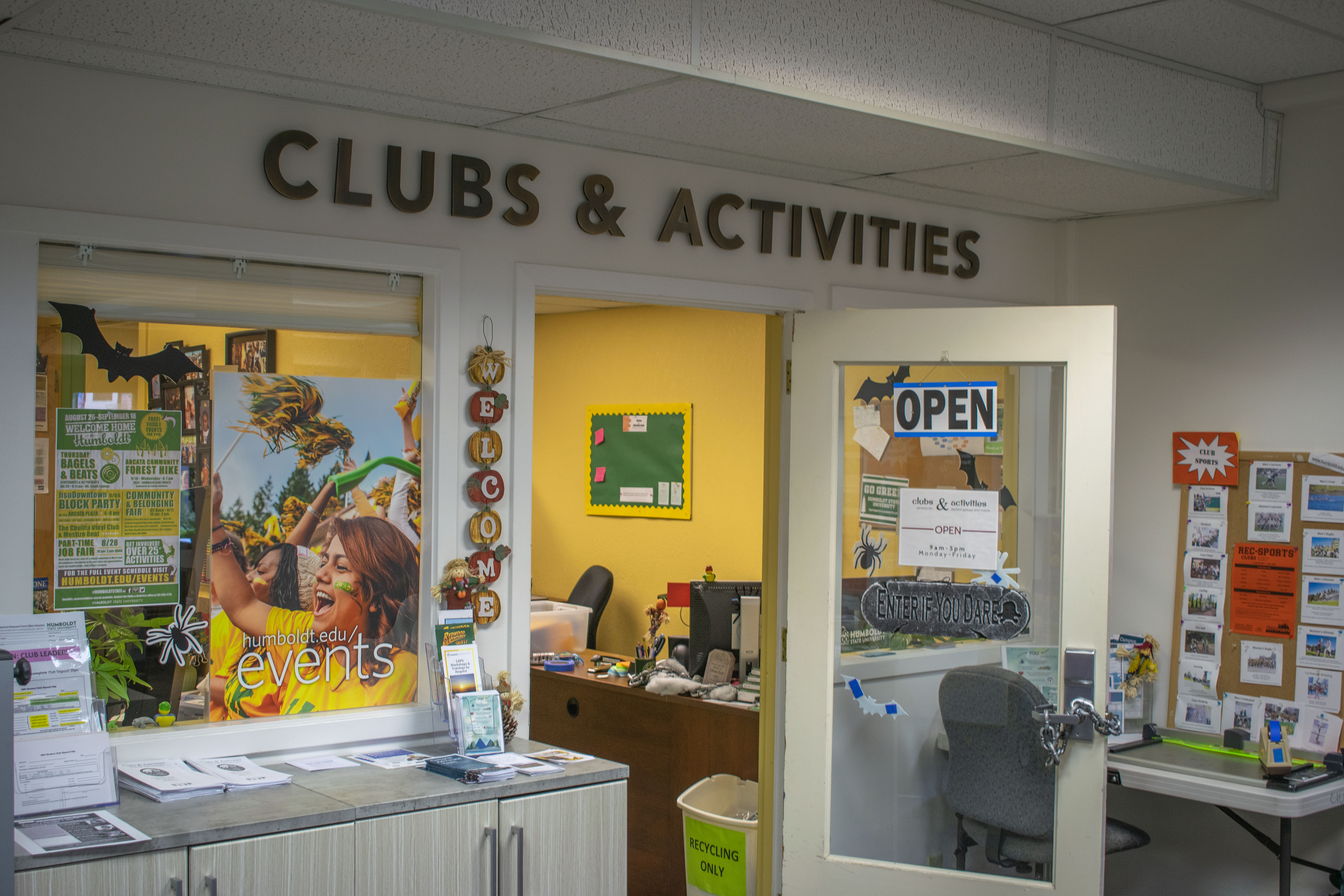
The clubs budget reduction has forced everyone involved to be more responsible with their spending, according to Clubs and Activities Coordinator Molly Kresl.
“That’s something that’s been really cool that’s come out of this unfortunate situation,” Kresl said. “Even though we have a decrease in funding, there’s an increase in collaboration with student-initiated programs.”
However, there’s still much improvement to be made. AS wants to hear the voices of students that are affected by these decisions. For students who want to take matters into their own hands, they can sign up as a candidate for the AS Board.
“AS is doing the best with the situation that they’re having to navigate through,” Kresl said. “It’s important to recognize the complexity of the situation, and that there are ways that we can help our students be successful and do what they wanna do on campus.”
Getting to the bottom of a rumor of an HSU club embezzling money
Student clubs aren’t guilty of embezzling money, but they have misused funds.
A rumor from a recent Humboldt State University clubs meeting said that a student club embezzled money. According to Tay Triggs, the director of the Office of Student Life, that rumor was false.
Triggs said the embezzlement mentioned in the meeting was an illustrative example from another college of how clubs might mishandle money. However, Triggs did acknowledge that some HSU clubs fail to follow proper financial procedures.
Triggs said she has seen students use club funds to pay for necessities, including textbooks, but that she wouldn’t label that as embezzlement. For Triggs, embezzlement is applicable only to long-term, premeditated theft.
“Some clubs can accidentally misuse funds if they didn’t get permission to do something,” Triggs said. “There’s all kind of cash handling rules. If they don’t follow them, that can technically be a misuse of funds.”
Triggs said she tends to take a forgiving stance when a student club is found to have mishandled money.
“When it comes to clubs, I’m more educational than punitive,” Triggs said. “I would rather meet with them and make sure they knew what the policy was—if they didn’t, then I’m going to give them a warning.”
Our students are learning all of this. Managing budgets as if they’re tiny nonprofits—which all of them are—is not easy and so we definitely recognize that, especially understanding that the state is a very bureaucratic system.
Molly Kresl, HSU Clubs and Activities Coordinator
HSU student clubs have seen changes in their financial management in recent years in an effort to comply with the Integrated CSU Administrative Manual for student clubs defined by CSU Executive Order 1068, passed late 2011.
HSU Clubs and Activities Coordinator Molly Kresl said all student club advisors, presidents and treasurers undergo financial management training before handling money. Nevertheless, Kresl said policy violations do happen.
“Mismanagement does occur,” Kresl said. “And sometimes it’s unintentional and sometimes there is mal-intent there. And more often than not that mal-intent is coming from a place of need from an individual, but whatever it is, we have these policies and procedures in place to protect that money, to protect our organizations and to protect our students.”
Kresl said Clubs and Activities promotes proper financial management procedures like the taking of inventory, the use of receipt books and the use of dual-custody, which Kresl elaborated on.
“Dual-custody is important because it ensures accountability that one person’s watching another,” Kresl said. “You’re less likely to mishandle money if there’s someone else there. Also to ensure the safety of the students, so an individual student who’s maybe handling like $100 or $200 dollars, doesn’t get targeted and then potentially attacked—not that I would expect that to happen in our community.”
Kresl said club funds are stored in HSU accounts, so transactions are monitored. A club’s advisor and president, or treasurer, must sign for any withdrawals from the accounts. Clubs and Activities tries to aid student clubs as much as possible to avoid financial mismanagement.
“Our students are learning all of this,” Kresl said. “Managing budgets as if they’re tiny nonprofits—which all of them are—is not easy and so we definitely recognize that, especially understanding that the state is a very bureaucratic system.”
Ryen Cosgro, recreation administration senior and president of the recreation club, said he underwent almost nine hours of training to become a club president. Cosgro agreed that learning to manage a club was difficult.
“There’s kind of a steep learning curve, and that’s something that I could tell the clubs office was trying to provide us resources to avoid,” Cosgro said.
Despite the time and effort Cosgro had to put in, he said he was grateful for the training he received.
“A lot of the educating, I was like, ‘Man, I have to go to a lot of meetings and orientations,’ but coming out of it, okay, I learned a lot,” Cosgro said. “That was very helpful.”
Cosgro had doubts about how anyone at HSU could pull off embezzlement, as he said any large expenses require prior approval.
Ryen Cosgro, recreation administration senior and president of the Humboldt State University recreation club, standing outside the HSU recreation and wellness building on Nov. 1. Cosgro said his only gripe so far as a club president has been a small travel budget. | Photo by James Wilde
“From my point of view, it seems really hard to do that,” Cosgro said. “I don’t really see how you can do that unless you’re making false receipts or something.”
In the event that mishandling does occur, Triggs will typically meet with students, gather information and divide up the responsibility of the mishandling based on what she finds.
If an entire club has benefited from mismanagement, Triggs would likely implement conduct policies upon the whole club.
Otherwise, Associated Dean of Students Roger Wang would oversee conduct procedures for individual students.
Depending on the severity of the mishandling, Triggs said she could put the club on probation or revoke its status as a club. Triggs also said she tries to keep an eye on any mishandling to prevent it from impacting all of Clubs and Activities.
“I’d rather confront and deal with one club to eliminate it happening again than to take the chance of it happening more and more and more and then we get into some kind of trouble,” Triggs said. “I’ve never had an audit finding and I don’t plan on it happening any time soon, because I know they’re not fun to rectify.”
Even for clubs caught mishandling money, both Triggs and Kresl emphasized that they ultimately aim to support and educate students.
“Our goal is ultimately to keep students here whenever we can and to support our students as best as we can,” Kresl said. “The whole reason we exist is as a learning institution and our goal is to help our students learn.”
These three campus clubs serve the community for good
Humboldt State University has a multitude of clubs who participate in community service. This week’s focus is on the Natural Resources Club, Campus Center for Appropriate Technologies and the Redwood Chapter of Environmental Educators and Interpreters.
Environmental Science student and Natural Resources ‘Club Homie’ Alexander Mouriten talked about a recent invasive Himalayan blackberry removal project at Fern Canyon.
“I gotta say, the thorns hurt but getting to work with my friends made that nothing,” Mouriten said. “I enjoyed it. I always enjoy volunteering.”
Mouriten said he volunteers for the field work, the experience and the gratification of a good honest job.
Early on Saturday mornings, the Natural Resources Club meets in front of the Natural Resources building before heading out for their weekly restoration service project. The Natural Resources Club does invasive plant removal, trail building and habitat restoration on a regular basis. Food and coffee are provided to keep up morale, and the club welcomes all students to join.
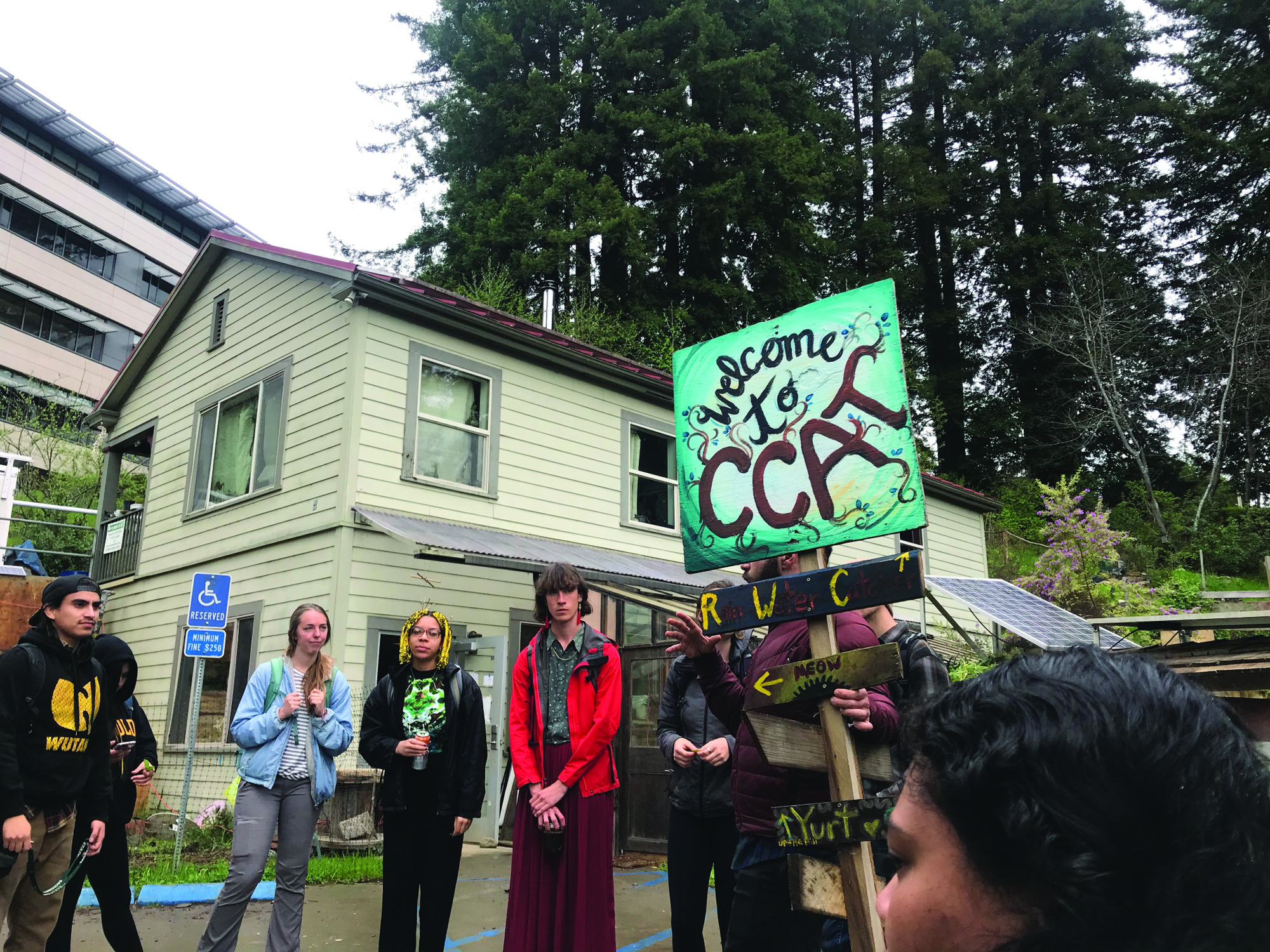
The Campus Center for Appropriate Technologies, CCAT, is built on environmentally-friendly means. CCAT often creates opportunities to volunteer and provides students with hands-on experience with unique technology.
Sebastian Forward is the sustainable gardener at CCAT. Forward is working on an ethnobotanical gardening project to educate people about the science and history of food domestication. Forward said he believes everybody who works at CCAT is here for the community.
“CCAT is a source of information and education in the community,” Forward said. “Every Friday is our signature volunteer Friday. Everyone is always enjoying their talking and enjoying their time.”
Volunteer Fridays are a really good opportunity to get involved with the CCAT community. CCAT invites environmentally conscious people who have sustainable technology ideas to come to the house and make their ideas come to life. Visitors will be met with a welcoming attitude. Just ask what you can do to help.
To have a healthy community, the community must serve itself. Every weekend, community service projects pop up across the nation. Projects rely on volunteers who offer their time to improve habitats, clean up streets and improve their communities. Participating in community service gives volunteers the opportunity to help improve the place they live while offering the chance to create a special bond with whomever they serve.
The Redwood Chapter of Environmental Educators cleans up for Coastal Clean Up Day. | Photo by Collin Slavey
The Redwood Chapter of Environmental Educators and Interpreters, RCEEI, excells at explaining challenging topics to the community in approachable ways. The club serves young community members often, with events like their annual March 4 Parks.
Brighton Hayashida is the vice president of RCEEI. He said March 4 Parks is an opportunity for students to serve young members of the community.
“Kids are really excited about March 4 Parks,” Brighton said. “Just the fact they’re outside is important. The biggest thing is that we made nature relatable to kids.”
RCEEI communicates environmental knowledge by interpreting it. Scientific interpretation is similar to language translation. Instead of language, RCEEI talk about science in a way everybody can understand. It’s a valuable tool for inspiring people to volunteer to serve their community.
Service is one of the United State’s defining values. From the beginning of the nation, Americans have been volunteering their time and energy for selfless progress. In 1736, Benjamin Franklin founded the first volunteer fire department. In 1865 William and Catherine Booth form the Salvation Army, which would become one of the largest volunteer organizations in the nation. Finally in 1961, President John F. Kennedy founded the Peace Corps which created volunteer opportunities across the world.
“And so, my fellow Americans: ask not what your country can do for you—ask what you can do for your country,” President John F. Kennedy said.
This website uses cookies to improve your experience. We'll assume you're ok with this, but you can opt-out if you wish. Cookie settingsACCEPT
Privacy & Cookies Policy
Privacy Overview
This website uses cookies to improve your experience while you navigate through the website. Out of these cookies, the cookies that are categorized as necessary are stored on your browser as they are essential for the working of basic functionalities of the website. We also use third-party cookies that help us analyze and understand how you use this website. These cookies will be stored in your browser only with your consent. You also have the option to opt-out of these cookies. But opting out of some of these cookies may have an effect on your browsing experience.
Necessary cookies are absolutely essential for the website to function properly. This category only includes cookies that ensures basic functionalities and security features of the website. These cookies do not store any personal information.
Any cookies that may not be particularly necessary for the website to function and is used specifically to collect user personal data via analytics, ads, other embedded contents are termed as non-necessary cookies. It is mandatory to procure user consent prior to running these cookies on your website.