The Lumberjack


Students Serving The Cal Poly Humboldt Campus and Community Since 1929

Tag: HSU dining services

  • Student employees unhappy with the university

    Student employees unhappy with the university

    Students show up to work despite stress, non-payment and fear of unsafety

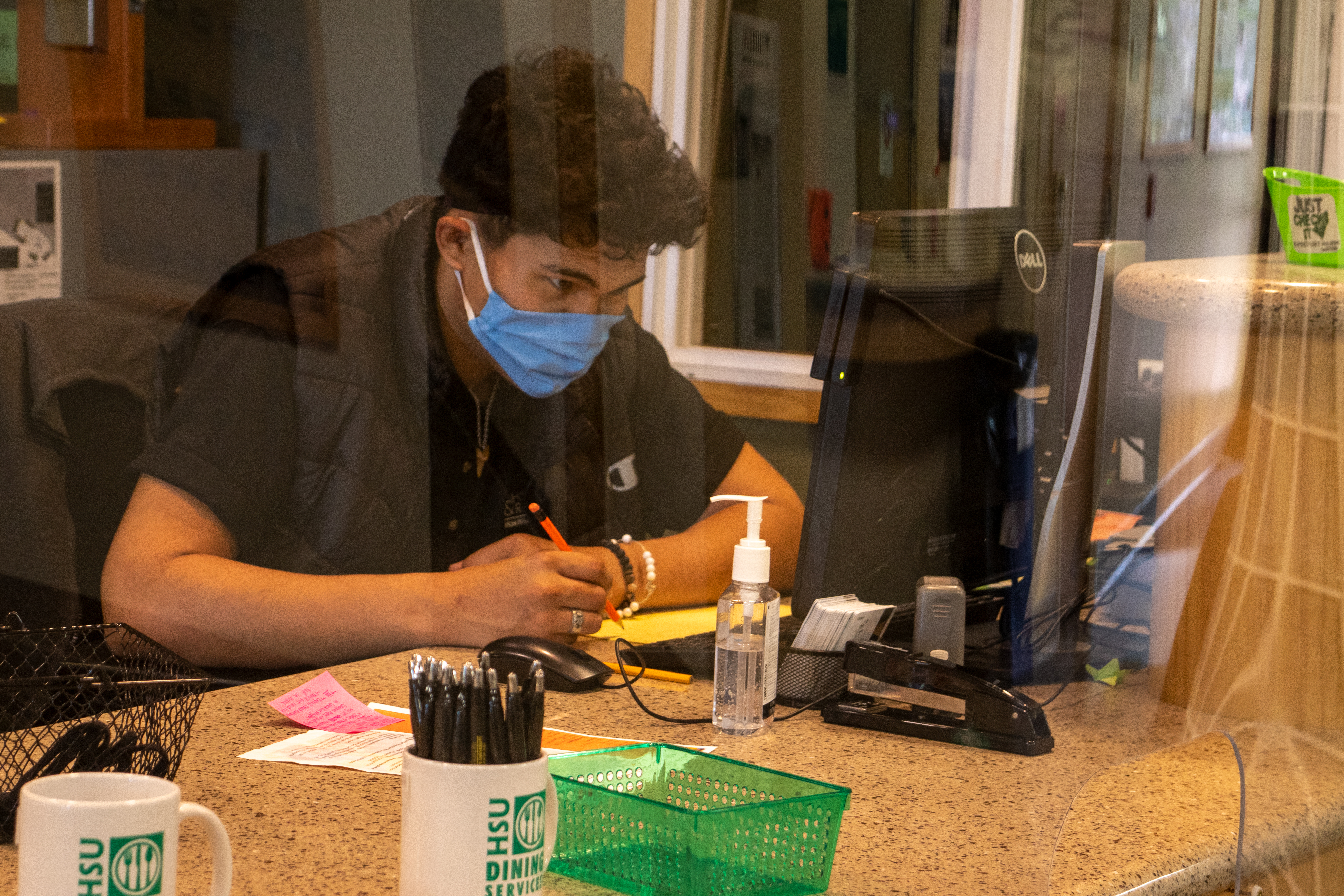
    José Juan Rodriguez Gutierrez is a second year Resident Student Service Advisor at Humboldt State University, which mostly involves providing general student assistance and taking phone calls. This semester, Gutierrez and the other RSSAs’ jobs added pandemic precautions.

    “We have new cleaning procedures at the start of every shift. We also have to get tested as employees,” Gutierrez said. “We also have followed the two week quarantine before any of us started working [and] if anyone leaves the county, that’s still being required.”

    When the pandemic began in the spring, Gutierrez and the other RSSAs were put on paid leave for the rest of the semester while the university developed a strategy for fall. For students like Gutierrez, returning home to Los Angeles wasn’t an option, so he spent the summer working odd jobs and searching for a long term back up plan.

    “If anything, LA was a lot worse during the pandemic,” Gutierrez said. “I decided it would be safer to stay up here and if school couldn’t employ me, I was gonna apply to some of the other local areas.”

    With education virtual this semester, many of the other RSSAs decided not to return to campus, reducing the staff to approximately half of what it was in the spring. According to Gutierrez, the most challenging part of the transition has been not having the authority to enforce proper pandemic protocols.

    “It’s been pretty disturbing seeing like groups of eight people hang out together since the first week,” Gutierrez said. “It takes like three, four days to get your [COVID-19 test] results and I think that even before people got them, they were already hanging out, walking in and out [of our building], and that is something that concerned me and many of my other co-workers.”

    Within his department, however, Gutierrez feels precautions are being taken very seriously and he takes comfort in the extra procedures that initially felt like a drag.

    “I feel like before this, we live in a society that was so set on doing things no matter what you felt, like your personal being did not matter,” Gutierrez said. “The fact that we can kind of rely on each other, that we’ve taken care of ourselves and we’re trying to do everything we can to stay safe, I feel like that’s been really rewarding and I feel that the sense of respect to ourselves and to others gets carried on out of this pandemic.”

    Lee Chase, Critical race, gender and sexuality studies major, got a job this semester as a Teacher’s Assistant in his department, after not receiving an offer to return to the the J dining services. The TA position offered a small pay increase. It wasn’t made clear, however, that he was being paid from a stipend that would max out.

    “That wasn’t communicated to me at the beginning of the semester,” Chase said. “I think ultimately it will be way below minimum wage if it becomes a stipend or if they’re not able to figure something out.”

    Along with likely receiving less compensation than he signed up for, Chase has yet to receive his first paycheck as of the first week of November.

    “I’ve been having a lot of trouble with paperwork cause usually they do this stuff in person, so it’s been really slow,” Chase said. “I would have expected them to be more organized in regards to payment and getting paperwork done and like, communicating.”

    Setting aside payment issues, Chase appreciated being able to conduct his work entirely online. Working from home, however, began to interfere with Chase’s education.

    “I put my camera off in my classes and just grade.” Chase said. “It’s simple work, you can kind of just get it done, but it does take time.”

    Along with grading, Chase also writes weekly assignments and collaborated with the professor in creating this semester’s midterm.

    “I feel like I’m learning a lot from just having to create questions and re-engage with the readings.” Chase said. “I’m learning a lot too just about what is expected in papers and responses and how to communicate what is expected to people, which is helping me in my other classes I think.”

    Destiny Aguilera, theatre arts major, worked at the Depot in the spring but was transferred to the Marketplace this semester after the Depot didn’t reopen. Like the RSSAs, dining service workers were not given notice about jobs until moments before the school year started. For Aguilera, this made the summer especially stressful.

    “To work on campus and to have that financial support was definitely a big factor [in staying].” Aguilera said. “Also, my partner and I didn’t have the funds to move back to Southern California [or] Minnesota where they live, so we had to figure out how to make it work up here.”

    New management and a significantly reduced staff presented additional challenges at the Marketplace this semester. In Aguilera’s case, this means sacrificing some of their rehearsal time in the theatre department to accommodate a less flexible work schedule. What really bothers Aguilera is HSU’s laid back approach to the threat of COVID-19.

    “A lot of the people who work on campus, like at the Marketplace, weren’t told that we had to come in and get testing done in any aspect,” Aguilera said.

    Aguilera also has serious concerns about serving students who don’t respect the social distancing protocols dictated inside the Marketplace. With a full schedule of classes and limited local opportunities available, however, Aguilera doesn’t have another option.

    “The honesty policy works, unless someone decides to be dishonest and that factor is always a little bit scary,” Aguilera said. “A lot of us don’t live on campus, we go home to other people and families and stuff. We don’t get to go home and just isolate and it’s hard when students disrespect the policies on campus.”

  • No Such Thing As a Free Lunch

    No Such Thing As a Free Lunch

    HSU’s Dining Services employees don’t receive a free meal while on shift

    While many food service employees receive heavily discounted meals or one free meal per shift, dining services student employees at Humboldt State University get the same meal discounts as anyone who pays with J-points: 25% off.

    Abigail Rosales, junior communications major and a floor manager at The Depot, said employees frequently complain about the minimal discount.

    “It would be nice to know that our job and our work is valued,” Rosales said. “Because if we’re just getting the same discount as people who already live on campus, then there’s not really an incentive food-wise. Obviously we’re getting paid, but it’s always a nice bonus if you get any benefits while working here.”

    Rosales previously worked at the fast-casual restaurant chain, The Habit Burger Grill. Employees received a free burger and fries every shift, and got 50% off everything else.

    Rosales said a free or more discounted meal per shift would likely make for a better workplace.

    “I think if we did get that, a lot of us would be a little less grumpy,” Rosales said. “Because sometimes we’re tired or hungry, and sometimes we just don’t have money on us, so we get irritated.”

    Abigail Rosales, a junior communications major, standing in The Depot at Humboldt State University on Nov. 8. Rosales, a floor manager at The Depot, said student dining employees often feel irritated with the lack of an extra discount, but never feel like they can do anything about it.

    William Weinberg, a forestry senior and College of Natural Resources representative and vice chair, said over the phone that he’d be interested in seeing HSU try a pilot program giving free meals to student employees.

    “I think it would be cool if it did happen, or if they ran a pilot to see if it would work,” Weinberg said. “Would the costs of that free meal maybe make up for more work ethic, more happier workers?”

    Rosales said many student employees bring their own food or have to clock out from work early to go home and eat before their next class to avoid paying for a meal. But according to Rosales, even a cheap meal would be helpful.

    “Even just like the fries and a corn dog,” Rosales said. “I think those are the two cheapest things. If we just get that, that’ll probably be enough for a lot of people.”

    Director of Dining Services Ron Rudebock pointed to money as the primary issue behind the lack of an extra discount for student employees.

    Rudebock, who has been the director of dining services for 15 years, said declining enrollment has reduced dining services income, while increases in minimum wage and insurance prices, alongside efforts to provide more organic and local food options, have increased costs.

    “It’s unfortunate, because we’re trying to keep our food costs lower while our costs are going up,” Rudebock said. “So how do you balance those two?”

    Dining services at HSU are not run by the university, but instead by the University Center. The UC is a nonprofit auxiliary corporation that works with HSU, but is not owned or operated by the school. The UC operates on-campus entities like dining services, the library, Center Arts and Center Activities.

    While student fees provide money for some of the services, Rudebock said dining services runs entirely on the income from student food purchases.

    In fact, Rudebock said dining services has to pay HSU rent for their facilities along with utilities, garbage, internet and so on.

    “It’s a separate business,” Rudebock said. “And we actually pay the university money.”

    All California State University Dining Services are run by auxiliary corporations, according to CSU Public Affairs Manager Hazel Kelly. We have reached out to all CSUs to determine which CSU dining services provide free meals to student employees.

    Thus far, only five CSU’s have responded.

    Student employees at CSU Bakersfield and CSU Monterey receive free meals during shifts, and according to a representative for Sonoma State, SSU student employees get free meals for shifts longer than four hours and free snacks for shifts shorter than that. San Francisco State gives its student employees a free meal if they work a shift longer than five hours, and CSU Chico gives students meals for $2.50 for shifts longer than four hours. In addition, Chico gives student employees 10% off all food items purchased on campus.

    Director of Dining Services Ron Rudebock in his office on Nov. 8. Rudebock said dining services has hit tough times lately due to declining enrollment and increased expenses. | Photo by James Wilde

    Any profit that dining services makes goes back into its operations, according to Rudebock. Rudebock pointed to The J’s more than 25-year-old dishwasher as one example of an upcoming expense. Rudebock said the dishwasher will cost around $250,000 to get replaced.

    “We need the reserves to be able to pay for everything so we can stay in business,” Rudebock said. “But we don’t have a set of stockholders. We don’t have—you know, like a corporation has a set of stockholders that have got to make money. We don’t have a magic investor.”

    Rudebock said the UC lost around $100,000 in each of the last two power outages, during which The J offered free meals to students, faculty and staff. Rudebock said HSU may only partially reimburse dining services for those costs.

    In regard to free meals, Rudebock said that dining services doesn’t have any plans to provide a larger discount for student employees. However, Rudebock said the issue is not off the table. HSU could suggest larger discounts for student employees to the UC, and while the UC does not have to follow HSU’s suggestions, Rudebock said it wants to work with the university.

    “We need the reserves to be able to pay for everything so we can stay in business. But we don’t have a set of stockholders. We don’t have—you know, like a corporation has a set of stockholders that have got to make money. We don’t have a magic investor.”

    Ron Rudebock

    HSU Director of News and Information Aileen Yoo said via email that HSU hasn’t suggested the UC adopt free meals due to the impacts it could have on prices.

    “We understand that offering free or more heavily discounted meals for student employees would be a financial burden for the UC and likely mean a price increase for all HSU students who may not necessarily have the means to cover those additional expenses,” Yoo said.

    At the moment, HSU dining services employs about 350 students and 26 full-time employees, which, according to Rudebock, is the highest proportion of students to full-time employees in the CSU system.

    Aileen Dominguez, a senior political science major who works as a student assistant at The Depot, said she sometimes wishes there were more full-time employees because when she started the position she felt she was never properly trained.

    “I was just kind of put in with my coworkers who actually just said, ‘Oh, this is what we do, or this is how we do it—or this is how the girl before taught me how to do it,’” Dominguez said.

    Dominguez said this has led to confusion and she’s not always sure how to train new employees.

    Aileen Dominguez, a political science senior, studying in the library on Nov. 10. Dominguez works as a student assistant at The Depot. Dominguez suggested that a bigger discount for dining service employees might increase sales. | Photo by James Wilde

    “I’ll say, ‘This is what you do, I think. At least, this is how I’ve seen the other girls do it,’” Dominguez said.

    As for meal discounts, Dominguez echoed Rosales.

    “I think we all talk about it,” Dominguez said. “But they probably don’t have enough money to feed us all.”

    Dominguez said she only eats at The Depot when she has to—typically on Thursdays, when she is on campus all day. She said that employees frequently go to Oh Snap or elsewhere instead of buying food on campus.

    Dominguez suggested that a larger discount might actually help bring in more business, but she doubts that one will be offered.

    “I just feel it’s unfair that we kind of have to choose,” Dominguez said. “Like, ‘I don’t want to eat this right now, because I have to buy other things,’ or say, ‘I’m just gonna go eat a cup of noodles at home because this burrito isn’t worth it.’”

    Rosales made a similar statement.

    “On our end, we kind of pick and choose if we want to pay for something,” Rosales said. “If we’re really that hungry to pay for it or if we’ll just deal with it and not.”

    This story will be updated if and when other responses for comments are received.

  • College Creek Marketplace introduces new bag rule

    College Creek Marketplace introduces new bag rule

    Students will now be required to leave their bags with cashiers when shopping at the College Creek Marketplace. This new rule is administered by Humboldt State University’s dining services.

    Ron Rudebock, dining services director, said theft has become a bigger issue this semester than the last.

    “It’s why this new system is being put into place,” Rudebock said. “We need to take the precaution to prevent more theft from happening.”

    The way the system works is customers will leave their bags in a rack supervised by an employee and receive a pin with a number.

    Once they’re done shopping, customers return to the rack where they left their bag, give the pin back to a supervising employee and receive their belongings.

    Rudebock expresses that he didn’t want to use this system, but is required to avoid an increase of the price of items sold in the marketplace.

    “We’ve already had people calling to say that they think it’ll be inconvenient for everyone involved,” Rudebock said. “But for us to not increase the price of items in the marketplace, we need to use this system.”

    Selena Ponce is a College Creek Marketplace employee.

    “There is some frustration at first when we ask for [a customer’s] bag,” Ponce said. “When we explain that theft is the reason for the new rule, people are willing to leave their bags with us.”

    Rudebock said dining services will consider implementing a similar bag rule in The Depot and The J if theft becomes more common in those locations.

    “It was much easier to just go in, get what you need and get out,” HSU student Natalie Carbarl said. “It’s kinda dumb, but I understand why [the Marketplace] need to enforce this rule.”

    “People who are stealing from the Marketplace are hurting the school more than they actually think,” Rudebock said.