The Lumberjack


Students Serving The Cal Poly Humboldt Campus and Community Since 1929

Tag: HSU Music department

  • Cal Poly Humboldt music department performs a once-in-a-decade recital

    Cal Poly Humboldt music department performs a once-in-a-decade recital

    by Sophia Escudero

    One o’clock on a Tuesday afternoon is not the usual time for a music recital. However, this particular performance was more than just a display of student skill. Accreditors from the National Association of Schools of Music were in attendance, after two days on campus visiting classes, listening to students perform, and ensuring the university meets standards for music programs. According to music department chair Cindy Moyer, this process is one that happens only once every ten years.

    “For this particular recital, what they wanted to see was the full spectrum of the program, which is why you can see there were all different music concentrations and students performing,” Moyer said.

    A highlight of the afternoon’s performances was staff accompanist John Chernoff’s rendition of a moody piano piece by composition major Theo Singer. The audience watched in captivated silence as Chernoff played through to the last, lingering note with an intensely focused expression, leaving the music hanging in the air for a moment, before breaking the spell as he turned to the audience with a wide smile and a quick bow, freeing the listeners to rapturous applause. Singer is a senior, but the performers comprised the full range of experience.

    “This was hard because we needed a real breadth of things, we had to find freshmen and sophomores,” Moyer said. “We do an honors recital every year and that’s pretty easy, students audition and the very best play— but that was not the goal here. The goal was not the most advanced, most skilled performers entirely, it was the whole spectrum of performers.”

    Marimba player Makani Bright was singled out by Moyer as a particularly talented senior performer. Bright has been playing for about 12 years, and has an upcoming senior solo recital on April 10. They are a double major in percussion performance and applied mathematics, finding beauty in both.

    “The way that I relate both of my majors in my mind is that I think of them artistically,” Bright said. “I think of mathematics as an art form, it’s perfect and there’s many beautiful things you can do within mathematics. Both of them, to me, are an art.”

    Bright’s piece, “Chain” by composer Kazunori Miyake, was not one they had previously performed before an audience. The instrumental composition had almost narrative elements, combining multiple different feelings and rhythms into a complex and beautiful melody.

    “I feel really good about it,” Bright said. “I feel like I was able to express what I wanted to express and I really enjoyed myself.”

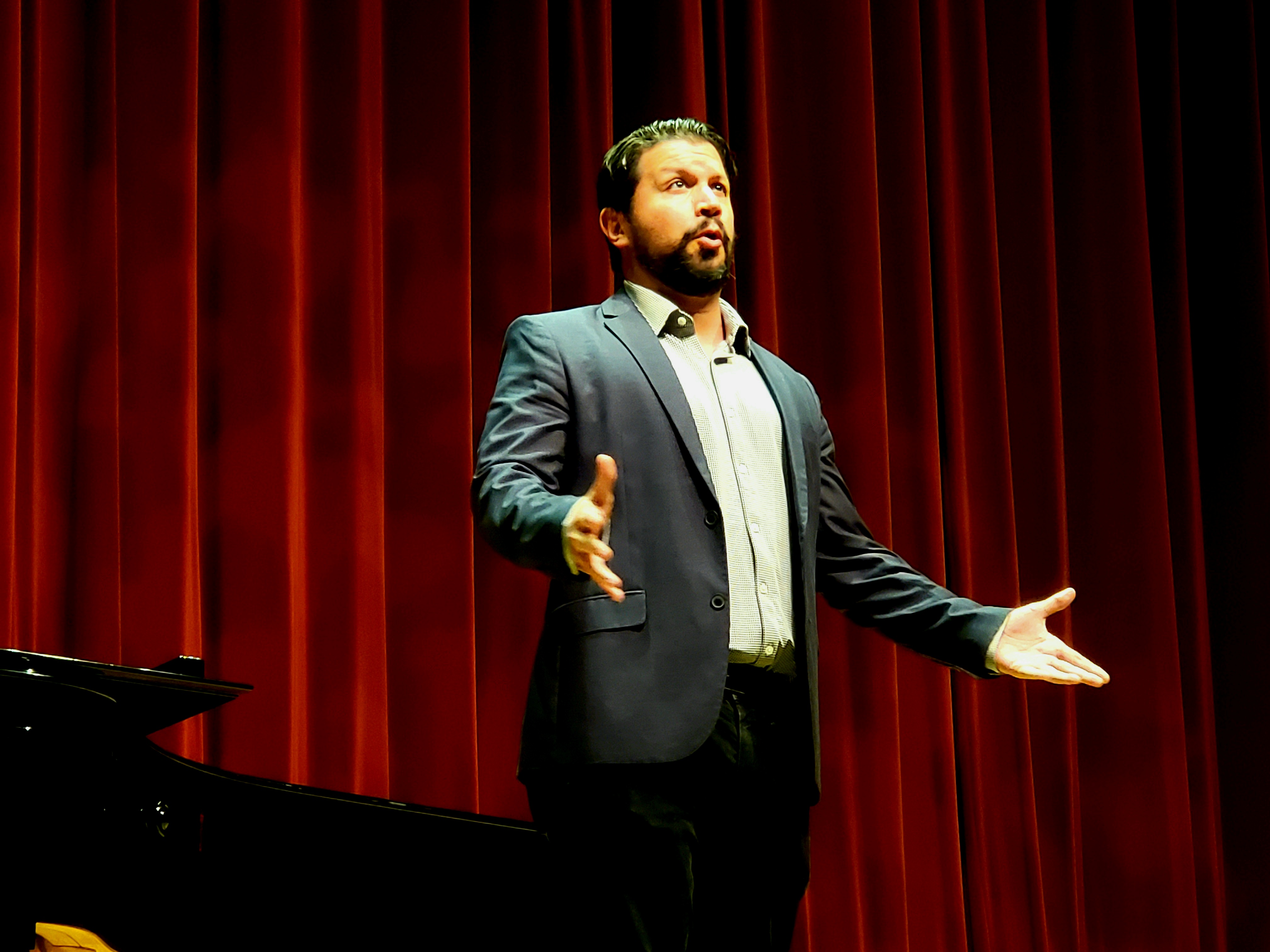
    The majority of the music on display was instrumental, with pianists, percussionists, and a saxophone quartet as standouts, but music education major Pablo Murcia was selected to represent the vocal arts.

    “I’m very honored, honestly,” Murcia said. “I was the only singer chosen, and that’s quite an honor. I’m very flattered, and happy that some people came out to support me. That was nice.”

    Murcia’s piece was an aria from Mozart’s Don Giovanni, “Deh, vieni alla finestra.” He performed in Italian, but his smooth baritone voice, expressive performing style, and connection with the music (which has been part of his repertoire since last semester) carried the story of the song to the audience.

    “Don Giovanni, he’s a Don Juan, he’s a player, and he’s trying to get the attention of a woman at her window,” Murcia said. “The whole piece is just him saying, come to me, come to me, trying different tactics to get her attention, and she just keeps sort of playing coy, and finally, by the end of the piece, she finally gives into his charms.” He laughs. “Quote, unquote charms— he’s kind of a narcissistic jerk, but yeah.”

    Music department ASA Samantha Heppe was excited to be involved in such an important production for the university.

    “I’m just excited for our music students to showcase their talents,” Heppe said. “This recital is in honor of the accreditation team, so this type of recital won’t happen again for another ten years.”
  • Music Department returns to rehearsals

    Band, symphony and orchestras proceed with in-person instruction this semester

    While the world remains in lockdown, music lives on. Students attending Humboldt State University have returned to in-person music classes where they can rehearse without the complications of connecting online.

    Professor Dan Aldag teaches two classes face-to-face, jazz orchestra and jazz combo. Although students have returned, he says the jazz orchestra isn’t entirely in-person.

    “We’re doing a reduced instrumentation of what we would normally do,” Aldag said.

    The transition from 17 people to nine resulted in a significant difference in musical quality. Music depends strongly on how many people and which instruments are present. Changing those factors can change the orchestra’s sound entirely.

    With such limited numbers, students and professors alike miss social aspects of classes.

    “I miss the folks that aren’t here,” Aldag said. “The nature of the jazz orchestra is that a lot of people play in it multiple semesters and multiple years, and so it feels like we’ve got people missing.”

    Like the rest of HSU, in-person orchestra have restrictions and precautions like wearing masks, covering horn instruments and taking breaks outside to let air refresh.

    “We’re used to having two straight hours of rehearsal and instead we go for 30 minutes then take a 15 minute break, and then another 30, and another 15 minute break so rehearsals feel a little choppy,” Aldag said.

    Less rehearsal time for students can negatively affect their performance. Since student musicians had their time cut short last semester, finding the time and space to practice has been a challenge for students.

    Kayla Rodenburg, a senior at HSU, hasn’t had an opportunity to practice and felt out of tune with her instrument.

    “We haven’t had the time to practice, so me going back now I’m really rusty,” Rodenburg said.

    Rodenburg is in the Humboldt Symphony and practices in person with her string trio. She’s still getting the hang of learning music online, especially with the symphony only meeting once weekly.

    “During COVID, it’s pretty different because we have to go online and record quick tracks so we can have everybody playing,” Rodenburg said. “The winds and brass and everyone that plays an instrument that you have to blow through, we can’t practice with them in person.”

    Music is strongly dependent on the people surrounding you as you play, and it’s harder to learn music without hearing the other musicians. Those in the Symphony who cannot join in-person join through a Zoom meeting.

    “There used to be more from the community, but a lot of them are more elderly and maybe they just don’t want to be in person right now,” Rodenburg said. “It’s a few of us but we make it work.”

    Joel Costello, HSU freshman, plays in the HSU Jazz Band twice weekly. Students meet when they’re part of a song that’s being rehearsed, however, with in-person instruction coming to an end in early Nov., that likely won’t last long.

    “It’d be cool if the school could find a way for there to still be in-person wind ensembles,” Costello said.

    Outside of group rehearsals, Costello currently practices in his dorm room. He said he felt noisy at first, but eventually realized he didn’t have any other choice.

    “Practice rooms is just too much of a hassle with pandemic requirements,” Costello said.

    The practice rooms are only open in certain buildings a few times a week, and students are struggling to get enough individual rehearsal done.

    Musicians are operating in a different reality, practicing music in dorm halls that are silent from a lack of students, little time to play with other students, limited ways to learn new music and a lack of community between musicians.

    “All in all, I think everybody is doing the best with the hand that we’ve been dealt,” Aldag said. “Hopefully we’ll be back to normal sooner rather than later.”

  • HSU music department breaks national accreditation standards

    HSU music department breaks national accreditation standards

    Students majoring in music suffer from education standards

    According to the National Association of Schools of Music, the Humboldt State University music department is acting out of line with national accreditation standards.

    Section 8B of the NASM handbook requires that students are provided sufficient time on tasks. HSU music buildings are closed half of the week, leaving students without access to their instruments during allotted class-time.

    Cindy Moyer, music department chair, advocated for her students to have access to the building’s practice rooms.

    “I was able to assign every student to their own room that no one else would enter,” Moyer said. “Now more people are in a building at a given time and students are sharing rooms which isn’t nearly as safe.”

    Without access to the music buildings, percussion students can’t practice, which was a huge problem last spring. Buildings were simply shut down and students have no way to play.

    “When you stop learning, it’s not like you stop, you actually get worse,” Moyer said. “No matter how hard I begged or cried, they wouldn’t give percussion students access to the buildings.”

    Students should have access to practice spaces at least 110 days in a semester, though they get more if they stick around over breaks. This semester students get only 28 days.

    “Definitely not getting the education [music students] are paying for,” Moyer said.

    Eugene Novotney, a music professor at HSU, sees the closed facilities as an enormous obstacle for his students. HSU students rely on university instruments to practice because they can’t afford to purchase their own.

    “No student owns instruments like Timpani, Xylophones, Marimbas, Vibraphones, Steelpans, Grand Pianos,” Novotny said. “Very few own their own drum sets.”

    Seth Mattingly is a fourth-year student in the music program. A percussion student, Mattingly finds that it is challenging for him to improve his performance using his professor’s feedback.

    “Normally I would be trying to get three to four hours every day of the week,” Mattingly said.

    Mattingly pre-records his musical pieces and performance with the limited instruments at his home. He doesn’t feel like he has enough time to act or improve on the feedback his professor gives him.

    “I am not learning nearly as much as in a traditional semester,” Mattingly said.

    Music students need facility access for the final eight weeks of the semester in order to continue practicing and improving as musicians. During finals week, every student who is taking lessons has a jury, which is essentially a final exam.

    Each student performs the music they have been working on this semester for five to 15 minutes in front of a jury of faculty. This semester, juries will be done over Zoom or through recordings.

    At the end of the semester auditions are held for students who wish to move into the performance or music education tracks. Students must be able to practice consistently to prepare for the auditions.

    Heather Madar is a representative on the Fall Instructional Transition Team (FITT) which is in charge of operationalizing the campus. FITT runs logistics to see if a request can be made given the COVID-19 circumstances. Any information or requests get processed through Madar, it’s sort of a hierarchical type of communication.

    “Because of the pandemic environment, simple decisions have ramifications for safety and trigger different things,” Madar said.

    Logistics that need to be weighed may have to consider listening to guidelines imposed by the county, the chancellor’s office, sustaining academics for students, listening to safety people on campus and custodial and facilities on cleaning and sanitization. To make matters more complex, guidance standards have been changing along this.

    Jenn Capps is provost and vice president for academic affairs, the highest level of academic administrator at HSU. Capps is aware of the problem that the music department is facing with facility accessibility.

    “Unless we are supporting our custodial and facilities working 24/7, there comes a barrier with the number of folks to support and operate under the cleaning protocols,” Capp said.

    HSU doesn’t have the capacity or resources to bring enough custodians on campus and can be a difficult position to hire.

    “Word is getting out, folks are frustrated,” said Capp, “We are applauding the people that are making the stuff happen.”