The Lumberjack


Students Serving The Cal Poly Humboldt Campus and Community Since 1929

Tag: HSU mycology club

  • Mycologists club: Fun-gis in the forest

    Mycologists club: Fun-gis in the forest

    by Alina Ferguson

    Mycology is a very young science, a baby in fact. Up until 1969, Fungi did not even have their own kingdom, as they do now, but were technically considered to be plants. Mushrooms are not plants, contrary to what many may believe.

    Some of the most prominent and common mushrooms in Humboldt are actually the edible ones such as the King Bolete and the Pacific Golden Chanterelle. According to Cal Poly Humboldt Mycology Club President Jack Mccann both of these mushrooms are very delicious. 

    Mccann said what brought him to the Mycology club was cooking. 

    “As a mushroom person I really love to cook,” said Mccann. “I think I like to cook first, that’s part of what got me into mushrooms, it’s just cause it opens a whole new world of food,” said Mccann.

    The club holds weekly mushroom hikes on Fridays, which are open to everybody regardless of club membership. This is a chance for the hikers to go out and experience the forest through a mycologist’s perspective.  Every alternating Friday, they host workshops and guest lecturers. These meetings are more targeted towards people who already know about fungi. 

    The Mycology club is having a two day DNA barcoding workshop on September 30th-October 1, 2022. The club members will learn about the process used to genetically test the species of a mushroom. This process can often lead to the discovery of new species. During the workshop, club members will see if there is a difference between different mushrooms on a genetic level. 

    “We’re gonna borrow a lab and, basically in a pretty sterile environment you separate the mushroom using some primers, seek out the genes you’re looking for and then amplify those genes so you could actually read them,” said Mccan.  

    Essentially, what Mccan said is that the club will be collecting mushrooms and then using their DNA to see if there are any genetic differences between species of mushrooms. 

    “The machine, known as a thermal cycler, gives you a visual representation of what it looks like, you compare it to what it’s supposed to look like, what you’re expecting.”
    All of the prep work will be done at the two day workshop. This includes the collection, the DNA sequencing and the comparison of the DNA. 

    Then, their guest speaker Damon Tighe will get back to them with the results. Tighe is a mycologist working out of Oakland and is working with the Company Bio-Rad. He is driving into Humboldt with all the equipment.

    The logging industry has a negative impact on mushroom culture. Unlike foragers, who simply take the ‘extension’ so to speak, of the fungi, what is known as the fruiting bodies, loggers do damage with their machines that dig into the ground. 

    Logging practices harm the mycelium, the other part of the fungus’ body.  Mycelium is a root-like network that grows under the soil, it is what produces the fruiting bodies we know as mushrooms. According to Tighe, mycelium is just the vegetative state of a fungus. 

    Treasurer Sam Parker said he was drawn to the foraging aspect of Mycology. 

    “I first learned to do that when I was around eight with morels, and I just love being out in the woods,” said Parker “Mushrooms are a very diverse lifeform and I feel like they just kinda tie everything together, and I just think they are just interesting to learn about,” said Parker.
  • HSU Mycology Club Identifies Mushrooms for National Research Project

    HSU Mycology Club Identifies Mushrooms for National Research Project

    Students at HSU participated in the iNaturalist-sponsored Mycoblitz to contribute to the North American Mycoflora project

    Humboldt State University’s Mycology Club is collecting samples of mushrooms and sending them to Purdue University for DNA testing.

    In association with iNaturalist, the Humboldt Bay Mycological Society and the North American Mycoflora Project, the Mycology Club is helping a national team of scientists record the location and species of as many fungi as possible.

    The North American Mycoflora Project will allow the scientific community to compile and use a huge amount of knowledge and data about the identity and location of macrofungi in the United States.

    “The sheer quantity of data getting piled in will give [scientists] a better idea of where species grow in the world. Sometimes people find species in a place where they were thought to be gone thousands of years ago.”

    Lucas Burton

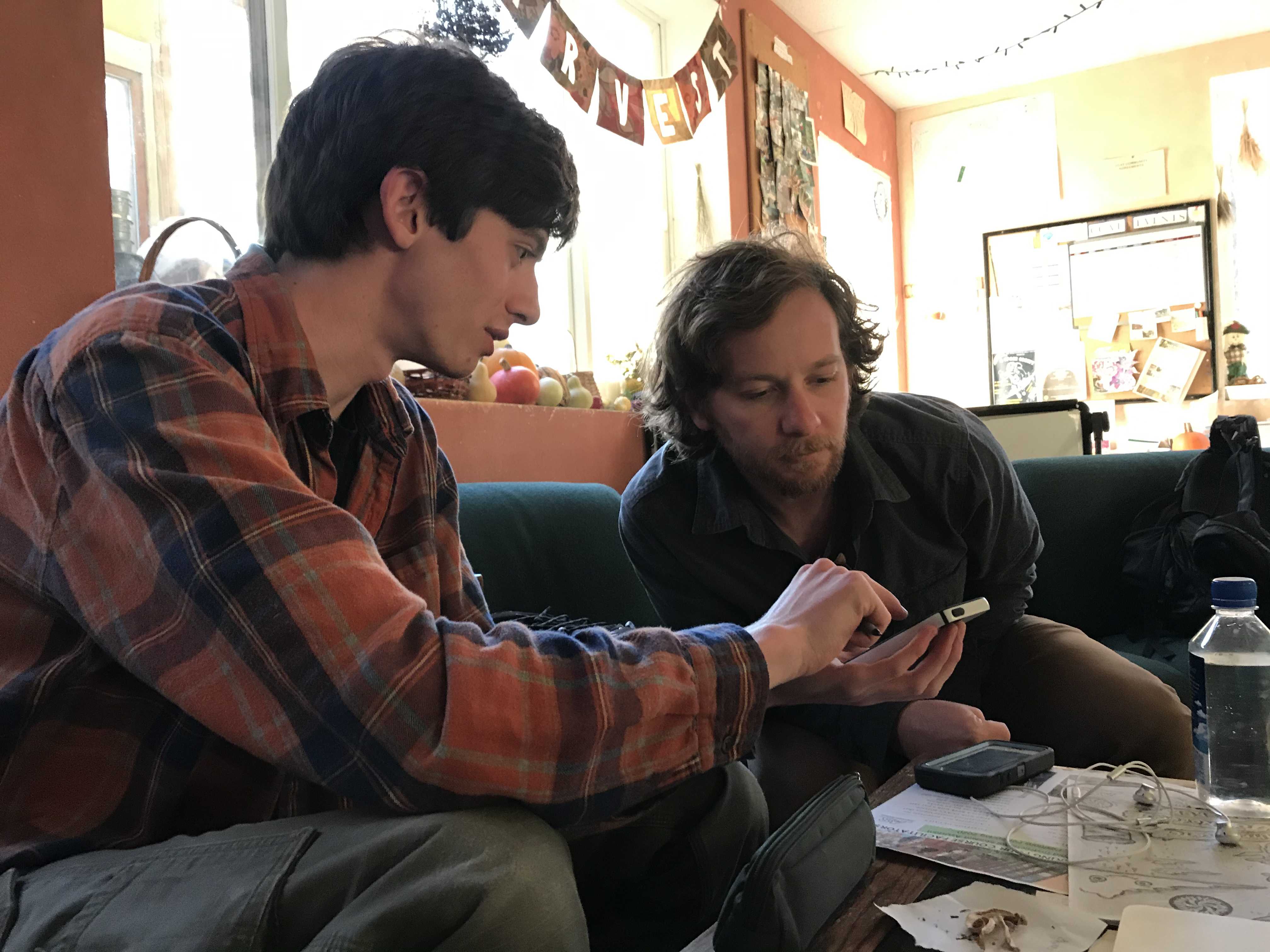
    Mycology Club members Lucas Burton and Caleb Von Rossum spent a cold Monday afternoon documenting their mushroom samples in the bottom of the Campus Center for Appropriate Technologies. Burton and Von Rossum recorded their amateur identifications of the mushroom and the date and location where it was found on a little slip of paper that would travel with their specimen.

    “We are using iNaturalist,” Burton said. “We upload a photo and GPS location, and people from all over the world can come together and help us positively ID it.”

    iNaturalist is a popular tool for biologists and botanists who want to take advantage of citizen science for data collection. Von Rossum mentioned a lot of people in the club record their mushroom finds on iNaturalist, but Burton and Von Rossum were taking it to the next level by mailing in their samples.

    “The sheer quantity of data getting piled in will give [scientists] a better idea of where species grow in the world,” Burton said. “Sometimes people find species in a place where they were thought to be gone thousands of years ago.”

    Mycology Club President Austen Thibault worked with the Humboldt Bay Mycological Society to get the Mycology Club participating in the Mycoblitz, the official iNaturalist mushroom-recording event.

    “Contributing to the Mycoblitz, you could easily be one of really just a few thousands of DNA specimens ever taken in the history of the globe. And for the rare specimens, your name will be saved with the specimen forevermore.”

    Austen Thibault

    The Mycoblitz was a national week long mushroom foraging event which challenged citizen scientists to record the location of as many mushrooms as they could. Participants rummaged through undergrowth for mushrooms and submitted pictures of their finds on iNaturalist. Locally, the Mycology Club was encouraged by the Humboldt Bay Mycological Society to participate.

    The Mycological Society offered a thorough training on iNaturalist and mushroom identification to prepare participants for the Mycoblitz challenge. The data and specimens that were gathered will be sent to Purdue University for DNA testing so they can be incorporated into the North American Mycoflora Project.

    “Contributing to the Mycoblitz, you could easily be one of really just a few thousands of DNA specimens ever taken in the history of the globe,” Thibault said. “And for the rare specimens, your name will be saved with the specimen forevermore.”

    The Mycology Club meets every other Wednesday in the Campus Center for Appropriate Technologies at 5:00 p.m.