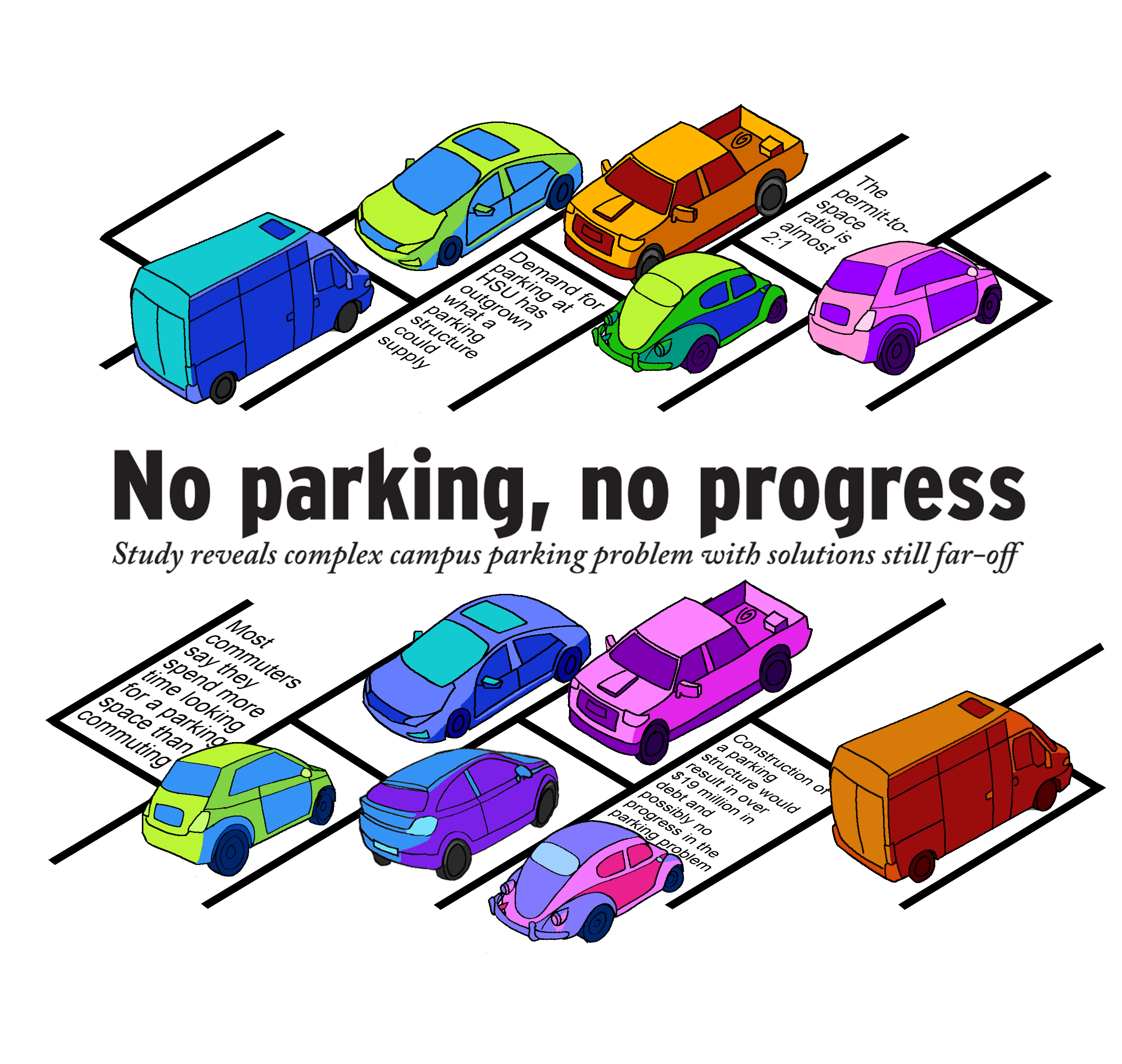
Study reveals complex campus parking problem with solutions still far-off
In 2017, Humboldt State University commissioned a parking market demand study which found exactly what commuters knew—there is a problem with parking on campus.
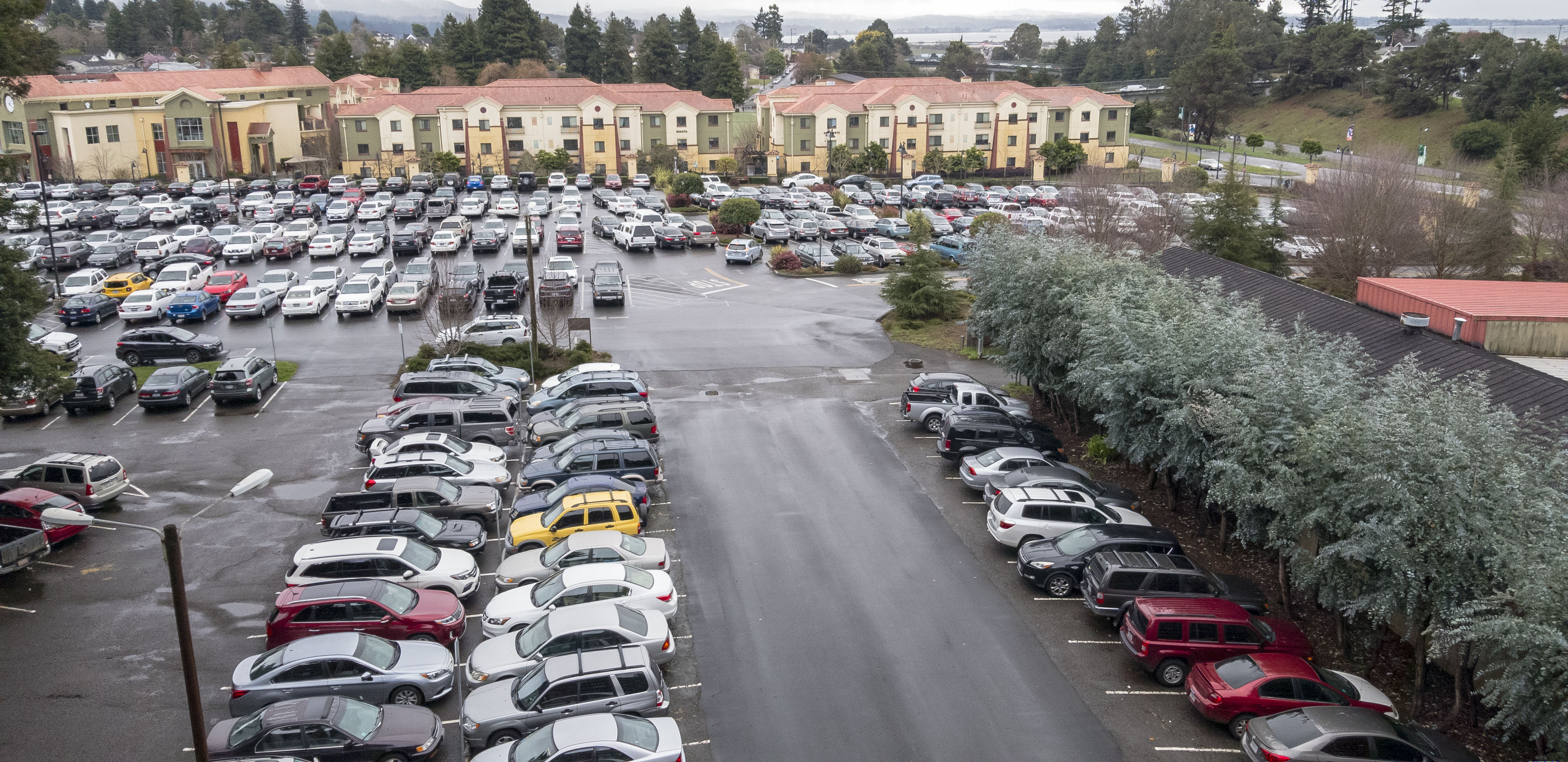
HSU has a total of 2,162 spaces, about 1,000 of which are general parking. These spaces are shared among more than 9,000 students, staff, faculty, visitors and administrators. The study found solving the parking problem might be harder than adding more spaces. Terrain is challenging, space is limited and HSU has a finite budget.
Film student Alice Peterson had a panic attack the first time she had to park on campus.
“It was raining really hard, I was late to class, it was the second or third week, there were no spaces and there was a lot of over-stimulation,” Peterson said. “My fight or flight kind of kicked in and I left.”
Peterson has needed to drive to class more and more ever since. A load of heavy, expensive film equipment makes walking every day impossible. During her time at HSU, she has racked up almost $500 in parking violations because she is forced to park illegally or in spaces meant for visitors.
David Lieb is the national director of higher education mobility planning at Walker Consultants, the parking consultant firm that HSU contracted to conduct the market demand study. Lieb worked on the study personally and said that although universities are a group of people sharing a common parking problem, HSU faces some unique issues.
“You have a challenging topography,” Lieb said. “Everybody wants to park in a space that’s convenient to where they go, but there’s a limit to the number of spaces.”
There is barely any room on or near campus to add a significant amount of spaces, which is why many students are advocating for a parking structure. But Lieb did not recommend a structure.
“The shortage at this point is such that we don’t believe it would solve the problem,” Lieb said. “The survey suggested that there was more demand out there, but people were saying, ‘Why would I buy a permit if I’m not going to get a space?’ So if you increased the number of spaces, the people who are currently saying, ‘I’m not going to buy one,’ are going to buy one.”
This process means the parking situation would remain the same if a structure was built, but the parking prices would have to increase to pay for the construction.
“By what we calculated, parking prices would at least double or possibly triple,” Lieb said. “Our company provides design services for parking structures. We would be delighted to design a parking structure for you, but we’re not going to recommend it if we don’t think it’s the right solution.”
Alternative transportation and ride share programs are already available through HSU.
Jeanne Rynne, the associate vice president of Facilities Management, and Krista Paddock, HSU’s Parking and Commuter Services program coordinator, are working together to alleviate parking demand. All plans are in preliminary stages of development, but the long-term goal is to limit the number of cars that are brought to campus instead of adding more parking spaces.
“We are looking at potential park-and-ride lots in the area,” Paddock said.
There are parking lots in Eureka and McKinleyville that stand nearly empty during HSU’s busiest times. Those lots could be used as off-campus parking. HSU could then provide buses to and from the designated lots to limit the number of cars coming to campus daily.
“We’re always trying to promote ride share with the Zip Cars and the Zagster bikes and the Jack Pass program,” Rynne said.
Alternative transportation and ride share programs are already available through HSU. Both Paddock and Rynne said there are no concrete solutions on the table yet. For the time being, they plan on heavily marketing the programs that already exist.
“We’re always open to feedback,” Rynne said. “We have the Parking and Transportation Committee and there’s two student vacancies.”
Rynne, Paddock and Lieb all agree that parking is an incredibly emotional issue. Finding a space can take a long time. The study noted many commuters take longer to find a space than to travel to and from HSU, and HSU’s lots fill to 100% capacity during peak hours.
Parking is stressful in a special way. No one studying or working at HSU needs additional stress, but money and topography appear to be blocking all the solutions.