Late night structure fire stays contained to one building with help from Humboldt Bay Fire
On Wednesday night, Humboldt Bay Fire responded to a structure fire on the corner of 8th & H streets in Eureka.
The structure in question appeared to be an abandoned Victorian house, with the damage contained to just the single building. Following calls, officials were on scene quickly, but were unsure how long the house had been burning before they arrived.
Humboldt Bay Firefighters shoot water over the back of a burning house as they respond to structure fire in Eureka on Oct. 30. | Photo by Thomas Lal
Public Information Officer for HBF Amy Conlin was on scene and confirmed that there was no humans, animals or pets found in the building when they arrived and that the fire had been burning for some time before they got the call.
“By the time the first truck 8181 was to the scene, there was black smoke pushing through the roof,” Conlin said. “So it had been going for a little bit.”
Conlin also noted that while the cause of the fire would likely remain unknown until HBF concluded their investigation into the matter, the blaze could have been the result of people staying in the vacant property in an attempt to stay out of the colder nights.
The burned out roof of a house in Eureka can be seen as Humboldt Bay Fire responds to a structure fire on Oct. 30. The surrounding houses were not damaged by the fire. | Photo by Thomas Lal
“It looks like it was a vacant building,” Conlin said. “So it could have been some kind of spontaneous accident with the building itself or it could have been that there were squatters inside.”
The fire was largely under control at the time of Conlin’s comments with firefighters on the roof cutting holes in order to vent the heated gases out of the structure. Given the late hour, a more thorough investigation into a cause for the fire is expected to be carried out in the morning. However, due to the extent of the damage, any evidence may be inconclusive.
Humboldt Bay Fire responds to a structure fire in Eureka as they work on the roof of a house in order to better attack the remaining flames on Oct. 30. | Photo by Thomas Lal
Humboldt Bay Firefighters assess the situation on the roof as they respond to a structure fire in Eureka on Oct. 30. | Photo by Thomas Lal
Humboldt Bay Firefighters are silhouetted against the smoke from a burning building as they get into position to open up a hole in the attic in order to better attack the flames trapped inside of a house in Eureka on Oct. 30. | Photo by Thomas Lal
A firefigher from HBF tests the structural integrity of a covered porch while water comes over the top of a burning house in Eureka while fire crews respond to the flames on Oct. 30. | Photo by Thomas Lal
A firefighter from HBF takes a moment to recover behind a fire truck as firefighters finish putting out a structure fire in Eureka on Oct. 30.
Humboldt Bay Coast Guard prepare for the worst at Big Lagoon
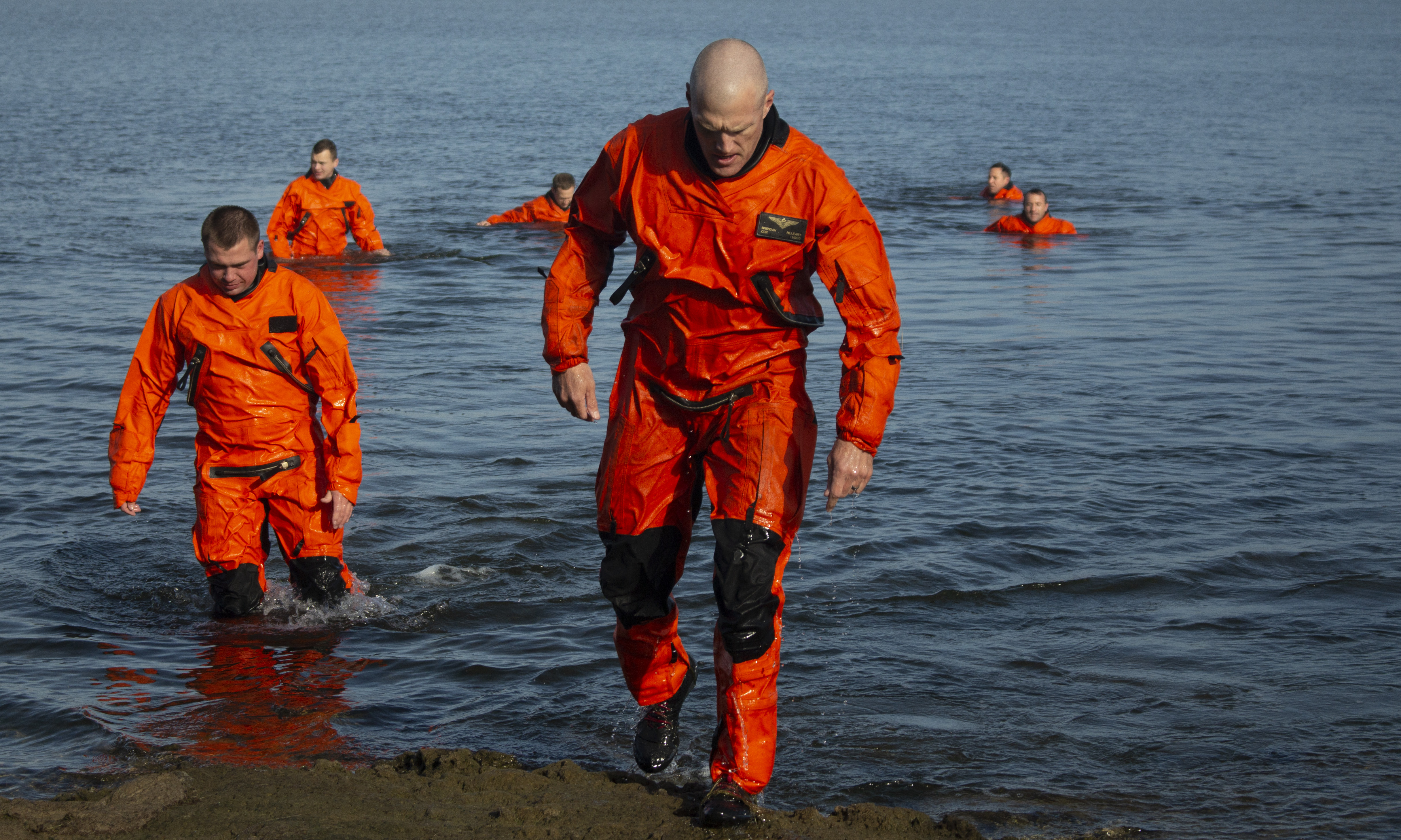
Despite a barbecue filled with pulled pork and dogs begging for attention, a meeting was held at Big Lagoon Campgrounds in Trinidad with an ominous purpose. Though the setting was light-hearted, the crew donned orange and black suits, preparing for the worst case scenario.
“The swimmer is basically dragging you through what seems like a monsoon or a mini-hurricane from the rotor wash coming off the helicopter,” said aviation mechanic Matt Lareau, age 28 from Springfield, Massachusetts, still wet after being hoisted up to the helicopter for the first time.
More than 40 members of the Coast Guard aviation unit went to Big Lagoon on Oct. 11 to practice their annual “wet drills.” The drills involve four training scenarios built around surviving a helicopter crash. The training covered raft and swimming drills, pyrotechnic training with flairs, land survival and vest itemization drills.
Chief rescue swimmer Chris Razoyk, age 40 from Haverhill, Massachusetts, said this training was a chance for the crew to come together and become well acquainted with procedures before they are in a stressful situation.
“Today is a good opportunity for the flight mechanics, pilots, whatever, to get a feel for what it’s like to be under the helicopter,” Razoyk said. “And to feel what it’s like for us, for them, to be in a real situation.”
Matthew Lindblad sets off a smoke flare at one station of the annual Coast Guard aviation training Oct. 11 at Big Lagoon Campground in Trinidad. | Photo by Deven Chavannes
The crew wore neon orange flight suits resembling space suits and waded out into the lagoon to learn how to stay afloat and wrangle each other into a raft of bad scenarios. They also wore bulky black vests to carry survival essentials that weigh 30 pounds on their own.
Avionics electrical technician John Kummerer, age 28 from Columbus, Ohio, experienced his first round of wet drills.
“It’s good to know what you have to do, in case god forbid you do go down,” Kummerer said.
The land survival lecture covered the use of sticks and clothing to create makeshift splints in the event of a land crash involving injuries. Interesting tidbits, such as peeing onto cloth to make it stronger, as made famous in the movie Shanghai Noon, were dispensed to educate the trainees and to also keep the mood light, in opposition to heavy training.
Kummerer found the lecture to be not only helpful in the event of catastrophe at work, but in day to day life here in Humboldt.
“You’re hiking and you don’t have any of that gear on you and you realize that you can use sticks, rocks, whatever for tourniquets,” Kummerer said.
Kummerer may have more use for this practical training now that he’s found a new passion here in Humboldt: disc golf.
“I had never even heard of it until I moved here,” Kummerer said. “And now I love playing disc golf.”
About a dozen pilots and technicians in the lagoon waited for their turn to be lifted up into a hovering helicopter and dropped back down again; a drill that simulated what rescue swimmers and victims experience during a real rescue operation. For some trainees, it was for their first time.
A helicopter hoists up the Humboldt Bay Coast Guard at the annual Coast Guard aviation training Oct. 11 at Big Lagoon Campground in Trinidad. | Photo by Deven Chavannes
Lareau had his first experience being lifted out of the water during these drills. Lareau said he wasn’t scared of the experience at all.
“The guy that was hoisting us up, I work with him every day,” Lareau said. “So I have really no doubt in my mind that everyone up there has our best interest in mind.”
The crew in the Coast Guard have dangerous jobs, but they are a tight-knit group, which makes the job, and living in a secluded place like Humboldt County, a little easier.
“Everybody makes sure that you don’t feel alone,” Lareau said. “We’re pretty close.”
After the drills finished, the grill churned out burgers and pork sandwiches by high-ranking Coast Guard officers. The crew seemed relaxed and at home despite the high-pressure trainings they had just experienced.
“It’s exhilarating,” Lareau said. “That’s why we took jobs like this in the Coast Guard.”
Community members gather to watch the mesmerizing flights of shorebirds dancing on the wind at the Godwit Days Spring Migration Bird Festival.
The natural habitat of the North Coast includes the Pacific Flyway. The Pacific Flyway spans the Pacific Coast from South America to the Arctic, making Humboldt Bay a stopover for millions of shorebirds on their migration.
Mark Colwell is a Humboldt State ornithology professor. While watching the spring migration at the Arcata Marsh on Sunday, Colwell describes the multitude of bird populations.
“Western sandpipers are one of the most spectacular aspects of bird migration in the Pacific Flyway,” Colwell said. “There are over 100,000 western sandpipers going north every day. They will spend three to four days in Humboldt Bay and then fly on.”
The Godwit Days Spring Migration Bird Festival is a week-long event. Godwit Days has many ways to explore bird species, field trips, lectures, workshops and boat trips, led by expert local guides. The tours include rivers, bay mudflats, redwood forests and the rocky coast.
The Arcata Marsh is a great place to bird watch. The marsh is close to HSU and just a few minutes walk from downtown Arcata. There are hundreds of species of birds that visit and live in the marsh that can be seen from the trails that meander through it.
Samantha Bacon teaches Birding 101 for Godwit Days.
“The marsh is one of the premiere birding places in California,” Bacon said.
Bacon spends an hour in class with her group going over the descriptions, habitats and behavior of birds. Bacon pulls apart the bird families, characteristics and names so the group of beginning birders can learn them better.
Bacon also gave information on bird feeding.
“Hummingbird liquid is four parts water and one part sugar,” Bacon said. “Make sure to keep the hummingbird and other bird feeders clean. Birds can get conjunctivitis from bird feeders and go blind.”
Birding 101 then spends a few hours viewing and identifying birds in the Arcata Marsh. Part of the excitement of birding is identifying or confirming rare sightings of bird species that are not frequently found in this region.
A green heron local to the San Francisco Bay has taken up residence in a tree at the Arcata Marsh.
“The green herons have been coming to the Arcata Marsh for the last three to four years. There is between one to four green herons a year at the Arcata Marsh,” Bacon said.
Citizen science helps identify and maintain reviewed listings of bird sightings on eBird, an online collection of sightings, maps and bird migration routes.
After confirming quite a few bird sightings, the group ends at the Arcata Marsh parking lot. There are numerous tripods mounted with telescopes along the path by the parking lot where people are viewing the tens of thousands of shore birds lifting off, flying back and forth and landing back down on the bay.
“This is called shuffling the deck,” Bacon said. “A peregrine falcon will fly down upon a flock of shorebirds and try to pick one off.”
Rob Fowler is a HSU alumnus and local editor for the quarterly ornithological journal North American Birds, and the eBird reviewer for the area.
While at the marsh parking lot viewing the shorebirds, Fowler refers to the scope of what is visible in the distance.
“This is a sight you don’t see often in nature — 200,000 shorebirds at once,” Fowler said.
The Godwit Days keynote speaker Sharon Stiteler is from Minnesota. Stiteler has seen 1 million snow geese at once while in Hardy, Nebraska.
“Shorebird-wise, this is exceptional,” Stiteler said.
The Arcata Community Center was “birding headquarters” for Godwit Days on Friday, Saturday and Sunday. At the community center, there were vendors, non-profit groups and government agencies. In addition, there were exhibits, workshops and live birds of prey on display.
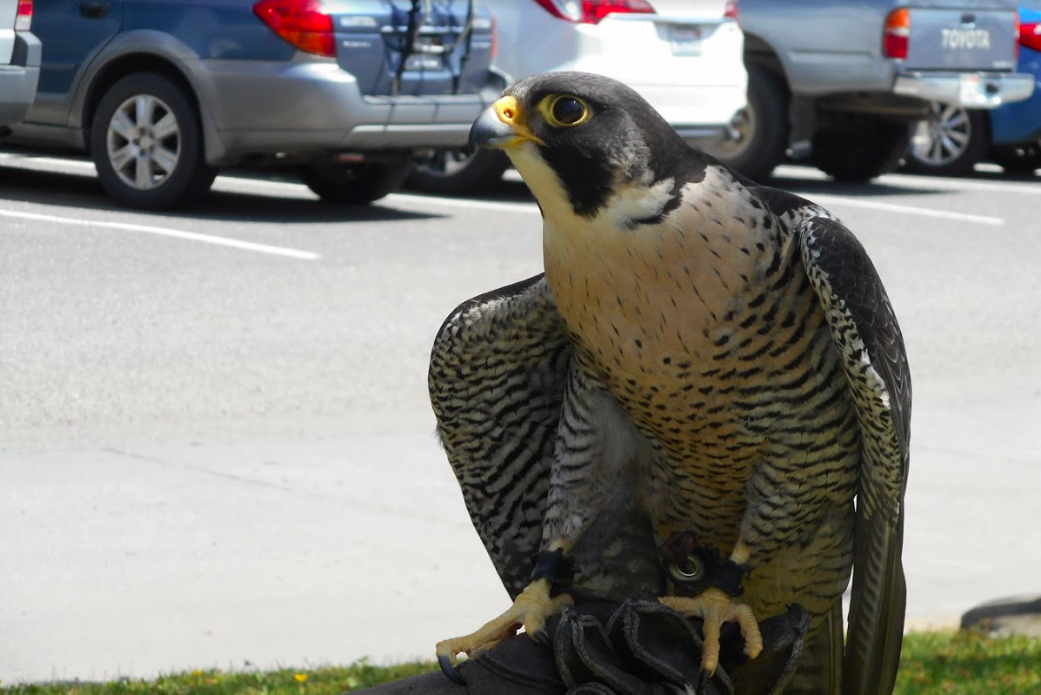
Carson is a 16-year-old peregrine falcon. Carson was out in front of the community center with his handler, Amanda Harwood, a senior at Arcata High School. Carson is the fastest animal on Earth, reaching speeds up to 273 mph.
“Carson is named after Rachel Carson the conservationist,” Harwood said. “He was found in the Arcata marsh with a broken femur and taken into the Humboldt Wildlife Center.”
People were fascinated by Carson. Spike Ciotti attends Fuente Nueva Charter School in Arcata and thought Carson looked fast.
“I think Carson can build a nest in about a minute,” Spike said.
You can see the shorebird spring migration on Humboldt Bay from the Arcata Marsh until mid-May.
On a warm Friday afternoon, student volunteers help trim eight different varieties of basil leaves for a study headed by undergraduate Fisheries Biology major Bryan Lester.
Lester is studying which strain of basil grows the fastest using this aquaponics facility, he completed his second trial on Friday. The stains grown in the study are dark opal, holy, Italian large leaf, lemon, lime, spicy globe, sweet Genovese, and Thai.
Fisheries Biology student volunteers trimming basil leave to be weighed Photo credit: Charlotte Rutigliano
A study he might not have been able to do without the help of Coast Seafoods, Hog Island Oyster Co., and Taylor Shellfish. According to assistant professor of Fisheries Biology Rafael Cuevas Uribe, past donations from Ameritas faculty ran out this past summer.
“The donation we received from these local businesses will help run the facility for about a year,” Cuevas Uribe said.
Since HSU starting leasing this facility, which belongs to the Humboldt Bay Harbor District, around two years ago Cuevas Uribe and the student volunteers have grown pak choi, lettuce, cilantro, chard, spinach, arugula, kale, and cabbage.
Cuevas Uribe started this program to help teach students about what aquaculture is and how to maintain and grow in a system like this.
“Aquaponics is an educational tool,” Cuevas Uribe said, “students often run their own research projects, like what Bryan is doing.”
According to Cuevas Uribe, aside from evaluating growth rates of plants, one of the other student-run research projects was evaluating the growth rates of the fish by changing their diets. A diet that normally consists of pellets made from fish meal, fish oils and other types of oils.
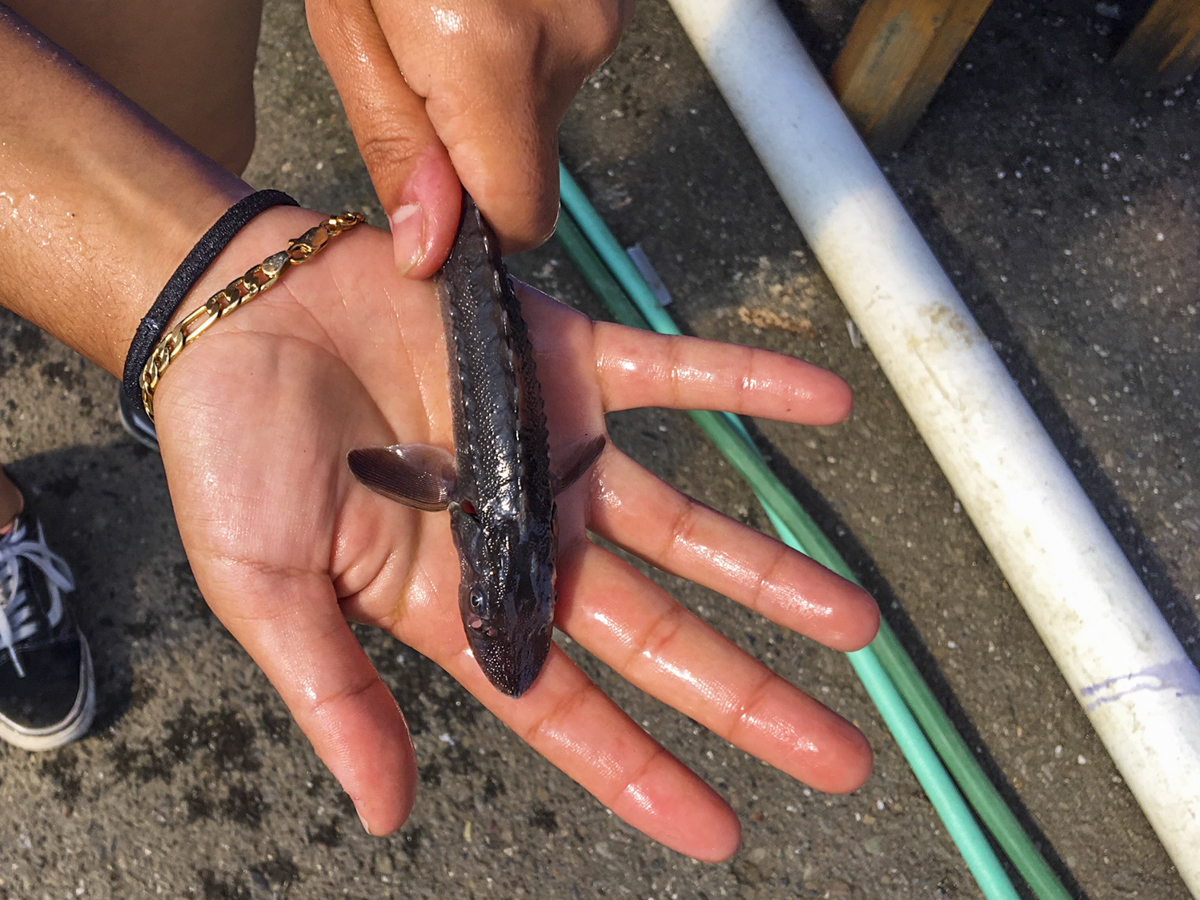
“This study evaluated the growth and feeding habits of the white sturgeon,” Cuevas Uribe said, “the students gave them a fish-free organic diet, and the results from that study were presented at a national conference.”
According to Cuevas Uribe, they get the white sturgeon from a fish farm in Galt, Ca.
“We have about 80 sturgeons that are 2-years old,” Cuevas Uribe said, “and another 400 sturgeons that are a few months old.”
Cuevas Uribe said that the fish are separated by their biometrics or their size, and student volunteers like senior Fisheries Biology major Alexis Harrison come down to the facility once a day to check on the water quality of the fish.
“We come down to check the oxygen levels, the temperature, the pH levels, ammonia levels, nitrite levels and nitrate levels,” Harrison said.
According to Cuevas Uribe, the fish help circulate the water for the plants. The water from the tanks the fish are held in is filtered by a polygeyser bead filter that holds bacterias that have nutrients the plants prefer.
“It’s a very symbiotic relationship,” Cuevas Uribe said, “even the waste drained from the filter, is strained and reused as soil for the plants.”
Cuevas Uribe said that everything that is grown at the facility is either taken home by the student volunteers or donated to the open community garden or the Food for People food bank in Eureka.
Lacy Ogan communications manager with Pacific Seafood, a company who has hired several HSU students as interns to work with the company because of this facility. Ogan said that companies are dedicated to the success of this program.
“They are in the process of helping to find a long-term funding source,” Ogan said, “so their resources can be focused on increasing internship programs.”
The Migratory Birds of the Americas Conservation Act was enacted by the Senate and House of Representatives on July 12, 2017. U.S. Senators Ben Cardin and Rob Portman introduced the bill as a reauthorization to The Neotropical Migratory Bird Conservation Act. The bill is intended to promote long-term conservation of Neotropical migratory birds and their habitats through a grants program, and so far, it is the only federal U.S grant program available throughout the Americas dedicated to the conservation of migratory birds.
This slideshow requires JavaScript.
Projects part of MBACA benefit most of the 386 bird species that breed in the continental United States or Canada and spend the winter in Mexico, Central America, the Caribbean, or South America. In addition, MBACA works to protect over 4.2 mill. acres of bird habitat, spanning across thirty six countries, according to The U.S. Fish and Wildlife Service.
The North Coast of California happens to be one of richest areas in the country in terms of avian diversity, between some 300 and 350 species of birds can be found from just offshore, all the way to the first inland ridge-line. Humboldt Bay in particular is a vital stop for birds migrating along the Pacific Flyway which is a route used by millions of birds for migration to wintering and breeding grounds. The Bay’s coastal mudflats support some of the highest densities of shorebirds in California, housing 60% of all migrating Black Brant, 23% of all migrating and overwintering Western Sandpiper, 44% of all migrating and overwintering Dublin, and 3.5% of all Long Billed Curlews, just to name a few, but there are several other species of birds protected under the act that migrate to and through Humboldt County.
Great Blue Heron with Mallard Ducks at Klopp Lake. Photo credit: Ian Thompson
The Humboldt Bay Wildlife Refuge, located within the Pacific Flyway, serves as a key migratory stopover and/or wintering area for several species of waterfowl and shorebirds. “The purpose of establishing the refuge was to provide habitat for those birds for their Wintering stopover.” said Kurt Roblek of the Humboldt Bay Wildlife Refuge. “Let’s say for example… Aleutian Cackling Goose, we provide Wintering grounds for that species…whose numbers were very low before the bird was listed.”
While he was not aware of Migratory Birds of the Americas Conservation Act itself, he says that-
“We do have projects that will have direct benefits to those species. Such as our White Slough Restoration Project, where we are creating salt marsh habitat along the edges of Humboldt Bay.”
How exactly are you creating these habitats?
“We are actually taking fill material and we are increasing the elevation behind the levees, so when the levees breach, that land will be high enough that it will be salt marsh.”
So what happens when it breaches?
“So once it’s breached… In a few years, through passive and active restoration of that habitat, we will create something that used to exist, but didnt… we’ll bring it back.” Says Robleck. “Pre-human, or pre-white man- In the past, there was salt marsh”
Looking out towards Arcata Bay at sunset from the marsh. Photo credit: Ian Thompson
*
George Ziminsky of the Arcata Marsh Interpretive Center, board member for the Friends of the Arcata Marsh, and graduate of HSU felt similarly about the necessity of our coastal habitats, stating that “Most migrating birds need mudflats for the invertebrates they eat.” Yet, a lot of the other habitats along the Pacific Flyway migratory birds rely on have been compromised, such as “Down in San Francisco Bay, places have been dyked and filled in so what was normally habitat for food for them, just had soil brought in and dumped on top of it.” He stated that over at the Arcata Marsh they are doing what they can to “create a more diverse habitat” and “restore what was taken away.” He also expressed that the city actually has been very involved in their efforts to restore the salt marshes.
“A Lot of the areas west of I Street was being used for agricultural land, 15 to 20 years ago, and the City of Arcata has removed part of the levee and took out the tide gate.”
As of now, The Arcata Marsh, includes around 307 acres of mixed habitat and serves as a solid foraging place for birds on their winter stopover. “The shorebird numbers are in the hundred of thousands in the winter” says Ziminsky
*
Jim Clark The Redwood Region Audubon Conservation Director and 4 time president, who graduated from HSU some 40 years ago, states that The MBACA is “the key conservation act that dictates everything from development to hunting,”
Yet when it comes to avian conservation, “A Lot of it is advocacy,” says Clark. “So we look at the act as backups to those principles. We largely are reactionary, we try to be proactive.” He feels that public awareness, “Going beyond just birdwatching, but understanding a need to protect migratory birds.” plays a vital role in habitat and species conservation. His hope is that one day people will see “that little yellowish’ bird with the black top, Wilson’s Warbler, actually migrates 1000’s of miles. I think that would be an outstanding thing if all the people saw it, better understood what it has to go through to have a life.”
“About 5 years ago we had seeds of varied thrush, and you wonder why this happens” says Clark
“If you don’t protect the birds, there won’t be any birders, because there won’t be any birds to watch, to put it bluntly.”
How can the public get involved in bird conservation?
“Be aware of what they can do on an individual basis for birds”
He recommends “putting reflective strips on windows so you don’t get bird strikes.” In addition, he advises that we also not leave garbage out on the street because it’s attracting crows and ravens, which have now become quite a nuisance. He says that “40 years ago when I was going to HSU I had to get in a car and go over the first ridge inland to see one or two ravens. And now their thick because they’ve learned that where humans live, there’s stuff to eat.”
In regards to what he has done to keep birds coming to his home, he says “in our yard we have planted red alders, it’s a native tree, and they get infected with little leaf hoppers which the warblers love to eat, sparrows love them too, they need them during nesting season.” In addition he states that he’s “planted native grass instead of the typical lawn.”
We can also do our part by “Carrying out invasive, non native plants, encouraging native plants that provide food for birds at the right time of the year.” On the same note, “rat ladders” as he calls them, in reference to Ivy in particular, he states, “let’s rats go up into the trees and eat birds eggs” says Clark “The rats love Ivy, they love Pampas grass, and they love Himalayan Blackberries. All 3 of those plants are non native invasive plants.” Yet the birds aren’t the only ones affected by the fuzzy creatures according to Clark, “When you consider rats it’s also a public health issue.”
What issues do you see having the greatest effect on the community now or in the near future?
“I think we’re going to be looking in the future to sea level rise and how that is going to affect the natural environment and how we’re going to live with that natural environment when we have to change our urban planning to accommodate that sea level rise, and it’s already happening.”
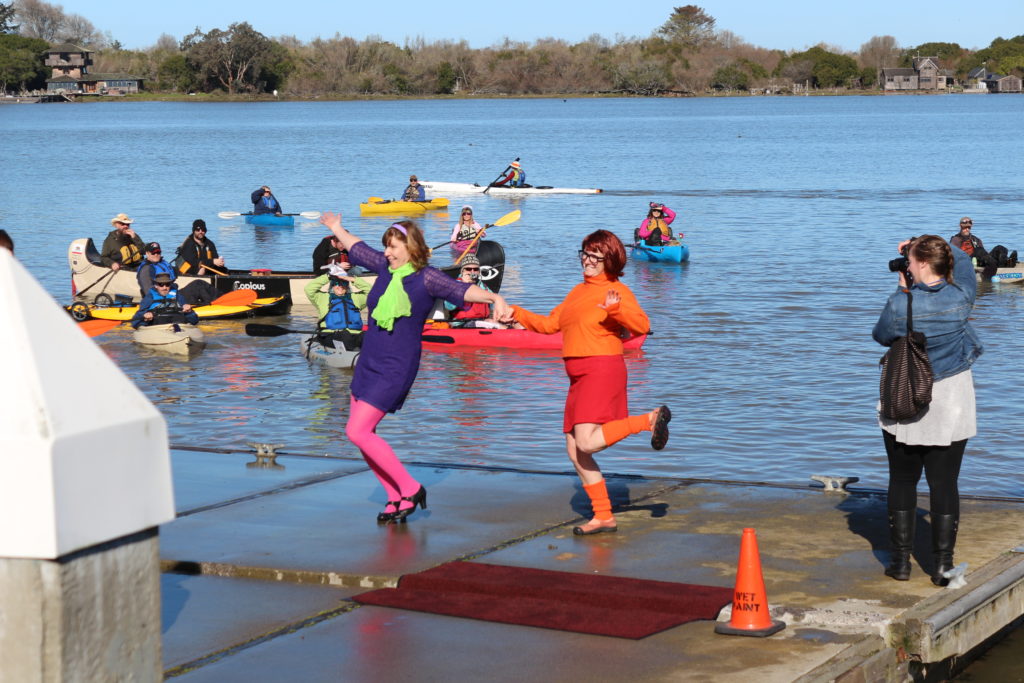
Participants line up to plunge into the icy cold waters of the Humboldt Bay for the children’s Discovery Museum.
The Discovery Museum in Eureka held its 16th annual Perilous Plunge fundraiser Saturday February 11.
The Perilous Plunge is a fundraiser for the Discovery Museum where people dress up in costumes to jump into the Humboldt bay to raise money. The Discovery Museum is a science museum for kids. It is the only children’s museum in the area according to Kala Minkley the executive director of the Discovery Museum.
The Perilous Plunge is the only big fundraiser the museum throws and covers 20 percent of their yearly budget said Minkley. Plungers needed to raise at least $150 to jump into the bay.
Plunger Brenda Urueta was dressed as Prince. This was Urueta’s first time plunging. She was with the Humboldt Area Foundation group that was plunging into the bay dressed as “the fallen stars of 2016”. The Humboldt Area Foundation is a non-profit community foundation that gives grants, scholarships and resource library to non-profit organizations.
“I am doing the plunge because I decided I wanted to do something adventurous and at the same time help advance the mission of the Discovery Museum,” Ureta said.
The Marching Lumberjacks performing at the Perilous Plunge on Saturday Feb. 11 2017 in Eureka, California. Photo by Iridian Casarez
Michele Stephens works for the Department of Health and Human Services and plunged into the bay with a group of her co-workers. The Department of Health and Human Services’ costume theme was beach inspired. This was Stephen’s second time plunging into the bay for the Discovery Museum fundraiser.
“It’s a great fundraiser for the Discovery Museum and the museum is a great part of the community,” Stephens said. “The water was super super cold.”
Jamie Corsetti from Corsetti Accounting Corporation raised over $2,000. This was Corsetti’s 10th year jumping into the Humboldt Bay for the Perilous Plunge fundraiser. “I do it to have fun,” Corsetti said. “I plunge to support the community and the Discovery Museum.
This website uses cookies to improve your experience. We'll assume you're ok with this, but you can opt-out if you wish. Cookie settingsACCEPT
Privacy & Cookies Policy
Privacy Overview
This website uses cookies to improve your experience while you navigate through the website. Out of these cookies, the cookies that are categorized as necessary are stored on your browser as they are essential for the working of basic functionalities of the website. We also use third-party cookies that help us analyze and understand how you use this website. These cookies will be stored in your browser only with your consent. You also have the option to opt-out of these cookies. But opting out of some of these cookies may have an effect on your browsing experience.
Necessary cookies are absolutely essential for the website to function properly. This category only includes cookies that ensures basic functionalities and security features of the website. These cookies do not store any personal information.
Any cookies that may not be particularly necessary for the website to function and is used specifically to collect user personal data via analytics, ads, other embedded contents are termed as non-necessary cookies. It is mandatory to procure user consent prior to running these cookies on your website.