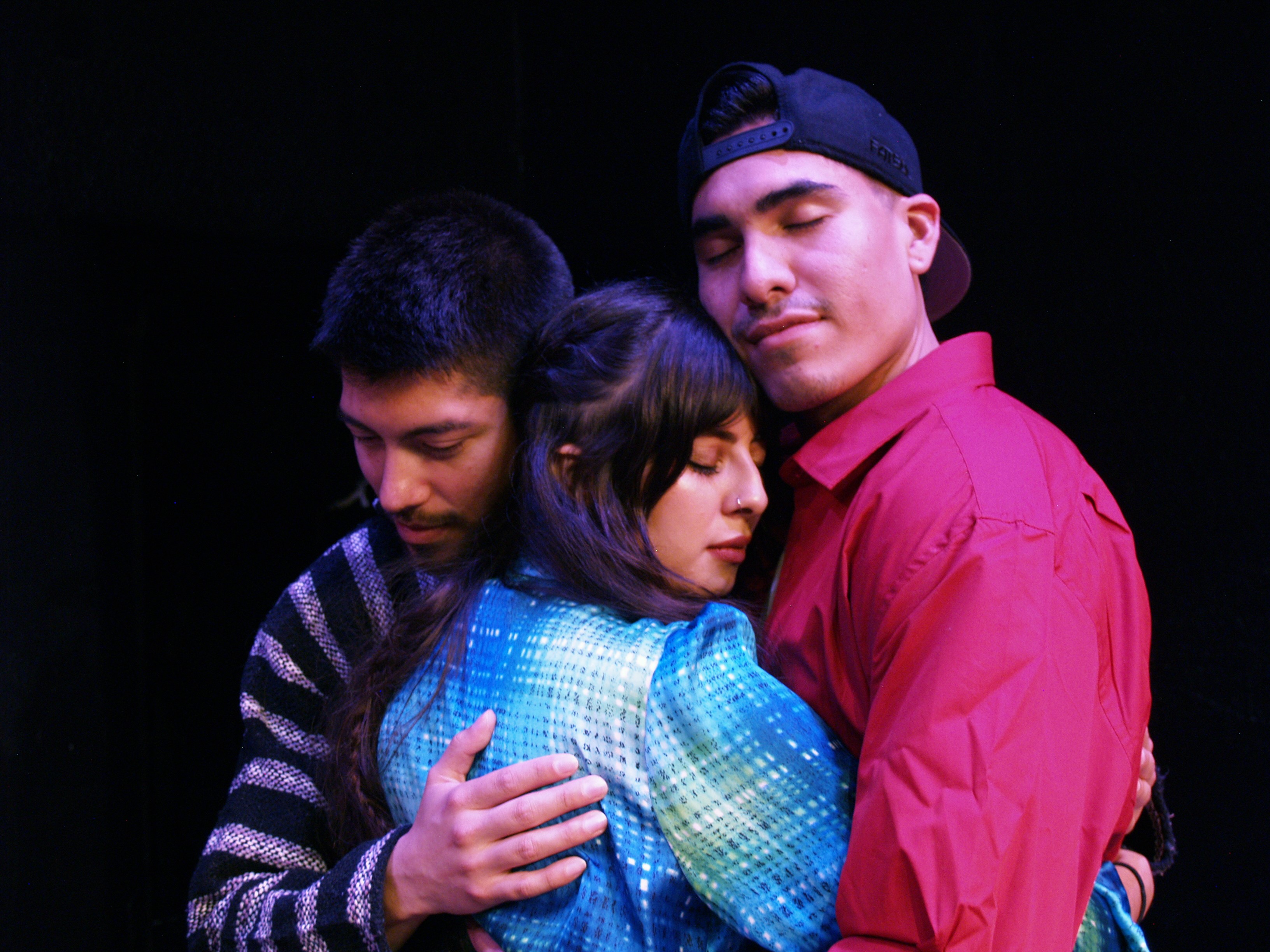
Cast and crew of “Dreamers: Aquí y Allá” shed light on complexities of immigration
The story starts in the blue and red lights that bathe a replica-sized model of a wall. Not just any wall, but The Wall, the most southern one that separates country from country, family from family and the hopes of migrants for better opportunities and life.
In that obscurity, bodies shift and take steps until they’re center stage and in full view. They face you, you face them and under the spotlight, the stories of immigrants and Deferred Action for Childhood Arrival recipients begins.
“Some of these scenes will break your heart because they show so much humanity,” Co-Director Andrea Carrillo said. “Humanity is such a great big theme within this story. You can’t help but connect and feel compassion for these individuals.”
The Humboldt State University Theater Arts, Film and Dance Department presents “Dreamers: Aquí y Allá.” The script was written by Andrea Caban, her students, and a collaboration from source material provided by Armando Vazquez-Ramos and the California-Mexican Studies Center.

Andrew “AJ” Hempstead, who plays Danny, Papa and Ximena’s dad, folds his arms across his chest during a scene of “Dreamers: Aquí y Allá” in Gist Hall Theater at Humboldt State University. | Photo by Jose Herrera 
Actors on stage during the final dress rehearsal of “Dreamers: Aquí y Allá” in Gist Hall Theatre. | Photo by Jose Herrera
Students in the California-Mexico Dreamers Study Abroad Program, DACA recipients and immigrant community members gave testimonials and interviews for the script.
Troy Lescher, co-director and HSU associate professor, came upon the script in spring 2018 when Caban emailed the script to all 18 California State Universities in hopes they would produce the show.
“I was blown away by the humanity of the story,” Lescher said. “As soon as I read it I said to myself, ‘We have to do this show at HSU.’ I mean, because of our social justice mission, commitment to minority voices on stage, how timely this issue is and this play had HSU written all over it.”
The play follows the memories and lived experiences of immigrants and DACA recipients who then obtained advance parole, which gave them opportunity to travel to Mexico and reconnect with their culture and families.
Carrillo said that they go through time jumps and include the audience as they break the fourth wall in various scenes from start to finish.

Alejandro Torres as Francisco, Wendy Carranza as Ximena and Victor Parra as Mateo raise their fists. | Photo courtesy of Michael Thomas
However, circumstances prevented the play from happening until fall 2019. Lescher reached out to theater arts graduate students Carrillo and Amy Beltrán via email. They said that they were overjoyed about directing the play.
“For me the biggest thing was to evoke empathy within the community because a lot of the community, as well as in Humboldt County, can be either on the middle ground or can be very conservative,” Carillo said. “These are human beings with their own experiences, their own love, their own families, and that was a big thing for me to show that to them.”
But just as the directors were compelled to tell this story, so too were the actors.
Business marketing major and theater arts minor Victor Parra, who plays Mateo, said he knew it was important for him to get involved when he heard about the script.
“As an actor and artist this is the kind of stuff that catches my attention,” Parra said. “This is the kind of work that I want to do personally.”
Parra said it’s important to remember that the play is a cumulation of many stories, real stories, and that these are real people who struggle everyday. These were stories close to him because he experienced similar struggles back home.
“We have to keep working to give spaces for minority voices to be heard, especially voices that aren’t heard very often.”
Troy Lescher
Co-director
“I brought a lot of personal past into this and it was my own decision,” Parra said. “Nobody asked it of me, but because I relate to this.”
Parra plays Mateo, who in the play fears being deported and leaving his child and mother behind. He said that is what happened to him when one of his parents was deported not too long ago, and he brought those feelings into the production.
“I envision my own family,” Parra said. “That’s what I just had to bring to the table because it’s so important. We need to say this. We need for our voices to be heard and something needs to happen.”
Lescher knew that he wanted to encourage and open the production to more students, so he reached out to El Centro Académico Cultural Coordinator Fernando Paz, Interim Executive Director of the Office of Diversity, Equity and Inclusion Edelmira Reynoso and Multicultural Center Coordinator Frank Herrera.
The result was that out of 11 cast members, six of them were non-theater majors and four of them performed for the first time.
“This story hits differently,” Carrillo said. “It resonates differently with people. It’s such an immediate connection with a lot of Latinx people and people of color. It made sense that we had so many new faces in the theater.”
Lescher said that the challenges DACA recipients struggle with is a big part of the conversation, because their voices are often unheard or aren’t highlighted in the news.
“We have to keep working to give spaces for minority voices to be heard, especially voices that aren’t heard very often,” Lescher said.