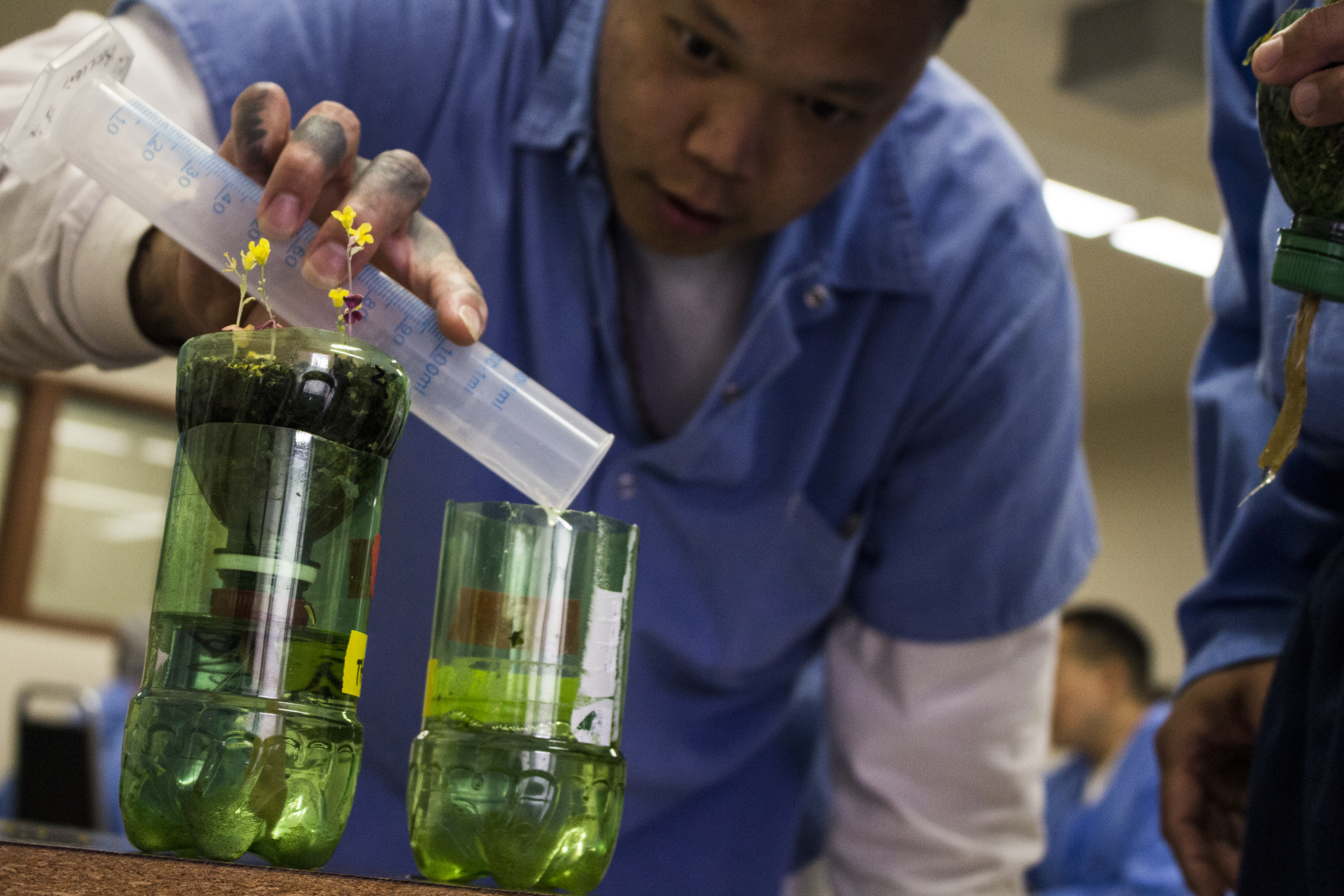
Project Rebound, seeks to help students on campus who have experienced incarceration
Project Rebound was founded by John Erwin, Ph.D in 1967 at San Francisco State University, before it began to branch out to other campuses in the state. Erwin’s goal was to help students who were formerly incarcerated achieve educational success. This year, HSU joins the list of California State University’s to officially integrate the program.
For Program Coordinator Tony Wallin, the work done by the group is personal. Wallin, who recently graduated from HSU, came to the campus after his own run-ins with the law. When he arrived at HSU, Wallin said he didn’t feel entirely like he belonged.
“For a year, it was essentially just me, working by myself,” Wallin said.
After almost giving up his first year here, Wallin would go on to create the Formerly Incarcerated Students Club at HSU with encouragement and help from others.
Kory Lambert, office coordinator for Project Rebound, said he felt the same out of place feeling Wallin felt when he first arrived at HSU.
“When I first came to HSU, I don’t know if it was self imposed, but it took me a whole semester to learn about Oh SNAP!,” Lambert said. “I think people take it for granted, they know these programs are there but they don’t really think about them.”
Lambert is an environmental science major focusing on social justice with a minor in scientific diving. He is looking to study how disasters and natural events disproportionally affect marginalized communities.
Lambert had just turned 18 when he was arrested in 2013. The arrest lead to him being kicked out of his community college and off the football team.
“That set me on a way different path,” Lambert said. “It’s kind of a different experience from people who just never went through that.”
Project Rebound tackled these problems by working on programs that focus on education and prevention. Their motto “From G.E.D. to PhD” reinforces the idea of an inclusive education.
According to the official statement provided by HSU, Project Rebound has a “…95% graduation rate while the CSU system as a whole has a 25% rate who finish within four years and 61% within six.”
For many, getting a degree is the first step in being respected and taken seriously when trying to reintegrate into society.
“A degree is a piece of paper,” said Wallin. “But if you’ve been formerly incarcerated it makes people go ‘okay, I’ll listen to you.’”
Project Rebound has spent the summer writing to current Pelican Bay State Prison occupants who are interested in pursuing their education inside and outside of its walls.
According to Lambert, interest expressed by prisoners surround the possibility of voting and getting involved in politics. Proposition 17 on the California ballot would reinstate the voting rights of many formerly incarcerated individuals if passed.
Due to COVID-19 regulations, the group has not been able to visit the supermax prison in Crescent City in-person, but hope to host workshops on things like tuition and classes in the future.
Currently the group hosts regular Zoom meetings to discuss future events in addition to check-ins, and listening to anyone in need who has past incarceration history.
“It doesn’t matter if you’ve spent a day in jail or 30 days in prison,” Wallin said. “We don’t discriminate.”
A conversation with a College of the Redwoods student at Pelican Bay State Prison
We now have more than 1.5 million people worldwide infected with COVID-19 and over 90,000 deaths. The United States has surpassed every other country in cases with just over 450,000. People are being told to socially distance themselves with six feet of space between others and isolate inside. But what about the millions who are incarcerated that don’t have that option?
Kunlyna Tauch is housed at Pelican Bay State Prison and is a student in the College of the Redwoods Pelican Bay Scholars Program at Pelican Bay State Prison. He is slated to graduate with his associate degree for transfer this summer. Tauch is also a student and contributor in Paul Critz’s audio journalism class, which produces Pelican Bay’s podcast “Pelican Bay: UNLOCKED.” Tauch has been a spokesperson of sorts for the recent programming at Pelican Bay and an advocate of the changes being made inside the supermax prison.
Cases of the coronavirus have risen just over 1,300 throughout 100 federal prisons, thousands of jails and 1,700 state-run facilities nationwide. The Federal Bureau of Prisons says 138 inmates and 59 employees have tested positive and at least seven inmates have died, bringing the total to at least 32 COVID-19-related deaths inside the nation’s prisons and jails.
On March 31, California state prison officials announced they would be releasing 3,500 incarcerated individuals early to help free space in cramped prisons due to a possible coronavirus outbreak. Governor Gavin Newsom announced a halt in the transfer and intake of incarcerated individuals and youths into California’s 35 state prisons.
According to the California Department of Corrections and Rehabilitation website, there are, as of April 9, 12 incarcerated persons at California Prison, Los Angeles County, 19 incarcerated persons at California Institution for Men in Chino, one incarcerated person at North Kern State Prison in Delano and one incarcerated person at Substance Abuse Training Facility in Corcoran who have tested positive for COVID-19. Seventy-one CDCR or California Correctional Health Care Services employees have tested positive for COVID-19 in 21 incarcerated facilities, and hundreds have called in sick for work.
In the past five years there have been more programs in Pelican Bay than ever before and the culture inside is changing. After a lawsuit was awarded to the incarcerated individuals participating in the 2011 and 2013 hunger strikes and their advocates, one of the two solitary housing units was shut down and terms of isolation were limited to five years. This caused the prison to mitigate the effects of solitary confinement with programs like education and therapy. I spoke with Tauch on what it’s like in Pelican Bay State Prison as a college student amid the changes COVID-19 has brought to the infamous prison.
Kunlyna Tauch looking upward in June of 2019. Tauch is slated to earn his associate degree for transfer through College of the Redwoods’ Pelican Bay Scholars program this semester. | Photo by T. William Wallin
Tony Wallin: What’s it like in Pelican Bay State Prison right now and what are your concerns?
Kunlya Tauch: First of all, CDCR stopped all visitation and there are no programs. So we’re doing like old prison time, right. Which is us in prison going to yard and trying to occupy ourselves with whatever we have, which is not that much. My concern is that people on the streets are so socially distant from each other they become callous of each other and become more segregated and more disconnected. But from what I am seeing on TV is a lot of good, which is making me happy. The little acts of kindness and videos of people on the street coming out, I love it. There’s actually a little silver lining out of this.
TW: Yeah. There’s a lot of opportunity for positivity through all of this.
KT: It’s hard to pass on those opportunities because it’s so in-your-face.
TW: What’s it like in there with programs shut down? What are you doing to keep busy?
KT: College of the Redwoods has been the only program that is really working on shifting their whole business model to make it work for us. They are still running classes through correspondence and we’re getting hella work like every Friday. Our teachers are saying, ‘This is what we expect. Your next essay is due this date, send it in the mail,’ but because I have five classes I have enough work to sustain me, plus I have hella books I’ve got to get through. I am pretty occupied but it’s pretty restless in here, you know? People are constantly checking on their family, making sure they are well. They aren’t reading, they aren’t programming, they aren’t going anywhere, so their day consists of the phone and the yard. The yard schedule in itself [has changed], we aren’t seeing the regular people we used to see. They’re making it real limited, they’re not giving the day room. They literally made some new rule where only five cells in the day room at a time, which prohibits ourselves from doing what we want to do. It’s kinda stressful. It feels like we are taking a lot of steps back as far as prison goes.
TW: CDCR said they were going to send out more cleaning supplies to all prisons and make sure every prison has what they need. Are you seeing that?
KT: That’s never been a problem. The cleanliness of the place isn’t a problem. Right now I have a personal friend who had some symptoms, they didn’t even test him and they just took him to quarantine and is on two weeks lockdown with no mail, no phone, no nothing. Just to see if he has it or not.
TW: Where do they have the quarantine right now? What do they have blocked off?
KT: They have one on A yard and one on B yard and it’s one section of one building and they’re basically in the SHU [secure housing unit]. They’re like kicking off drugs by themselves. That’s their treatment and I guess the nurses are going over, but I don’t know. I assume nurses are checking on them professionally. There’s too much of a shortage of testing, but one thing about medical is they are a separate entity than CDCR, so CDCR can’t dictate what they do.
TW: Interesting. They operate differently? The warden doesn’t have a say on the medical side of things?
KT: No, medical community operates the medical community. All records are sealed and confidential. The prison has to accommodate that or else there’s a big lawsuit. I think CDCR concedes medical and there’s an agreement [between them]. According to the American government this is it and [CDCR] is only the California government, same with religion and same thing with tech. For some reason the tech, IT, here is their own entity and they suck. It takes like a month to transfer music onto our laptop [for the podcast]. It’s been stagnant. I’ve been feeling lethargic. I feel like they caged me back up and I’m really back in prison again. Pelican Bay was really doing good with their programs and everything running everyday and now it feels like this modified program where it feels like we’re just on lockdown. I feel like a lot of our minds aren’t being stimulated because a lot of us aren’t in those programs we are forced into or choose to be in.
TW: Right. It feels like pre-2014?
KT: Yes. Real shit. It feels like before and it feels like out of mind will cause more trouble. I am waiting for the ball to drop. I am waiting for something to happen. I’m almost mad that personally we’re on lockdown, but the whole fucking world is on lockdown and I can’t make more moves happen.
TW: Yeah, the irony in all of this is everything is locked down globally. How is your morale and the overall morale in the prison? Are there still positive interactions?
KT: I feel like we’re losing that. I feel like the tank is draining every single day. Guys that were motivated are losing that motivation. I see my college peers going like, ‘I don’t even feel like doing the work.’ But you don’t have that motivation no more because you’re not in front of the teacher anymore, you’re not engaging. You have questions but you can’t get an answer. I have a bleeding heart for my community in here, but it’s hard for me to help them because I have five courses and I have to study. We’re getting hella shit to read and it’s like, ‘I don’t have the time to worry about you guys because I have to get this out of the way first.’ Before all of this coronavirus I was approved to transfer to Lancaster [California State Prison, Los Angeles County]. That’s a level three. That was a big decision I had to make because that means I have to detach myself from this place I grew roots in. The process of this whole coronavirus—I’m back worrying about college and I can’t really be the catalyst to get my guys rallied up to do their work because I have to just worry about my work. So, I’ve been feeling like the morale is ‘Let’s see what happens while we are in this state of limbo,’ which is worse than staying stagnant because we’re losing the momentum, you know? We work on momentum on the programs that are on a level four yard. Without that momentum it’s like, ‘I’ll just watch Jerry Springer all day.”
TW: It’s gotta be rough going from so many programs for the first time at Pelican Bay and then, in an instant, they’re gone. For those of you that are students at College of the Redwoods, can you study together?
KT: Everything in person is shut down but we can do our own personal study groups, but we are divided. So, we only see our own dudes in our own yard and maybe another building and they’re across the fence so we can’t even have a study group out there. Also the COs [correctional officers] are really cracking down on what stuff we can bring out and they’re asking us, ‘Why were you bringing books and stuff out to the yard since programs are shut down?’ So we can’t even have that. So technically no, we can’t have a study group. We can have an impromptu one if there’s a cool CO that says it’s cool, we can sit out there.
When Vanessa Vrtiak started volunteering at the Humboldt County Correctional Facility, she noticed that the inmates didn’t have many resources needed for success after release.
Vrtiak is a graduate sociology student at HSU. Vrtiak coordinated and organized the Criminal Justice Dialogue. The dialogue centered on discussing and identifying challenges and resources related to currently and formerly incarcerated people. (jump)
“I organized the event because there is a need for support services for people impacted by the criminal justice system,” Vrtiak said. “It’s supposed to be a correctional facility meaning we’re going to help you.”
Hector Verdugo speaking to correctional officers and law-enforcement at the Criminal Justice Dialogue. Photo courtesy of Vanessa Vrtiak.
Vrtiak now works at the Humboldt County Correctional Facility as the programs coordinator for reintegration work. She helps incarcerated people get the resources they need to succeed while they are in jail. She helps them find a ride home when they are released, a job, and housing. According to Vrtiak, people who have gone to jail often have trouble finding work and housing when they are released. A study by Urban Institute found that only 45 percent of formerly incarcerated men are employed eight months after they are released from prison.
“When people go to jail they are forgotten about and when they get out they’re still being punished,” Vrtiak said. “These are people who deserve second chances.”
Vrtiak said that incarcerated people are a part of the community. If the community invests in them they improve the community as a whole.
“I’m a firm believer in helping incarcerated people get better,” Vrtiak said.
Vrtiak worked alongside other sociology students and the Sociology, Criminology and Social Justice club to organize the event. Ian Kochinski is a sociology major at HSU and the president of the Sociology, Criminology and Social Justice club at HSU. Kochinski was approached by Vrtiak to help organize the dialogue. Kochinski had been interested in helping with the dialogue since day one.
“Prisoners are locked in a hole and we hardly ever see them so it’s hard to empathize with them and address the inequalities they face,” Kochinski said. “I think they are deserving of a little more attention.”
The dialogue was a week long discussion filled with guest speakers who were impacted by the justice system. Hector Verdugo is part of Homeboy Industries, a gang intervention program centered in Los Angeles. Verdugo came to HSU to speak at one of the discussions. He spoke about what life was like as a gang member in Los Angeles and the trauma he faced.
The housing reentry roundtable talking about housing facilities in Humboldt county. Photo courtesy of Vanessa Vrtiak.
“I saw a lot of things that went on in my house like overdoses and people getting shot,” Verdugo said. “I was scared but I had to act tough.”
Verdugo said he met the founder of Homeboy Industries as a gang member ready to change his life.
“I want to give an understanding that gang members are people that just need to heal,” Verdugo said.
This website uses cookies to improve your experience. We'll assume you're ok with this, but you can opt-out if you wish. Cookie settingsACCEPT
Privacy & Cookies Policy
Privacy Overview
This website uses cookies to improve your experience while you navigate through the website. Out of these cookies, the cookies that are categorized as necessary are stored on your browser as they are essential for the working of basic functionalities of the website. We also use third-party cookies that help us analyze and understand how you use this website. These cookies will be stored in your browser only with your consent. You also have the option to opt-out of these cookies. But opting out of some of these cookies may have an effect on your browsing experience.
Necessary cookies are absolutely essential for the website to function properly. This category only includes cookies that ensures basic functionalities and security features of the website. These cookies do not store any personal information.
Any cookies that may not be particularly necessary for the website to function and is used specifically to collect user personal data via analytics, ads, other embedded contents are termed as non-necessary cookies. It is mandatory to procure user consent prior to running these cookies on your website.