The Lumberjack


Students Serving The Cal Poly Humboldt Campus and Community Since 1929

Tag: indigenous peoples day

  • Film Screening Displays Indigenous Resistance and Heroism

    Film Screening Displays Indigenous Resistance and Heroism

    ‘From Wounded Knee to Standing Rock’ offers insight into 71-day rebellion

    As Indigenous Peoples’ Week came to an end, one of the last events was an airing of the documentary, “From Wounded Knee To Standing Rock: A Reporter’s Journey” at the Eureka Theatre.

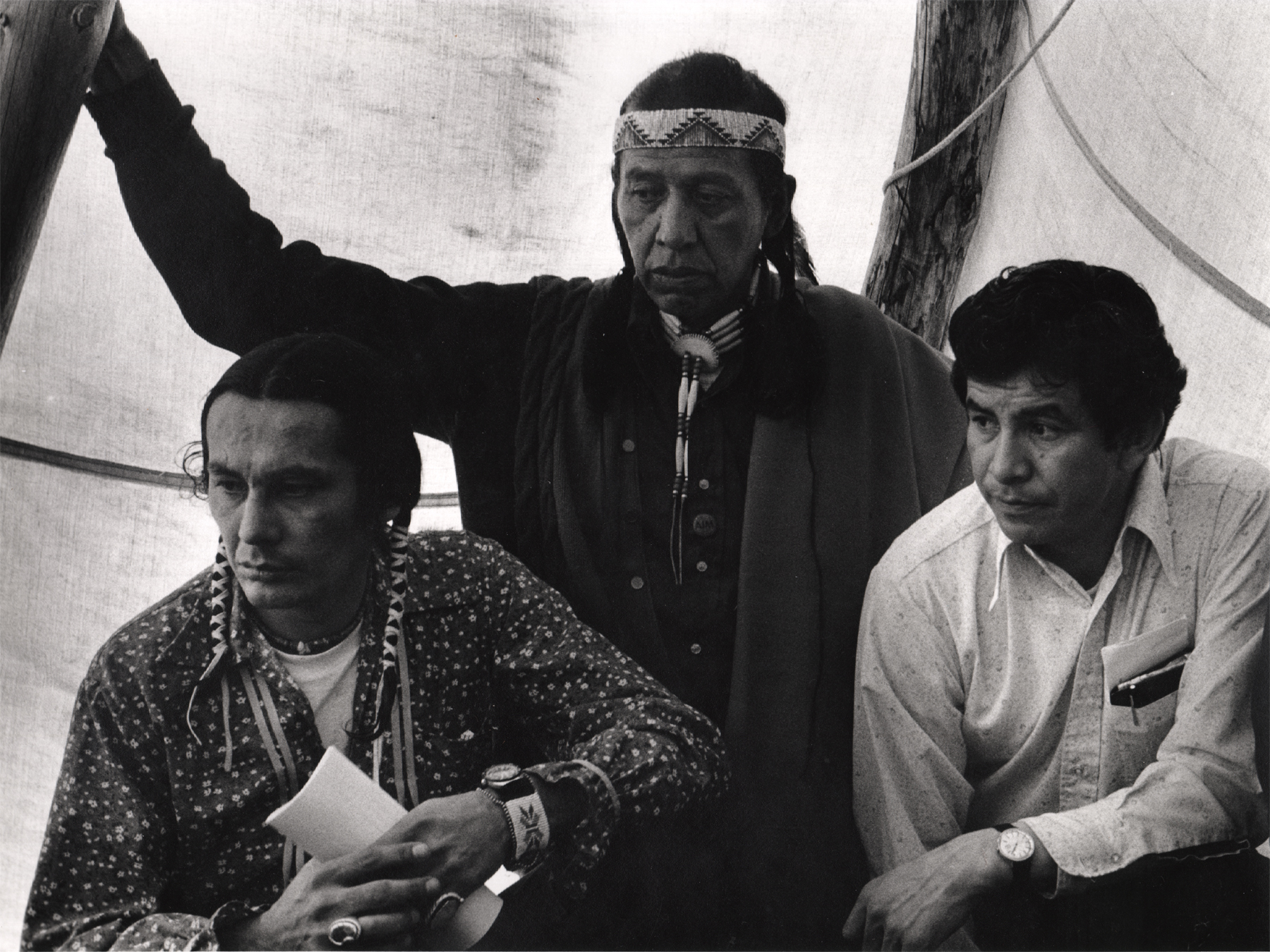
    This story followed rookie reporter Kevin McKiernan and his experiences recording the events of the 71-day seizure and occupation of the town of Wounded Knee, South Dakota on the Pine Ridge Indian Reservation from Feb. 27 to May 8, 1973.

    Richard A. “Dick” Wilson was chairman of the Oglala Lakota Sioux of the Pine Ridge Indian Reservation. Protests started in response to failures of impeachment. Wilson had accusations ranging from giving jobs to friends and family, to suppressing his political opponents with his private militia, the Guardians of the Oglala Nation.

    In addition, there were protests of the United States Government’s failure to uphold treaties with Native Americans. This was concerning since there was a history of abuse and neglect from American police and government. Cases such as State v. Bad Heart Bull served as a catalyst for the occupation.

    As a result of the GOON squads’ weaponized militia, the American Indian Movement was brought in to assist the protesters. Wilson also received help from the American Government in the forms of U.S. Marshals Service and the FBI.

    Photo courtesy Kevin McKiernan

    AIM started as a grassroots movement in Minneapolis, Minnesota, to address police brutality towards Native Americans; and grew to represent all indigenous tribes and help them with the issues they have faced since European colonialism, as well as helping people reconnect with their heritage. Many people lost their history once Americans forced native youth assimilate into Euro-American society.

    Acclimation to the colonizers’ lifestyles included forcibly removing Native people from their families, as well as preventing them from practicing their traditional customs. By accepting the different values as their own, such as Christianity, private property and material wealth, people became disconnected from their roots. AIM was a way for people to reconnect to their ancestors’ ways of life.

    During the time of this occupation, the U.S. Government prevented media personal from entering the reservation or recording any discussions between them and the rebel leaders, such as Dennis Banks and Russell Means. They also implemented roadblocks to prevent aid for the natives.

    McKiernan snuck in with the help of some rebels and slept on the floors of a church. While inside he recorded conversations with multiple members of the rebellion, shootouts with the FBI and USMS, took pictures of the aftermath of the altercations and recorded meetings with U.S. officials. Conflict escalated to the point of the USMS and FBI using helicopters, armored vehicles, snipers and automatic weapons.

    Photo courtesy Kevin McKiernan

    U.S. Marshal Lloyd Grimm was shot in the conflict and suffered paralysis from the waist down and Cherokee activist Frank Clearwater was shot in the head April 17, within 24 hours of his arrival, during a fire fight with federal forces.

    Shootings were just one reason for keeping the media in the dark, by preventing coverage of the measures that the government took against the AIM and Sioux. At one point during the winter, Department of Justice appointee Kent Frizell, to manage the government’s response, cut off water, electricity and food supplies to Wounded Knee in an attempt to starve them out. They also made attempts to stir up distrust in the local factions, which lead to some activists being killed by their own allies, for fear they were government plants.

    The final blow came in late April, when Lawrence “Buddy” Lamont, a local Oglala Lakota, was shot by a government sniper and killed. Soon after, both sides would come to an agreement to disarm. This led to the eventual end of the 71-day standoff between the Wounded Knee activists and AIM, and the United States assisted tribalists, serving as but one example of the Native American’s struggles since European Colonization.

  • Working to Correct History

    Working to Correct History

    Home Away From Home potluck kicks off Indigenous Peoples’ Week

    Arcata is home to the Wiyot Tribe and Humboldt State University sits on Wiyot land. The Home Away From Home Potluck is one example of the community’s attempt to welcome all members to interact and is a fun, inclusive way to start Indigenous Peoples’ Week.

    The second Monday of October has become an opportunity to counter-protest Columbus Day. Along with a celebration of Native Americans, their history on this land and their culture, Indigenous Peoples’ Week highlights the customs of indigenous peoples and acknowledges the years suffering.

    Arcata Mayor Brett Watson spoke on some of the actions the city has taken in order to support local Native Americans. Watson spoke of a proclamation from 2016 where Arcata officially recognized Indigenous Peoples’ Day.

    “The university is our lifeblood and we see the diversity of the student body as a positive. We welcome students of all backgrounds.”

    Wesley Chesbro

    “Just on October 2, we did a resolution affirming our support for a United Nations resolution,” Watson said. “Acknowledging the rights of Indigenous people around the world.”

    The inclusion and acceptance of Native Americans’ history is one way that the community is attempting to reach out to students of all ethnicities. Wesley Chesbro, local volunteer and HSU alumnus, believes the potluck is inviting and feels like home for students.

    “What we hope happens is students will sit down with community members and develop relationships,” Chesbro said. “The university is our lifeblood and we see the diversity of the student body as a positive. We welcome students of all backgrounds.”

    The Home Away from Home potluck is more than it’s food, it’s about a sense of welcome. The goal, according to Equitable Arcata’s Communications Chair Cati Gallardo, is racial equity.

    “The Home Away From Home potluck started as a way to let students know they’re loved by the community,” Gallardo said. “We love our students and some of the feedback we received stated how we need to make a change in Arcata. Folks were feeling it wasn’t a racially equitable community and we wanted to change that.”

    Skits from based off the 1490s were performed by a Native American comedy group. The potluck consists of community members coming together to donate food and local businesses offer gifts for raffle prizes as well as warm winter clothing donated by locals for students who may need them.

    Other events for Indigenous Peoples’ Week include highlights of HSU’s Native American programs. The Native Forum provided guests with a geographical exposure to local tribes on Monday. Professor Rain Archambeau-Marshall is hosting a showing of Dodging Bullets followed by a post-film discussion on Wed., Oct. 16. The Native American Center will also hold an open house Friday, Oct. 18, where they will play Cards for Decolonization. To find out more information go to humboldt.edu or itepp.humboldt.edu.

  • Arkley I call bullshit

    Arkley I call bullshit

    By | Phil Santos

    Only a sick mind believes you can give something that you have stolen. To give something, it must be yours in the first place. When you steal something, the status of your possession is always illegitimate. You can’t give something you’ve stolen because it was never yours, to begin with. This elementary concept is one that many fail to grasp or disregard completely.

    One of those people is Rob Arkley. He has recently pledged to “buy” Tuluwat, the site of the 1860 massacre of Wiyot women, children and men from the city of Eureka. This is in direct conflict with Eureka’s plan to transfer the land back to the Wiyot tribe.

    Regarding the outcry against Arkley’s proposal, Arkley said, “I am stunned by this whole thing. I don’t get it.”

    Tuluwat is stolen land, but it’s in the process of being returned. Why would anyone pay money to stop that process? My answer is as stated above: their mind is sick.

    However, Arkley says that he’s “concerned about what public access to the island will be like if the land transfer goes through.” He also says that “if [my] offer is taken up, [I] will set up a charity, similar to how Friends of the Dunes operates, [which is] to provide stewardship to the land [and that] it will remain open for public use like it is today.”

    I call bullshit. In 2005, Friends of the Dunes tried to purchase land to preserve and Arkley pulled the same move on them!

    An article in the North Coast Journal wrote, “‘they got in second place,’ Arkley said, making no effort to conceal his glee. ‘And it’ll never, ever, ever, ever, ever be sold to them. I’m not going to give it to the government agencies. I believe there’s far too much government land.’ Arkley has no specific plans for the parcel, which also includes a house. But he made it clear the land would be fenced off and not open to the public.”

    Wiyot tribal administrator Michelle Vassel wrote in an email regarding the transfer of Tuluwat, “The Wiyot Tribe is a government which by nature is a public, not a private entity… the tribe has no intention of excluding people. We have worked long and hard with the city of Eureka and other government agencies, local native and non-native, people and organizations in this community to come together to work toward these goals.”

    It seems like Arkley is afraid that the Wiyot would bar anyone from stepping foot on Tuluwat after it is returned to them. Where does that fear come from? It sounds like something that he would do. It’s an irrational fear of being subject to his own practices. By disregarding the statements of Michelle Vassel, Arkley is practicing the historic American tradition of distorting Indigenous practices. The Indigenous nations on this continent are historically stereotyped as “savage,” “uncivilized” and “unsophisticated.” The list goes on. The common element is that it’s all fabricated for the sake of telling a story to justify the genocide and theft which founded the settler society called The United States of America.

    Arkley’s unfounded concerns promote an irrational fear of exclusion. This mobilizes the public to buy into his perspective – to believe the Wiyot will exclude the public from Tuluwat. He invokes classic tropes that are used to justify the theft of Indigenous land such as giving things back to Indigenous communities, or how Indigenous peoples aren’t using Tuluwat. This is representative of a deep divide in the way that American settler society sees history and the modern reality of contemporary life. As polarized as these viewpoints may be, there is hope because there might be one place where Arkley and the Wiyot see eye to eye.

    This is best said by Arkley himself “I don’t get how they can take one of our assets and give it.”