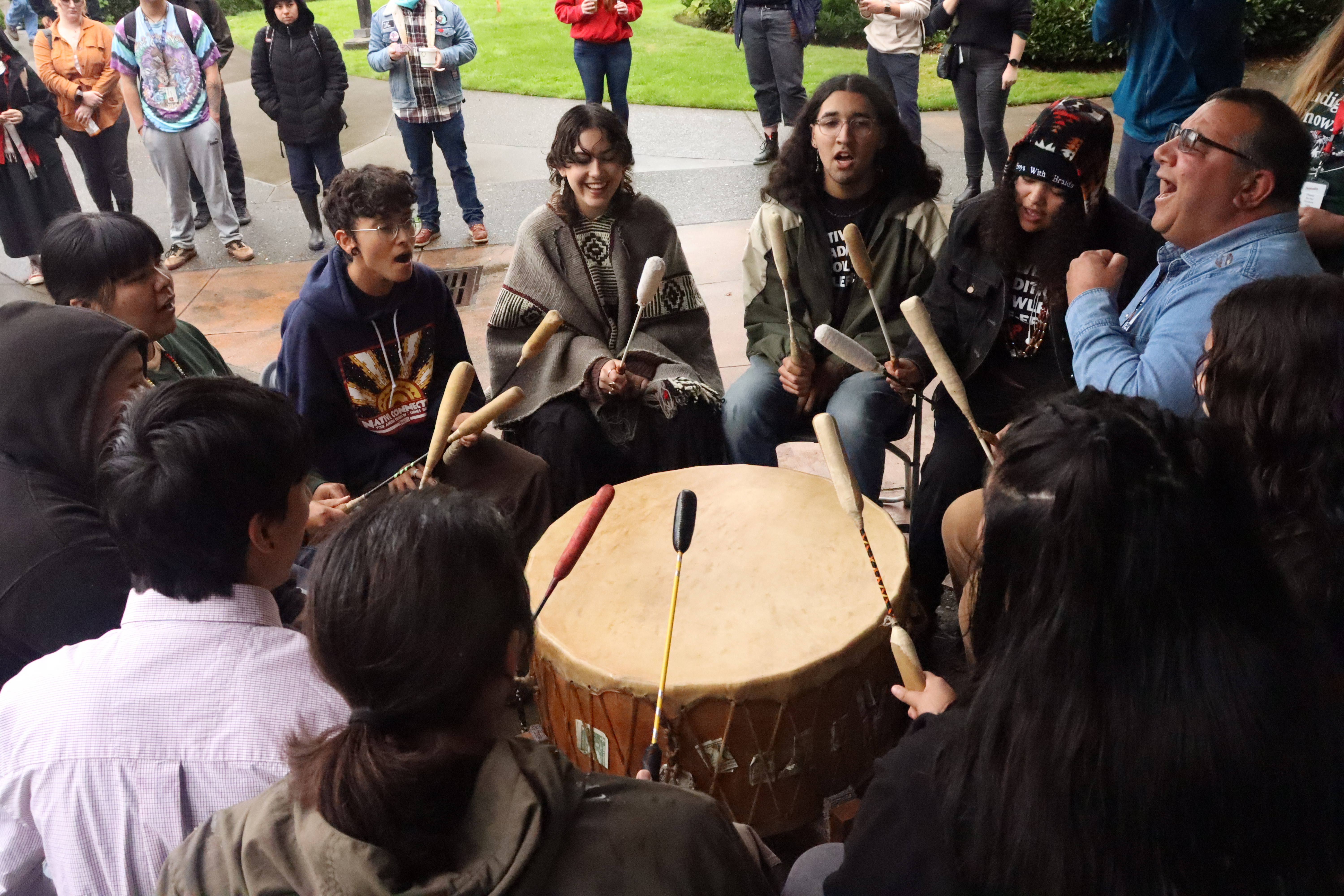
Indigenous Peoples Week kicked off on the Cal Poly Humboldt Quad Oct. 9 with a drum circle and mesmerizing rhythms echoing through the crowd. Participants of the drum circle beat their non-traditional drums and sang together, creating harmonies connected with the spirit. The beating of the drums mimicked the heartbeat of Mother Earth as it began to rain. According to the people in celebration, the sounds of the drums and vocals are used to heal, restore balance and improve people’s mood. The goal of the week is to embrace the rich cultures of Indigenous people and to honor the resilience, tradition and history.
Throughout the week, a variety of events and discussions for both staff and students to participate in were hosted by the The Indian Tribal & Education Personnel Program (ITEPP). ITEPP has been supporting students for more than 50 years.
The celebration included traditional card game demos, an Inuit film “Slash/Back” showing and more. These activities offer not only a way for native people to connect with each other, but with the earth, and with their ancestors. The celebration included speakers such as Dr. Kaitlin Reed, who discussed decolonization and her new book, “Settler Cannabis, From Gold Rush to Green Rush in Indigenous Northern California.”
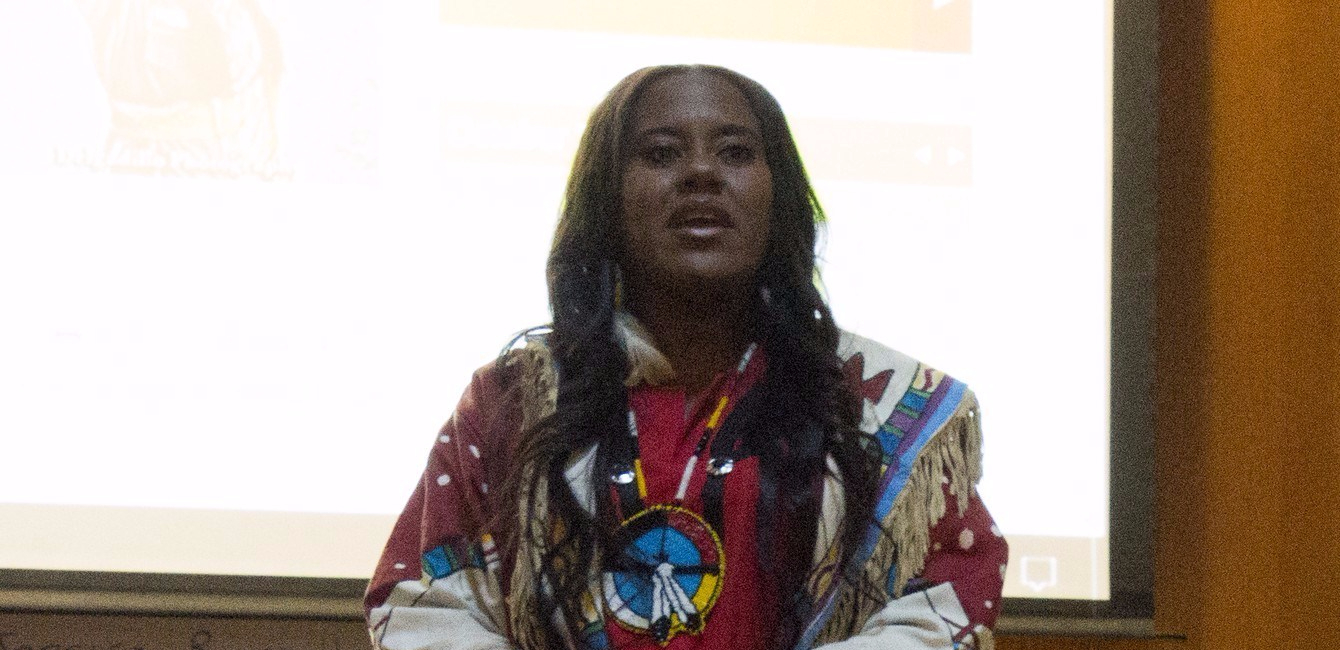
Photos by Andrés Felix Romero. ITEPP leadership addresses the crowd towards the end of the Oct. 9 drum circle in the Quad.
Indigenous Peoples Day is held in high esteem for those on campus and in the Humboldt community. The ITEPP program at Cal Poly Humboldt provides Native American students a sense of belonging that’s centered around cultural values, beliefs and traditions. The program also assists students in navigating higher education with confidence and a sense of independence.
“I want you all to erase a couple words from your vocabulary,” said Vincent Feliz, a lecturer in the department of social work. “Stop using them. Words like discovered, founded and settled. Indigenous people never needed to be discovered, we never needed to be founded, we never needed to be settled. A lot of us already had government systems set up, languages, structures and ceremonial rites of passage that were established.”
The week brought community members a chance to raise awareness and encourage understanding about Indigenous history.
Ted Hernandez, the Cultural Director and Chairman for the Wiyot Tribe, spoke at the drum circle in the Quad at the beginning of the week.
“There was a lot of damage done to our tribes that are in this area, not just this area, but all over the United States,” Hernandez said. “And it’s time that we start telling each other the true history. Its time for us to start talking about the genocide that happened to our people. It’s time for us to let the world know what happened.”
After nearly 160 years in the hands of Eureka, Tuluwat, briefly known as Indian Island, returns to its rightful owners
Wiyot Tribal members and Eureka community members were joyful, yet solemn, at the Eureka City Council meeting to officially return Tuluwat Island to the Wiyot people.
Wiyot tribal elder Cheryl A. Seidner blessed the room in a prayer of welcome. In the prayer, Seidner welcomed people from the East and from all directions as she turned in a circle, speaking in her native language. The crowd was silent and respectful, and tribal members let out emotional “ho’s.” Seidner thanked everybody in the audience and asked them to rise.
Wiyot tribal elder Cheryl A. Seidner speaks during the public comment section of the city meeting to return Tuluwat Island to the Wiyot Tribe while she is surrounded by supporters and tribe members at the Adorni Center in Eureka on Oct. 21. | Photo by Thomas Lal
“This is something I’ve always wanted since I was a kid,” Seidner said. “I thought the island was always ours, not anybody else’s. So we came together and said, ‘Let’s do this, let’s make it ours.’ So I decided to be bold and ask the new mayor to give us the island they owned.”
In 2004, 40 acres of Tuluwat were returned to the Wiyot Tribe. Oct. 21 marked the return of the remaining 202 acres. The tribe has been working with the City of Eureka for the last five years to make this happen, and this action marks the first step to repairing the damage caused to the tribe that began 100 years ago.
Cutcha Risling Baldy, Ph.D, the Native American Studies department chair at Humboldt State University, delivered one of many moving speeches to the hundreds of assembled community members. Baldy talked about the future of the Wiyot people and how she knew, one day, they would come back.
“I realized that native people were always making plans for our future and that we never gave up on our land or where we came from,” Baldy said. “That is the story I want people to know. I know that the story of Tuluwat, which people often refer to as Indian Island, has been one of a massacre for most people, but for me it has only been a place for world renewal.”
Baldy once read a book about stories gathered from people about Tuluwat. One particular story was about a woman who was stuck in the mud after the violence on the island. While it may be a story of sadness, Baldy said it was a moment of strength and hope. The woman sang a mourning song because she knew she had to send her tribe off properly. Her strength showed she knew her kin would one day return to Tuluwat.
Wiyot Tribal Chairman Ted Hernandez performs a traditional dance with members from the local tribes at the Oct. 21 Eureka City Council meeting to return Tulutwat Island to the Wiyot. | Photo by Thomas Lal
Jene L. McCovey sings a song during the Eureka City Council meeting to officially return Tuluwat Island to the Wiyot Tribe at the Adorni Center on Oct. 21.
A child stands with other tribal members at the Oct. 21 meeting to return Tuluwat Island to the Wiyot people. | Photo by Thomas Lal
HSU anthropology professor Gordon Ulmer acknowledged the significance of the day. Ulmer said the day should be a celebration of time immemorial, and that it displayed the vibrancy of the Wiyot tribe, despite the dark history.
“What we see here is a very vibrant thriving community that lives in the shadow of genocide,” Ulmer said. “People remember the genocide, but what is rarely acknowledged -or at least to a much lesser extent- is that people are still here, the Wiyot are thriving. There’s a lot to celebrate here.”
Eureka Mayor Susan Seaman began official proceedings by declaring the day as a moment in time that should forge strong bonds going into the future to create a long sought-after vision. Seaman prepared to take a vote from the council people while tension in the air grew as the crowd waited.
“I move to authorize the transfer of Tuluwat Island to the Wiyot Tribe and I authorize the vote,” Seaman said.
Leona Wilkinson sits and watches as the Eureka City Council meets to officially return Tuluwat Island to the Wiyot tribe at the Adroni Center in Eureka on October 21.
Members of the local Native American tribes perform traditional dances and songs during the Eureka City Council meeting for the return of Tuluwat Island to the Wiyot tribe at the Adorni Center on October 21.
Hilanea Wilkinson holds up a quilt designed to honor those who can now return to Tuluwat Island at the Eureka City Council meeting at the Adorni Center on October 21.
The Eureka City Council spoke on behalf of the motion, each member contributing a unique perspective to the magnanimity of the event. HSU Lecturer and Eureka City Council Member Natalie Arroyo wasn’t physically present, but she FaceTimed in and a representative shared a letter penned by her about Tuluwat.
“This is the first known transfer of land from a city to a tribe of this kind,” Arroyo said. “We are all responsible to do what we can to actively participate in healing. I will be so bold to say under current conditions Eureka owns the land, but it was never truly ours.”
The tension began to ease as Seaman’s voice fell over the crowd.
“The vote to return the Tuluwat island to the Wiyot Tribe was unanimous and the motion passed,” Seaman said.
A sea of people applaud the Eureka City Council during their meeting to return Tuluwat Island to the Wiyot tribe at the Adorni Center in Eureka on Oct. 21. | Photo by Thomas Lal
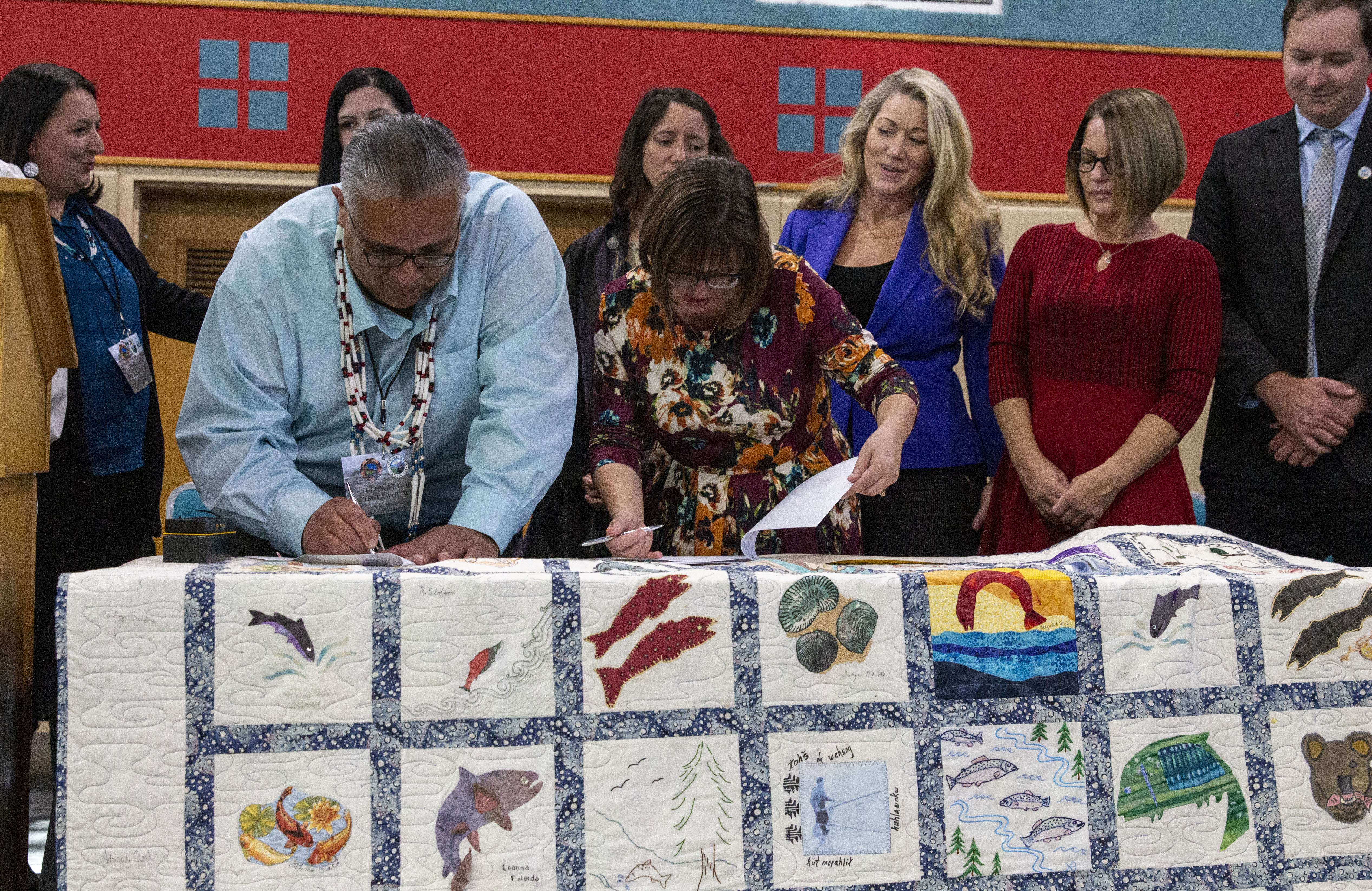
The signed documents with the signature of Wiyot Tribal Chairman Ted Hernandez after the Eureka City Council Meeting to return Tuluwat Island to the Wiyot tribe at the Adorni Center on Oct. 21. | Photo by Thomas Lal
Cheryl A. Seidner sings “Coming Home” at the end of the Eureka City Council meeting to return Tuluwat Island to the Wiyot tribe at the Adorni Center on Oct. 21. | Photo by Thomas Lal
Applause erupted from the audience. The crowd stood on their feet to clap and shout in joy.
Seidner invited her family to the front of the auditorium to sing a song to the people gathered in the room. Seidner welcomed everyone in the audience and invited them to sing the song “Coming Home.”
“I know that our ancestors knew this day would come,” Baldy said. “I think that we need to consider it an opportunity to think about our next steps in the future. People stand up and ask me, ‘What can I do?’ And I have one answer for them: you can start by giving all the land back. And now we know it’s possible.”
The signing of the deed marked the end of the meeting. Seidner placed a quilt representing all who could not be present on the table, and the council people huddled around to officially return Tuluwat to its ancient owners.
Wiyot Tribal Chairman Ted Hernandez and Eureka Mayor Susan Seaman embrace after signing the papers to officially return Tuluwat Island to the Wiyot Tribe at the Adorni Center on Oct. 21. | Photo by Thomas Lal
Baldy concluded her address with honest praise. With the Wiyot land reparation, the people in the room could now envision a radical future.
“A future with no dams, a future with salmon that are healthy, a future with our children that are singing, a future where we are dancing all the time,” Baldy said. “I know we’ve seen it and I know we’ve felt it, and I look forward to how amazing that is going to be. And I know that we can do it, and I look forward to how everyone in this room is going to make that happen.”
‘From Wounded Knee to Standing Rock’ offers insight into 71-day rebellion
As Indigenous Peoples’ Week came to an end, one of the last events was an airing of the documentary, “From Wounded Knee To Standing Rock: A Reporter’s Journey” at the Eureka Theatre.
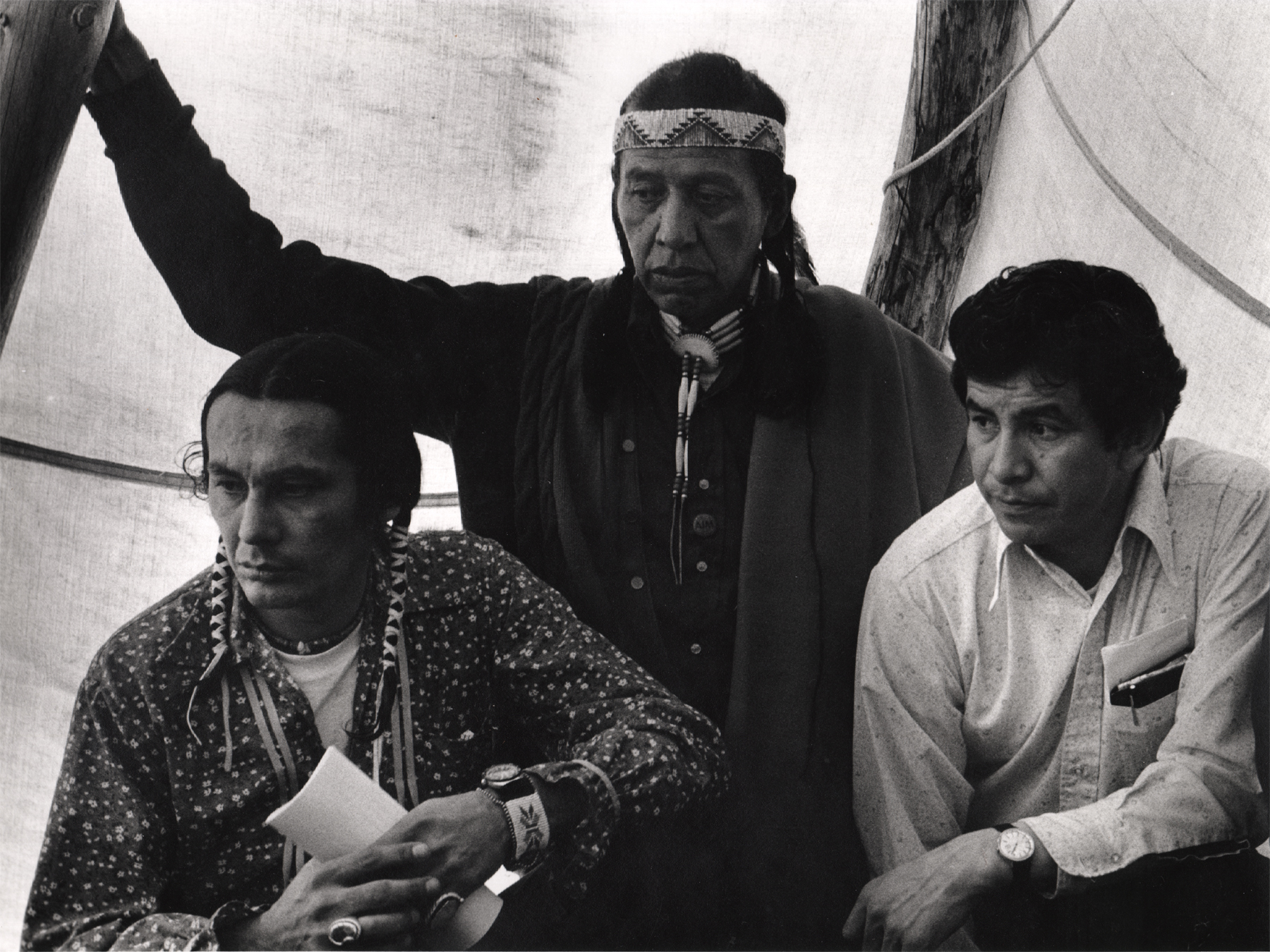
This story followed rookie reporter Kevin McKiernan and his experiences recording the events of the 71-day seizure and occupation of the town of Wounded Knee, South Dakota on the Pine Ridge Indian Reservation from Feb. 27 to May 8, 1973.
Photo courtesy Kevin McKiernan
Photo courtesy Kevin McKiernan
Photo courtesy Kevin McKiernan
Richard A. “Dick” Wilson was chairman of the Oglala Lakota Sioux of the Pine Ridge Indian Reservation. Protests started in response to failures of impeachment. Wilson had accusations ranging from giving jobs to friends and family, to suppressing his political opponents with his private militia, the Guardians of the Oglala Nation.
In addition, there were protests of the United States Government’s failure to uphold treaties with Native Americans. This was concerning since there was a history of abuse and neglect from American police and government. Cases such as State v. Bad Heart Bull served as a catalyst for the occupation.
As a result of the GOON squads’ weaponized militia, the American Indian Movement was brought in to assist the protesters. Wilson also received help from the American Government in the forms of U.S. Marshals Service and the FBI.
Photo courtesy Kevin McKiernan
AIM started as a grassroots movement in Minneapolis, Minnesota, to address police brutality towards Native Americans; and grew to represent all indigenous tribes and help them with the issues they have faced since European colonialism, as well as helping people reconnect with their heritage. Many people lost their history once Americans forced native youth assimilate into Euro-American society.
Acclimation to the colonizers’ lifestyles included forcibly removing Native people from their families, as well as preventing them from practicing their traditional customs. By accepting the different values as their own, such as Christianity, private property and material wealth, people became disconnected from their roots. AIM was a way for people to reconnect to their ancestors’ ways of life.
During the time of this occupation, the U.S. Government prevented media personal from entering the reservation or recording any discussions between them and the rebel leaders, such as Dennis Banks and Russell Means. They also implemented roadblocks to prevent aid for the natives.
McKiernan snuck in with the help of some rebels and slept on the floors of a church. While inside he recorded conversations with multiple members of the rebellion, shootouts with the FBI and USMS, took pictures of the aftermath of the altercations and recorded meetings with U.S. officials. Conflict escalated to the point of the USMS and FBI using helicopters, armored vehicles, snipers and automatic weapons.
Photo courtesy Kevin McKiernan
U.S. Marshal Lloyd Grimm was shot in the conflict and suffered paralysis from the waist down and Cherokee activist Frank Clearwater was shot in the head April 17, within 24 hours of his arrival, during a fire fight with federal forces.
Shootings were just one reason for keeping the media in the dark, by preventing coverage of the measures that the government took against the AIM and Sioux. At one point during the winter, Department of Justice appointee Kent Frizell, to manage the government’s response, cut off water, electricity and food supplies to Wounded Knee in an attempt to starve them out. They also made attempts to stir up distrust in the local factions, which lead to some activists being killed by their own allies, for fear they were government plants.
The final blow came in late April, when Lawrence “Buddy” Lamont, a local Oglala Lakota, was shot by a government sniper and killed. Soon after, both sides would come to an agreement to disarm. This led to the eventual end of the 71-day standoff between the Wounded Knee activists and AIM, and the United States assisted tribalists, serving as but one example of the Native American’s struggles since European Colonization.
Home Away From Home potluck kicks off Indigenous Peoples’ Week
Arcata is home to the Wiyot Tribe and Humboldt State University sits on Wiyot land. The Home Away From Home Potluck is one example of the community’s attempt to welcome all members to interact and is a fun, inclusive way to start Indigenous Peoples’ Week.
The second Monday of October has become an opportunity to counter-protest Columbus Day. Along with a celebration of Native Americans, their history on this land and their culture, Indigenous Peoples’ Week highlights the customs of indigenous peoples and acknowledges the years suffering.
Arcata Mayor Brett Watson spoke on some of the actions the city has taken in order to support local Native Americans. Watson spoke of a proclamation from 2016 where Arcata officially recognized Indigenous Peoples’ Day.
“The university is our lifeblood and we see the diversity of the student body as a positive. We welcome students of all backgrounds.”
Wesley Chesbro
“Just on October 2, we did a resolution affirming our support for a United Nations resolution,” Watson said. “Acknowledging the rights of Indigenous people around the world.”
The inclusion and acceptance of Native Americans’ history is one way that the community is attempting to reach out to students of all ethnicities. Wesley Chesbro, local volunteer and HSU alumnus, believes the potluck is inviting and feels like home for students.
“What we hope happens is students will sit down with community members and develop relationships,” Chesbro said. “The university is our lifeblood and we see the diversity of the student body as a positive. We welcome students of all backgrounds.”
The Home Away from Home potluck is more than it’s food, it’s about a sense of welcome. The goal, according to Equitable Arcata’s Communications Chair Cati Gallardo, is racial equity.
“The Home Away From Home potluck started as a way to let students know they’re loved by the community,” Gallardo said. “We love our students and some of the feedback we received stated how we need to make a change in Arcata. Folks were feeling it wasn’t a racially equitable community and we wanted to change that.”
Skits from based off the 1490s were performed by a Native American comedy group. The potluck consists of community members coming together to donate food and local businesses offer gifts for raffle prizes as well as warm winter clothing donated by locals for students who may need them.
Other events for Indigenous Peoples’ Week include highlights of HSU’s Native American programs. The Native Forum provided guests with a geographical exposure to local tribes on Monday. Professor Rain Archambeau-Marshall is hosting a showing of Dodging Bullets followed by a post-film discussion on Wed., Oct. 16. The Native American Center will also hold an open house Friday, Oct. 18, where they will play Cards for Decolonization. To find out more information go to humboldt.edu or itepp.humboldt.edu.
The American Indian community of HSU hosted the 24th annual Indigenous People’s Week from Oct. 9 thru Oct. 16, with many free events held on campus.
The eight day event began on Monday, Oct. 9, with a celebration on the Quad. Throughout the week, workshops, film screenings, a community-building reception and cultural sharing events were held around campus. Professors of the Native American Studies program hosted the event, as well as guest speakers from the Seventh Generation Fund, and Native American activist YoNasDa LoneWolf Hill.
Children gather on the Quad at Humboldt State University during a protest that began Indigenous People’s Week Oct. 9-16, 2017. Photo credit: Robert Brown
An Indigenous Voices Forum titled, “Columbus, The Doctrine of Discovery and Indigenous People’s Rights,” hosted by HSU Professor Cutcha Risling Baldy, and Lorna Bryant from Race Beat on KHSU was held in the Kate Buchanan Room on Wednesday night. HSU Professors Marlon Sherman and Kayla Begay, Chris Peters and Tia Oros-Peters of the Seventh Generation Fund, and Cynthia Boshell of the Environment and Community program at HSU took part in a discussion on the Doctrine of Discovery and how it continues to impact society to this day.
“Columbus is a figment of people’s imagination,” Oros-Peters said. “He is a construct of a dominating colonizing society that’s become a caricature of what the aspiration of colonization is. He is used as a weapon against people’s minds and their capacity to think freely.”
“Columbus is part of this nation’s origin story, Columbus Day is really a celebration of White supremacy, Christian superiority, the genocide of indigenous people. The state needs to erase indigenous people in order to legitimize its claim of sovereignty over us.”
A reception was held on campus Thursday to honor Native American women who have notoriously been murdered at more than 10 times the national average. Participants were asked to wear red in honor of the missing and dead indigenous women.
“Indigenous women have remained for more than 500 years, the most targeted, exploited, trafficked, raped, murdered, tortured, brutalized, and torn apart group of people on the face of this planet,” Oros-Peters said. “We are the embodiment of Mother Earth. The assault against indigenous women is how they treat the Earth. We are the echo of the Earth within our bodies, and she within us.”
“Columbus began the sex trafficking trade in America, he gave women away as slaves and prostitutes,” Sherman said.
Also on Thursday, a conversation with YoNasDa LoneWolf Hill was held in the Behavioral & Social Sciences building. Hill is a Lakota and African-American activist, speaker, and published writer of social and environmental justice issues. She was adopted and raised by Minister Louis Farrakhan, leader of the Nation of Islam.
“The truth is coming out, and the truth hurts, everyone is looking at the truth. There is a separation of good and evil taking place at this time,” Hill said.
“Women are at the heart of this movement, as mothers, we feel pain, we bear pain when we give birth,” Hill said. “Even if you’re not able to give birth, you still feel it in your blood. It’s all in everything that we are made of as women. In this way, we connect with and feel Mother Earth.”
This website uses cookies to improve your experience. We'll assume you're ok with this, but you can opt-out if you wish. Cookie settingsACCEPT
Privacy & Cookies Policy
Privacy Overview
This website uses cookies to improve your experience while you navigate through the website. Out of these cookies, the cookies that are categorized as necessary are stored on your browser as they are essential for the working of basic functionalities of the website. We also use third-party cookies that help us analyze and understand how you use this website. These cookies will be stored in your browser only with your consent. You also have the option to opt-out of these cookies. But opting out of some of these cookies may have an effect on your browsing experience.
Necessary cookies are absolutely essential for the website to function properly. This category only includes cookies that ensures basic functionalities and security features of the website. These cookies do not store any personal information.
Any cookies that may not be particularly necessary for the website to function and is used specifically to collect user personal data via analytics, ads, other embedded contents are termed as non-necessary cookies. It is mandatory to procure user consent prior to running these cookies on your website.