The Lumberjack


Students Serving The Cal Poly Humboldt Campus and Community Since 1929

Tag: indigenous

  • Signs of Passage: Nostalgia and New Beginnings

    Signs of Passage: Nostalgia and New Beginnings

    By Christina Mehr

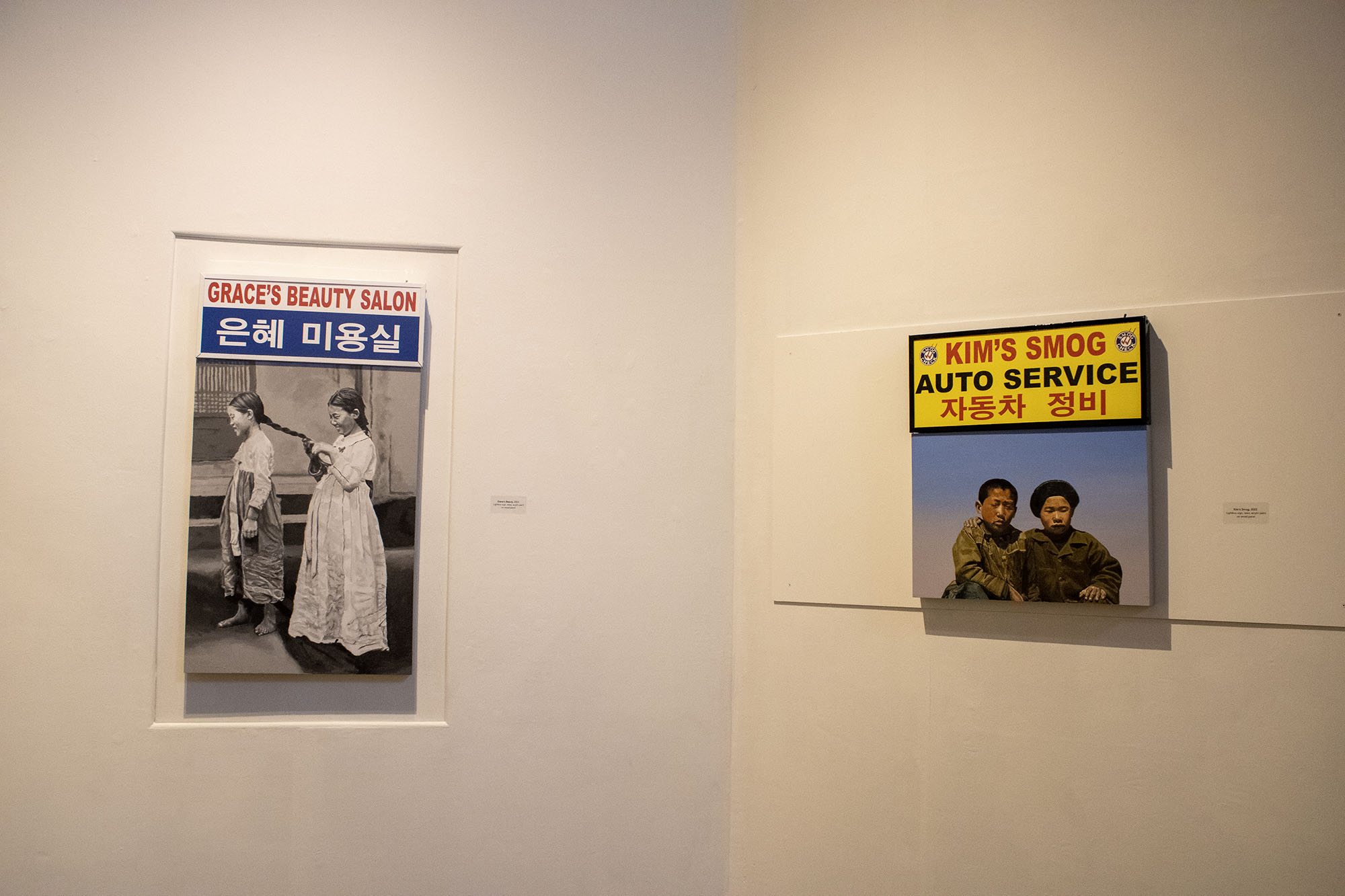
    Signs of Passage: Nostalgia and New Beginnings debuted in the Reese Bullen Gallery at Cal Poly Humboldt on Nov 8. The exhibition runs through Dec. 9 [2023] in the Art Building. 

    The Reese Bullen Gallery is named in honor of a founding professor of the Art Department and has been an addition to Humboldt since 1970. The gallery usually contains the university’s permanent collection of art and sponsors exhibitions of works by professional artists related to many different areas of instruction. The Reese Bullen Gallery also presents an annual exhibition of student art in May, the Graduating Student Exhibition.

    The mission of the Reese Bullen Gallery is to offer free and publicly accessible exhibitions representing artists from all demographics. Extending beyond Humboldt, the Gallery seeks to strengthen partnerships with local communities as well as stimulate support and participation in the arts. 

    This new body of work presented by Dave Young Kim at the Reese Bullen Gallery uses latex paint on wood panels. 

    Dave Young Kim is a Los-Angeles based artist who visited Humboldt County with a newly created body of work for his solo exhibition at the Cal Poly Humboldt Reese Bullen Gallery. Kim is a fine artist, born and raised in Los Angeles. He received his Bachelors of Fine Arts Degree in Studio Art from the University of California, Davis, and a Master of Fine Arts in Studio Art from Mills College. 

    His current display of work engages with the quality of home and explores themes of nostalgia, war, conflict and displacement. Through his work, Kim explores the unifying search for belonging across disparate conditions. In 2020, he co-founded the Korean American Artist Collective (KAAC), which is a group of artists building a community around work rooted in the Korean-American experience. In 2021, he was a selected muralist for the Eureka Street Art Fest and in connection with the Eureka Chinatown Project to paint a mural named Fowl. 

    “My work plays with that idea of manufacturing nostalgia as integrated with my family history, memory, and identity,” Kim said. “My artistic approach is drawn from a sense of loss or longing, looking for a place to belong.”

    His online portfolio can be found at https://www.daveyoungkim.com

    Goudi’ni Native American Arts Gallery displays “Tintah: Amongst The Trails” 

    Robert Benson’s Redwood Sculptures and Watercolor Studies

    By Christina Mehr

    In collaboration with Cal Poly Humboldt, Robert Benson presents his work in “Tintah: Amongst The Trails” at the bottom floor of the Behavioral & Social Sciences Building.

    The art installations of Native art used the mediums of watercolor and wood pieces. Focusing on a new body of work, Tintah, Hupa language for amongst the trails, features newly carved salvaged old-growth redwood sculptures and watercolor studies. Robert Benson, is a leading figure among artists in the NorthWest California art world. He has worked as a teacher for more than 30 years at the College of the Redwoods, as well as being a curator of Native art.

    Tall sculptural wooden carvings adorn the exhibit and viewers must make their way through the art, almost like walking amongst the trails. Redwood slabs carved into beautiful sculptures lined the room. 

    His current paintings and sculptures are filled with imagery of trails, both of the literal kind and suggested. With Benson’s deep connections to the environment and land, those motifs clearly shine throughout his work. 

    “There is the trail into our family hunting camp that I traveled for more than 50 years, there are trails handed down through stories and mythologies, and there are the trails of imagination,” Benson says. “When we consider that at the most basic level, a trail is just something connecting two points, even the ladder and stairway forms that populate my work can be viewed as kinds of trails. To be amongst the trails is to find your rhythm, your place and to discover the interplay between that rhythm and the melody of the universe.” 

    This solo exhibition was installed by the Art + Film Department Museum & Gallery Practices class under the direction of Assistant Professor Berit Potter and Gallery Director Brittany Britton. This exhibition was partially funded by Instructionally Related Activity Fees. 

    Photo courtesy of Goudi’ni Native American Arts Gallery
  • Indigenous Peoples Week embraces rich cultures and honors resilience

    Indigenous Peoples Week embraces rich cultures and honors resilience

    by Christina Mehr

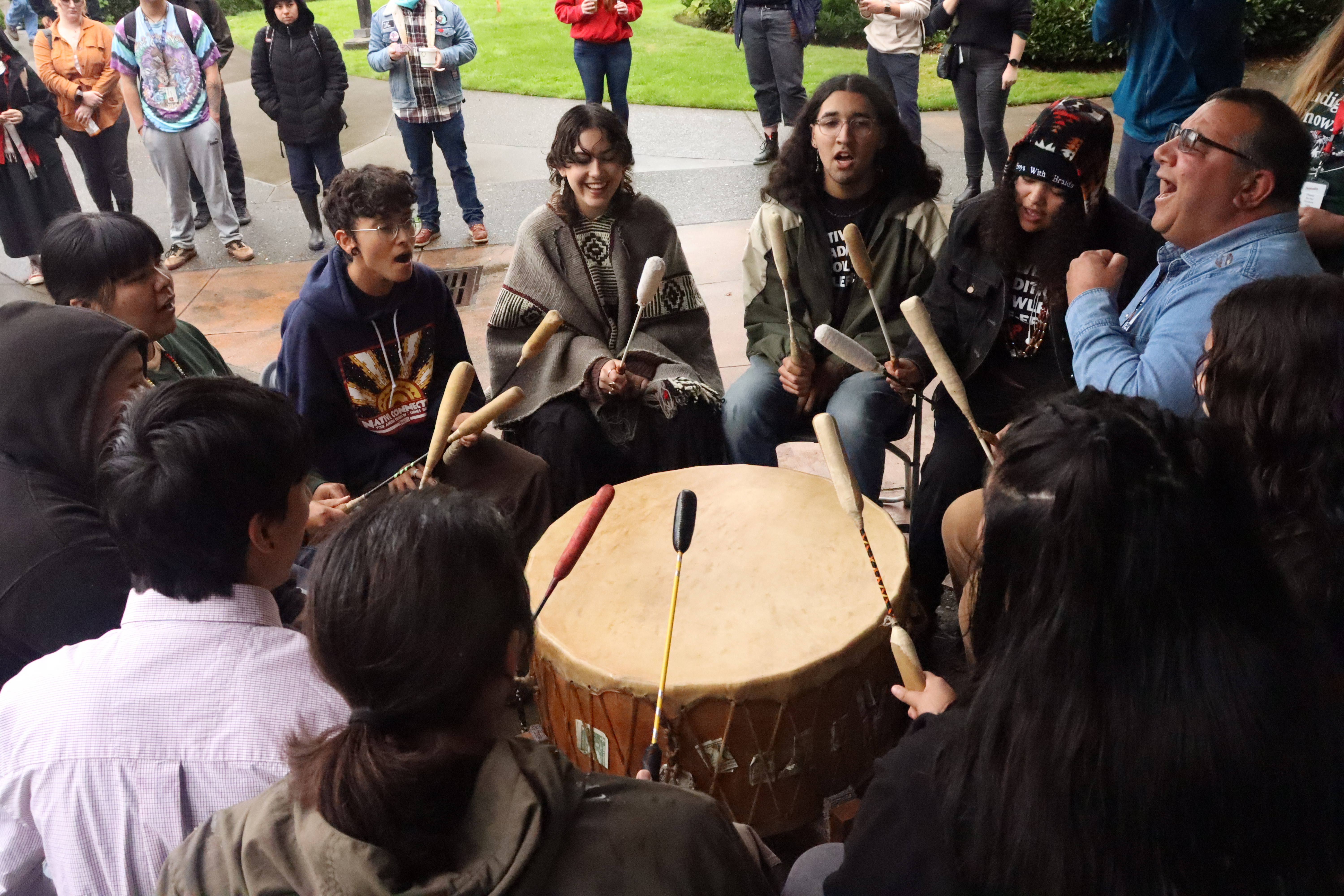
    Indigenous Peoples Week kicked off on the Cal Poly Humboldt Quad Oct. 9 with a drum circle and mesmerizing rhythms echoing through the crowd. Participants of the drum circle beat their non-traditional drums and sang together, creating harmonies connected with the spirit. The beating of the drums mimicked the heartbeat of Mother Earth as it began to rain. According to the people in celebration, the sounds of the drums and vocals are used to heal, restore balance and improve people’s mood. The goal of the week is to embrace the rich cultures of Indigenous people and to honor the resilience, tradition and history. 

    Throughout the week, a variety of events and discussions for both staff and students to participate in were hosted by the The Indian Tribal & Education Personnel Program (ITEPP). ITEPP has been supporting students for more than 50 years. 

    The celebration included traditional card game demos, an Inuit film “Slash/Back” showing and more. These activities offer not only a way for native people to connect with each other, but with the earth, and with their ancestors. The celebration included speakers such as Dr. Kaitlin Reed, who discussed decolonization and her new book, “Settler Cannabis, From Gold Rush to Green Rush in Indigenous Northern California.”

    Photos by Andrés Felix Romero. ITEPP leadership addresses the crowd towards the end of the Oct. 9 drum circle in the Quad.

    Indigenous Peoples Day is held in high esteem for those on campus and in the Humboldt community. The ITEPP program at Cal Poly Humboldt provides Native American students a sense of belonging that’s centered around cultural values, beliefs and traditions. The program also assists students in navigating higher education with confidence and a sense of independence.

    “I want you all to erase a couple words from your vocabulary,” said Vincent Feliz, a lecturer in the department of social work. “Stop using them. Words like discovered, founded and settled. Indigenous people never needed to be discovered, we never needed to be founded, we never needed to be settled. A lot of us already had government systems set up, languages, structures and ceremonial rites of passage that were established.” 

    The week brought community members a chance to raise awareness and encourage understanding about Indigenous history.

    Ted Hernandez, the Cultural Director and Chairman for the Wiyot Tribe, spoke at the drum circle in the Quad at the beginning of the week. 

    “There was a lot of damage done to our tribes that are in this area, not just this area, but all over the United States,”  Hernandez said. “And it’s time that we start telling each other the true history. Its time for us to start talking about the genocide that happened to our people. It’s time for us to let the world know what happened.” 

  • QTBIPOC Film Coalition hosts first annual film fest

    QTBIPOC Film Coalition hosts first annual film fest

    by Camille Delany

    Originally printed April 26, 2023

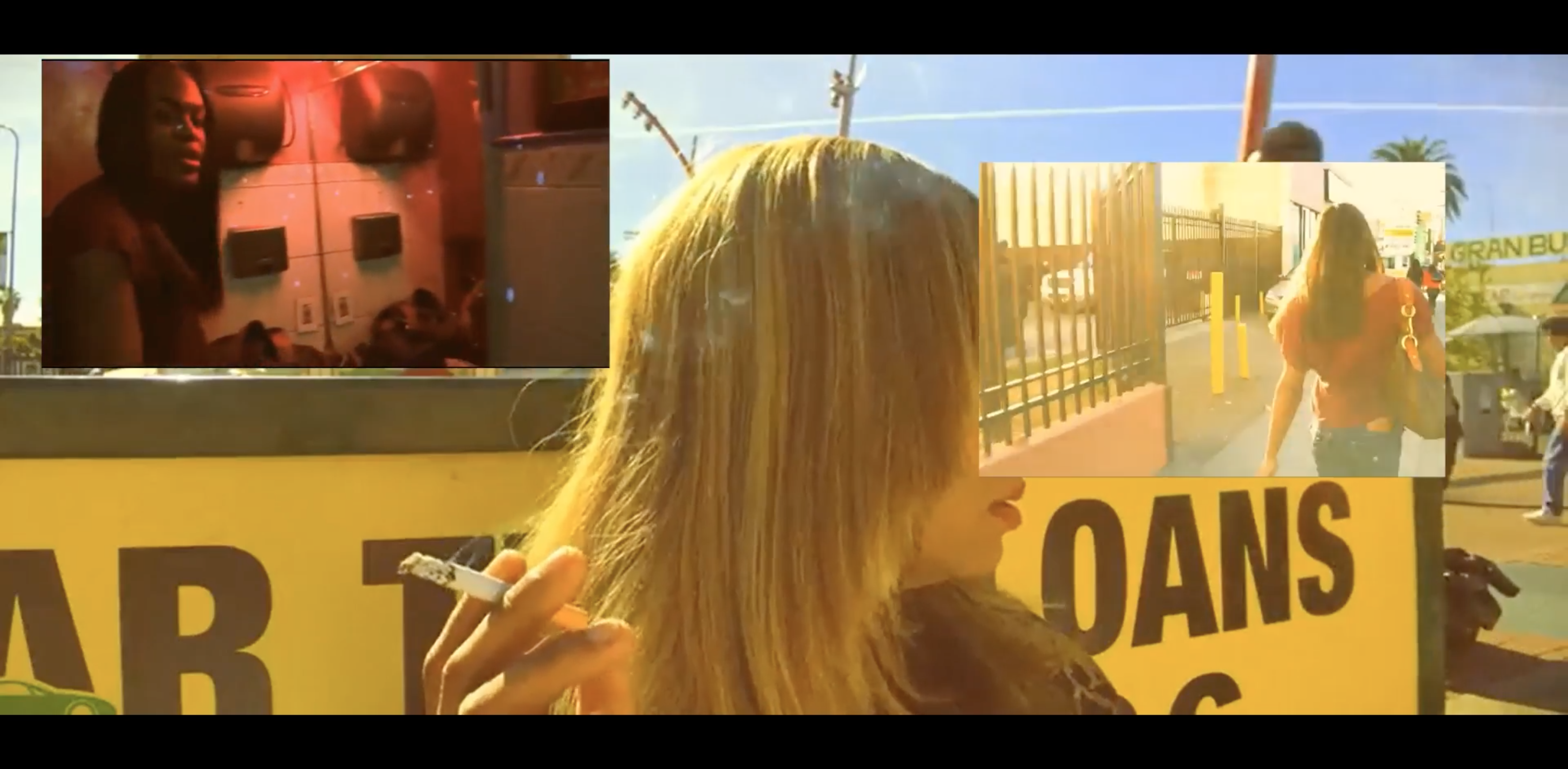
    The first annual QTBIPOC Film Festival on campus Saturday, April 15, centered the work of student filmmakers from communities rarely represented on the festival stage. The festival was hosted by the newly-formed QTBIPOC Film Coalition and the Cinema Club. Featuring work by QTBIPOC (Queer, Trans, Black, Indigenous, People of Color) and non-film students, it was a much-needed opportunity for artists from diverse majors to share their work in a festival setting.

    The fest was programmed by Danny Garcia, a Critical Race, Gender and Sexuality Studies (CRGS) senior, and Matthew Mason, a senior in the Film program. They had gained experience in festival programming from attending both the Santa Barbara International Film Festival (SBIFF) and SXSW in Austin.

    “I rediscovered the joy of film through these festivals where I got to see representation that actually resonated with me, and I thought about how to bring this back to the people,” Garcia said. 

    At SBIFF they were inspired by the representation of Trans and Indigenous communities they saw on the big screen.

    “I saw films that I would never have expected to get the spotlight,” Garcia said. “That sparked my interest as a CRGS major in the potential of film as a liberatory medium.”

    The QTBIPOC Film Festival showcased films ranging in length from less than two minutes to thirty minutes, and included experimental dual projections as well as longer films including documentaries and narratives.

    Garcia collaborated with filmmaker and computer science major David Yaranon to write “What a Waste,” a thirty minute narrative critique of misogyny that follows a stalker. Production took place over the span of a week, and involved many of Yaranon and Garcia’s close friends both in front of and behind the camera.

    “I would love to make more films with these guys,” Yaranon said. “This idea was kind of locked in, but it would be great to hear from other people, different ideas and talk about how we can make something meaningful and with a message behind it.”

    Garcia screened their short “i am chicano,” which they produced for Professor M. Cartier’s Fall 2022 class Representation in Film Matters. Among other films that had been produced for the class and screened at the QTBIPOC Film Festival was Lake McLeod’s “I AM,” an experimental short in which the filmmaker reads an original poem.

    Also in the experimental category, Mason showed his 2022 production “Woman in Gold,” starring McLeod and Raelynn Davis, in which a mysterious protagonist follows a woman through a dark forest, and is in turn pursued by a masked stranger.

    Mason welcomes the opportunity to show his work outside of the class it was produced for, because he values the outside viewpoint that the audience brings.

    “Everyone has a different reaction and takeaway from it,” Mason said. “People can see the same thing but take away infinitely different meanings.”

    The QTBIPOC Film Festival encapsulated art created in a pivotal moment for rights and representation of QTBIPOC people.

    “Right now we’re going through a cultural change. Things are shifting. Film still needs to catch up,” Garcia said. “At the forefront of the industry, representation is real and they’re putting money and resources towards it.”

    Disclaimer: The author of this article showed a film at the festival

  • Community revives lost indigenous seafaring craft

    Community revives lost indigenous seafaring craft

    by Valen Lambert

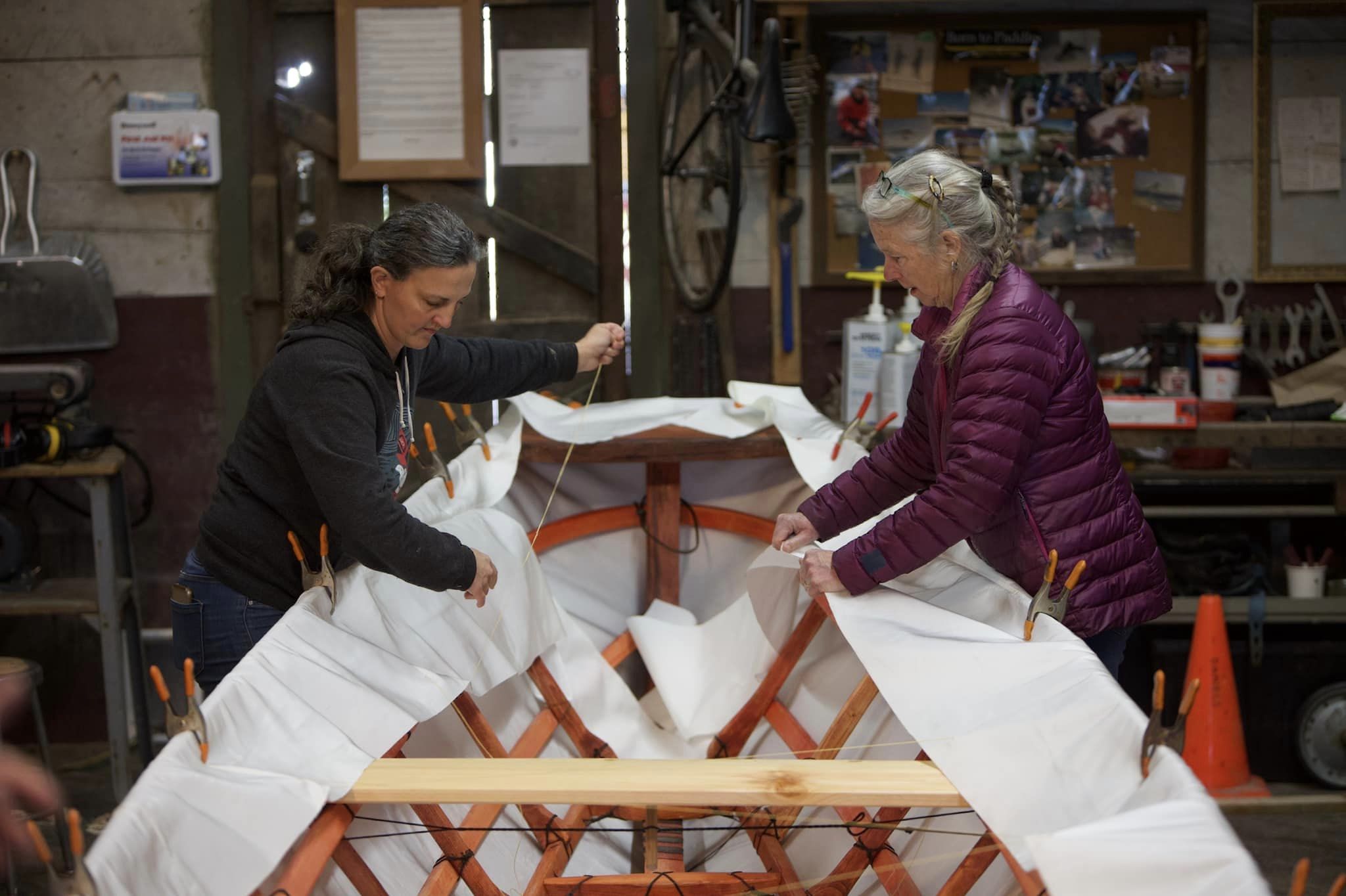
    Mind’s Eye is more than just a charming cafe in the center of Ferndale’s downtown. It’s also home to the Manufactory, a makerspace that cafe-goers can watch through glass as artists and craftspeople work on projects. Right now, there is a community at work building a 27-foot-long Unangan canoe called a nigilax̂. 

    Longtime woodworker Marc and his wife Leah Daniels are the owners of Mind’s Eye Manufactory and Coffee Lounge. For several years, Marc Daniels has been collaborating with Unangax̂ to host apprenticeships on the crafting of iqyax̂, or the traditional kayaks of the Unangax̂ people of Alaska’s Aleutian islands. However, this nigilax̂ build is something entirely different.

    The nigilax̂ has not been built in the nearly two centuries since Russian fortune seekers invaded Unangax̂ villages, enslaving the people and cutting off all chances of escape by destroying their nigilax̂ fleet and anyone with the knowledge to build one. Two centuries later the Daniels, Unangax̂ descendants, Wiyot Tribe members, and other non-Native community members are putting together the missing pieces. 

    Some Russian invaders sketched pictures of these boats in the ship’s log. In a few instances, actual draftsmen were on board these invading ships, documenting some of the details of how these vessels were put together. Some of this information was found in the least expected places.

    Marc Daniels was doing some work with the Museum of the Aleutians, which had retrieved 1,500 year old kayak parts that some mummies had been buried with.

    “But then there were these odd parts,” says Daniels. “And turns out, after looking at them for a while, we realized that they were nigilax̂ ribs from that era 1,500 years ago.”

    The project and its materials have the blessing and approval of the Wiyot. The wood was combed from beaches in Humboldt and Alaska, like the 27-foot-long Sitka spruce now serving as the base of the nigilax̂. Traditionally, bull seal skin is used, but this nigilax̂ will be constructed with a ballistic nylon material. The vessel will hold eleven paddlers in addition to another ten to fifteen people. 

    The project has been bringing together Wiyot members and non-Native Humboldt community members, as well as distant Unangax̂ who have come to Ferndale for the build. For Mike Ferguson, an Unangan, working on the nigilax̂ has been a way to connect with his ancestry. 

    Photo courtesy of Mike Ferguson | Marc Daniels teaching people lashings on the lower stringers

    “It feels like the start of a potentially really deep journey,” says Ferguson. “I think there’s many deep stories to explore; some of that has to deal with healing trauma for my family.”

    Ferguson met another Unangan on the build who turned out to be a cousin he hadn’t met, solidifying the feeling that this project was powerful. 

    Leah Daniels finds the communal effort of the build deeply rewarding.

    “It’s a life connection,” Daniels said. “You’re connecting with each other, but you’re connecting with life, with ancestors, with the universe, and that just deepens relationships with people.”

    If blessed by the Kashia Pomo of the area, the ceremonial launch of the nigilax̂ is planned to take place during the Unangax̂-hosted festivities on Alaskan Native Day, May 27, at Fort Ross on the Sonoma Coast. Fort Ross, originally a Kashia Pomo village site named Metini, is a former Russian settlement that many displaced Unangax̂ ended up at. 

    “It’s kind of a full circle thing,” Leah Daniels said. “To rebuild the vessels, and to bring one back into this region, it feels much more powerful to have it launched at that site.”

    The nigilax̂ has an active future ahead, including plans for cultural journeys like Sealaska Celebration in Juneau, and Tribal Journeys in the Salish Sea waters of Washington and British Columbia. It will be made fully available for use by Unangax̂ to connect with their heritage and ancestry. Marc Daniels also plans to take members of the public out into Humboldt Bay once a month so the community can experience the beauty of Humboldt from the water. 

    “I hope that more opportunities like this become available for people of all cultures, backgrounds, and abilities,” Ferguson said. “It’s a really special way to be in community.”

  • Film Screening Displays Indigenous Resistance and Heroism

    Film Screening Displays Indigenous Resistance and Heroism

    ‘From Wounded Knee to Standing Rock’ offers insight into 71-day rebellion

    As Indigenous Peoples’ Week came to an end, one of the last events was an airing of the documentary, “From Wounded Knee To Standing Rock: A Reporter’s Journey” at the Eureka Theatre.

    This story followed rookie reporter Kevin McKiernan and his experiences recording the events of the 71-day seizure and occupation of the town of Wounded Knee, South Dakota on the Pine Ridge Indian Reservation from Feb. 27 to May 8, 1973.

    Richard A. “Dick” Wilson was chairman of the Oglala Lakota Sioux of the Pine Ridge Indian Reservation. Protests started in response to failures of impeachment. Wilson had accusations ranging from giving jobs to friends and family, to suppressing his political opponents with his private militia, the Guardians of the Oglala Nation.

    In addition, there were protests of the United States Government’s failure to uphold treaties with Native Americans. This was concerning since there was a history of abuse and neglect from American police and government. Cases such as State v. Bad Heart Bull served as a catalyst for the occupation.

    As a result of the GOON squads’ weaponized militia, the American Indian Movement was brought in to assist the protesters. Wilson also received help from the American Government in the forms of U.S. Marshals Service and the FBI.

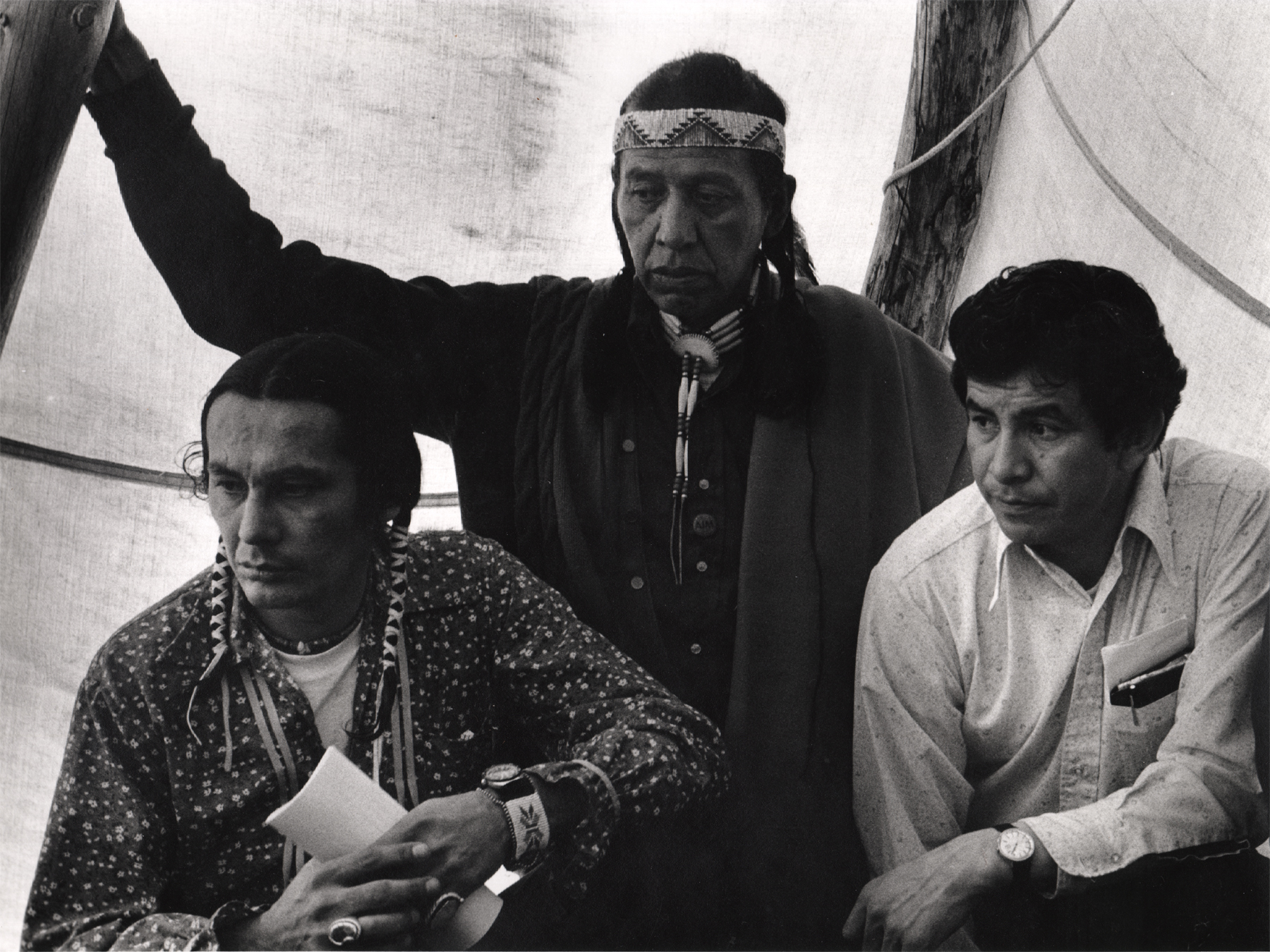
    Photo courtesy Kevin McKiernan

    AIM started as a grassroots movement in Minneapolis, Minnesota, to address police brutality towards Native Americans; and grew to represent all indigenous tribes and help them with the issues they have faced since European colonialism, as well as helping people reconnect with their heritage. Many people lost their history once Americans forced native youth assimilate into Euro-American society.

    Acclimation to the colonizers’ lifestyles included forcibly removing Native people from their families, as well as preventing them from practicing their traditional customs. By accepting the different values as their own, such as Christianity, private property and material wealth, people became disconnected from their roots. AIM was a way for people to reconnect to their ancestors’ ways of life.

    During the time of this occupation, the U.S. Government prevented media personal from entering the reservation or recording any discussions between them and the rebel leaders, such as Dennis Banks and Russell Means. They also implemented roadblocks to prevent aid for the natives.

    McKiernan snuck in with the help of some rebels and slept on the floors of a church. While inside he recorded conversations with multiple members of the rebellion, shootouts with the FBI and USMS, took pictures of the aftermath of the altercations and recorded meetings with U.S. officials. Conflict escalated to the point of the USMS and FBI using helicopters, armored vehicles, snipers and automatic weapons.

    Photo courtesy Kevin McKiernan

    U.S. Marshal Lloyd Grimm was shot in the conflict and suffered paralysis from the waist down and Cherokee activist Frank Clearwater was shot in the head April 17, within 24 hours of his arrival, during a fire fight with federal forces.

    Shootings were just one reason for keeping the media in the dark, by preventing coverage of the measures that the government took against the AIM and Sioux. At one point during the winter, Department of Justice appointee Kent Frizell, to manage the government’s response, cut off water, electricity and food supplies to Wounded Knee in an attempt to starve them out. They also made attempts to stir up distrust in the local factions, which lead to some activists being killed by their own allies, for fear they were government plants.

    The final blow came in late April, when Lawrence “Buddy” Lamont, a local Oglala Lakota, was shot by a government sniper and killed. Soon after, both sides would come to an agreement to disarm. This led to the eventual end of the 71-day standoff between the Wounded Knee activists and AIM, and the United States assisted tribalists, serving as but one example of the Native American’s struggles since European Colonization.