The Lumberjack


Students Serving The Cal Poly Humboldt Campus and Community Since 1929

Tag: international students

  • International Education Week: Feb. 14 – 18, 2022

    by CPH’s International Studies Students

    Global Engagement Begins at Home

    This year’s keynote speaker, Mary Akpovi, who was born in Nigeria but has lived most of her life in California, inspired us to be both local and global citizens. While Akpovi has spent most of her career in public accounting, her true passion, in recent years, has been charity work. Having been involved with several charity organizations here in the United States and abroad, she has a lot of wisdom to offer.  

    Photo courtesy of Mary Akpovi

    In California, Akpovi was previously a board member for the Exceptional Children Foundation, an organization that provides services to children and adults with learning and developmental challenges. She also worked with Hope of the Valley Rescue Mission, an organization that assists people experiencing homelessness. 

    Her international work has been centered in Sierra Leone, Uganda, and Kenya. She has been instrumental in opening vocational training centers in these countries and continues to support several vocational schools, primarily in tailoring, catering and salon care. 

    When asked where her passion for charity work comes from, she said it was the support she received in her own life, from her father, her religion, and from others.  Now, she is paying it forward by mentoring, and it is at the heart of everything she does. In her opinion, it is one of the best investments a person can make. She hopes participants got the overall message that everyone has potential. That potential can be fostered by encouraging one another, being intentional, and “staying in your lane,” a phrase that Akpovi holds close to her heart.

    by Rachel Hood

    Movement and Identity

    In light of forced displacements, violence, and complex geo-political issues, Dr Tani Sebro (PSCI) explored the cultural performances that have served the critical function of Myanmar’s refugee population in her session “Aesthetic Nationalism: The Dance of War and Exile along the Thai-Myanmar border.” 

    In the context of conflict and exile, music, dance, and the performing arts play a pivotal role in creating a sense of national and community, according to Sebro. As a cultural ethnographer who also underwent training in the traditional performance arts called Jaad Thai, Sebro was able to experience how dance and performing arts made life possible outside the contemporary nation-state system for exiled people. In essence, physically synchronized rhythmic movement promotes a strong sense of unity within all cultures, religions, and nations. It also holds potential for expressing ethnic identity for refugees, especially for the Tai living in a time of danger.  

    by Johnny Mendoza

    IEW Highlights Black Voices 

    On Feb. 14, Professor Maxwell Schnurer kicked off International Education Week with a presentation about the music and activism of Fela Aníkúlápó Kuti, a Nigerian Pan-Africanist and musician. 

    During his life, Kuti reinvented African culture as a revolutionary act to subvert colonialism and reassert his autonomy as a Black person. “I never thought about it, being African as such,” Kuti said in an interview from the 1970s. “It didn’t mean anything to me until much later in my life.”

    Schnurer deconstructed the sociology of colonialism to provide a framework for cultural appropriation, a phenomenon that exploits indigenous Black cultures in particular. Colonialism is a kind of discourse that perpetuates a narrative of European superiority. 

    “You’re born out of the womb into a world of discourse,” Schnurer said. “Your grandparents, your aunts and uncles had language on this planet, before you arrived.” 

    Umoja Center for Pan-African Academic Excellence Coordinator and International Studies alumnus Doug Smith also spoke, sharing his ongoing master’s research about Pan-African identity. 

    “For many people of color, the use of English as a language, as a means of communication, is very tied into their history and engagement with colonialism and settler colonialism,” Smith said. 

    by Emma Roberts and Lex Valtenbergs 

    Levels of Connection

    International Education Week helps inform us about the issues that connect us wherever we are in the world; two presentations made this point very clear. 

    COVID-19 is perhaps the most immediate example of how globalization affects our daily lives. Economics professor Beth Wilson brought this idea closer to home by looking at the impact of the pandemic on education. 

    Wilson’s information-packed presentation examined the different ways that the pandemic has affected the lives of one billion students worldwide, particularly in developing countries with little access to technology. Short term decisions made by local authorities will have long term economic consequences Wilson argued that “COVID-19 is the biggest education disruption in history.”  

    To finish out the week and bringing the world back to Humboldt, alum Viridiana Preciado discussed the work done by the Sovereign Bodies Institute, an organization that helps locate missing and murdered Indigenous women. 

    Preciado’s presentation highlighted the injustices that indigenous communities face on a daily basis and talked about the work SBI has done locally with the Yurok tribe and offered ways people can support this effort. She concluded her presentation by pointing out that she got her job after meeting the CEO of her organization at an IEW session two years ago. 

    “I just followed my heart and introduced myself after the session. I told her I really wanted to help make a difference and here I am,” said Preciado. 

    by Laura Gurney

    Following the Flow: Coffee and Gold

    We are very fortunate here at Cal Poly Humboldt to have professors who are passionate about the work they have done, and who want to share their knowledge and experience. International Education Week offers faculty from across the university the opportunity to showcase their work. 

    Gordon Ulmer and Noah Zerbe traced the “social life” of two very different commodities economically and culturally. 

    Together, they explored the impact of global markets for gold and food (and specifically for coffee) on local communities around the world. Each of these common goods ties together different social, cultural, political, and economic ideas. They also asked us to think about our own responsibility in that global exchange. 

    “Starting my day with a cup of coffee connects us, connects me, connects all of us to these broader economic, political, cultural, environmental questions,” Zerbe said.  

    by Abby Reina-Guerra 

    Only 1% of College Students Study Abroad – Stand Out from the Crowd

    Despite COVID-19 and lockdowns, Cal Poly Humboldt is beginning to plan for study abroad again. Five different sessions during International Education Week helped students prepare for their trips. Videos are available on the IEW website (iew.humboldt.edu/schedule) where you can hear from students about their own experiences; from budget planning and cell phone plans to what it was like to be a student of color in a strange place. 

    Professors Matthew Dean and Joseph Diémé also hosted a session to talk about their Leon, Spain and Nantes, France programs scheduled to take place this summer. They discussed the appeal of faculty-led programs, including the ease of transferring credits and even the possibility of gaining a minor. More information can be found on the Humboldt Study Abroad website, which also includes information about other programs through the CSU or third-party providers. All programs are available to any student at Humboldt regardless of major. 

    A final look at study abroad was presented by Jonathan Maiullo of College of the Redwoods, who discussed the importance of recognizing the impact you have in the communities where you travel. He stressed the importance of “responsible storytelling” as a way to share your experiences with others while respecting the culture you visit. If you are thinking study abroad is not for you because of cost, there are a number of scholarships with deadlines coming soon. 

    Stand out from the crowd – study abroad: https://humboldt-international.terradotta.com/

    by Debora Rios

    A World of Love, Education and Grief

    Kicking off on Valentine’s Day, it seemed natural for anthropologist Mary Scoggin to speak of love in the context of China.She discussed the many different ways in which we understand and express our affection, and how even our most cherished emotion is rooted in our own cultural history. 

    Educating the next generation is deeply rooted in culture. Vincent Biondo, Department Chair of Religious Studies at Cal Poly Humboldt, talked about Islam and citizenship education in Europe. Biondo addressed the question of how Europe should respond to diversity and incoming migrant communities, specifically Muslims. Biondo argued that Europe should invest in schools that teach pro-social values. 

    “There’s a lot of evidence that shows that people solidify their prejudices by the time they’re in middle school,” Biondo said. 

    In other words, if one educates students at a younger age about diversity, communities would become more accepting. 

    On the other end of the spectrum, Kerri Malloy of San Jose State discussed a workshop he was asked to help host in 2019 on promoting and protecting civil and human rights. That year the seminar was exclusively designed for members of the US civil service like ICE and FBI agents. Perhaps more importantly, it took place at the Auschwitz concentration camp as organizers felt there was no better place to talk about the erosion of human and civil rights. 

    As Malloy showed multiple pictures of the camp, he asked his audience to consider these images not simply as foreign, but to think of places here in California that are also places of violence. 

    As he repeatedly observed, “These places were built to last – they have a permanence – they mark the landscape forever.”   

    by Haley Rodden and Cataleena Tchieng

    Work Around the World 

    International careers offer an extraordinary experience for anyone to branch out of their comfort zone and explore the world. Through your experience abroad you can gain a stronger understanding of other types of cultures, peoples, environments, and governments depending on the work you choose. People who work in an international setting are often pushed to confront extraordinary new elements that open any number of lifetime options. 

    Careers extend from working on a campus to help students to build their own international experience. Nora Montoya of Cal Poly Humboldt’s Academic and Career Advising Center took time to work for the Peace Corps, and Ryan Gliha worked for the State Department. He has since spent his career helping build strong relationships between the United States and other nations around the world. Now, as the diplomat in residence for California, Gliha is helping students join the foreign service. 

    Even while still in college there are ways to build a strong international profile. For example, the State Department has remote internships around the world and every government department hosts internships that could help you build your career. 

    “International work is an opportunity like no other,” Gliha said. “It will change your life”. 

    For support or more information contact ACAC and Nora Montoya (nora.montoya@humboldt.edu), John Keller, Peace Corps (Jkeller2@peacecorps.gov) or Ryan Gliha, State Dept (DIRnorthwest@state.gov).

    by Leslie Ortiz


    About International Studies

    Photo courtesy of the International Studies dept.

    International studies is an interdisciplinary major that examines the drivers of globalization. The goal is to better understand the forces that shape the world so we can make changes in that world. Students study other languages and are required to study abroad as part of their own exploration of the interconnections between people and places local and global. 

    International Education Week, now in its 23rd year at Humboldt, is a 1-unit colloquium crossed-listed by six majors and open to the community, but required for international majors. This year, IEW brought together faculty and staff from across Humboldt, California and the world via Zoom to present 30 hours of programming to well over 700 attendees. 

    Students in this year’s international capstone class acted as hosts for each session and wrote this report of the week’s events. We are honored to be guest reporters for The Lumberjack and hope this helps you feel less distanced in a time of COVID-19. We are rooted in this community but still reaching for the world.

    If you have any questions about IEW or international studies, my door is always open. 

    Professor Alison Holmes (alison.holmes@humboldt.edu). 

    International Education Week would like to thank its sponsors and all of our presenters. The full schedule and videos of sessions from 2022 (and 2021) can be found online: https://iew.humboldt.edu/

    International Studies Capstone Class Spring 2022
    Laura Gurney, Rachel Hood, Johnny Medoza, Leslie Ortiz, Abby Reina Guerra, Debora Rios, Emma Roberts, Haley Rodden, Cataleena Tchieng, Lex Valtenbergs
  • Goodbye to last round of Intensive English students

    Goodbye to last round of Intensive English students

    One staff member was let go from their position, two more members soon to follow.

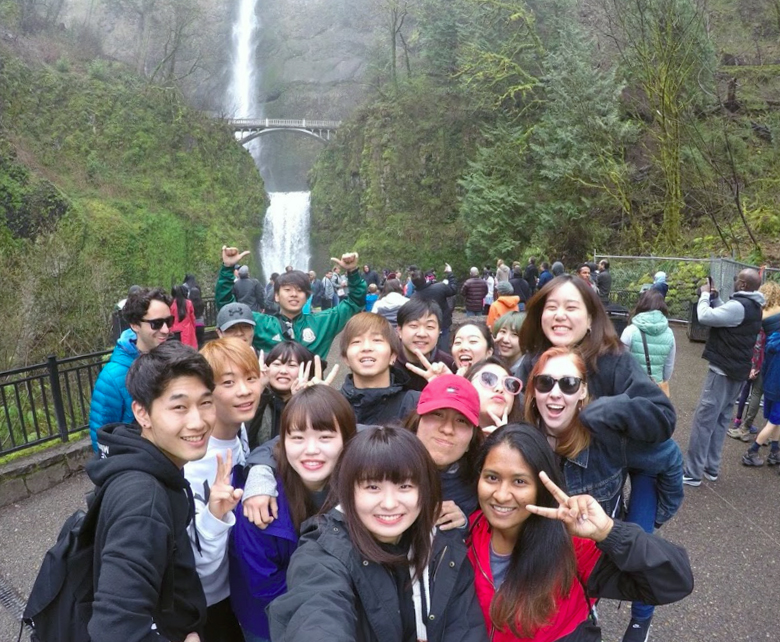
    Kotaro Kawakubo​ is an international student from Tokyo, Japan who will lose his friend when a second language program shuts down in July.

    “A friend I met here from China is leaving and going to a university in Seattle to study English. I will miss him,” Kawakubo said.

    The International English Language Institute has been open for 30 years. The Center for International Programs that houses the IELI program is downsizing, resulting in a lack of funds. Humboldt State’s financial crisis is the cause.

    “Without this program I will lose my friends I made here that came from other countries to learn English,” Kawakubo said. “They want to stay here, and keep studying English, but they have to go to other universities where there are English language programs.”

    This year Kawakubo returned to the IELI program for a second round. He returned to Humboldt County on March 9.

    Kawakubo plans to go to College of the Redwoods to study English after the program ends, and then transfer back to Humboldt State University.

    He heard about the program closing from his host mother who works at the center.

    “One day, she looked so sad,” Kawakubo said. “She told me the program is closing. Her coworker can’t get next year’s job at the office. She had to move to a different job because of the budget cuts.”

    Tyl​er Bradbury​, academic program coordinator of IELI, emailed host families on April 3 to inform them about the program closing.

    “This was a somewhat sudden and surprising decision I was informed of late last week. I cannot thank you enough for opening your homes and your hearts to the students,” Bradbury said in an email. “It breaks my heart to have to deliver this news.”

    ​Mikayla Kia is an international studies major who ​works closely with the IELI students. Kia is also vice president of the Global Connections Club.

    “Not having the international students would leave an empty space, because when the IELI students come to the club meetings, that is like half the room,” Kia said. “I don’t know what it’s going to be like without them.”

    An employee at the center connects the IELI students to the club. At the club IELI, students play board games, sports and go on sightseeing trips around Humboldt.

    “I’m sad and confused. They bring such joy here. It’s crazy to know they won’t be here,” Kia said. “I feel like they pay so much to come to this school. It doesn’t make sense to me how cutting the program can save money?”

    Angelica Huerta is a chemistry major who works at the center. She is a coordinator for Takachiho University, a Japanese school in Tokyo.

    Huerta plans activities every day for three weeks for the students, and helps integrate the students into American life.

    “A lot of the IELI student recommend the program to other student in their country,” Huerta said. “The students make a presentation in their school about their experiences, and what they learned. They promote for us.”

    Ge-Yao Liu, director of the center, lost his job. A second staff member accepted a job at a different department on campus. A third staff member will transfer to another department when IELI closes.

    Huerta said that Ge-Yao Liu made the students a priority.

    “Ge-Yao Liu was super nice. He would constantly say hi to students. He would ask the students their name, ask where they were from and why they came here. He was like a cheerleader,” Huerta said.

    Carl Hansen, the dean of Extended Education, met with the provost Alexander Enyedi last month.

    “When I looked at the numbers, it was very clear that they did not have the student population to support the program,” Hansen said. “I made a recommendation to the provost looking at the financial report. Once I laid things out for the provost, we had conversations and he agreed that this would be the best thing to do.”

    Hansen said he struggled with creating a sustainable program. A large part of the budget was strictly for recruiting, which meant sending staff abroad to visit partners.

    “We eliminated positions that the general fund was paying for,” Hansen said. “In some ways, it made the budget situation worse because the recruitment effort had not delivered. The budget gave us the incentive to make the program changes.”

    The center is relocating from the Feuerwerker House to the Student and Business Services building. The center will be inside the office of the College of Extended Education.

    “We are still interested in attracting international students, particularly exchange students,” Hansen said. “The difference is those students have the language skills. They would take English in their home university where they are at a level to speak, and then come here.”

  • Struttin’ the walkway internationally

    Struttin’ the walkway internationally

    An international fashion show

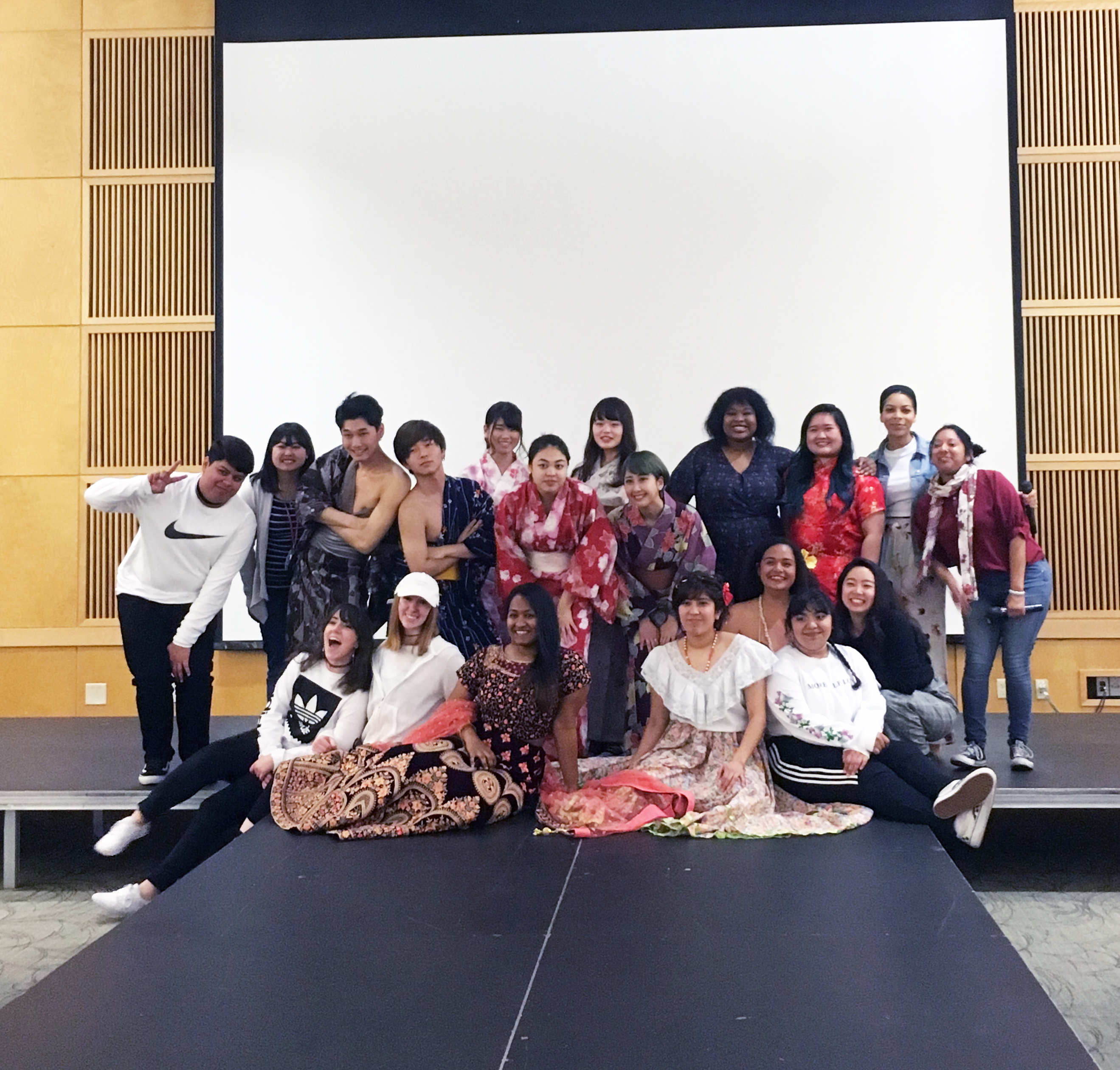
    Participants were invited to come dressed to represent their own cultural background or other cultures that interested them. Seven countries and cultures were represented with attire from China, India, Japan, Mexico, West Africa and Hawaii, as well as culturally significant and traditional dances from Mexico, Hawaii and Korea.

    Guests were greeted by Global Connections Club member and secretary Amanda Madden for the International Fashion Show at the Kate Buchanan Room on April 4. Her introductory speech highlighted the importance of inclusion and disregarding preconceived notions.

    “It is important that we sit here and keep in mind that this is a safe space,” Madden said. “We need to ignore cultural assumptions and preconceived notions regarding culture and tradition.”

    Representing her culture in dance and fashion was Humboldt State sophomore and Global Connections Club member Mikayla Kia, 20, dancing Hula ‘Aauna from Hawaii.

    “We just really wanted to put on another big event from the Global Connections Club for all the students involved, just before everyone leaves to go back home,” Kia said. “A lot of students are here with the IELI program from Japan, but it’s really sad because we just found out the program is getting cut after 30 years, and so this is the last group of students we get to host.”

    The IELI, or Intensive English Language Institute, was a foreign exchange program aimed to assist exchange students from 11 countries in acclimating to American culture and education, as well as becoming proficient in the English language. After HSU’s financial crisis was brought to light, the administration decided that defunding this program would help allocate funds to other exchange and international programs.

    “Even though it is really sad that this is the last group of IELI students, I feel like we are going out with a bang and they are all representing Japan today on the runway,” Kia said.

    Models on the runway strutted their stuff to the beat of legendary drag queen RuPaul’s hit single “Supermodel,” before stopping to talk about the cultural and familial significance behind their dress and presenting a brief powerpoint about the history.

    In addition to the fashion show, some models also took the opportunity to perform traditional or traditionally-inspired dances representative of their cultures.

    Anastina Steiber, Danny Flores, Caroline Mora and Dom Richards, members of the Global Connections Club, performed K-Pop-themed choreography to the song “As if It’s Your Last” by Korean girl group BLACKPINK. The group spent several weeks cultivating and rehearsing the choreography, which they debuted at HSU’s Lunar New Year celebration. They were inspired to do so by their love for dance and Korean culture.

    “We actually first performed this at this year’s Lunar New Year celebration on Feb. 16,” Steiber said, “and there weren’t too many people there so it wasn’t that intimidating, but today there were more people and the runway was pretty unnerving to dance on.”

    “I’m so sweaty, but that was awesome!” Richards said. “We all did so great, no obvious mistakes.”

    Mexico was also represented in dance by Daniel Gomez, 22, who performed an incredible rendition of the Jarabe in his fifth time at the International Fashion show.

    “I’ve been doing this since I’ve gotten here in 2013,” Gomez said. “I’m a dance minor here at Humboldt, and it’s pretty cool that Folklorico is taught here, but the program is definitely underfunded even though a lot of people are passionate about it.”

  • International students promote diversity at Global Cafe

    International students promote diversity at Global Cafe

    A collective gasp was heard across the HSU Library Fishbowl after Pakistani exchange student and Humboldt State business major Archana Nilhani made a shocking statement.

    “You can go to jail just for celebrating Valentine’s Day there,” Nilhani said.

    Nilhani delivered an insightful presentation on her home country of Pakistan during Global Cafe on Tuesday.

    The presentation is part of a semester-long series put on by HSU Clubs & Activities and Associated Students, known as the Global Cafe.

    With 61 students in attendance, attendees were offered coffee and a traditional Pakistani dessert known as gulab jamun at the entrance.

    The presentation consisted of basic information about Pakistani geography, the different cultures within the country and a brief look into the history of how Pakistan came to be. The presentation went so far as to even address certain social justice issues in Pakistan and contrasted them to issues we have to deal with in the United States.

    Nilhani was excited to be at HSU and enjoyed her experience as an international ambassador. She also shared what she planned to do with her experience as a business major.

    “I want to help blend cultures through clothing and fashion design. I am really lucky to be here on a scholarship,” Nilhani said. “The government wants me to pursue my dreams.”

    Of the many students in attendance, Gary Ploenus, an international student from Germany, looked forward to this event.

    “Being an international student myself, I thought it would be very interesting to not only learn about other cultures, but see how Americans react to learning about other cultures,” Ploenus said.

    Molly Kresl is a coordinator for the Clubs & Activities office.

    “The school has been trying to do a better job [of] getting international students engaged in the student life,” Kresl said. “We are hoping to give current HSU students a chance to understand other cultures and see what they are like.”

    Kresl hopes to include presentations by people of indigenous descent for the next semester and also encourages students to approach her if they want to do their own presentation.

    The next Global Cafe, presented by an Italian HSU student, will be on March 21 in the same location at 5 p.m.

  • International students first few days in the U.S.

    International students first few days in the U.S.

    As the spring semester approached, Humboldt State University welcomed new foreign exchange students. Archana Nihalani from Pakistan and Gereon Ploenes from Germany are two of the new incoming students. Nihalani came from Hyderabad, a city located in the Sindh province of Pakistan, and Ploenes came from Nijmegen, a city in the Dutch province of Gelderland where he resides. Both had stories to tell about their first few days in the U.S. before the spring semester started.

    Nihalani thinks that people are too polite.

    Archana Nihalani from Pakistan. Photo by Ahmed Al Sakkaf

    “People here say thank you a lot and sorry a lot,” Nihalani said. “A lot of times and I’m not used for this.”

    Saying thank you and sorry too much is considered a very formal behavior in Pakistan, according to Nihalani. It may mean that a person has too many boundaries.

    “Here [U.S.], if you don’t say ‘thank you’ or ‘sorry,’ it’s rude,’ Nihalani said. “But there [Pakistan], it’s rude if you say ‘thank you’ and ‘sorry’ all the time, because it means that you’re being too much formal.”

    Nihalani described food to be her worst struggle. She thinks the food here is too plain and lacks flavor.

    “Food here is plain,” Nihalani said. “I’m not used to eating plain food with no flavors… it’s too plain. In Pakistan, we put so such spices in food, so many flavors.”

    Nihalani thinks that people here in the U.S. have more personal space than their counterparts in Pakistan. She also notices that people here are easily offended.

    “People here [U.S.] have so much personal space and there [Pakistan] we don’t have so much personal space,” Nihalani said. “Everything here offends people I don’t know why? They get offended very easily.”

    Ploenes from Germany residing in the Netherlands. Photo by Ahmed Al Sakkaf

    “The first impression I had of the U.S. [is] that it’s exactly like the movies,” Ploenes said. “The J cafeteria and how it works… it’s really like the High School Musical.”

    To save money on his flight, Ploenes flew to San Francisco International Airport and took the Greyhound bus to Arcata. He was surprised when a Greyhound worker asked him several times if he is carrying any guns in his oversized backpack.

    “The guy working in the Greyhound asked me five times if I carry guns in my big backpack,” Ploenes said. “It’s not normal to carry any guns in Europe. You’re not allowed to. But in America, guns are normal.”

    Ploenes was also surprised by the amount of “big cars” and pickups he found in the streets here.

    “I’m not used to seeing a lot of pickups and a lot of big cars. Why [do] people need these big cars?” Ploenes said.

    Ploenes noticed that the toilets here in the U.S uses a lot of water to flush and they have a lot more water in their bowls too.

    “Toilets are totally different here,” Pioenes said. “You use a lot of water to flush.”

    Both Ploenes and Nihalani think that people here are very kind.

    “I was surprised with how friendly the people are,” Ploenes said.

    “People are really nice here,” Nihalani said. “They’re very helpful.”


  • Farewell time

    Farewell time

    * Ahmed Al-Sakkaf works as front desk student assistant for the Center for International Programs

    The Center for International Programs hosted a farewell party on Saturday for international exchange students who are going back to their home countries. They are leaving with unforgettable memories they’ve made here at Humboldt State.

    Sonja Willigerode is a German exchange student studying Business. During her semester at HSU, Willigerode took a sustainability-focused business class.

    In Germany, Willigerode studied economic theory which was “just about money and trade,” she said.

    At Humboldt she learned how to apply that same theory in an environmental context.

    “I studied economic theory in Germany and it was just about money and trade,” Willigerode said. “But here you learn how you can apply it to environmental context.”

    This is Willigerode’s last semester of study and she chose to spend it abroad here in HSU.

    “It was the best semester in my whole studies,” she said. “I’m so thankful that I can be here and stayed this semester.”

    Linus Kaminski is another exchange student from Germany. He’s majoring in Water Resources Management. Kaminski loves Humboldt and thinks it’s beautiful.

    “I like the area here. It’s so beautiful. The ocean the forest it’s beautiful,” he said. “There aren’t many places where I can see deer and raccoons on just my way walking from my dorm to the library.”

    Kaminski celebrated Thanksgiving for the first time this year. He celebrated it with the family of one of his American friends. He also played American football for the first time.

    “This year it was my first Thanksgiving and it was really cool, I really like it,” he said. “There was so much to eat. I also played football it was my first time playing American football and it was so much fun.”

    Ruby Saint a bilateral exchange student from Australia. Students in the bilateral exchange program pay their tuition fees at their home university and study abroad at another university. Saint grew up in Tasmania and previously studied at the University of Tasmania in Hobart. This year she also celebrated Thanksgiving for the first time. She and her friends had a Friendsgiving celebration.

    “That was interesting , we had like a Friendsgiving,” she said. “It was interesting to kinda experience Thanksgiving.”

    Saint thinks Humboldt is “kinda quirky and interesting,” she said. Saint arrived to the U.S. few days before the beginning of the fall semester. She flew to San Francisco and took the Greyhound bus to Arcata. She was shocked by the smell of weed in the bus.

    “I was like shit where am I,” she said. “Marijuana back home is a big no-no. If the police smell it on you’re done.”

    Here in Humboldt Saint discovered her love for Pumpkin pie.

    “Pumpkin pie, I need to take back and make a thing there.”

    Yasmina Umarkhanova an exchange student from Kazakhstan studying Psychology. When she first arrived in the U.S. at the beginning of the fall semester, she was amazed by the redwood trees.

    “I was really amazed by the redwood forest,” she said. “I really like the fact that I’m living in a forest.”

    Umarkhanova is going back to Kazakhstan in two weeks. She going to miss the redwoods the most.

    “I’m going to miss the forest,” she said. “When I’m walking and looking around, it’s meditation every day.”

    As Umarkhanova reflects on her semester abroad experience at HSU. She thinks it’s the best “chapter” of her life.

    “Humboldt for all international students was one chapter of our lives,” she said. “For me, this chapter of my life is the best.”