The Lumberjack


Students Serving The Cal Poly Humboldt Campus and Community Since 1929

Tag: Intersectionality

  • Humboldt takes on the Public Interest Environmental Law Conference

    Humboldt takes on the Public Interest Environmental Law Conference

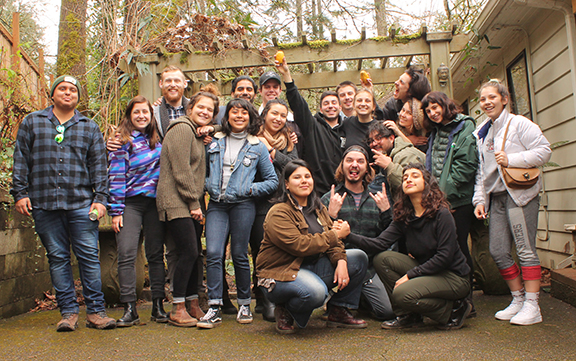
    Students and professors from HSU traveled to the University of Oregon to attend the Public Interest Environmental Law Conference focusing on environmental issues and global sustainability.

    A group of Humboldt State students drove six hours through rain, hail and snow to the Public Interest Environmental Law Conference, or PIELC, at the University of Oregon this past weekend.

    The four-day conference featured speakers, panelists, activists and organizers from all over the world. Two of them were Humboldt State professors. This diverse group of people came together in one space to discuss current environmental issues and the legal work fueling their fight to global sustainability.

    Brooke Holdren, a senior at HSU majoring in biology, brought a scientific perspective to the event. She encourages bridging the gap between the sciences and humanities in terms of environmental activism.

    “People from all different facets come here,” Holdren said. “So you have the people practicing law along with the anarchists and the homesteaders. And you see everyone working together in this really unconventional way.”

    This year’s conference pushed the theory of intersectionality, their “buzzword” for the weekend. Intersectionality is a concept that came from the early 1900s feminist movement and is the idea that all aspects of humanity – race, class, sexuality and geographic location – are all interconnected and cannot exist separately.

    Intersectionality is now being applied to environmentalism with the understanding that environmental problems and social injustice are interconnected.

    James Bradas is an environmental studies major at HSU who found a sense of agency in going to the conference.

    “I came cause I give a damn, and that’s half the battle,” Bradas said. “Our major is very activism-based, but you can’t escape the insular bubble, so being here is a real eye opener. To actually see the faces of the names we’ve read is a reminder that you don’t need a whole lot of money to do something and be active.”

    Conference guests ranged from guerrilla tree climbers and food justice-based farmers to representatives from the Center for Biological Diversity and EarthJustice – people pushing for justice and equity for humans, as well as the natural world. The event offered students an opportunity to network with other environmentalists and get more involved in the world of activism.

    Samantha Garcia, an environmental studies senior at HSU, thought the conference brought a welcome shift in the tone of environmental conversations.

    “As an environmental studies major, it can get depressing, and you absorb the negative energy from what we’re learning,” Garcia said. “So, it’s refreshing to be around all of these like-minded people.”

    The weekend provided a wide range of activities for conference attendees to participate in. However, not all came without criticism. Some were pushing a very aggressive version of activism. Holdren was able to take a step back and see the positives, even from this negativity.

    “There were a lot of things within and without of PIELC that were really problematic,” Holdren said. “It’s good to bring a critical lens to something like this and take what you want from it, but also learn from it in the sense of how not to go about things.”
  • Finding an interdisciplinary approach to sustainability

    Finding an interdisciplinary approach to sustainability

    Armed with their usual commitment to sustainability and an updated mission statement, the Waste Reduction and Resource Awareness Program (WRRAP) is starting to integrate intersectionality into their brand of environmentalism.

    WRRAP started as an on-campus recycling program in 1989. Their goal has always been to reduce waste coming from HSU through environmental education. Since its inception, the organization has expanded into compost diversion, water quality assurance and a reusable office supply exchange.

    This semester, the organization is attempting to bring together two important fields of activism by designing this semester’s projects with inclusive sustainability in mind.

    “Environmentalist” is a label that comes with a dark history of eugenics, exclusivity and barriers that WRRAP is attempting to dismantle on a local level. The campus-based organization WRRAP recently hired an environmental justice intern with the intention of making sustainability more accessible for all HSU students.

    Lauren Wardle, the newly hired environmental justice intern, has experience running an intersectional feminist club and wants to bring those concepts to her position.

    “Social issues go hand in hand with environmental problems,” Wardle said. “Environmental justice and intersectionality will bring in the voices of the communities that are most affected.”

    The program’s main goal is to ensure that HSU students are using their available resources to the fullest extent. WRRAP’s first environmental justice project will be a campus-wide survey to assess students’ access and understanding of sustainability.

    Shanti Belaustegui Pockell, an environmental studies major, WRRAP’s education director and intern coordinator, hopes the internship will help shift environmentalism into something more accommodating for everyone.

    “Instead of trying to get more people into this little space we have created, we want to expand the circle,” Pockell said. “We are reimagining what sustainability can look like, because a lot of people are living sustainably, just without the label.”

    Irán Ortiz, environmental studies major and director of the student-led campaign Take Back the Tap, credits WRRAP’s leadership and innovations for social justice.

    “We need to bring together the communities that are affected, but ignored,” Ortiz said. “I hope this new position helps address the problems we see in our institution by creating a new perspective and understanding of intersectionality.”

    When environmentalism is executed with an intersectional lens, social and environmental issues are looked at as one. To put it another way, it is the understanding that all oppressions exist under the same hegemonic systems.

    Ryan Sendejas, environmental studies major and community garden coordinator at Campus Center for Appropriate Technology, realizes the importance of incorporating environmental justice into an institution.

    “In society and bureaucracies specifically, we tend to compartmentalize everything in an attempt to understand it,” Sendejas said. “Nothing is truly singular. So, we need to start thinking in terms of interconnectedness.”

    WRRAP will be hosting a Zero Waste Conference on Feb. 9 and 10. Look out for flyers around campus for more details!

    For more information about WRRAP, visit their website HERE.