The Lumberjack


Students Serving The Cal Poly Humboldt Campus and Community Since 1929

Tag: Israel

  • Student protestors barricade themselves inside Siemens Hall, demand end to war in Gaza

    Student protestors barricade themselves inside Siemens Hall, demand end to war in Gaza

    by Dezmond Remington

    Dozens of students barricaded themselves in Siemens Hall and hundreds more swarmed the UC quad to protest the war in Gaza and to demand Humboldt stop associating with Israeli organizations.

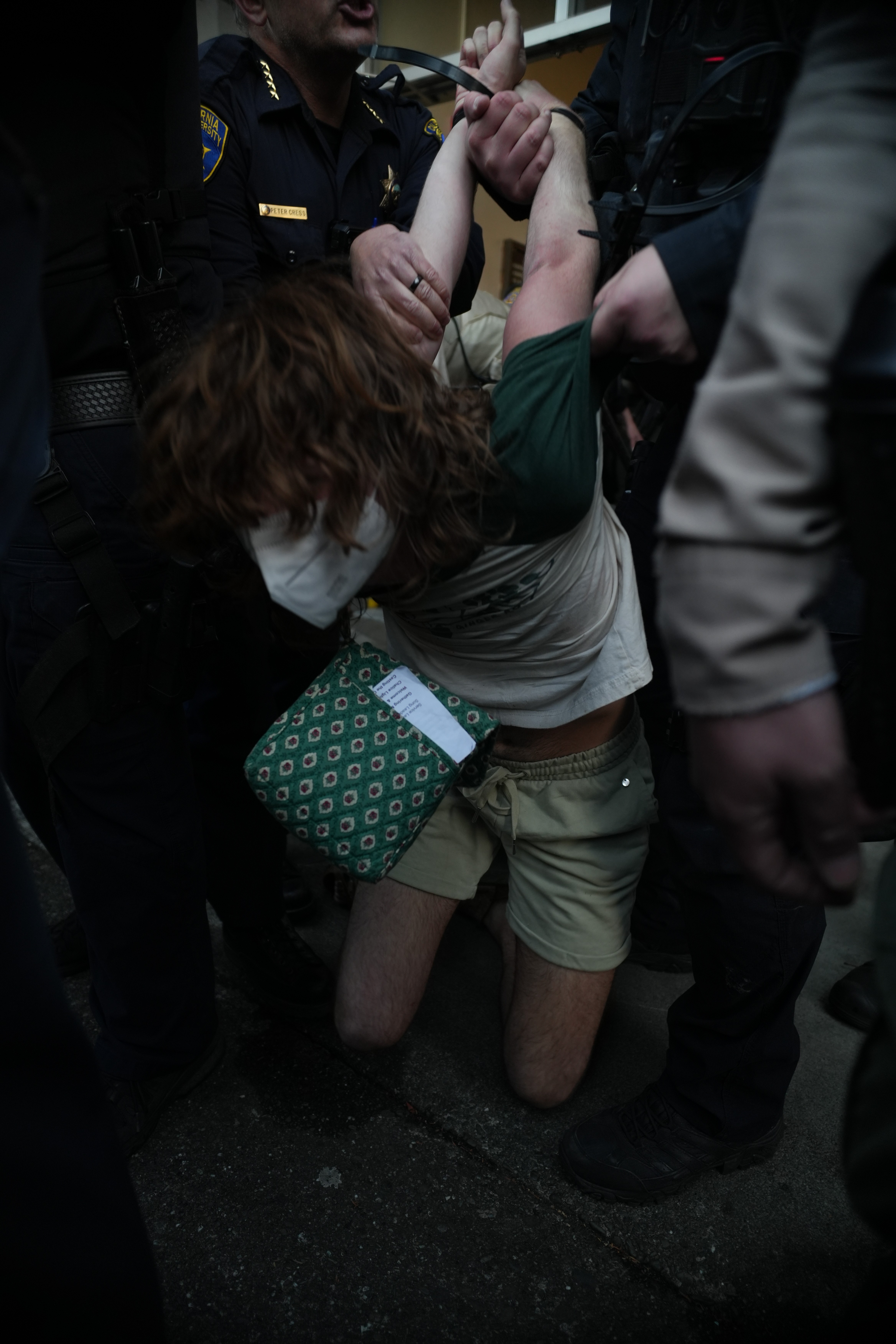
    At least one person, local teacher Alice Rose Finen, was arrested by the University Police Department. She was released on Monday night. 

    The protest started at around 5 p.m. on April 22, when a few protestors showed up to Siemens Hall. They piled chairs and tables up in front of entrances. The five classes being taught in Siemens were evacuated. Police arrived soon after, as did a California Highway Patrol helicopter.

    As of publication, the protest is still ongoing. Dozens of students occupy Siemens, and doors have mounds of office furniture blocking them. Though there’s no consensus, they plan on staying until their demands are met or they are forcibly removed. Several occupiers broke into university president Tom Jackson’s office by shattering the window on the door. Siemens Hall is covered in graffiti, as is the outside of the Van Duzer theatre. The American and Californian flags were taken off of the flagpole in front of the library by a man with climbing gear. 

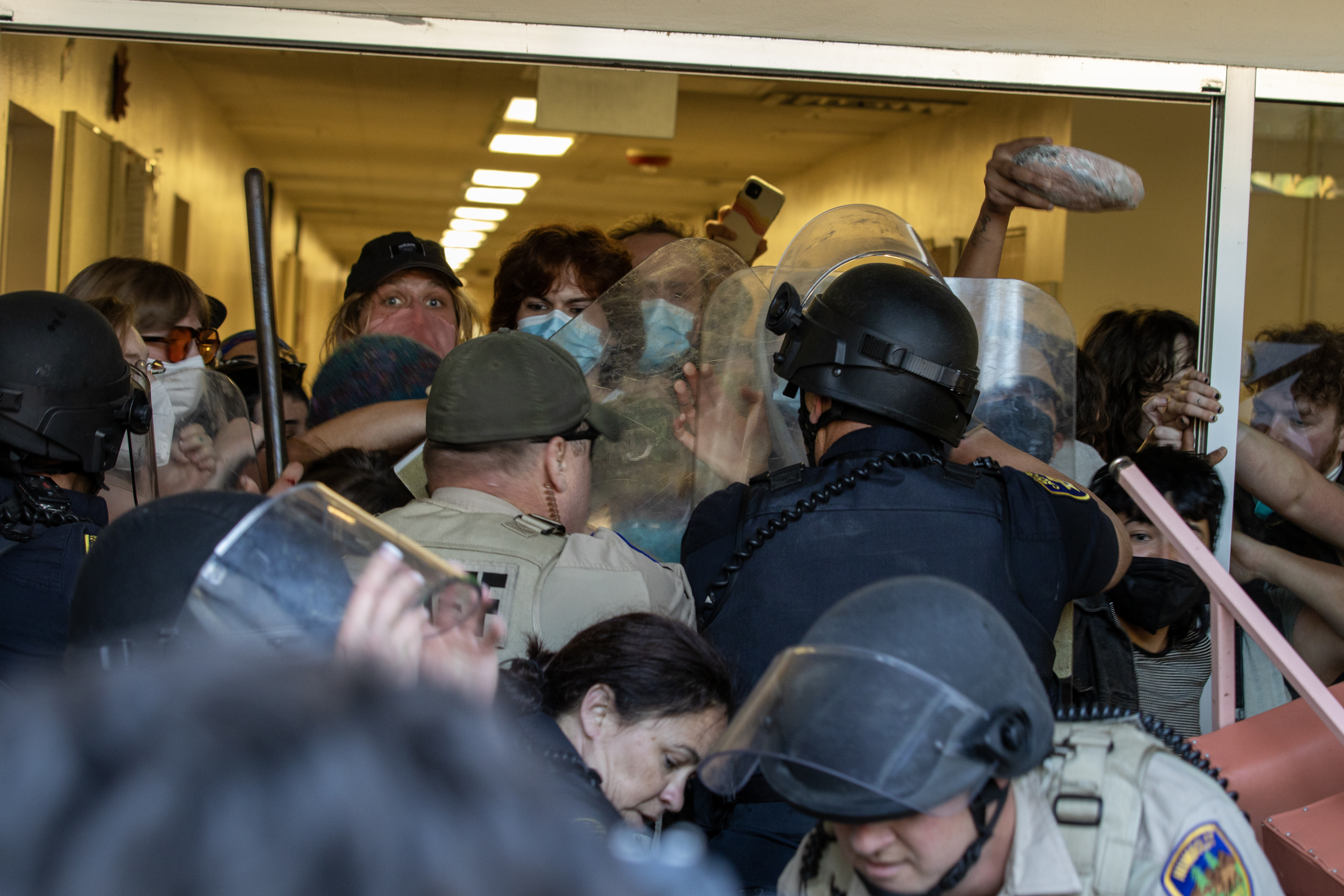
    For hours, student activists inside Siemens Hall were only a few feet away from the police on the other side of the main entrance on the second floor. Cops showed up from all over Humboldt, including the California Highway Patrol, Humboldt County Sheriff’s Office, and even some officers from as far away as Rio Dell. At one point, police scanner traffic indicated riot control police from Redding were coming to campus, but they never showed up.

    Police left at 11 p.m. on April 22, and those inside tore the barricades down. Over 100 students entered the top floor, walked to the end of the hallway, turned around, and left. After that, the protest dwindled to less than 100 people, most of them outside. People played music and barbecued. 

    The occupation had been generally peaceful, but violence broke out at around 7 p.m. when police tore down the barricade and entered Siemens Hall. A line of law enforcement with riot shields and a crowd of activists crushed together, and a protester inside hit an officer with an empty water jug. At least one officer retaliated by bludgeoning a protester with a baton. Other reports of students being batoned are circulating, but unconfirmed. 

    The main demands of the protestors are: to end the war in Palestine, for the university to disclose any dealings with Israeli companies or the Israeli government (and end those relationships if they exist), cut all ties with Israeli universities, and for the university to end prosecution of student activists. Many of the same demands student activists all over the nation are demanding at universities such as Columbia and UC Berkeley.

    “We’re doing this out of principle and righteous rage for our comrades,” said Casey, one of the protestors who was inside the building before the police left. “We want to make this happen at other universities across the nation.”

    Another one of the protestors, who asked to be identified as “Bum,” was one of the first to blockade inside the hall. They decided they would join their friends the day before the protest was planned. 

    “When the homies started talking, I was like, ‘Yeah, dog,’” Bum said. “It’s time to fight genocide in general. It’s time to stand up with our Indigenous homies. [We’re occupying the building because] trying to dialogue with the oppressors doesn’t work well.”

    Cal Poly Humboldt has not responded to a request for comment on its ties to Israeli institutions.

    Some of the people at the protest weren’t there to demonstrate. Students thronged the balconies of the Student Activities Center and crowded around the main cluster of activists in front of Siemens Hall to watch the action, many of them on their way home from class. The helicopter hovering overhead attracted many sightseers.

    “Nothing ever happens in Arcata,” said Shawn Rogan, a curious student. “It’s novel for a small campus, and [the war in Gaza] is a cause worth protesting.”

    One of the biggest concerns the protestors had was the heavy police presence. Before they left, those barricaded inside the building said they would negotiate once the police were gone. One protester blockaded inside who asked that he only be identified as “Joe” said he would stay there until he was fought off by law enforcement.

    “I’m going to resist,” Joe said. “If they beat me, they beat me.”

    Protestors chanted anti-police slogans at law enforcement to try to get them to leave, and many of them tried to talk some officers into leaving. Communications professor Aaron Donaldson argued with Rio Dell’s Chief of Police Greg Allen and two other officers outside of Siemens Hall for over half an hour. Donaldson attempted to make the case that they could decide to leave. Allen disagreed. 

    Cal Poly Humboldt has made it clear they want protestors to leave Siemens Hall and to return home. As of April 23, graduation is still planned to happen on May 11.

    “The University supports free speech through open dialogue that is respectful and constructive, but will not tolerate endangering people, destroying property, and disrupting campus,” read an alert published on April 23. “As a community, we are committed to keeping our students, staff, and faculty safe and fostering a learning and working environment where the campus community can feel safe, included, and respected.” 
  • Behind the Barricades: Inside Siemens Hall

    Behind the Barricades: Inside Siemens Hall

    by Andres Felix Romero and Jasmin Shirazian

    Due to potential ramifications, some individuals interviewed for this article are only identified with pseudonyms.

    By the afternoon of April 23, President Tom Jackson’s personal porcelain throne was up for free use by the pro-Palestine protesters occupying Siemens Hall after a broken window allowed occupants access to the presidential suite.

    After the police had withdrawn from the entrances of Siemens Hall around 11 p.m. on April 22, the protestors opened the doors and barricades to embrace their compatriots outside. Once the students committed to staying the night, they got to work building barricades around the building entrances. Despite the action not being organized by a specific individual or organization within 24 hours, protesters such as Naomi Chambers felt compelled to act in support of Palestine.

    “[This action] was loosely organized,” Chambers said. “This has been six months of boiling rage. [This action is run by] like-minded youth that want to see Palestine liberated.”

    With law enforcement gone, the protestors got to work around Siemens hall to secure themselves inside out of fear of another clash with police. Protestors sealed the doors with chains, locks, and fire hoses. The occupants then gathered chairs and desks throughout the building and barricaded each of the entrances. Doors were removed from hinges and bulletin boards from walls to be recruited into the barricades. The staircases leading to the second floor of the hall was barricaded as well. 

    What was meant to be a sit-in protest had turned into a full-on occupation of Siemens hall following the clash between protestors inside the hall and the multi-departmental police force including agencies from Arcata, Eureka, Ferndale, Fortuna, California Highway Patrol, and Cal Fire. Students who clashed with the police, such as Friend UU, felt frustrated about the police’s action during a prayer circle led by an indigenous student. According to UU, it was officers in tan uniforms at the front lines against the protesters in Siemens Hall.

    “We were just chanting and [law enforcement] weren’t doing anything,” UU said. “But then, the second Indigenous students [began to pray], that was the moment they started pushing. I mean, how evil is that?”

    Meanwhile, protestors outside of Siemens Hall erected barricades at the entrances. Some also slept or stood guard outside of the hall, behind the outdoor barricades. 

    Jasmine Jolly, a child development and family relations major, was one of the student protesters outside. 

    “I’m really showing up as support,” Jolly said. “I have been trying my best to hold it down outside so that people inside know they are supported and that they have allies backing them up, and if necessary, blocking the entrances.”

    Jolly was at the protest from 8:30 p.m. on April 22 to 3:00 p.m. April 23. They carried a black megaphone that amplified their voice for the crowd. 

    “I was leading some chants last night, but I was not the only one by a longshot,” Jolly said. “It was very organic. When someone’s voice started to give in, another person’s voice would take over. It was like a community.”

    According to Jolly, the community came together to ensure the safety of protestors. There was not a single leader, but rather a collection of voices.  

    “This is a group of people really working together to try to get voices heard,” Jolly said. “This was a community showing up in support of those inside, and even people inside, there’s not a ‘single’ leadership.”

    After the building was secured, the occupiers settled in. Supporters outside of the building found ways to smuggle supplies such as food, water, medicine, hygiene products, and blankets into the building. 

    Students slept where they could. The occupants set up a sleeping area by the elevator, and a few students were able to erect tents in the hallways outside of the provost’s office. Some students chose to lay out sleeping bags in the hallway, while others found rest on the floors of empty classrooms left open. 

    The protesters began to create posters to hang on the windows as well as scrawled messages on the hallways throughout the building. One poster was created using bloodied bandages from an injured protestor. Messages in support of Gaza as well as condemning the police’s actions were scrawled on hallways, done with marker or spray paint. One protestor, Casey O’Connor, drew a mural depicting police striking their friend who was also protesting. 

    “I felt the need to convey what happened in a visual medium,” O’Connor said. “So that admin can not ignore the fact that students were bloodied in this building.”

    By the end of Siemens Hall rearrangement, the building felt surreal and almost out of a war zone. Doors were boarded up and students were camping underneath their written messages surrounded by supplies.

    The first night was spent resting, taking shifts watching the barricades for other potential law enforcement action, and strategizing next moves. There was a mix of emotions amongst the group such as anxiety, uncertainty, and exhaustion. However, the more prevailing emotions were a sense of pride and community. The protestors knew the odds may not be perfect, but they were emboldened by law enforcement withdrawing. 

    “I feel exhilarated,” Chambers said. “Everything in this world tells us [resistance] is impossible.”

    As the sun rose after the first night, some activists took more drastic measures to get a point across to campus leadership. At some point in the afternoon on April 23, an unknown individual gained access to Tom Jackson’s presidential suite through a door window and protesters entered the suite.

    Jackson’s suite had files looked through, wine taken, his desk left a mess, and as with the hallways, messages were written on the walls. Some of them noted the disgust they felt in their writings.

    “DO YOU CARE?” One message wrote. “Seeing this office made me sick. Students, Palestinians, so many people are in pain and struggling, while you have an empty office full of amenities. DO BETTER.”

    The protestors have vowed to remain occupying Siemens Hall until demands have been met. Despite the chaotic and stressful possibilities with this protest, the occupants are hopeful that the situation will be peaceful with its ending.

    “I was expecting to get arrested.” Chambers said. “I was prepared for everything to go wrong, but I was also prepared for everything to go right for us. I’m determined to hold onto that [hope].”

  • Students March on the Quad for Palestine

    Students March on the Quad for Palestine

    by Andres Felix

    On the morning of Wednesday, Jan. 24, students and faculty in and around the Gutswurrak Student Activity Center (SAC) stopped their activities and looked towards the quad. They could hear the chants and the drums long before the roughly two dozen demonstrators marched into the quad after beginning their demonstration at the Cal Poly Humboldt’s Children’s Center.

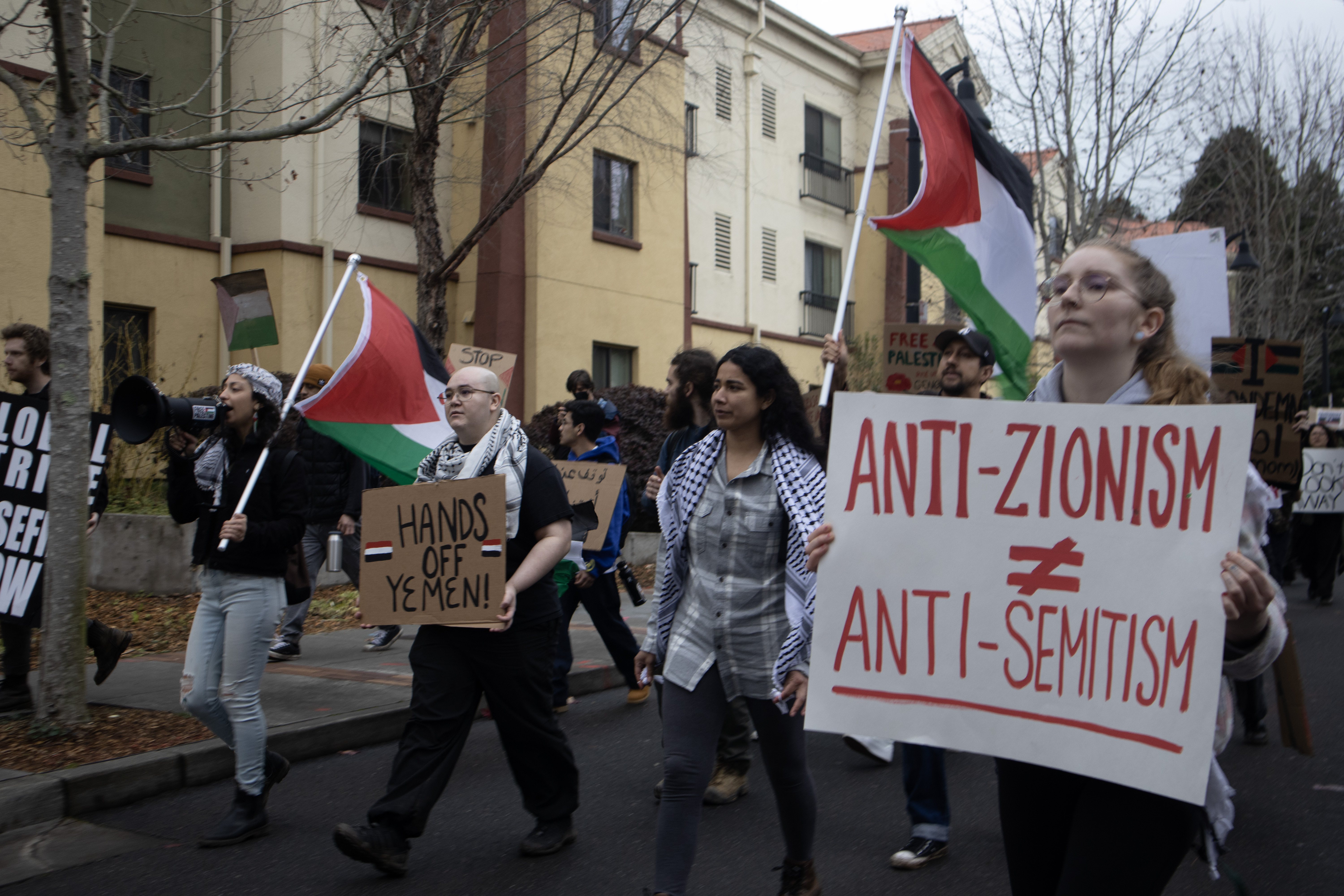
    The action was organized in part by Humboldt for Palestine, a collective of individuals from the community to support Palestine and protest apartheid. The demonstrators waved Palestinian flags, held their fists in the air, and held signs reading, “Resistance is not equal to terrorism,” “Don’t look away” and “Mourn the dead, fight like hell for the living.” Alongside this, the crowd chanted led by a demonstrator wielding a microphone.

    “Ceasefire now!” The demonstrators chanted. “Free, free Palestine! Gaza, Gaza can’t you see? Palestine will be free! No peace on stolen land!”

    After about 15 minutes, the demonstrators continued their march, passing by the library and chanting all the way.

    “Let. Gaza. Live!” They chanted to the drums. “No peace on stolen land!”

    The demonstrators eventually marched off campus, heading towards Wildberries. Maria Fragoso Calzada, a student who marched in the demonstration, feels that there are many parallels between her struggles growing up in Mexico and the struggles of the Palestinians in Gaza.

    “[I want] everyone to be liberated and supported,” Fragoso Calzada said. “[We need to] keep educating, because education is power and it’s liberation.”

  • Students honor Palestinian lives lost

    Students honor Palestinian lives lost

    by Jasmin Shirazian

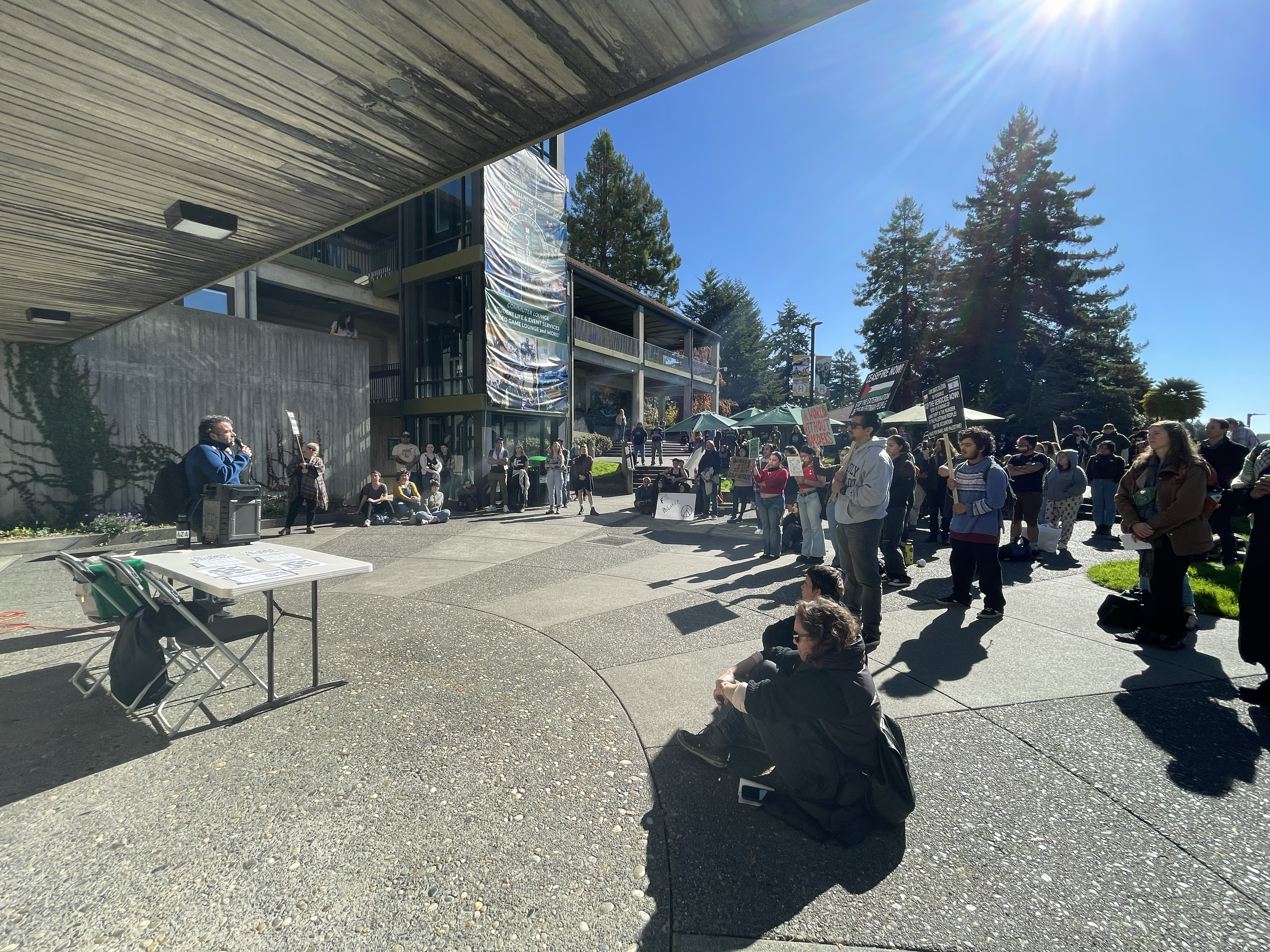
    Students gathered in the University Center quad on Oct. 27 for a vigil to honor the lives that have been lost due to the war in Palestine. 

    Student and organizer of the vigil, Jamilla, who has declined to share her last name, began by thanking the crowd for joining her to remember and honor the Palestinian people. She continued speaking about the attacks that had been launched onto civilians, mentioning the resilience of the Palestinian people and expressing thankfulness for the safety of her family members that are still in Palestine. 

    Jamilla passed the microphone to her friend and colleague, who told a personal story of growing up in New Jersey as a young Jewish girl, being told to collect donations for causes that funded tree planting in Israel and feeling responsible for the loss of lives after being informed on the history of the State of Israel. The microphone was passed to various students and faculty members who had prepared speeches entailing their experiences and calling for an end to the occupation of Palestine.

    Throughout the speeches, a few were able to form a volunteer group, with students and community members offering to be involved in gathering press, spreading awareness, helping with city council matters and more. Jamilla ended the vigil with chants for peace in Palestine as classes were being let out at 1 p.m. 

    Students and community members alike attended the vigil. Kiara Farias, a Critical Race and Gender Sexualities (CRGS) major, attended the vigil to become more educated on what’s happening in Gaza and the West Bank and to show their support for Palestinians. 

    “This is a humanitarian crisis,” Farias said. “[I am] forever and always going to be against genocide and going to [support] liberation for those like Palestinian people.” 

    Michael Steeleman, also a CRGS major, attended the vigil for the same reasons as Farais. 

    “I come from a population who was forcibly removed from their land and is still continuing to deal with that trauma,” Steeleman said. “I think it’s ridiculous to still view that and have that happen in the present day.” 

    Steeleman and Farias both believe that through unity, petitions, protest and creating opportunities to show community support, vital steps can be taken to make a difference individually and collectively. 

    One of the students who volunteered to help with organizing future vigils and protests is Margarita Fedorova.

    “I’m here because I feel pain – I heard the cries of Palestinians in Gaza, for people to draw awareness and support,” Fedorova said. “I’m Ukrainian, and we have a lot more in common than people may think. As long as we keep talking about it, things can get better.” 

    Jamilla, the organizer of this vigil, has been taking several initiatives to educate the community on what is happening, such as the history of resistance through embroidery. 

    “The level of violence that we are seeing happen right now is just the most horrific, egregious thing I’ve seen broadcast on TV,” Jamilla said. “I’m grieving. I have family and friends in Gaza that have lost their homes at this point. This is the least I can do to be speaking out against that, and organizing a collective response to end this horrible violence.”

    Jamilla believes that the university needs to have a stronger stance in response to what is happening to Palestinians. 

    “A neutral stance on this is unacceptable. The university really should be… acknowledging the level of violence of what this actually is, and not just taking a neutral stance because they’re worried about creating riffs or waves,” Jamilla said. “It’s about being against genocide, and our voices matter in bringing an end to that.”

  • Peace in the Middle East

    Peace in the Middle East

    An interfaith community panel discussion

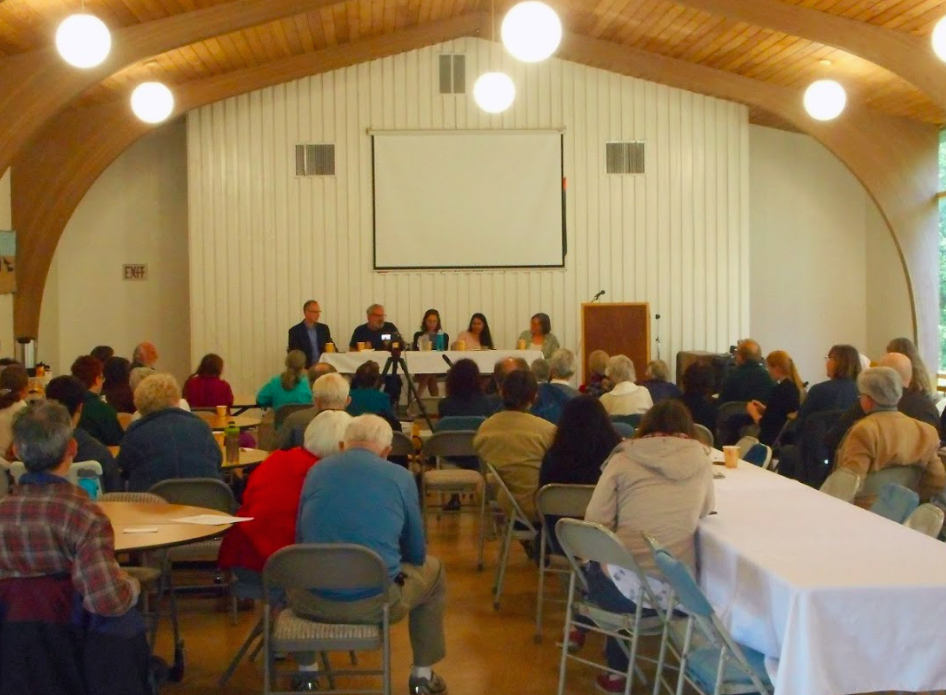
    Middle East peace and the role of the U.S. was a panel discussion from three professors from Humboldt State and an Israeli filmmaker. The three professors from HSU were history teacher Leena Dallasheh, and political science teachers Swati Srivastava and Kathy Lee. The Israeli filmmaker was Udi Aloni. The moderator was John Meyer, HSU chair of the history department.

    The panelists discussed how to give the Palestinians a voice. Palestinians have been consistently prevented from being heard.

    “There is an exclusion of Palestinians in public space, and they are villainized in their representation by the media,” Dallasheh said. “American weapons have been used consistently against Palestinians. American money has been used to support a system that continues to suppress millions of people and continues to prevent millions of others to return to their homes, despite international decisions. That is why as Americans, we have a responsibility to address the plight of the Palestinians.”

    There are Palestinian refugees in Berlin and Europe doesn’t want them.

    “If something terrible happened to a Jew in France, they can come home to Israel and be surrounded by Jewishness. An experience I’ll never forget is seeing Palestinian refugees in Berlin. They come to find refuge in Berlin where Europe doesn’t want them, when really their home is in Palestine,” Aloni said.

    The Palestinian situation is much worse than apartheid, it is an occupation.

    “In apartheid, you don’t have people shooting at you from point blank range,” Dallasheh said.

    It is not so much that Israel is using America, but America is using Israel. America pushes weapons on Israel.

    “Israel is a place of colonialism in the Middle East to serve the purpose of America,” Aloni said.

    The United Nations is supposed to support Palestine. In order to receive help from the UN, you must be an international state with recognition.

    “You have to be a state to have international recognition. Palestine can’t just call itself a new state, it must have international authority and recognition. This needs to happen and it hasn’t so far,” Srivastava said.

    The occupation of Palestine has something to be hopeful about.

    “With the decline of the U.S. in the world stage, and the decline of the U.K. because of Brexit, does not automatically mean that the new right will take over. It might mean that the new left will take over and perhaps different kinds of nationalism will flourish that will not rely on antiquated ideas of what a state is,” Srivastava said.

    A huge piece of the puzzle is the American arms industry and moving the American economy away from an industry of war.

    “Vote for people that pledge to move the U.S. economy away from where it is today,” Lee said.

    “The U.S. will enter trade agreements that will have nothing to do with weapons and make a provision in the agreement that the country will have to buy American-made weapons. That is something that we have been exporting for a long time. We should move away from these old models of trade agreements, supplying arms to countries that don’t even need them,” Srivastava said.

    Why should we care about this?

    “It is problematic that students coming to my class don’t know about this,” Srivastava said.

    In closing, we are reminded that this is a tough topic.

    “Gandhi said, ‘Almost everything that you do is insignificant, but it is important that you do it.’ That is the approach that we have to take,” Lee said.

  • This week in news (March 15 to March 21)

    This week in news (March 15 to March 21)

    Local

    -The Humboldt County Jail gets $20 million grant

    A $500 million grant was awarded to the state, 20 million will go towards the expansion of the Humboldt County Jail. The new structure is set to have a new parking level and two more levels for a day reporting center for probation, mental health, and programs that are centralized in the county.

    Source: News Channel 3

    -Drug task force makes a bust

    The Humboldt County Drug Task Force reported on March 17 that as part of a three-month-long investigation, three people from Bakersfield, California were arrested after they were found with over 2 pounds of methamphetamine.

    Source: North Coast News

    -Americorps prepares for cuts

    Last week was National Americorps Week, a time for the nation to celebrate a program that emphasizes community service. Americorps will lose its funding if the anticipated federal budget proposal is approved. President will cut domestic programs in an effort to increase the military budget.

    Source: Mad River Union

    U.S.

    -New social media rules for marines

    Amid a nude photo scandal, the U.S. Marine Corps has enlisted a longer and and more detailed social media policy that lays out the professional and legal ramifications for service members responsible for online misconduct.

    Source: CBS News

    -David Rockefeller dies at 101

    Billionaire philanthropist David Rockefeller, former head of Chase Manhattan Corp and patriarch of one of the most famous and influential American families, died on March 17, a family spokesman said. He was 101.

    Source: Reuters

    -Louisiana deputy shot and killed

    A sheriff’s deputy in Louisiana is dead after being shot near a movie theater in Baton Rouge on March 19. The deputy was was conducting an investigation with another deputy at a strip mall near the AMC movie theater when the shooting occurred.

    World

    -Israel’s defense system almost complete

    A senior Israeli air force official says a joint U.S.-Israeli missile interceptor will be operational soon, completing the country’s multi-layer defense system. The missile will be operational in April.

    Source: Washington Post

    -The Pope asks for forgiveness

    on March 20, Pope Francis has asked Rwandan President Paul Kagame for forgiveness for the “sins and failings” of the Catholic Church during the 1994 Rwandan genocide .

    Pope Francis acknowledged that priests, nuns and members of the Catholic church had succumbed to hatred and violence in Rwanda.

    Source: CNN

    -Britain’s path to Brexit

    A date has been set to Britain’s path to Brexit. On March 29, Prime Minister Theresa May will trigger Article 50. Article 50 is the European Union legislation that sets out how a member state can leave the organization.

    Source: Washington Post