Breaking down the power and importance of global funk music
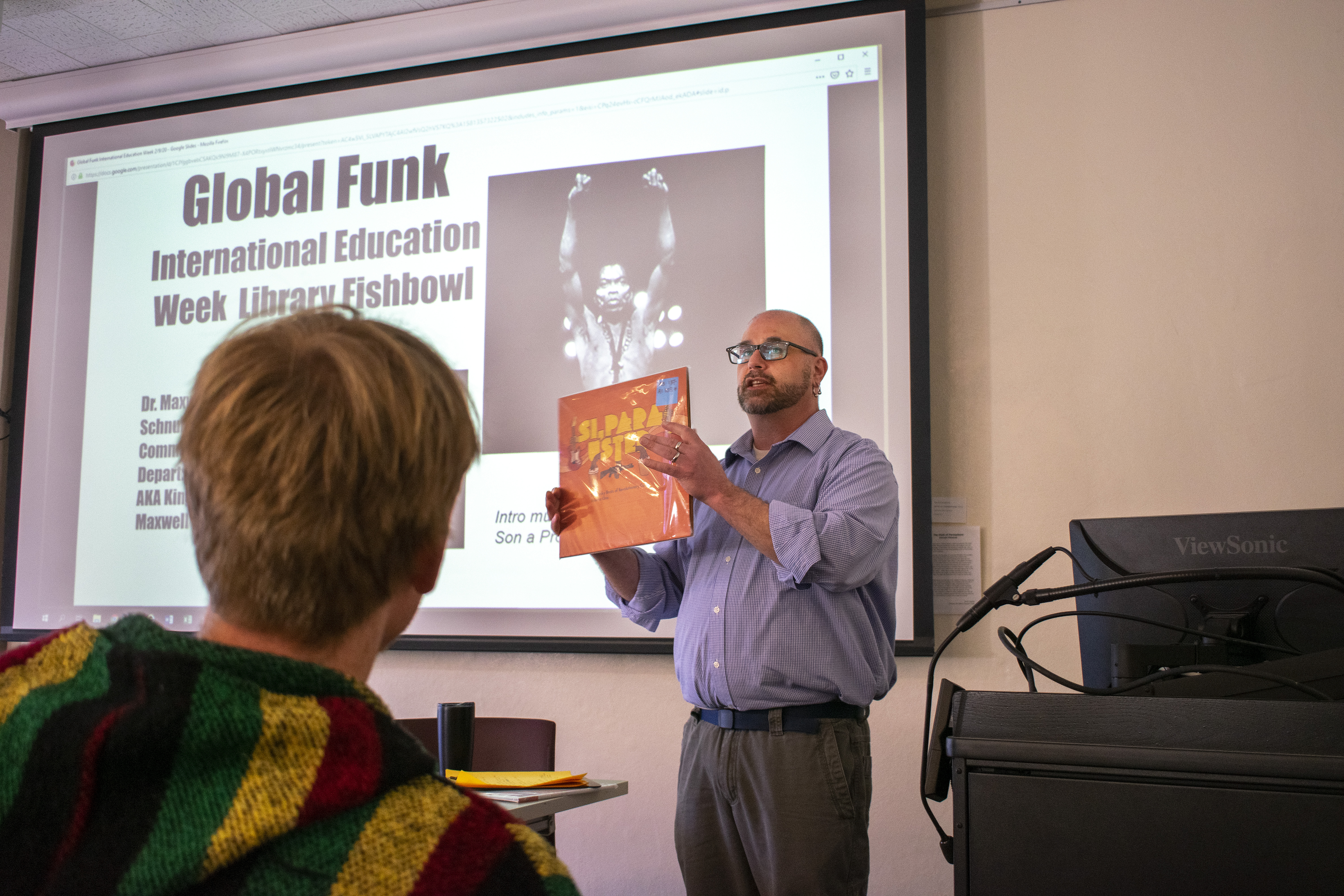
A few minutes into his talk on global funk music, local DJ and Humboldt State University Communication Department Chair Maxwell Schnurer stumbled into a definition of funk.
“If you want my definition of funk, that might be it: revolutionary praxis with a desire to get down,” he said.
Schnurer’s talk on Feb. 10 flowed quickly. His enthusiasm for the tracks he played trickled into the audience of about 20 students, who nodded and laughed along. But Schnurer later gave a more serious definition.
“I find global funk to be ethical, significant and real,” he said.
Alison Holmes, associate professor and the lead of the international studies program at HSU, facilitated the event. Holmes eagerly offered context to the presentation as part of HSU’s 20th Annual International Education Week. Schnurer’s talk was just one of 45 scheduled hours of material that over 1,000 students and staff were expected to attend.
“It’s a showcase for all the global things we do in the community,” Holmes said.
“I think that funk has a certain feeling. It makes you move and it makes you dance and it makes you feel all of these different things, but if you actually listen to it, the things that are being said are of importance.”
Skye Freitas, communication major and film minor
Near the end of Schnurer’s talk, he gave the audience a take-home message. Most music artists, he said, have been historically ripped off—especially artists of color. He urged students to pay artists for their work.
“Does that make sense? That ethically, as we move forward, we try to be aware of the politics of power,” Schnurer said. “And that often times means that we are going to have to pay up for information.”
After the presentation, Skye Freitas, a communication major and film minor, said she loved Schnurer’s presentation—Schnurer is her adviser—and gave a surprisingly passionate explanation of the importance of music.
“I think that funk has a certain feeling,” Freitas said. “It makes you move and it makes you dance and it makes you feel all of these different things, but if you actually listen to it, the things that are being said are of importance.”
Schnurer skipped across the globe with audio clips to give the audience a taste of different funk styles. The first stop: Nigeria and Afrobeat pioneer Fela Kuti’s song, “Pansa Pansa.”
“He hexes and challenges the Nigerian government at this level while being—literally at various points—a revolutionary and also a candidate for president of Nigeria,” Schnurer said.
“Honestly, this could be like an hour-long, three-unit course.”
Maxwell Schnurer, local DJ and communication department chair
The next stop on the funky foray was Brazil and the music of Tim Maia. In describing the Brazilian funk scene, Schnurer explained the underground spiritual game—or the use of funk music by artists to express their spiritual selves.
Schnurer called Maia’s album perhaps the greatest Brazilian funk album ever, but only after noting its joint inspirations of a heavy dose of LSD and a cult pamphlet.
“You know, those things I would maybe not be inspired by or take away from the Tim Maia story,” he said.
Schnurer flew the room to Japan to meet Haruko Kuwana, and then to India with a soundtrack from a compilation album, Pysch Funk Sa-Re-Ga! Schnurer said many funk tracks remain hidden as instrumental movie soundtracks. He finished with a short profile video on El Rego, a funk artist from Benin in West Africa.
Schnurer paused midway through the talk.
“Honestly, this could be like an hour-long, three-unit course,” he said. “If I were to criticize my own lecture I would say that there is something kind of disrespectful about name-dropping dozens of interesting global musicians without giving them all musical space.”
Rachael Thacker, another communication major, hadn’t taken any classes with Schnurer, but admitted she would attend just about anything he does for his interesting takes. Thacker knew little about funk.
“Just my first impression was that you can groove to it, you can dance to it and you can relax to it,” she said.
Thacker planned to ask Amazon’s Alexa to play some funk later.
A hand sprang up when the talk ended.
“Will you teach a class on this?” a student asked.
The group chuckled and Schnurer hemmed and hawed. He wasn’t sure.
While he pondered making a class out of the talk, Schnurer left the audience with an appropriately funky anecdote.
“Let me encourage that maybe it’s time to buy the like Thai funk box set for your brother for Christmas from Mike in the attic,” he said.