The Lumberjack


Students Serving The Cal Poly Humboldt Campus and Community Since 1929

Tag: journalism

  • Being a part of the fourth estate: The Lumberjack attends the ACP conference in La Jolla

    Being a part of the fourth estate: The Lumberjack attends the ACP conference in La Jolla

    By Griffin Mancuso

    One of the distinctive qualities of a journalist is that they never truly stop working. They may finish working on a story or taking photos, but they are always thinking of their next story, their next assignment, their next grand idea to pitch to their editor. A great journalist can make a story out of almost anything.

    One of my greatest qualities (and downfalls) is my ability to turn what was supposed to be my vacation into another article.

    Every March, just before spring break, a handful of journalism students at Cal Poly Humboldt get the chance to attend the Associated Collegiate Press Conference (ACP), where we get to attend panels on journalistic practices, connect with companies and other students, and submit our work for the chance to win awards. It takes place in a different city in California every year, which gives us the opportunity to travel to new places and see all the local sights.

    This year, the ACP conference was held in La Jolla, a sunny beachside town populated by rich people and entitled seagulls. Journalists travel from all over the country to attend this conference and, hopefully, win some awards for their student media. Apparently, this year had the most attending journalism students out of any ACP conference, according to a fellow journalist who interviewed me for an article. Even with the large number of attendees, there was an unspoken sense of comradery and understanding among us, even if we had never met each other.

    One of the appeals of the conference, besides the opportunity to network and learn new skills at the dozens of panels, is getting to explore the city as a group. I didn’t have the opportunity to stick around and enjoy the city at last year’s conference, so I’m happy I had the chance to spend time with the rest of the Lumberjack team. We had a group breakfast of homemade eggs and potatoes made by our editors. We visited the Birch Aquarium where I stared at the leopard shark tank for a good ten minutes. We browsed downtown La Jolla and I made everyone visit my mother’s yoga teacher’s deli shop. I got to swim at the beach for the first time since high school.

    I make an effort to attend panels with differing topics to broaden my knowledge and gain an appreciation for the other jobs in the newsroom. I learned about the particular but important art of typography, I got a refresher on inclusive design for newspapers and websites, I learned about covering LGBTQ+ communities in San Diego County, and I attended the panel on satire news hosted by our amazing adviser and one of our editors-in-chief. Everyone was laughing for a good half of the presentation, so I consider that a success. I smiled as journalists from other schools ecstatically told me how they planned to pitch a satire issue to their publications. Holding figures of authority accountable is much more fun when you get to be funny about it.

    The biggest part of the conference for our newspaper is the awards. The ACP hosts its own award show, and a separate group called the California College Media Association (CCMA) has its own awards on the last night of the conference. ACP is a national organization, and out of all the schools with less than 15,000 students, we still won 5th place in Best in Show for one of our papers. Not too shabby for a staff of less than 30.

    The CCMAs focuses more on awards for individual journalists and is where we get most of our recognition. We all watch with anticipation as the announcer reads off each category, waiting for our school’s name to appear on the projector.

    Being unable to take a break ever, I took it upon myself to film all of our announced awards for social media. As the announcer read off the top three winners for Best Headline Portfolio, I narrowed my eyes as three familiar headlines rolled across the screen. I soon realized they were my headlines and I had won second place out of all California schools with under 15,000 students. I can now proudly put on my resume that I have the second best headlines in the state, and I have the piece of paper to prove it.

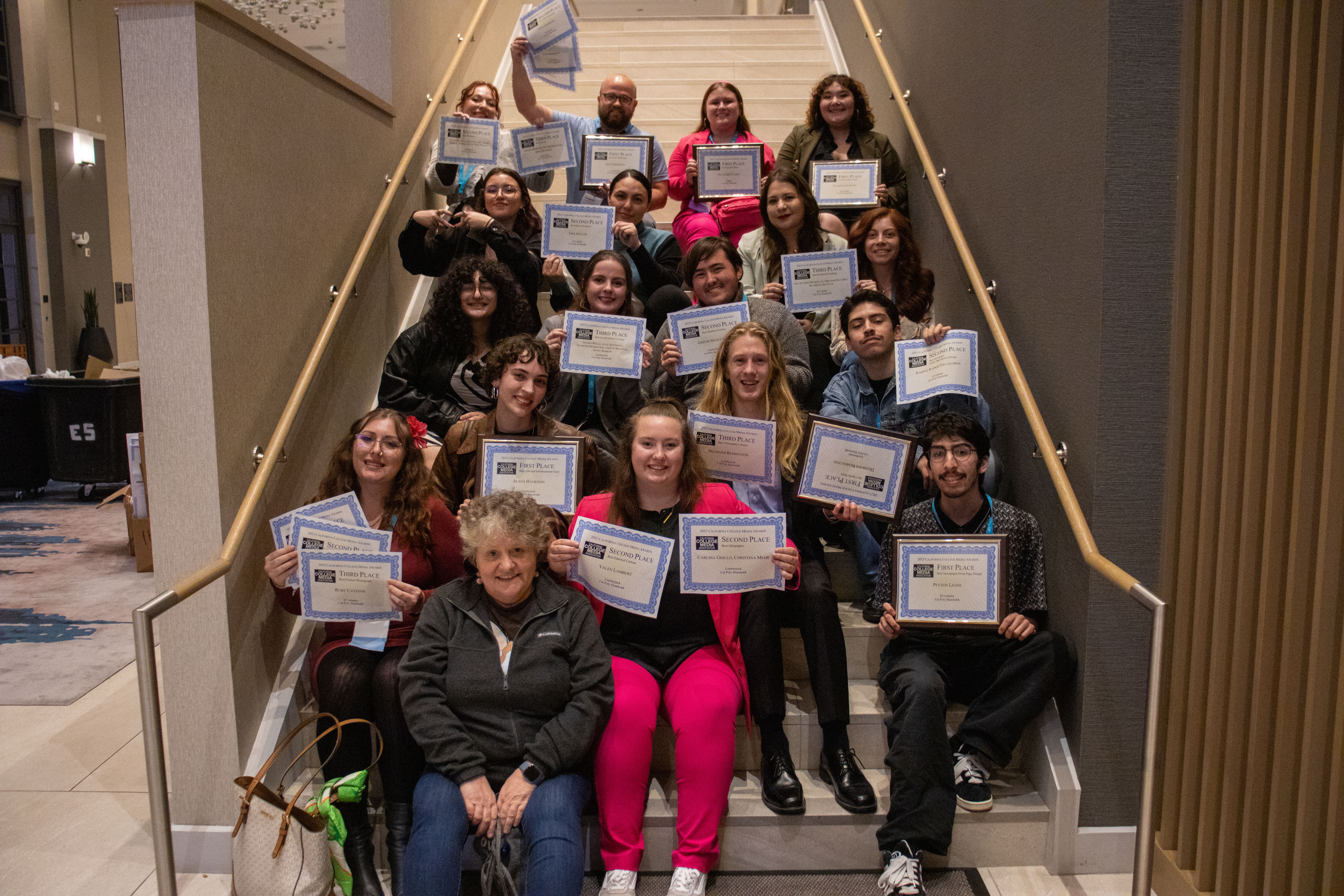
    We embraced one another and cheered as we collected a total of 14 awards for the Lumberjack. We placed in categories like Best Social Justice Coverage, Best Feature Photo, Best Arts and Entertainment Story, and Best in Show. We were struggling to get a photo with all of our awards together on the table, even when I stood on a chair and raised my camera in the air. Our advisor soon approached each of us to get a snippet of our reactions for social media. At the time, I was so overwhelmed with excitement and pride in my team that I couldn’t give the groundbreaking, heartfelt speech I wanted. I can at least give that speech in writing.

    I didn’t originally come to Cal Poly Humboldt as a journalist. I was an English major and I wanted to write novels. I joined the student magazine, Osprey, during my first semester and fell in love with it. I loved learning from people and giving that knowledge to the public. I knew I wanted to write. When I took the Lumberjack workshop, I didn’t expect to be writing for an award-winning paper. I’m grateful to be a part of the process and I am honored that our hard work gets to be recognized on a state and national level. The pressure of working on The Lumberjack is intense, but you take on that pressure as a team. No matter what else is going on in our lives, we get together every Tuesday, hunker down in the newsroom, and make a newspaper for our campus.


  • Impending mergers threaten Humboldt’s identity

    Impending mergers threaten Humboldt’s identity

    The merging of departments within the College of Arts Humanities & Social Sciences will lead to the detriment of distinct programs and the appeal of Humboldt State as a unique university. 

    As smaller departments are pressured to combine in order to meet the demands of budget cuts that add up relentlessly in the face of the COVID-19 pandemic, we run the risk of losing the focused, intimate education that drew students to campus in the first place. 

    Due to low enrollment the journalism and communication departments have submitted a proposal to Dean Roseamel S. Benavides-Garb, suggesting they be combined, for fear of losing the departments altogether – a fear that is shared among many of the smaller departments on campus.

    One practical benefit of combining the journalism department with the communication department is the opportunity it would allow for courses to be offered more often with more students in the department. On the flip side, combining departments presents the potential to strip each major of its individual identity. While the increased size of the combined department could potentially attract more attention to each discipline, the lack of distinction between the two could also prove confusing and drive prospective students away. 

    Higher education is a step away from the general, scattershot education of grade school. We learn what we’ll focus on, and begin developing specific skills. We also begin to add to the greater pool of knowledge for our chosen field of study. The less our education hones in on a specific field, the more it feels like a shallow high school class – lacking the depth that student’s pay for when they attend a university. 

    While the emphasis of the study of communication is on the underlying meaning of how we communicate, the primary concern for most journalism students is the application of skills to make media of our own. Journalists are already required to take communication classes which prepare them for their chosen focus. Communication classes are valuable to journalists. Every member of our editorial board has taken a communication class which has shaped our perspective, just as our other general education classes impart valuable lessons. 

    Combining departments also comes with grave concerns that the departments will lose lecturers and potentially some of the classes they teach as former chairs are forced to move into teaching positions. This would cost journalism students opportunities to interact with more media professionals and those lecturers would be placed in danger of losing pay and the health insurance they have come to rely upon for themselves and their families. 

    The proposed plan not only throws the student experience in the department into question but ultimately, the merger’s promise to cut $180,000 in expenses annually feels almost like chump change in comparison to the monster deficit the university currently faces. At the end of the day, administrators, students and faculty have to ask themselves whether or not all this restructuring will benefit the university in the long term. Cuts save some money in the short run, but they represent a greater loss to the university and the Humboldt community.

    Some good will come of department mergers. We all have a lot to learn from each other. As journalism students, we will welcome our peers from the communication department and the value their program will add to ours in regards to the developing fields of ethics and theory of communication. Understanding how we interact with the world through language and the culture of communication is critical to operating as an effective journalist. 

    We hope that we can offer greater knowledge of media literacy. Today especially, media literacy is an essential skill any student with a university education should have, and it is crucial that students across all disciplines are armed with the tools to critically assess, analyze and critique media so that they can be more mindful of the media they consume.

    We also hope to impart our own personal experience writing about our university. All of us hear stories of poorly run programs, incompetence at the top of the HSU ladder, haphazard cuts, and a lack of forward thinking. We speak to staff who are afraid of the repercussions for simply telling us their stories. If we want to make HSU a better place, where else might $180,000 per year be saved?

  • Humboldt State Violated California Law by Requiring Registration for a Public Meeting

    Humboldt State Violated California Law by Requiring Registration for a Public Meeting

    HSU briefly required registration for two public webinars as a security measure

    Update, April 22: Humboldt State Vice President of Enrollment Management Jason Meriwether penned a letter to The Lumberjack, making the case that HSU did not violate California law. Read it here.

    Editor’s note: Grace Caswell is a student in Journalism Department Chair Vicky Sama’s media law course. Almost the entire staff of The Lumberjack has also had Sama as an instructor in journalism courses.

    Humboldt State University hosted public meetings via Zoom to inform the public about its projected enrollment decline and budget cuts April 13 and 15. However, as a security measure protecting the university from “Zoom bombings,” HSU enacted mandatory registration requirements prior to entering the meetings in violation of California state law.

    “Zoom bombings” describe a new term for an infiltration or hijacking of a Zoom session with the intent to harass and disrupt the session. With an increase in Zoom users, from 10 million in December 2019 to more than 200 million in March of 2020, Zoom CEO Eric S. Yuan released a statement April 1 detailing additional measures being taken to enhance Zoom security over the next 90 days.

    HSU Vice President of Enrollment Jason Meriwether claimed HSU has experienced Zoom bombings and enacted the registration as an additional security measure. The additional measures required the public to respond twice via Google forms before being sent the Zoom meeting invitations, basically giving the administration, a government body, the power to sift through and deny public access.

    An approved registration screen for one of HSU’s enrollment and budget webinars held April 13 and 15.

    HSU Chair of the Department of Journalism and Mass Communication and media law professor Vicky Sama alerted and engaged with HSU administration, specifically Meriwether, on the violations being committed.

    “Using ‘security’ reasons to require the public additional registration to access a public meeting on the people’s business does not satisfy the openness and liberties that our Constitution provides,” Sama said in an email. “In addition to violating state law that I explained in my earlier email.”

    “The unintentional message is that some people are not welcome and/or we at HSU don’t want the public to know what is going on.”

    Vicky Sama, HSU journalism chair

    Sama said the additional requirement for the public to register prior to receiving an invitation was tantamount to reviewing their qualifications.

    “The email did not justify the registration nor did it outline its purpose, raising suspicions that the university doesn’t want certain people to attend or know what is going on,” Sama wrote. “The unintentional message is that some people are not welcome and/or we at HSU don’t want the public to know what is going on.”

    Specifically, HSU’s actions against the public violated the Brown Act and Bagley-Keene Act. Both California state acts provide assurance of rights to the public. Sommer Ingram Dean, staff attorney for the Student Press Law Center, explained how these security measures directly conflict with both acts.

    “Section 54953.3 of Brown says ‘A member of the public shall not be required, as a condition to attendance at a meeting of a legislative body of a local agency, to register his or her name, to provide other information, to complete a questionnaire, or otherwise to fulfill any condition precedent to his or her attendance,’” Dean explained in an email.

    “Section 11124 of Bagley Keene says ‘No person shall be required, as a condition to attendance at a meeting of a state body, to register his or her name, to provide other information, to complete a questionnaire, or otherwise to fulfill any condition precedent to his or her attendance.’”

    Sommer Ingram Dean, staff attorney for Student Press Law Center

    Additionally, Dean cited the Bagley-Keene Act and the measures it provides ensuring the public’s rights.

    “Section 11124 of Bagley Keene says ‘No person shall be required, as a condition to attendance at a meeting of a state body, to register his or her name, to provide other information, to complete a questionnaire, or otherwise to fulfill any condition precedent to his or her attendance,’” Dean wrote.

    Sama informed Meriwether of the illegal activity violating both the Brown and Bagley-Keene Acts April 13, citing the specific sections mentioned above. In response, Meriwether continued with the registration in place and adjusted the meetings by offering public links.

    “Since this issue was just raised today, it appears to me that the best thing to do is to move forward with today as planned,” Meriwether said in an email. “We will also explore hosting a third event. We will provide both the option for registration and the public link for the already scheduled event on Wednesday. The entire point of having these events was to be transparent.”

    Since then, the links to the April 13 and 15 meetings went public. However, the concern more surrounds HSU’s decision to filter through the public’s right to access a public meeting regarding matters directly impacting them.

    The registration requirement, Sama wrote, amounts to intimidation and goes against the spirit of openness and transparency, and “reeks of sneakiness.” In a time of crisis, government bodies can use the mirage of security to deny the public their right to voice their opinions. Ultimately, it can amount to an abuse of power against the public.

  • Parody is Protected Speech

    Parody is Protected Speech

    HSU administration cannot tell student media what to publish

    Press at any capacity in the United States is protected by the First Amendment against federal censorship of speech. The government cannot make editorial decisions, retractions or content suggestions. Student press publications in California are protected not just by the First Amendment, but also by the California Student Free Expression Law of 1977, or California Education Code 48907.

    When a government entity such as a state university interferes with the press by policing publications on what is appropriate to publish, it inhibits the independence of the press.

    Recently, Humboldt State University administration sent out a school-wide email regarding material printed in a student parody newspaper, called The Dumberjack, found in an insert in the Nov. 20 issue of The Lumberjack.

    The public announcement accused the students in the parody news class that produced The Dumberjack of reinforcing rape culture and gender-based discrimination through a photo that depicted a “sexist ‘riddle’” which was displayed on a sign in a window of an all-female room at the College Creek Apartments.

    The school administration held The Dumberjack staff responsible for a joke on a sign they did not create nor stage. A student-journalist outside of the parody news class observed and documented campus culture with this photograph. The parody news class simply featured it in the paper and in no way amplified any perceived gender-based discrimination with the story that ran alongside the photo.

    Parody facilitates the palatability of relevant information through comedy.

    No one in The Dumberjack class or on The Lumberjack staff supports gender-based discrimination or wants to reinforce rape culture. But journalism, of any kind, is not public relations. The publication of a photo of a sign on campus does not represent endorsement of what the sign says. Journalism draws attention to troublesome realities by documenting them and showing them to the public. When a publication reveals a sign that a university finds offensive, the university’s focus ought to be on the sign, not on the journalists who documented it.

    Administration officials invited the class to have a conversation to “discuss the impact and implications of the cover photo.” The meeting was intended to be an open dialogue surrounding the development of “critical lenses.”

    Instead, on Thursday, Dec. 5, the class became the site of a direct act of administration intimidation.

    Two school officials—only one of whom had been momentarily invited—came to the class and lectured journalism students on how to make editorial decisions. Chair of the Sexual Assault Prevention Committee Kim Berry and Dean of Students Eboni Turnbow, both of whom are government employees, reprimanded a class of students educated in journalism ethics.

    The administration is demonstrating unprofessional behavior of questionable legality by attempting to contain this incident and filter what student press can and cannot print. The administration cannot tell student media what to publish.

    Parody writers take real world situations and use a critical lens to highlight a topic in a juxtaposed way. These satirical pieces can sometimes be offensive, but the key is that the subject matter is still being discussed.

    The goal of parody is to create a dialogue on topics that are either overshadowed or too controversial to be discussed openly. Parody facilitates the palatability of relevant information through comedy.

    The First Amendment protects speech, including satire and parody. Satire and parody are used as impressionistic language that aim to create commentary on sensitive issues through the use of humor, absurdity and exaggeration. Utilizing these writing tactics serves as a more approachable way of tackling uncomfortable yet prominent issues.

    Journalists aim to relay information in the most accurate and concise manner as possible. Censorship defeats that purpose. The government censoring the media is illegal and obstructs the transparency of journalism. It creates bias and subjectivity, as journalists become fearful of backlash for what they print.

    When censorship appeases a specific group of people, it’s a domino effect. Censoring one thing for a single group leads to censoring all material to please everyone. That defeats the purpose of journalism as an independent eye intended to expose overlooked issues.

    In today’s political climate, journalists are constantly under fire. The fourth estate, journalism, is as vital to uphold as the fifth estate, non-traditional media like parody news. When federal figures undermine the editorial freedom of a publication, even a parody news publication, a slippery slope follows in which government infringes upon the freedom of the press.

  • El Leñador: Inspiring Diverse Coverage

    El Leñador: Inspiring Diverse Coverage

    HSU’s bilingual monthly newspaper highlights and represents minority groups 

    Lack of diversity in newsrooms across the nation perpetuates the lack of representation in stories. According to the Jelani Cobb from the Guardian, it is all too often that the demographics of news writers look nothing like the communities they cover.

    Humboldt State University’s bilingual newspaper, El Leñador, is changing that one monthly issue at a time.

    “This paper is so special because it’s part of taking back that narrative,” Jose Herrera, El Leñador’s layout editor, said. “We are producing the paper. We are first generation, Latinx, African American, LGBTQ or Asian. We’re writing our own stories.”

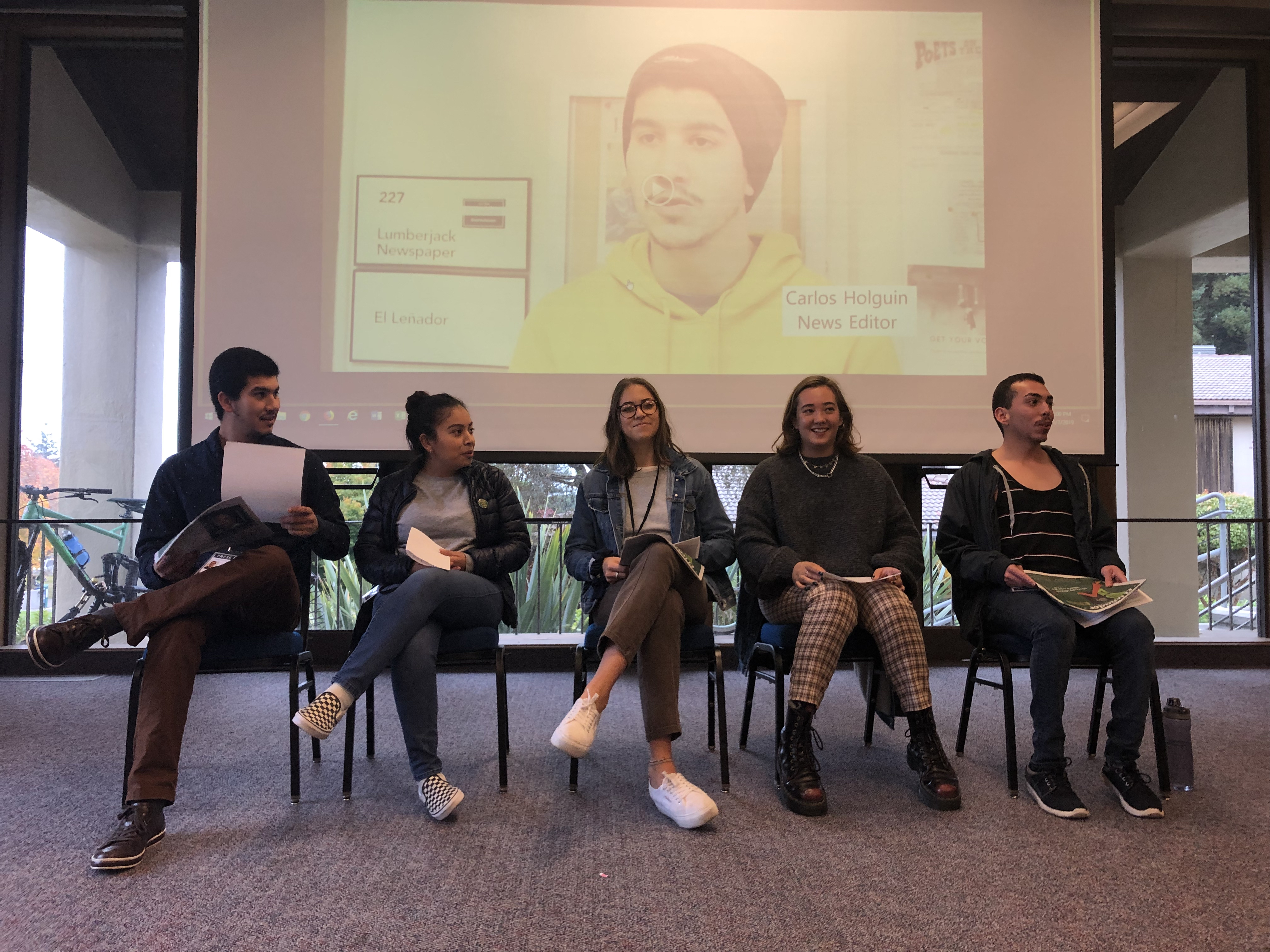
    El Leñador held a panel discussion Nov. 7 in the Goodwin Forum as part of the week-long Campus & Community Dialogue on Race event. The student-run publication features under-represented stories of the school and community.

    Attendees of the CDOR event listen to editors speak about the paper’s production process. | Photo by Chelsea Wood

    El Leñador’s staff is not limited to those who can speak both Spanish and English, or specific journalism majors; all HSU students are welcome and encouraged to contribute.

    “For me it’s been a life changing experience,” Vanessa Flores, El Leñador’s editor-in-chief, said. “It’s very important for students to pick up newspapers. Not just ours, but the other publications on campus.”

    Flores stressed the importance of student journalism. Without it, campus stories would remain unrepresented since local media isn’t as connected to a campus story as student journalists are.

    Over the past six years El Leñador has covered under-represented communities and continues to carve out a space for minority narratives within Humboldt-based media.

    The work by the student-run publication reverberates throughout the secluded community. El Leñador has forged ahead of larger, local news publications by connecting with its audience more intimately.

    “This paper is so special because it’s part of taking back that narrative. We are producing the paper. We are first generation, Latinx, African American, LGBTQ or Asian. We’re writing our own stories.”

    Jose Herrera

    The editorial board reminded community members at the discussion about the importance of continuing to cover underrepresented stories.

    Cali Fournier, an HSU student, attended the panel discussion and believes that informative, speaking panels are important to have.

    “Racism is a big deal still to this day,” Fournier said. “You should be judged by who you are not by the color of your skin.”

    The El Leñador staff assume multiple roles within the publication. Producing the paper monthly gives students access to a hands-on learning environment, and staff are able to expand their passions whether their skills are in writing, video, audio or art.

    “As a monthly paper and as a student-run paper, it’s really a big training ground for students,” Silvia Alfonso, El Leñador’s managing editor, said.

    El Leñador enables its contributors to bring different perspectives to the table. Its staff encouraged the panel attendees to contribute to the publication.

    Jack Surmani, an HSU alumnus, believes in the message El Leñador emits and thinks the the commitment of the students behind the publication is evident.

    “They know why they’re doing it and have a passion and commitment for being better journalists,” Surmani said.

  • EDITORIAL: Our code of ethics

    EDITORIAL: Our code of ethics

    Students serving the Humboldt State campus and community since 1929

    The Journalism Code of Ethics is what every journalist follows, whether they are a writer from a multi-media conglomerate or a student run newspaper. We of the Lumberjack newspaper hold these code of ethics to heart, as it helps us navigate the world of becoming a journalist and presenting our stories to readers or viewers.

    One of the most vital rules we follow is to never show our work to the sources. We strive to make our stories as accurate as possible, and when we are asked by sources to preview a story before it’s publish, it will most likely not happen. We follow this rule because it takes away the independence of a journalist from gathering, writing and editing their story. If we were to share the story it would no longer belong to the writer, it instead implies that it belongs to the source. Our job as journalists is to seek the truth to a story and report it. Allowing someone to preview the story takes that away from us.

    Previewing a story for a source also sets a precedent of having to allow every source in the Lumberjack newspaper to preview a story. Hypothetically speaking, say we allow a story to be previewed by source. But because a minimum amount of sources for a story is three, that means having to allow those sources to preview the story as well. Not only that, but other stories have to follow the same thing as well. It not only takes away the story from the writer, but it takes time needed for the news to be published.

    The only time a journalist is allowed to share what they wrote for a story, is if they are talking about something complex like quantum physics. In this case, an expert can be consulted for accuracy.

    We understand the concern of a source wanting to preview a story is for accuracy purposes, but it’s up to us as journalists to be accurate in our story. If more clarity is needed in a story, the journalists will most likely ask for it.

    Student journalism can be an unpaid profession. Some students have to juggle running the news, while also attending classes. We have a rare luxury of making mistakes in the Lumberjack, but we learn from them.

    Mistakes are bound to be made. When we make mistakes, we answer questions of accuracy and make necessary correction as soon as possible. For us it’s a learning experience to run the Lumberjack. We are held to a high standard for delivering an accurate and fair story to our readers, so much so that we’ve won awards for our excellence. We pride ourselves in delivering stories for our readers.

  • Consuming news safely

    Consuming news safely

    Sorting through the mainstream, and now local media

    When you turn on your local news TV station, you expect a solid mix of local and national news, and a variety of messages between stations.

    The news coverage from one area to the next will differ based on location.

    What you don’t expect is to be able to watch hundreds of news anchors, ironically reading the same script, on hundreds of different channels, about the importance of varied news sources and supported communities, like the companies owned by Sinclair Broadcast Group.

    Recognizing and understanding how to sort through the news, and have a well-rounded idea of what is happening, is important to processing the information you consume. Here are two important parts of journalism and fake news you should understand when consuming information.

    Understanding journalism objectivity

    Before diving into how to fact check and navigate the media, it is important to understand that objective journalism is incredibly hard, if not impossible, to achieve.

    People are inherently biased and influenced by the world around them. Journalists do their best, however, to inform the public, simply for the sake of the public.

    However, it is equally as important to understand that when it comes specifically to the news facet of journalism, journalists study, and are taught, to present the facts of a story from either side.

    This does not mean journalists agree with the information they have been given, but instead are presenting this information to the reader or viewer with as much objectivity as they can manage.

    The Society of Professional Journalists code of ethics is one of the most prominent professional ethics guidelines journalists follow, and sets the tone for what real journalism is supposed to be. These ethical principles exist to promote clear and concise reporting with four main facets: to seek the truth and report it, act independently, minimize harm and be accountable and transparent.

    For example, mainstream media outlets being owned by giant companies allows an argument to be made that these outlets are not independent, though they should work this way.

    Consider the case of Sinclair pushing right-based opinions and scripts to their newscasters across multiple local news stations. Sinclair also released a video in an attempted act of transparency, trying to inform the public why this script was given out. Deadspin, who released the compiled video footage of news anchors reading from their script, also provides this video in order to provide more detail to their story. This style of reporting leans toward writer bias, and is a little less formal than other outlets.

    In order to rise above the many messages media on all formats is designed to present to you, start with skepticism, and then some careful consideration. Make sure you’re digesting factual information, as opposed to fake news or misinformation.

    There are websites that specifically try to sort through political fact and fiction like the website Politifact.com. Politifact aims to provide fact-checking based journalism with principles based on “independence, transparency and fairness through reporting and clear writing.”

    Fake news in itself could be considered an oxymoron. News must be factual to be news. However, as the word of the year, and the biggest threat to our democracy today, knowing when you’re being fooled is vital.

    Skepticism and careful consideration

    As declared watchdogs of those in power, and also those who abuse their power, journalism is easily considered to be shady. The idea that journalists are out to dig up dirt and expose powerful or public figures for joy is an easy mistaken thought process to fall into.

    When you hear something on the news you find to be negative or shocking, understand there are news determinants that allow journalists to consider what is noteworthy and important for the general public to know.

    We take it upon ourselves as journalists to study these determinants seriously and with practiced objectivity. Knowing trust in the media is at an all time low, we encourage you to refer to other news sources when this happens.

    Use your skepticism of what you’ve heard reported and consider other articles or broadcasts on the same subject. Different reporting might present different facts. Even after studying a variety of sources, you as a reader or viewer may only have a small piece of the picture still. We as journalists have also considered multiple sources before presenting information so we are not failing our public by reporting on rumors or false information.

    Some websites exist to make this easier for you, such as Media Bias/Fact Check. This website lists specific sites and news sources that are either politically left-biased, centralized, right-biased or left-center and right-center-biased. You can find a list of questionable sources here as well. If you see a source on this list, they may not be the most trustworthy news outlet to refer to.

    Politifact, an outlet centered around fact checking, provides a truth-o-meter that follows the specific decisions and promises of politicians by following their actions and reporting back to inform the public whether their actions align with their words.

    The sources provided here are merely suggestions and are not an end all to fact-checking sources.

    Practicing the ability to step outside your own bias and recognize that of some media outlets to compare and contrast information is important to democracy.

    Always double check where your information is coming from and who might be influencing the message.

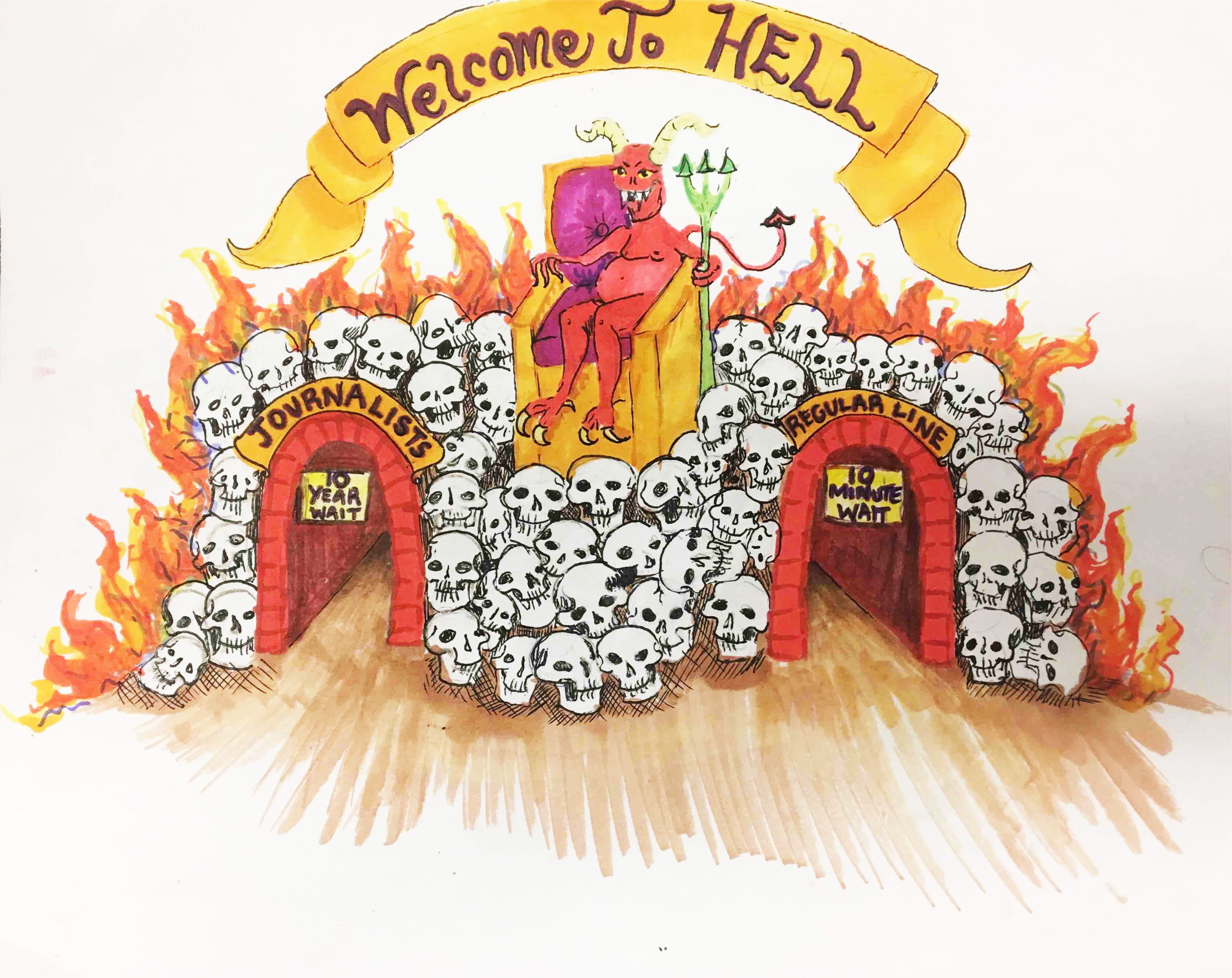
  • All journalists go to hell

    All journalists go to hell

    It’s 9 a.m. outside Gist Hall, the mecca for journalism activities at Humboldt State. All the students that typically fill the hallways are still in bed, unable to be bothered until at least 11 a.m.

    Meanwhile, the only ones awake are those who woke up to hit the bong once or twice before they stumble into their sweats and yawn their way to campus somehow.

    Yet, these are the elites. The ones who will go on to be some of the most brilliant voices in news, because, frankly, there are no brilliant voices in news anymore.

    The persona of the tortured artistic type has morphed into a really obnoxious pissing contest not only between news stations, but among individual journalists as well.

    In an era where news outlets and their worker bees are being discredited at every turn, we must face our fears and beat the elephant in the room to death… journalists are all terrible people.

    It takes a certifiably insane human being to want to write news. It’s an impossible job for a level-headed person, and to recommend such a thing to a young and prospering academic is nothing short of treason.

    The late Hunter S. Thompson, well-respected journalist and noted troublemaker, once said, “Sacrificing good men to journalism is like sending William Faulkner to work for Time magazine.”

    Thompson, William Burroughs, Ken Kesey, Tom Wolfe, Tomi Lahren and more are known far and wide for rampant drug use, domestic abuse, drunken and boorish behavior.

    All of these names belong to well-respected and famous journalists, who were all made famous not only by their work, but by the sleaze and trouble that came with it.

    “Journalists have just operated under a veil of superiority, because our role was to call out B.S. and find truth,” said Nick Garcia, Humboldt State graduate with a bachelor’s in journalism. “Now everybody wants to be a personality and has an agenda.”

    A newsroom in full swing is comparable only to the trading floor of the Wall Street Exchange.

    Fingers senselessly tap-dance across the keyboard, beads of sweat trickle off any given forehead, phones buzzing every few seconds. Everybody swears like sailors and the coffee machine heat combines with cigarette stench to create the feeling of a sweat shop in the belly of an antique whaling ship.

    If there’s a hell, journalists are going to be the first in line. They drink, they smoke, they weasel their way into stories and take photographs without asking.

    Every national tragedy to ever befall this country, journalists earned a salary by showing up to annoy the victims.

    Journalists could have ignored Donald Trump, but they wanted ratings and now there’s a tangerine with a neck running the White House.

    The hell of it all is that the only journalists worth their salt aren’t paid nearly enough to be doing what they do.

    Those who strive for objectivity even in the face of a world where small fish get hooked and transferred to a small pond with toxic runoff to slowly die while the big fish get botox and work for CNN.

    Hats off to those chosen few who toil and sweat for little to no reward.

    To be fair, it’s not like journalists would be good at their jobs if they weren’t capable of getting a little sleazy for the cause. It’s kind of a sleazy job. Writing in general is a bit greasy. It’s an inherently impossible job which might be why so many journalists find themselves at a news agency, addictive tendencies and an ego the size of a house.


  • Get your facts straight

    By | Matthew Hable

    You, the reader, have a moral responsibility to verify the truth when it comes to news. Fake news is everywhere and much of it has to do with the fact that the average person can be a journalist these days. Millions of bloggers and social media users distribute biased, inaccurate and partial information. Add bipartisan news organizations to the mix and we have ourselves a flood of conflicting information inundating our lives every day.

    The Society of Professional Journalists says that an ethical journalist “strives to ensure the free exchange of information… is accurate, fair and thorough.”

    A good journalist aims to report objective information that has been carefully verified. Readers should do the same. If you dig deep enough, you’re likely to discover that the source of a story has media bias. By understanding the motive behind the story, the reader can make a better decision about sharing information. To put it another way, don’t immediately accept news for its face value.

    It’s also worth mentioning that objectivity does not necessarily mean taking a neutral stance.

    “Because the journalist must make decisions, he or she is not and cannot be objective. But journalistic methods are objective,” said Bill Kovach and Tom Rosenstiel, authors of “The Elements of Journalism.”

    Verifying the truth is one way to combat fake news. Go over the Code of Ethics on the Society of Professional Journalists website to gain a better understanding of ethical journalism.

    “The first task of the new journalist/sense maker is to verify what information is reliable and then order it so people can grasp it efficiently,” said Kovach and Rosenstiel. Our responsibility is “to provide citizens with the tools they need to extract knowledge for themselves from the undifferentiated flood or rumor, propaganda, gossip, fact, assertion and allegation the communications system now produces.”