The Lumberjack


Students Serving The Cal Poly Humboldt Campus and Community Since 1929

Tag: Klamath River

  • How wildfire can cause flooding

    How wildfire can cause flooding

    by August Linton

    After the consuming heat and flame of a wildfire, flooding seems an unlikely problem to have to worry about. But catastrophic floods after a section of land is burned often threaten both human settlements and ecosystems. 

    Post-wildfire flooding can be caused by several processes. According to Cal Poly Humboldt professor of forestry, fire and rangeland management Dr. Jeff Kane, the forest floor normally acts as a sponge, soaking up and slowly releasing rainfall. When a wildfire burns that layer, there’s nothing left behind to stop rainfall from rushing directly downstream.

    Wildfire also can release and vaporize waxy compounds from conifer needles, which then accumulate on the burned ground and form an even more water-resistant layer. 

    “Instead of percolating, [water] may flow overland,” Kane said. “If you don’t have the vegetation to absorb the precipitation, then it’s going to be more impactful.”

    Hydrology and watershed management professor Dr. Andrew Stubblefield says that the impacts of this flooding extend to the whole ecosystem. When the forest floor loses its ability to absorb water, the topsoil can become saturated and eventually sloughs downstream, taking with it the nutrients it stores.

    “Now you have a forest that’s less able to hold water to grow trees and provide nutrients to grow trees,” said Stubblefield. “It’s impoverished, or it’s depleted; and it can take a while to hundreds of years even to rebuild the nutrients.”

    This can impact what plants regrow while the land recovers from the fire and flood. Weedy, often-invasive plants may have an easier time reestablishing themselves in this less-nurturing environment than native species, according to Kane. 

    Soil and nutrients washed into rivers and streams also negatively affect their ecosystems. Sediment and debris carried by flooding associated with the McKinney fire caused fish kill in the Klamath River earlier this August, as clays in the soil interrupted oxygen flow and nutrients nourished a deadly algal bloom. 

    Post-wildfire flooding can also be dangerous to human settlements and to the ecosystem around it because it picks up debris and soil and carries it downstream. Debris flows caused by heavy rain after the Thomas fire in Montecito, California killed 23, injured at least 167, and damaged 408 homes, according to a 2019 research article by J.W. Kean et al. 

    It’s the charge of the National Forest Service’s BAER (Burned Area Emergency Response) teams to analyze the risks for flooding after each fire and implement measures to mitigate damage and environmental impacts. According to the McKinney Post-Fire BAER incident overview, these multidisciplinary teams of scientists decide what, if anything, needs to be done to protect natural resources or human settlements in the area. 

    Examples of possible interventions include seeding the hillside from the air, setting up log breaks along hills or in creek beds, or stabilizing at-risk areas with hydro-mulch (a material similar to paper mâché which also contains seeds,) said Stubblefield. Sometimes the best treatment is to warn people away from at-risk areas with weather alerts when a big storm is coming in.

    But with modern fires often burning millions of acres at once, what scientists can do to mitigate flooding becomes a problem of scale. 

    “The August Complex [fire] last summer was a million acres, what would it cost to try and stabilize that landscape, you know, it’s too big,” said Stubblefield. “It would be the gross domestic product of a small country.”

    Flooding is not an inevitable follow-up to wildfire. It takes both intense fire and intense rain to create the right conditions. If ground cover vegetation like grasses have time to return before the next intense rain, it stabilizes the soil and can even begin to break down the waxy hydrophobic layer.

    However, due to the effects of anthropogenic climate change and poor forest management, the perfect storm happens more often. 

    When this land was stewarded by Native Americans, regular fires were part of that management. In the post-colonial absence of that management, white settlers saw wildfires as something that needed to be suppressed immediately, rather than allowed to run their course as a physiological process of the forest. When the dense, thick, choked forests that this policy produces catch fire, they burn hotter, longer, and over a wider area. The environmental legacy of clear-cut logging and fire-prevention has left the forests in a vulnerable and volatile state.

    “We are moving into an era of active fire management,” said Stubblefield.

    This means more prescribed burns, and an attitude towards fire that acknowledges its essential role in forest health. Post-fire flooding, too, is a physiological component of the ecosystem. According to Stubblefield, if sediments weren’t carried into the river, salmon might not have gravel to spawn on at all.
  • Yurok Tribe’s Connection to Klamath River Weakens as Ecosystem Declines

    Yurok Tribe’s Connection to Klamath River Weakens as Ecosystem Declines

    Indigenous Peoples’ Week provided an opportunity for the community to not only recognize native culture but learn about it

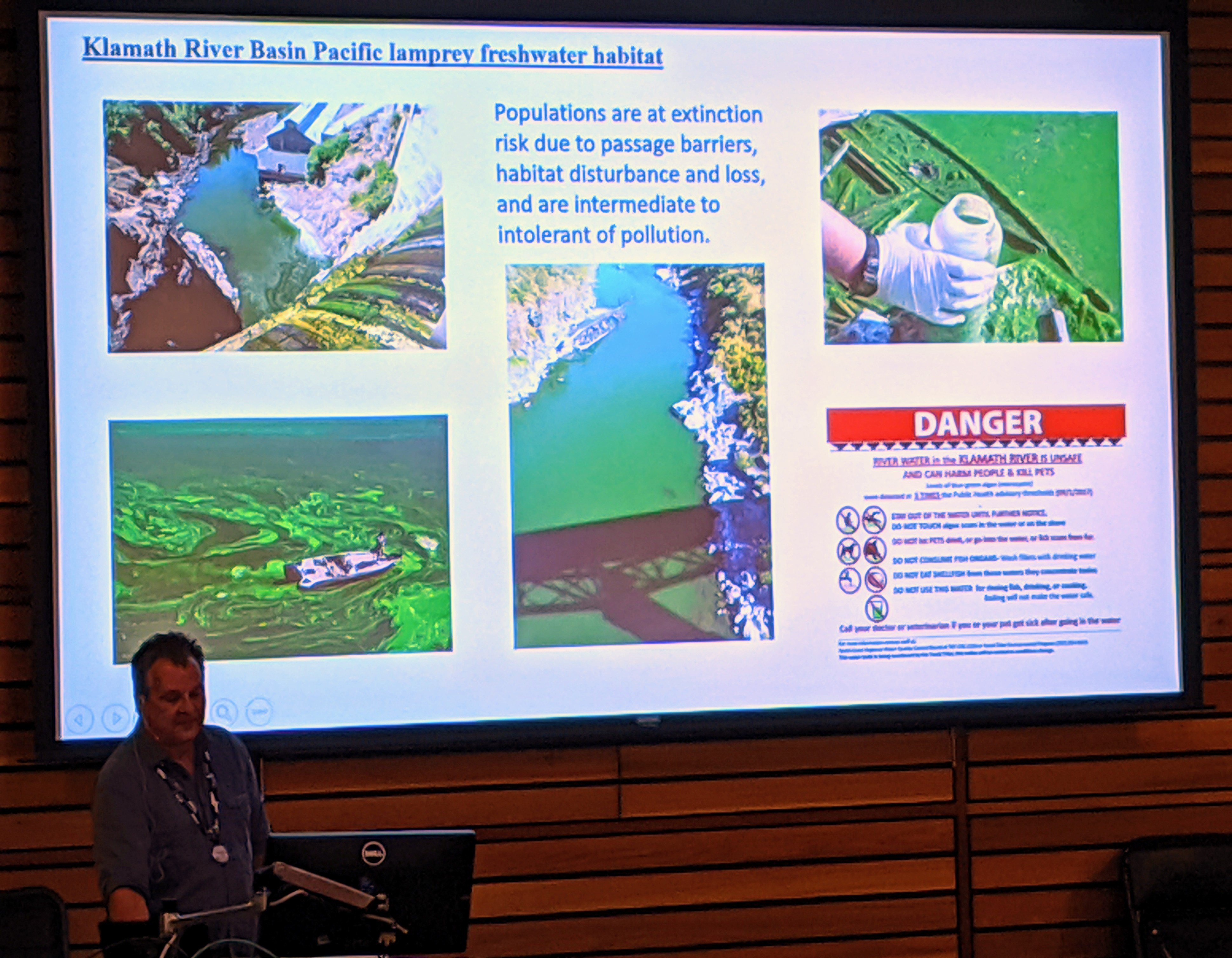
    Last Thursday Yurok Tribe member Keith Parker, a Humboldt State alumnus and fisheries and molecular biologist, gave a presentation on campus about the Klamath River, his work on Lamprey eels and the local ecosystem.

    As a tribal scientist, Parker gets to use his traditional knowledge from his Yurok heritage combined with his master’s degree from HSU to conduct field and lab work. The Klamath River is significant to the Yurok Tribe, as Yurok translates to “downriver people.”

    “I have a spiritual and innate connection to the land,” Parker said. “It’s not just a study subject for me, it’s not just empirical data. I have skin in the game, literally.”

    “I have a cultural connection. I live off that river, my kids eat off that river, we eat the salmon, the sturgeon, the lamprey, the elk, the deer and we harvest the roots.”

    Keith Parker

    Parker feels that his upbringing along with his academics makes him a better and more effective scientist. It is more than just conducting research for him, as he continues to learn and then teach others about a topic he feels passion for.

    “I have a cultural connection,” Parker said. “I live off that river, my kids eat off that river, we eat the salmon, the sturgeon, the lamprey, the elk, the deer and we harvest the roots.”

    The river has a rich history in native lore, being home to other tribes including the Karok and Modoc long before the earliest settlers came west. But in more recent years, the river has taken a decline in health.

    Some of the causes can be attributed to the damming of the river, preventing the water from flowing properly and allowing harmful algae to grow. Specifically cyanobacteria, commonly known as blue-green algae.

    The North Coast Regional Water Quality Control Board and the Humboldt County Department of Health & Human Services send out broadcast warnings, cautioning people to avoid swimming in areas that contain the algae.

    In July 2018, the Humboldt County Department of Health & Human Services issued a news release stating, “The presence of cyanobacteria has been previously confirmed in some water bodies within Humboldt, Mendocino and Lake counties including the South Fork Eel River, Van Duzen River, Trinity River, Clear Lake and Lake Pillsbury. It is difficult to test and monitor the many lakes and miles of our local rivers. Most blooms in California contain harmless green algae, but it is important to stay safe and avoid contact.” “It isn’t just a loss of biodiversity when you see a river system like that slowly dying, it’s a loss of cultural heritage as well.”

    Another effect of the damming is that the salmon find it much harder to swim to and from the ocean, which slowly harms the surrounding wildlife.

    “It isn’t just a loss of biodiversity when you see a river system like that slowly dying, it’s a loss of cultural heritage as well.”

    Keith Parker

    “Those fish leave as juveniles and they go out to the ocean and they come back later on in life much larger in size,” Parker said. “They then spawn and die, all those marine-derived nutrients that are in their flesh are absorbed into those forests.”

    Yurok culture is linked to the river in many ways, including using it for transportation and trade. The Yurok tribe would trade items downstream, from the ocean, as they looked to collect larger deer and elk from deeper in the mountains.

    “A lot of our people, even now, they’re breaking out in rashes from putting their hands in the water and taking the fish out,” Parker said. “The females of the tribe often weave baskets from roots they harvest from the water’s edge as well, and part of the method is sucking on the roots to soften them up so they can weave baskets and more. They are being affected as well.”

    The Lamprey eels used to thrive, and were something that the natives could smoke and preserve as their food throughout the winter. They used handmade eel hooks, which the men make by hand and include carvings that are personal to each individual.

    “When the women harvest those roots from this nasty river edge, when they’re making them they keep them in their mouth and they soften them up with their saliva while they’re making their basket, and they’re getting poisoned,” Parker said. “It isn’t just a loss of biodiversity when you see a river system like that slowly dying, it’s a loss of cultural heritage as well.”

  • Salmon and us, tied to the health of the Klamath River

    Salmon and us, tied to the health of the Klamath River

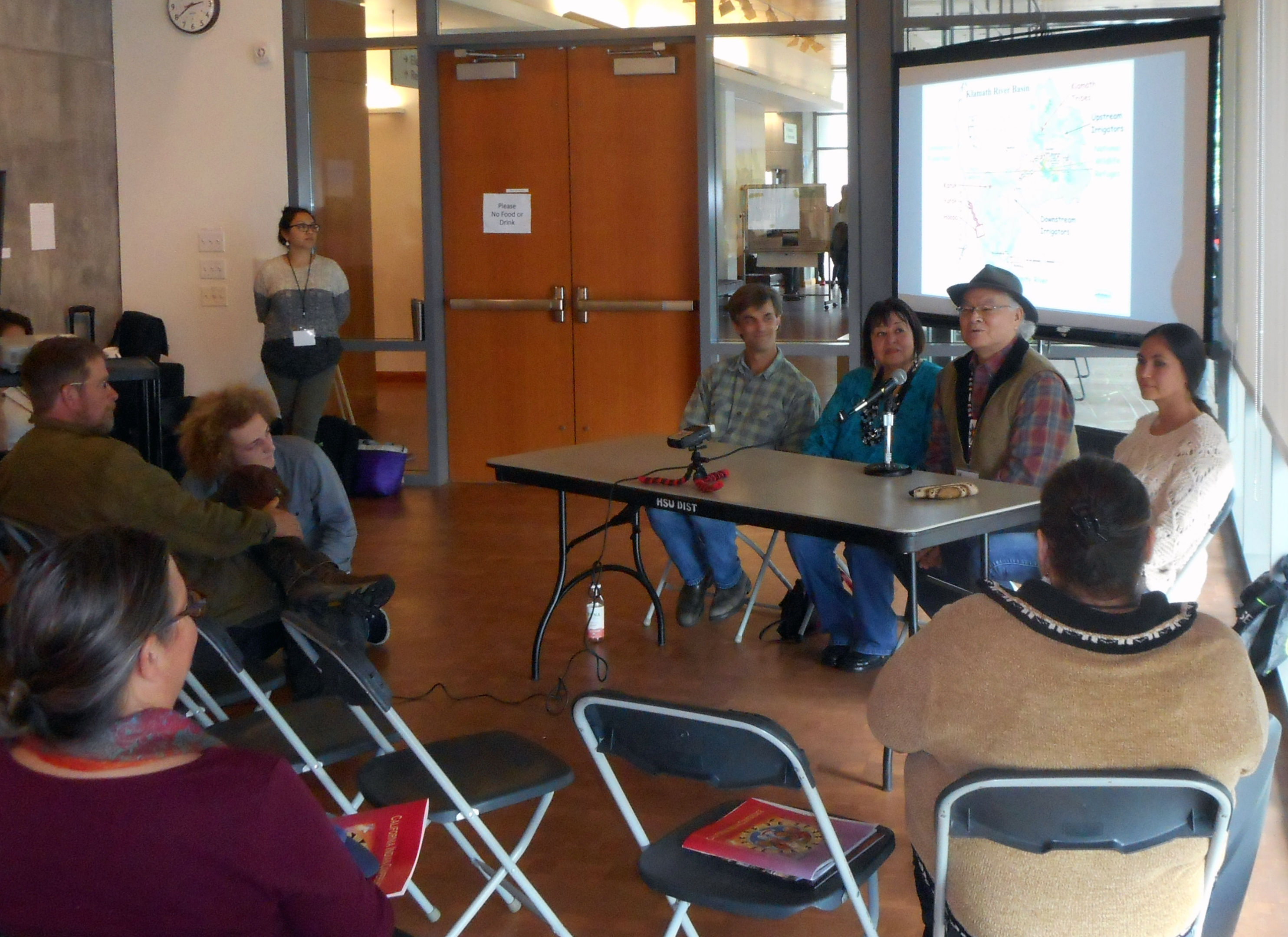
    The We Are the River: Connecting River Health to Community Health panel met to discuss the state of the Klamath River, and the communities whose lives are tied to the health of the river.

    The discussion was held in the Goudi’ni Gallery at Humboldt State during the 32nd Annual California Indian Conference on April 6.

    Dale Ann Sherman, a Yurok Tribe member and retired HSU professor of Native American Studies, was one of the four panelists.

    “I come from the Klamath and Smith Rivers. I belong to those rivers,” Dale Ann Sherman said. “In our blood runs the rivers and with that blood runs the salmon. We were born to go through time together. The salmon and us.”

    There were four panelists for the We Are the River: Connecting River Health to Community Health discussion: Dale Ann Sherman, Louise McCovey, Marlon Sherman and Konrad Fisher.

    Marlon Sherman is a Lakota tribal member, as well as the HSU department chair of Native American Studies.

    “The people on the Klamath River depend upon the salmon, and other fish,” Marlon Sherman said. “That’s their sustenance and their livelihood. That’s their spirituality. It is what their ceremonies are based on. Everything flows around the salmon, and if those salmon don’t have sufficient water, they will not come back any more. It is fairly obvious.”

    The salmon are at their lowest all time in returns due to problems with the river itself.

    “Dams, diversions and pollution sums up what is wrong with the river,” Fisher said.

    Fisher is a water protector who described the factors plaguing the Klamath River.

    “Dams are the biggest source of blue-green toxic algae build up, nasty stuff that will make humans very sick,” Fisher said. “Naturally occurring toxic blue-green algae production is dramatically elevated by dam water restriction. Some of the highest levels [of blue-green algae toxicity] ever recorded on Earth were collected behind the dams on the Klamath River.”

    A few years ago, a decades-long lawsuit by the Klamath tribes of the upper Klamath River went to the United States Supreme Court.

    “They finally were able to get the U.S. Supreme Court to realize that they had water rights to the Klamath River based on as far back as what they called time immemorial,” Marlon Sherman said.

    “Something exciting is happening very soon,” Fisher said. “We are on track for dam removal. Maybe not quite 2020, but 2021. Let’s continue to be hopeful.”

    “The [Klamath River Renewal Corporation] is the entity that will essentially take ownership of the dams, and take them out. Go to one of their meetings if you can. It is on their website,” Fisher said.

    “The salmon right now are at their bottom ebb. What they need now is plenty of clean, cold water,” Marlon Sherman said. “Water allocation is what the salmon need right now. This needs to be approached right now before the salmon are all gone. When the salmon go, who knows what’s next?”

    Water allocation rights and diversions are Fisher’s specialty, and water in the Trinity River that would run into the Klamath River is currently being diverted.

    “Water laws say there is a certain amount of water that should be left in the streams to meet certain needs,” Fisher said. “By and large they [the government] don’t [do their job] unless they are being forced, especially when it comes to telling people to use less water,” Fisher said.

    The needs of the communities most affected by the destruction of the Klamath have gone unheard.

    “The local laws of the people who have always lived there, and know the river, are never acknowledged,” Marlon Sherman said.

    “Ceremony is law. Culture is law. Very few people recognize that fact,” Marlon Sherman said. “The tribal attorneys need to be paying more attention to the tribal imperatives of spirituality, culture and tribal knowledges of their indigenous localities.”

    “Our people are fix-the-world people, that is what we do in our ceremonies,” McCovey said.

    McCovey is the Yurok Tribe environmental director and HSU environmental science alumnus who was on the panel.

    “There has been a rash of suicides in our community,” McCovey said. “For me in my job, I try to eliminate the environmental threats so that people can maintain their identity as river people, and feel safe in it.”