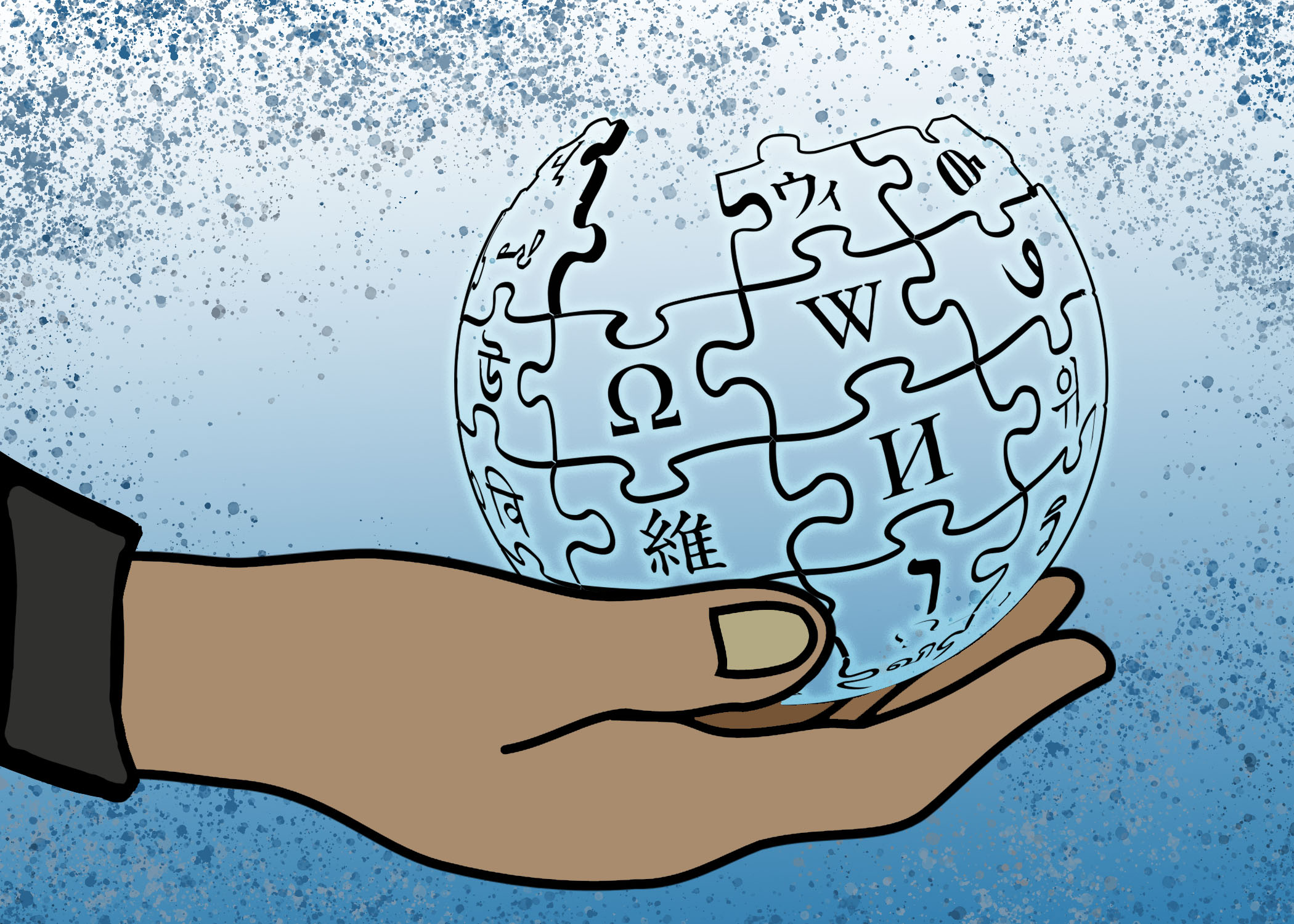
Wikipedia shows collaboration is crucial for accuracy
We’ve all been there. You’re sitting in a class. Your professor wants you to write a paper on the different types of asexual reproduction of the Sanderia malayensis jellyfish or some other arcane drivel. Your first reaction is to hit up Wikipedia. Then comes the kicker. You can’t cite Wikipedia. You scowl and snarl under your breath.
Wikipedia deserves more credit than we give it. Turning a blind eye to Wikipedia as a reliable source is shortsighted and has implications beyond the realm of encyclopedias. Distrusting Wikipedia represents academia’s unwillingness to open the gates of collaborative truth-seeking.
Scientific papers, meanwhile, are far from perfect.
Contrary to what your professors may tell you, Wikipedia, as a source, is statistically just as accurate as published encyclopedias for most of its content. A 2005 study by the Nature research journal, “Internet encyclopaedias go head to head,” found errors in both encyclopedias, but among the entries tested, the difference in accuracy was small.
Wikipedia, in their signature self-aware style, has reported on their own reliability as well. Wikipedia does not guarantee validity, but it is an invaluable research resource.
Inaccurate information on Wikipedia is usually corrected quickly. Hyperlinked citations back up nearly every claim made on an entry. The Sanderia malayensis jellyfish’s page hosts six sources from international professionals, biologists and a handbook on poisonous jellies.
Scientific papers, meanwhile, are far from perfect. Soft sciences have suggested cures to unhappiness or boosts to confidence through simple behavioral change, but as other researchers try to replicate the experiments, their conclusions are significantly different. This indicates a serious error in the scientific method. If science isn’t replicable, science is null.
In the last few years, a plethora of papers have fallen under criticism after researchers have failed to reproduce their results—it’s been called the replication crisis. The crisis may have a few sources.
Mistakes happen on Wikipedia too and it is always essential to be critical of anything read.
First, it’s not hard to get published. The University of World News said in 2018 that too much scientific research is being published. It estimated nearly 30,000 scientific journals are in circulation, publishing approximately two million articles each year. They said the volume burdens the peer review system and makes it dysfunctional.
Second, the media likes to be the first to report on news, including science news. Journalists can be wrong and often are when it comes to reporting on science, especially when they’re grasping to be the first to report on new findings. These bad practices report inaccurate, unconfirmed, flawed science to their audience before the study can be replicated.
Mistakes happen on Wikipedia too and it is always essential to be critical of anything read. Search around, find supporting articles for any claim made and be aware that there may be flaws. But be able to recognize valid and sound knowledge.
Critical review by the editors of Wikipedia—who can be any person—is what makes Wikipedia so powerful and so accurate. It’s the world’s largest encyclopedia—about 50 times larger than Britannica—with over six million entries and over 200,000 contributors. Wikipedia should serve as a banner for collaboration—especially between diverse groups.
In “The wisdom of polarized crowds,” a 2019 study from Nature Human Behavior, researchers found politically-diverse teams created more accurate entries than teams with less political diversity.
Wikipedia comes in clutch, often. Using it as a source may be frowned upon by professors, but a short chat with most of them and they’ll say Wikipedia is an excellent place to start. The website is a tool, not a cheat code. It would be ignorant to ignore it, but if it’s used appropriately, maybe, just maybe, we could learn something about jellyfish.
Sitting in silence with our eyes closed, we listened to Loba guiding us through the mediation, instructing us to allow the seed to tell us what it needed to communicate.
La Loba Loca, a queer herbalist visited CCAT (the Campus Center for Appropriate Technology,) this past Wednesday guiding students on an herbalist knowledge share centered around herbal Medicina Feminista.
Some students and community members that attended La Loba Loca’s Herbalism knowledge share at CCAT on Oct. 18, 2017. Loba requested to take a photo with everyone who attended the workshop. Photo credit: Mariza Ocampo
Erick Garcia, a Sociology major, was right at home in the herbalist knowledge share.
“I’m queer and I enjoy herbalism, so it was the perfect thing for me,” said Garcia.
Loba is from Arequipa, Peru, but currently resides in LA teaching herbal medicine, conscious mooning (classes on menstruation,) the oral history surrounding the healing practices as well as many other topics and practical tools. Loba identifies as “a queer, Chocolla, Andina, South American migrant, artist, researcher, writer, handpoke tattooist, full spectrum companion/doula, aspiring midwife student, seed-saver, gardener and yerbetera,” on La Loba Loca’s website.
The knowledge Loba shares with audiences is Abuelita Knowledge, the wisdom and practices passed down through generations of women and femmes. Leading the knowledge share with a seed meditation, Loba gave each individual a seed to hold. Loba then introduced the idea of seeds as technology.
“Literally to me, seeds are the most reliable technology that we have,” said La Loba Loca.
From there everyone was led through a meditation in which we held the seed in our hands and were guided to open ourselves to anything the seedling wanted to tell us. In a room packed so that only standing room remained, everyone there simply closed their eyes and focused on the knowledge that the seeds had to share.
One attendee said that their seed was old, “not necessarily the seed itself, but the information it holds.”
Other individuals attending the workshop simply reflected on the importance and process of a singular seed, noting that we often don’t stop to appreciate the work and undertaking of one simple seed.
Loba then encouraged everyone attending to research seeds and plants important and cherished within our own heritage and cultures. Different plants used for healing and nurturing native to one’s own history that we could incorporate into our diet and/or daily life. The coca plant, specifically the coca leaf holds special significance to Loba as a grounding and energizing plant native to Peru.
From there, Loba went into the oral history and roots of some of the healing practices of herbalism today. Discussing the power of Medicina Feminista, its origins, certain tools and practices, as well as the history of the witch trials and how that has affected women/femme interactions and healing.
“To me, feminism is the magic that happens when women and femmes have resisted the patriarchy,” said Loba.
Loba delved into the topic of women/femmes as the traditional caregivers and healers in comparison to the male and masculine dominated health fields of western medicine. In a field composed of primarily white males, Loba works to take back and teach the traditions and knowledge to healing through herbalism. Loba honored the acts of women and femmes who for centuries have healed and cared for individuals, sharing their knowledge and healing as an act of free labor.
Aliah Bueno’Strong, a Rangeland major at HSU felt a strong connection to the dialogue surrounding feminism and Loba’s
“Hearing her talk about feminism, that’s what I really resonated with the most,” said Bueno’Strong. “I’m one of those people that doesn’t believe that you have to have equality of the genders, but simply the equality for everyone. It was good to hear it come from someone else.”
Loba discussed the current inequality between the genders, allowing for discussion on historical events that influence us now, such as the witch trials.
Viewing the witch trials as an intentional act of the church and state, the patriarchy, as a way to take away women’s power. The healers, midwives, doulas, herbalists, and any woman or femme who practiced traditional non-westernized healing were persecuted. Even women who were not as versed in Medicina Feminista and Abuelita Knowledge were under suspicion.
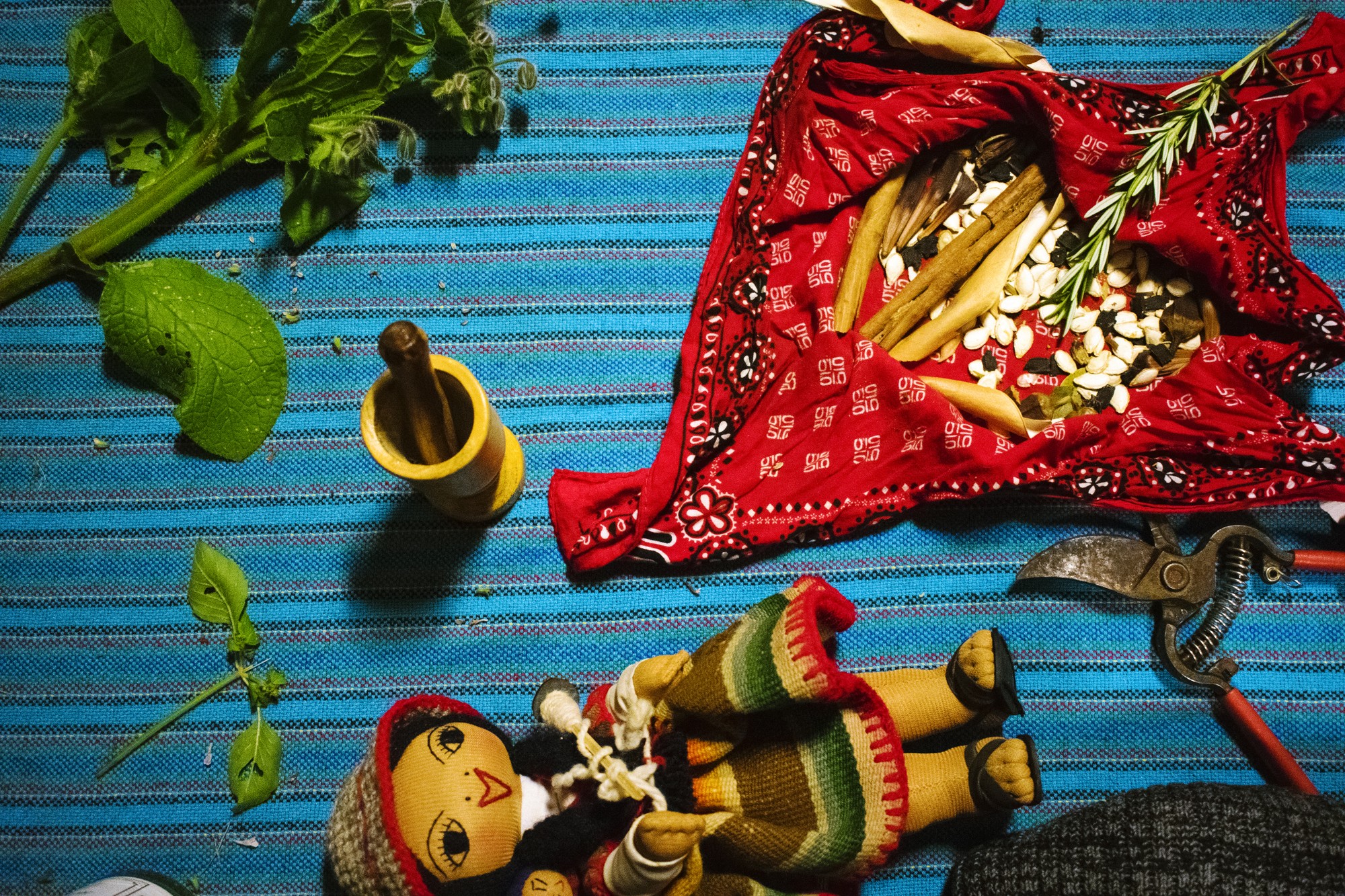
Loba showing and explaining some of the items that were brought for the knowledge share. Photo credit: Mariza Ocampo
“The witch hunts were toxic masculinity at its best,” said Loba.
The witch hunts eliminated much of the trust and communication between women, turning one another against each other to prevent their own persecution. This robbed women and femmes of spaces to share information and stories, places to come together in healing and discussion.
“They took away the bond and unity between women and femmes,” said Loba.
Loba discussed the effects of the trials in the way women and femmes bond and communicate with one another today. These historical events are still very much with us in that they affect the perception and acceptance of woman interaction and healing today.
The systematic goal of mainstream society is to prosper as individuals, to rise up alone. Herbalism and Medicina Feminista work to bring up everyone and benefit everyone collectively.
To learn more on Abuelita Knowledge you can read Loba’s article, “Reclaiming Abuelita Knowledge as a Brown Ecofeminista.” The article discusses the roots of Loba’s knowledge and works to take back the knowledge and practices that have been westernized and claimed by many white hippies as new eco-friendly practices.
Diving into the history and the roots of herbalism, La Loba Loca explains some of the benefits and properties of certain plants during the herbalism knowledge share at CCAT. Photo credit: Mariza Ocampo
“Specially all these white supremacist ideas that make people believe that conscious mooning is a white hippie thing, that giving birth to a baby under a tree is white, that gardening organically is white, that meditating is white,” Loba writes in the article.
Deconstructing common misconceptions on this passed down cherished knowledge and working to reclaim these ancestral practices is one of Loba’s main goals. Knowledge shares like the one held at CCAT is another incentive for Loba to continue educating and sharing knowledge.
One of Loba’s goals laid out on the La Loba Loca website is to create safe spaces and resources for “Spanish-speaking communities of color as well as queer and trans communities of color.”
Vanessa Cota, a Political Science major at HSU, left the knowledge share at CCAT house feeling nourished and refueled.
“It’s a space that was very needed,” said Cota.
After going over some of the oral history and recalling the origins of some of the practices, Loba moved on to share knowledge as an herbalist discussing certain plants and their beneficial properties.
Passing around borage, fennel, rosemary, lemon balm, calendula, tulsi, and a Mexican Marigold, Loba shared knowledge on each plant, explaining their healing properties and some of the ways incorporating them into our lives could beneficial.
Each plant was discussed in-depth with an open dialogue between Loba and the audience as everyone shared their experience and knowledge with the different plants.
“It takes what I’m learning about in Botany out of the confines of academia and back to the down to earth roots on how people actually interact with plants,” said Kevin Riley.
Riley, an Environmental Science and Management major, loved attending the knowledge share, both for the knowledge he gained and because of the space CCAT and those in attendance created.
“It was very positive and uplifting, we were talking about life and health together,” said Riley.
After the workshop, Riley said, “I have the biggest smile on my face I’ve had all week.”
The knowledge share concluded with a tea meditation, in which all of the attendees were given a cup of tea that had been brewing throughout the event.
A simple mixture of lemon balm and rose prompted the ending discussion on what the tea could do for our bodies and minds. With each individual in the audience feeling and focusing on the tea, we concluded the knowledge share explaining what the tea brought up for us, both physically and emotionally.
Erick Garcia was glad to have attended the event.
“A whole bunch of people ready to learn came together, if you wanted to be here you were,” said Garcia. “We came in here with love and joy and we are leaving with love and joy. Some of us don’t have that on a day to day basis, so it was nice to know that there is a community filled with that.”
Aliah Bueno’Strong is in the herbalism class on campus at CCAT, and knew a good deal of what Loba went over. Bueno’Strong had a strong appreciation for the dialogues on feminism, gender, race, and equality as well as the herbal discussions.
“I’m heterosexual, but to be in a room with a lot of people who are not necessarily like me was amazing,” said Bueno’Strong.
Loba succeeded in creating a safe space to discuss the power of plants, the history of healing and herbalist practices, the effects of the patriarchy and white supremacy, as well as many other topics that come up when a large group tells stories and shares ideas.
“I was very happy by the turnout, I left to go get food and when I came back the room was full,” said Bueno’Strong. “It shows how diverse and inclusive the school is as a whole, and our students.”
Everyone in attendance stayed until the very end, soaking up all of the knowledge Loba had to share. While each individual gained something different from the workshop, everyone left feeling different from when they entered CCAT.
“Rooted.”
“Rooted is the best word to explain it,” said Cota.
This website uses cookies to improve your experience. We'll assume you're ok with this, but you can opt-out if you wish. Cookie settingsACCEPT
Privacy & Cookies Policy
Privacy Overview
This website uses cookies to improve your experience while you navigate through the website. Out of these cookies, the cookies that are categorized as necessary are stored on your browser as they are essential for the working of basic functionalities of the website. We also use third-party cookies that help us analyze and understand how you use this website. These cookies will be stored in your browser only with your consent. You also have the option to opt-out of these cookies. But opting out of some of these cookies may have an effect on your browsing experience.
Necessary cookies are absolutely essential for the website to function properly. This category only includes cookies that ensures basic functionalities and security features of the website. These cookies do not store any personal information.
Any cookies that may not be particularly necessary for the website to function and is used specifically to collect user personal data via analytics, ads, other embedded contents are termed as non-necessary cookies. It is mandatory to procure user consent prior to running these cookies on your website.