The Lumberjack


Students Serving The Cal Poly Humboldt Campus and Community Since 1929

Tag: letters

  • It’s a small world, after all

    It’s a small world, after all

    By Carlina Grillo

    ‌These days, there are multiple forms of sightseeing. There’s the typical guided tours, pub hopping, gift shops, and getting lost. Then, there’s Tinder.

    ‌Using Tinder abroad took sightseeing to a whole new perspective—that perspective being from the depths of the dating pool.

    I am writing to you from across the pond, all the way from Ireland, where I am currently sitting on a bus on my way to Cork.

    ‌Besides writing for The Lumberjack and watching raindrops roll down the bus windows, there are limited activities for these long travel days.

    ‌Social media is pretty boring when most of my mutuals are still sleeping. The seven hour time difference means when I’m sipping on my morning cappuccino, or on my mid-day bus ride, the only people up are the night owls and insomniacs.

    ‌That’s when I switched to Tinder, social media for the single and bored. I’ve noticed two things about Irish Tinder: half of the men are named Seán (or some other variation of Shawn) and 99% of Tinder cover photos are group photos. When you figure out who in the group the profile belongs to, it’s never the one you had hoped for. It’s especially difficult when the European men are friends with people who look exactly like them. I can go through an entire profile never knowing who’s who.

    ‌So, here I am, scrolling on Tinder as I’m leaving Galway, and I see another familiar face. This person however didn’t have a group photo, didn’t have a stereotypical European profile and what caught my attention the most was a photo from the Monterey Bay Aquarium. This man is either a tourist in Galway or has been a tourist around my stomping grounds. Either way, there’s some commonality.

    ‌I swiped right and it was a match. Immediately, I asked if he was from Ireland.

    “Yes! I lived in America for a good while… didn’t we go to school together?” He asked.

    ‌Then it all clicked. His face was familiar because we attended the same small town high school in the Santa Cruz mountains. Turns out, he moved from Ireland to California, and then back to Galway. What are the odds?

    ‌And maybe this coincidence wouldn’t have blown my mind so much if it was my first encounter within this teeny tiny world.

    ‌What I failed to mention was my plane ride to Ireland from SFO. I sat in the terminal with my friend waiting to board our Aer Lingus direct flight to Dublin. From the corner of my eye, I see another familiar face. Sure enough, I wasn’t the only Cal Poly Humboldt student who had traveled from Arcata to SF to Dublin for Spring break.

    I felt a sense of déjà vu as a classmate from my women’s studies lecture sat right down the row, just like we had done in the classroom 48 hours prior. I wasn’t completely sure it was them until 11 hours later when we caught the same bus into town. It was clear we caught each other by surprise, experiencing our first moments in Ireland together. Again, what are the odds?

    ‌Needless to say, my first time abroad, from one rainy city to another, I’ve been feeling right at home and  as the Irish say, céad míle fáilte – or one hundred thousand welcomes.

  • Letters from Pelican Bay

    Letters from Pelican Bay

    By| Tania Mejia

    In August of 2016, the Department of Justice [DOJ] made an announcement claiming it would begin phasing out the use of private prisons. I clearly remember coming back to school and a number of people sharing their excitement and asking my personal thoughts on it.

    I would start off by saying yeah it was a great thing, but our number of private prisons was miniscule to the total amount of state and federal prisons in our nation. So while it seemed like a great accomplishment, federal private prisons only made up about 8% of our incarcerated population and in the end of December 2015 only housed 22,660 inmates according to an inspector general report. Also, this did not include state private prisons, which similar to our federal government are in the low percentages. I personally thought it would be a greater accomplishment had it been in regards to immigration detention centers, considering about two-thirds of them are privately owned. This is where it is worth mentioning, simply because it is called “detention center” does not mean it is not a prison. 

    Following the DOJ statement, stocks for private corporations such as Corrections Corporation of America, now Core Civic, and GEO Group, formerly Wackenhut,  plummeted. It seemed those who prioritize profits over people were concerned about the future of their investment. But this was not a clear win, and with such companies donating to Trump’s campaign it was expected that the fight was not over. Most recently, the Trump administration announced it will not uphold former Former Deputy Attorney General Sally Q. Yates’ memo and that we will continue and increase our use of private prisons.

    The reason this is so concerning starts with looking at the models in which companies as CCA and GEO operate in. To ensure maximum capacity and profits, contracts are introduced where states are required to keep a certain percentage of beds full.  What are the problems with private prisons? Culture of violence, poor unsanitary conditions, health care, food, operational conditions, sexual abuse, If crime rates have been down in the past decade, how do we account for such usage of these facilities?

    Some contracts require 90 to 100% occupancy, which means if states don’t provide those numbers, they have to pay these companies for the unused beds. If not, increase the criminalization of everyday life. 

    Private prisons did not exist before the early 1980s when U.S. states and the federal government needed a solution to overcrowding in public prisons. But between 1990-2009 the number of people in private prisons increased by a massive 1600 percent. The business model of these companies essentially depends on locking up more and more people up.

    In its 2010 annual report to shareholders, CCA stated, “The demand of our facilities and services could be adversely affected by the relaxation of law enforcement efforts, leniency in conviction or parole standards and sentencing practices or through the decriminalization of certain activities that are currently proscribed by our criminal laws.” Because of these concerns, private companies spend a lot of money lobbying for policies which will benefit their pockets.

    How can we stop the use of private prisons? Unfortunately, we now have a president who is going to make any effort nearly impossible. But we know private prisons spend a lot of money on lobbying politicians there is hope. They all support governors, state legislators, and judges, which we all have a say in. This requires digging into local and state politics.

    I would encourage everybody to read “My Four Months as a Private Prison Guard” by Shane Bauer for Mother Jones. We have vulnerable populations in these facilities including juvenile and immigrant detainees. The problem spreads beyond America into countries like Africa, Australia, and more.  Our nation’s prison system is a failure on its own. Prioritizing profits over people does not serve community, families, and society, but only those who are invested.

    Any Orange is the New Black fans will be somewhat familiar with the problems that follow when public institutions turn to for profit companies. Fun fact, Management Correction Corporation (MCC) piggybacks off the real private prison company Management Training Corporation (MTC).

  • HSU looks at the big picture for enrollment

    HSU looks at the big picture for enrollment

    By Charlotte Rutigliano

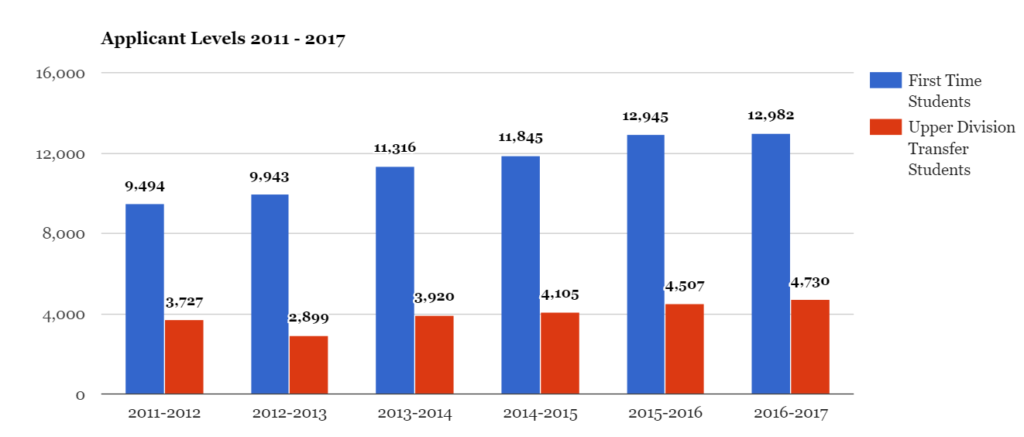
    The days of generalizations may be in the university’s rear view as various department’s throughout Humboldt State aim to start writing personalized letters to prospective students due to a drop in enrollment this past term.

    This is part of a plan the university has created to start focusing more on prospective students who applied and turning them into current students. Director of Admissions Steven Ladwig said every student needs to have a relationship with someone on campus before attending to make them feel more comfortable once they’re here.

    This plan has been put into place with the hope that it will boost enrollment for the 2017-2018 school year. According to Nicholas Conlin, coordinator for Orientation and New Student Programs, enrollment only dropped this last year. There were about 200 to 250 fewer students than the university was hoping for.

    Graphic by | Charlotte Rutigliano

    The drop in enrollment was not a drastic one, and HSU was not the only California State University to see this drop.

    “There were six CSU’s who didn’t meet enrollment numbers this term,” said Ladwig. “Chico, Fresno, Monterey Bay, San Bernadino, San Francisco, and Sonoma.”

    The slight drop in enrollment last term didn’t affect the number of impacted majors [majors that have more students than the program accepts.] Additionally, the number of visitors to campus was not impacted.

    HSU is known for its science programs with the most sought after majors being biology, botany, environmental resources engineering, wildlife and zoology. This past year however, both the social work and environmental management & protection departments became impacted as well.

    John Panting, lead admissions counselor, said that there hasn’t been a decline in the number of tours given but the number of visitors does depend on the time of year, saying that November through January typically have less visits.

    “In the beginning of February is when the number of visitors really starts to ramp up,” Panting said.

    HSU, in an attempt to identify the contributing factors hired John Capaccio as Associate Vice President of Enrollment Management. Carpaccio’s role is simple —  to increase enrollment without lowering admissions standards.

    Graphic by | Charlotte Rutigliano

  • Letters from Pelican Bay

    Letters from Pelican Bay

    By | Tania Mejia

    Last week, Humboldt County joined the Women’s March movement and marched in solidarity for women’s rights and related causes at the largest protest in our nation’s history. Not only was this a historical day for our country, it was also a historical day for the Humboldt County: the march became the largest demonstration in Eureka’s history.

    During the Women’s March I held a sign which read, “INCLUDE THE 1.2 MILLION WOMEN BEHIND BARS IN YOUR ACTIVISM,” in bold black letters over an orange painted women’s power symbol. Inspired by Intersectional Feminists Against Fascist Overlord’s Instagram post with a poster reading “INCLUDE DISABLED WOMEN IN YOUR FEMINISM,” I thought the same message could be applied to an often forgotten imprisoned population.

    With one in 100 US adults behind bars, it is important to be conscious of those who cannot participate in free speech and currently sit behind bars. As I marched, I saw posters reading, “MY BODY, MY CHOICE” or “A WOMAN’S PLACE IS IN THE RESISTANCE,” and couldn’t help but cringe at the lack of thought about the privilege behind such messages. Just to be clear, women are currently the fastest growing prison population.

    Women, especially trans women of color are being arrested, harassed and victimized by our criminal justice system far more than any other incarcerated population. They are being housed in male prisons where they are put in solitary confinement for their so-called protection. Alternatively, if left in general population, they are mistreated and/or become victims of sexual assault both by correctional officers and inmates significantly more than other prison populations.

    It’s also important to note that when we talk about “MY BODY, MY CHOICE” this is not true for women behind bars. In her book, “Are Prisons Obsolete,” Angela Davis writes. “Prison and police officers are vested with the power and responsibility to do acts, which if done outside the work hours, would be crimes of sexual assault.”

    Let’s think about that. Let’s think about the sterilization of female inmates without consent as a form of birth control, which California recently banned in 2014. Let’s think about the lack of medical and reproductive health care women behind bars face and endure on a daily basis in unsanitary conditions.

    Overall, when we proclaim, “WOMEN’S RIGHTS ARE HUMAN RIGHTS,” we must include every self-identified female body behind bars. While I understand not everybody is seeking to reform the criminal justice system, we must connect the dots between other social justices. This is where we have to build the kind of unity and solidarity across very different places – culturally, geographically, and politically– to create a stable foundation to progress as a nation.

    How this is put into action is up to us, but as a self-identified prison abolitionist this is my favorite example: In Spring 2001, Critical Resistance, an organization that works to dismantle the prison industrial complex system, filed an environmental lawsuit against the California Department of Corrections (CDC) with the goal of stopping the construction of a 5,160 bed prison in California’s Central Valley that would have cost taxpayers $335 million. Critical Resistance organized a group of coalitions that had previously never worked together, including anti-prison activists, environmentalists, farm worker’s unions and immigrant advocates.

    So, when I say, “INCLUDE THE 1.2 MILLION WOMEN BEHIND BARS IN YOUR ACTIVISM,” I don’t mean, ‘don’t forget them.’ I am calling for us to unite, organize and combine strategies to address our societal problems. I am calling for grassroots organizing and legislative work with diverse individuals, organizations and state agencies. I am calling all of the civil rights activists, environmental protectors and social justice warriors who want to live in a better world. As we continue on, we must move into new and formerly unlikely alliances which allow for participation from all of us.

    Note: When stating there is 1.2 million women behind bars, this includes those in prison, jail, probation and parole. According to the Sentencing Project, “The rate of growth for female imprisonment has outpaced men by more than 50% between 1980 and 2014.”