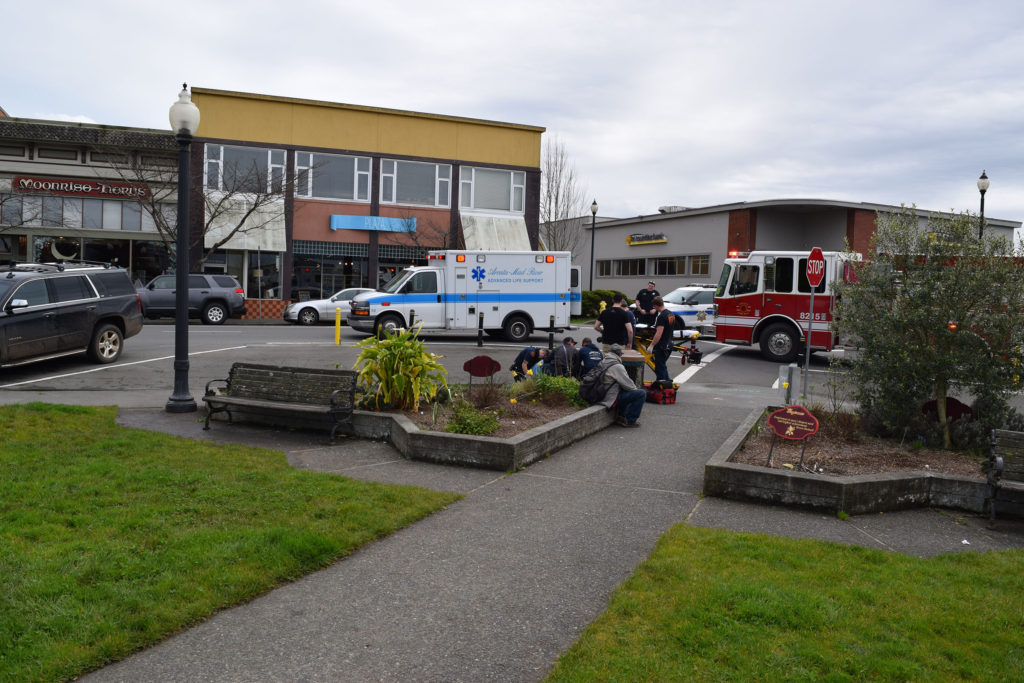
Earlier today several dozen women gathered on the plaza dressed in red and pink to celebrate National Women’s Day. The rally began at approximately noon, however, less than an hour later the celebration was interrupted by loud sirens.
Cat Koshkin holding a sign at Arcata women’s rally | Curran Daly
A man who appeared to be around 50 years of age became disruptive during the onset of the event and later collapsed to the ground. He initially walked up to rally participant, Cat Koshkin, and put his hand on her shoulder.
“Please stop him please,” the man said.
“What happened?” Koshkin said .
“I can’t catch up with him,” the man replied.
The man then collapsed and began shaking. A nearby parking enforcement officer had the man sit down. After the officer was unable to get any clear response from the man he called an ambulance.
Man arrested by APD | Alex Hassenstab
The Arcata Fire Department, Mad River Hospital ambulance and the Arcata Police Department arrived at the scene shortly after the call was made. The man refused medical attention and after screaming and showing aggression towards medical workers he was taken into custody by the Arcata Police Department. The Lumberjack will provide additional updates as more information becomes available
Last week, Humboldt County joined the Women’s March movement and marched in solidarity for women’s rights and related causes at the largest protest in our nation’s history. Not only was this a historical day for our country, it was also a historical day for the Humboldt County: the march became the largest demonstration in Eureka’s history.
During the Women’s March I held a sign which read, “INCLUDE THE 1.2 MILLION WOMEN BEHIND BARS IN YOUR ACTIVISM,” in bold black letters over an orange painted women’s power symbol. Inspired by Intersectional Feminists Against Fascist Overlord’s Instagram post with a poster reading “INCLUDE DISABLED WOMEN IN YOUR FEMINISM,” I thought the same message could be applied to an often forgotten imprisoned population.
With one in 100 US adults behind bars, it is important to be conscious of those who cannot participate in free speech and currently sit behind bars. As I marched, I saw posters reading, “MY BODY, MY CHOICE” or “A WOMAN’S PLACE IS IN THE RESISTANCE,” and couldn’t help but cringe at the lack of thought about the privilege behind such messages. Just to be clear, women are currently the fastest growing prison population.
Women, especially trans women of color are being arrested, harassed and victimized by our criminal justice system far more than any other incarcerated population. They are being housed in male prisons where they are put in solitary confinement for their so-called protection. Alternatively, if left in general population, they are mistreated and/or become victims of sexual assault both by correctional officers and inmates significantly more than other prison populations.
It’s also important to note that when we talk about “MY BODY, MY CHOICE” this is not true for women behind bars. In her book, “Are Prisons Obsolete,” Angela Davis writes. “Prison and police officers are vested with the power and responsibility to do acts, which if done outside the work hours, would be crimes of sexual assault.”
Let’s think about that. Let’s think about the sterilization of female inmates without consent as a form of birth control, which California recently banned in 2014. Let’s think about the lack of medical and reproductive health care women behind bars face and endure on a daily basis in unsanitary conditions.
Overall, when we proclaim, “WOMEN’S RIGHTS ARE HUMAN RIGHTS,” we must include every self-identified female body behind bars. While I understand not everybody is seeking to reform the criminal justice system, we must connect the dots between other social justices. This is where we have to build the kind of unity and solidarity across very different places – culturally, geographically, and politically– to create a stable foundation to progress as a nation.
How this is put into action is up to us, but as a self-identified prison abolitionist this is my favorite example: In Spring 2001, Critical Resistance, an organization that works to dismantle the prison industrial complex system, filed an environmental lawsuit against the California Department of Corrections (CDC) with the goal of stopping the construction of a 5,160 bed prison in California’s Central Valley that would have cost taxpayers $335 million. Critical Resistance organized a group of coalitions that had previously never worked together, including anti-prison activists, environmentalists, farm worker’s unions and immigrant advocates.
So, when I say, “INCLUDE THE 1.2 MILLION WOMEN BEHIND BARS IN YOUR ACTIVISM,” I don’t mean, ‘don’t forget them.’ I am calling for us to unite, organize and combine strategies to address our societal problems. I am calling for grassroots organizing and legislative work with diverse individuals, organizations and state agencies. I am calling all of the civil rights activists, environmental protectors and social justice warriors who want to live in a better world. As we continue on, we must move into new and formerly unlikely alliances which allow for participation from all of us.
Note: When stating there is 1.2 million women behind bars, this includes those in prison, jail, probation and parole. According to the Sentencing Project, “The rate of growth for female imprisonment has outpaced men by more than 50% between 1980 and 2014.”
What began as a simple Facebook event post has now turned into a worldwide grassroots movement.
Teresa Shook, a Hawaiian resident angered by the 2016 election results, decided to make a Facebook event and invited 40 of her friends to a “March on Washington,” on the day after the inauguration.
That very next morning she woke up to over 10,000 responses to her Facebook event. Shook, alongside others with the same emotions, came together to form the Women’s March.
Their mission – to “invite individuals and organizations committed to equality, diversity, and inclusion and those who understand women’s rights as human rights to join local coalitions of marchers in representing the rights and voices of progressive people around the world.”
On Jan. 21, more than 670 Women’s March rallies occurred throughout the country. One of those marches shut down much of Old Town Eureka Saturday evening.
Women and men, girls and boys all packed the streets of the C Street Market in Eureka. The event began with a few guest speakers followed by a march through the streets of Old Town Eureka.
Guest speakers, such Ramona Bell, Cheryl Seidner, Wendy Ring and Terry Uyeki, spoke about how the marchers could promote change during Donald Trump’s presidency.
“We need to be together, as the mass of humanity, with all our diversity in order to join up and be powerful, and challenge the other powers that are trying to oppress us,”Arcata local Joanne McGarry said.
McGarry is a member of Stand for Peace, a local group that gathers every Friday afternoon in the Arcata Plaza and stands for something they believe in.
“We stand for peace,” said McGarry. “It’s been happening for 13 years, you can stand for whatever kind of people you want and for as long as you want.”
An estimated 2,000 people attended the march according to Eureka Police Department Chief Andy Mills.
Barbara Keating, a former HSU employee, was one of those people.
Julie Rofman and Iris Koski showing support for the Women’s March Saturday, Jan. 21 2017 in Eureka, California.
“I’m a 67-year-old white women, I do not have a target on me,” Keating said. “But this is the first election that I’ve been afraid, and not for me, but for my fellow citizens.”
This was not only a march for “girl power vs Trump power.” The protestors hit the streets for a range of reasons including immigration, health care, income equality, and the environment.
“I just don’t think we have time to waste on four years of climate change denial,” Eureka resident, Syd Munguia said. “I also think it’s a tragedy that so many millions of people are going to lose their health care, that’s what got me here today.”
Protestors say it’s time for peace. No matter your race, your gender, your color, your social status, your sexual orientation, or even your political views, it’s simply time for peace.
This website uses cookies to improve your experience. We'll assume you're ok with this, but you can opt-out if you wish. Cookie settingsACCEPT
Privacy & Cookies Policy
Privacy Overview
This website uses cookies to improve your experience while you navigate through the website. Out of these cookies, the cookies that are categorized as necessary are stored on your browser as they are essential for the working of basic functionalities of the website. We also use third-party cookies that help us analyze and understand how you use this website. These cookies will be stored in your browser only with your consent. You also have the option to opt-out of these cookies. But opting out of some of these cookies may have an effect on your browsing experience.
Necessary cookies are absolutely essential for the website to function properly. This category only includes cookies that ensures basic functionalities and security features of the website. These cookies do not store any personal information.
Any cookies that may not be particularly necessary for the website to function and is used specifically to collect user personal data via analytics, ads, other embedded contents are termed as non-necessary cookies. It is mandatory to procure user consent prior to running these cookies on your website.