
The Lumberjack


Students Serving The Cal Poly Humboldt Campus and Community Since 1929

Tag: Mask protection

  • Not all masks are made equal

    Not all masks are made equal

    According to Cal Poly Humboldt regulations, face masks are required everywhere on the campus, and at all school functions. Amid the predicted peak of the Omicron surge, mandated masking is a key part of the university’s strategy to prevent widespread transmission of COVID-19.

    Humboldt County Health Officer Ian Hoffman has confirmed that the Public Health Department has been in contact with Cal Poly Humboldt with regards to the university’s COVID-19 regulations.

    “We, as Public Health, have continued to offer, you know, clear guidance on how to make public spaces safe, which includes things like masking, distancing, testing, vaccinations – they are doing all of those things at HSU [Cal Poly Humboldt], and we have been in communication with them,” Hoffman said. “So, I think the ultimate decision is up to them.”

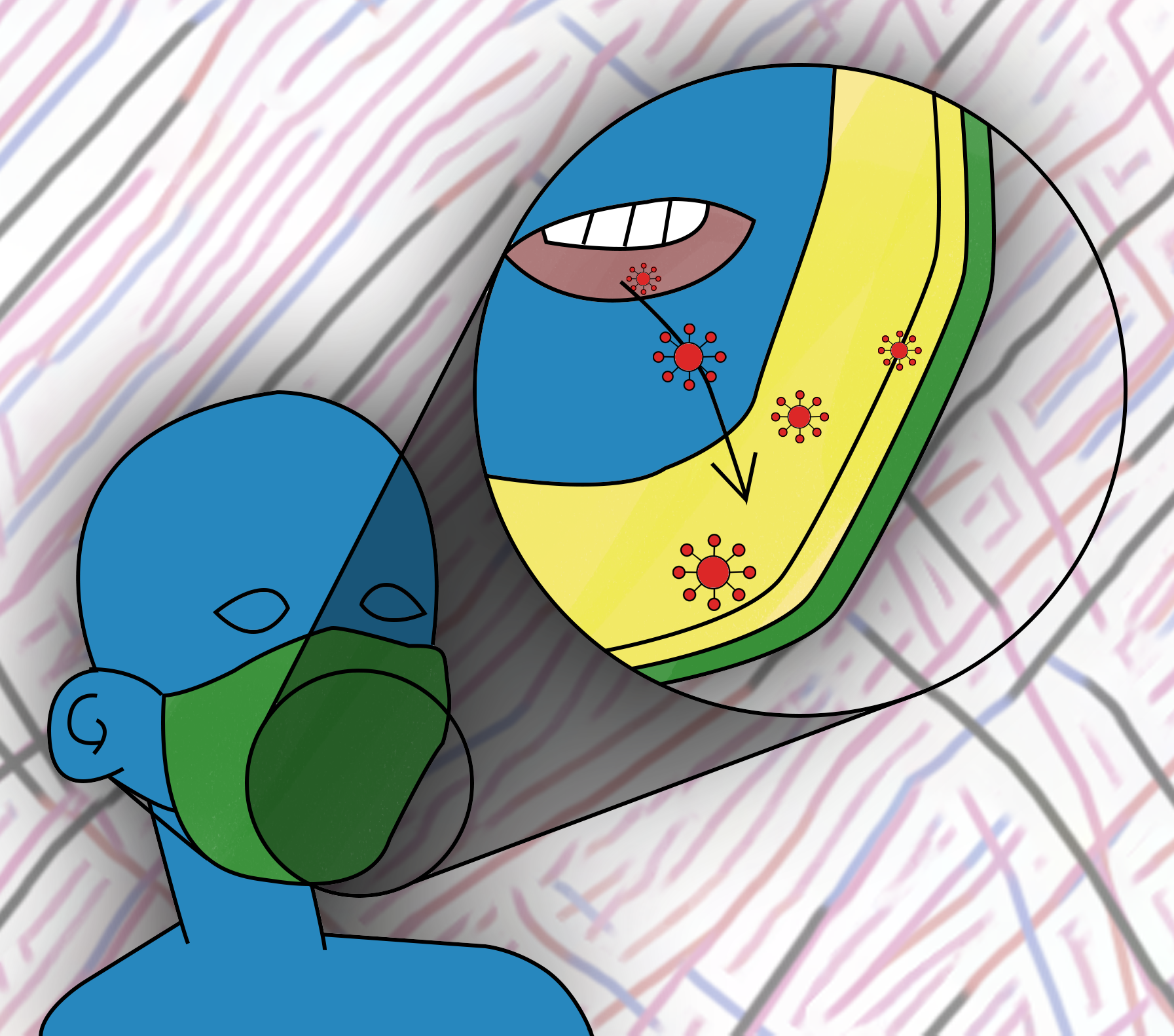
    Graphic by August Linton

    Not all masks offer the same amount of protection, to the wearer or to those around them.

    According to the CDC, NIOSH-approved N95 masks are the best, followed by KN95s and surgical masks. Cloth masks rank the lowest, although it is noted that layered, finer fabrics are more effective than loosely woven or single-layered varieties.

    Whatever type, it is important that masks be well-fitted, with no gaps around the nose or edges. A surgical mask underneath a cloth mask may resolve fit problems.

    County Health Officer Hoffman suggested double-masking for all types except N95s. He also cautioned against masks with one-way vents.

    “Those vents … protect the person wearing it, but they’re not protecting anyone around them,” Hoffman said.

    Despite their efficacy, Cal Poly Humboldt does not currently require that students wear N95s.

    “The reason N95 Masks cannot be mandated on campus is that there are some situations where N95 masks can exacerbate medical conditions for the wearer,” the university stated in a Campus Ready email update. “The campus community is encouraged to wear N95 masks if they are able.”

    Free N95s and surgical masks are available at College Creek Mailroom, JGC mailroom, UPD, Welcome Center, the Library, and the SAC.
  • More Layers, More Protection?

    More Layers, More Protection?

    Humboldt State demands double masking on campus, does more layers equal more protection?

    You’ve probably read the headlines: Wearing a Mask Prevents the Spread of COVID-19. But which mask you choose could affect how protected you and others really are.

    Masks were first mandated in Humboldt County on April 24 when Health Officer Dr. Teresa Frankovich introduced an order requiring all members of the public wear facial coverings while inside a facility other than their residence. Since Humboldt State University was required to close campus prior to that, the university announced safety precautions on Aug. 4, which included wearing face coverings with at least two layers of 100% cotton. This was done in conjunction with the reopening of campus for the fall semester.

    The Centers for Disease Control and Prevention (CDC) urges people to wear masks with at least two or more layers of washable, breathable fabric. Masks need to be worn covering both your mouth and nose at all times.

    Director of News and Information Aileen Yoo stated, “HSU is following recommendations from the CDC. Its website is also a great resource for information on different types of protective gear.”

    Karen Wilkinson, Joint Information Center representative, said, “The county looks to the California Department of Public Health and the CDC for guidance.”

    According to the Association of American Medical Colleges (AAMC), “studies have shown a double-layer cloth face covering was significantly better at reducing the droplet spread caused by coughing and sneezing, as compared to a single-layer one.”

    Mark Wilson, a microbiology professor at HSU believes that “the main goal of mask wearing is to reduce the emission of droplets and aerosols from a person infected with the coronavirus, by trapping emitted droplets in the fabric. Mask-wearing can reduce the transmission of airborne diseases like coronavirus.”

    Wilson added that when deciding on the type of masks, “the tighter the weave of the material, and the more layers it has, the more effective it will be at filtering out particles.”

    May Chu, an epidemiologist at the Colorado School of Public Health, as quoted by NPR said, “a good option is a mask made of two layers of a tight-weave fabric with a built-in pocket where you can place a filter.”

    A University of California, San Francisco article reported that based on a simulation, researchers predicted that 80 percent of a population who wear masks would reduce the spread of COVID-19 more than being on lockdown. Further, the Institute for Health Metrics and Evaluation projected that 33,000 deaths could be prevented by October 1 if 95 percent of the population wore masks in public.

    Many researchers have looked into N95 masks which are made out of many layers of fine polypropylene fibers. They are able to block at least 95% of small airborne particles but only when worn correctly. Though they are proven to be effective, the short supply should be reserved for medical professionals and first responders.

    A recent Duke study rated a fitted N95 and a three-layer surgical mask as the top two protectors, followed by two layer cotton masks.

    According to an article by Science Daily in July, a team of Australian researchers did a study comparing the effectiveness of single and double layer cloth face coverings. They used LED lighting to film the airborne droplets. Their results showed that double layer face coverings prevented more droplets from spreading.

    HSU students can be provided with double layer masks at the campus Police Department, the first floor of Student and Business Services building, Jolly Giant Commons, College Creek Market and the Parking Kiosk.