After nearly 160 years in the hands of Eureka, Tuluwat, briefly known as Indian Island, returns to its rightful owners
Wiyot Tribal members and Eureka community members were joyful, yet solemn, at the Eureka City Council meeting to officially return Tuluwat Island to the Wiyot people.
Wiyot tribal elder Cheryl A. Seidner blessed the room in a prayer of welcome. In the prayer, Seidner welcomed people from the East and from all directions as she turned in a circle, speaking in her native language. The crowd was silent and respectful, and tribal members let out emotional “ho’s.” Seidner thanked everybody in the audience and asked them to rise.

“This is something I’ve always wanted since I was a kid,” Seidner said. “I thought the island was always ours, not anybody else’s. So we came together and said, ‘Let’s do this, let’s make it ours.’ So I decided to be bold and ask the new mayor to give us the island they owned.”
In 2004, 40 acres of Tuluwat were returned to the Wiyot Tribe. Oct. 21 marked the return of the remaining 202 acres. The tribe has been working with the City of Eureka for the last five years to make this happen, and this action marks the first step to repairing the damage caused to the tribe that began 100 years ago.
Cutcha Risling Baldy, Ph.D, the Native American Studies department chair at Humboldt State University, delivered one of many moving speeches to the hundreds of assembled community members. Baldy talked about the future of the Wiyot people and how she knew, one day, they would come back.
“I realized that native people were always making plans for our future and that we never gave up on our land or where we came from,” Baldy said. “That is the story I want people to know. I know that the story of Tuluwat, which people often refer to as Indian Island, has been one of a massacre for most people, but for me it has only been a place for world renewal.”
Baldy once read a book about stories gathered from people about Tuluwat. One particular story was about a woman who was stuck in the mud after the violence on the island. While it may be a story of sadness, Baldy said it was a moment of strength and hope. The woman sang a mourning song because she knew she had to send her tribe off properly. Her strength showed she knew her kin would one day return to Tuluwat.

Wiyot Tribal Chairman Ted Hernandez performs a traditional dance with members from the local tribes at the Oct. 21 Eureka City Council meeting to return Tulutwat Island to the Wiyot. | Photo by Thomas Lal 
Jene L. McCovey sings a song during the Eureka City Council meeting to officially return Tuluwat Island to the Wiyot Tribe at the Adorni Center on Oct. 21. 
A child stands with other tribal members at the Oct. 21 meeting to return Tuluwat Island to the Wiyot people. | Photo by Thomas Lal
HSU anthropology professor Gordon Ulmer acknowledged the significance of the day. Ulmer said the day should be a celebration of time immemorial, and that it displayed the vibrancy of the Wiyot tribe, despite the dark history.
“What we see here is a very vibrant thriving community that lives in the shadow of genocide,” Ulmer said. “People remember the genocide, but what is rarely acknowledged -or at least to a much lesser extent- is that people are still here, the Wiyot are thriving. There’s a lot to celebrate here.”
Eureka Mayor Susan Seaman began official proceedings by declaring the day as a moment in time that should forge strong bonds going into the future to create a long sought-after vision. Seaman prepared to take a vote from the council people while tension in the air grew as the crowd waited.
“I move to authorize the transfer of Tuluwat Island to the Wiyot Tribe and I authorize the vote,” Seaman said.

Leona Wilkinson sits and watches as the Eureka City Council meets to officially return Tuluwat Island to the Wiyot tribe at the Adroni Center in Eureka on October 21. 
Members of the local Native American tribes perform traditional dances and songs during the Eureka City Council meeting for the return of Tuluwat Island to the Wiyot tribe at the Adorni Center on October 21. 
Hilanea Wilkinson holds up a quilt designed to honor those who can now return to Tuluwat Island at the Eureka City Council meeting at the Adorni Center on October 21.
The Eureka City Council spoke on behalf of the motion, each member contributing a unique perspective to the magnanimity of the event. HSU Lecturer and Eureka City Council Member Natalie Arroyo wasn’t physically present, but she FaceTimed in and a representative shared a letter penned by her about Tuluwat.
“This is the first known transfer of land from a city to a tribe of this kind,” Arroyo said. “We are all responsible to do what we can to actively participate in healing. I will be so bold to say under current conditions Eureka owns the land, but it was never truly ours.”
The tension began to ease as Seaman’s voice fell over the crowd.
“The vote to return the Tuluwat island to the Wiyot Tribe was unanimous and the motion passed,” Seaman said.

A sea of people applaud the Eureka City Council during their meeting to return Tuluwat Island to the Wiyot tribe at the Adorni Center in Eureka on Oct. 21. | Photo by Thomas Lal 
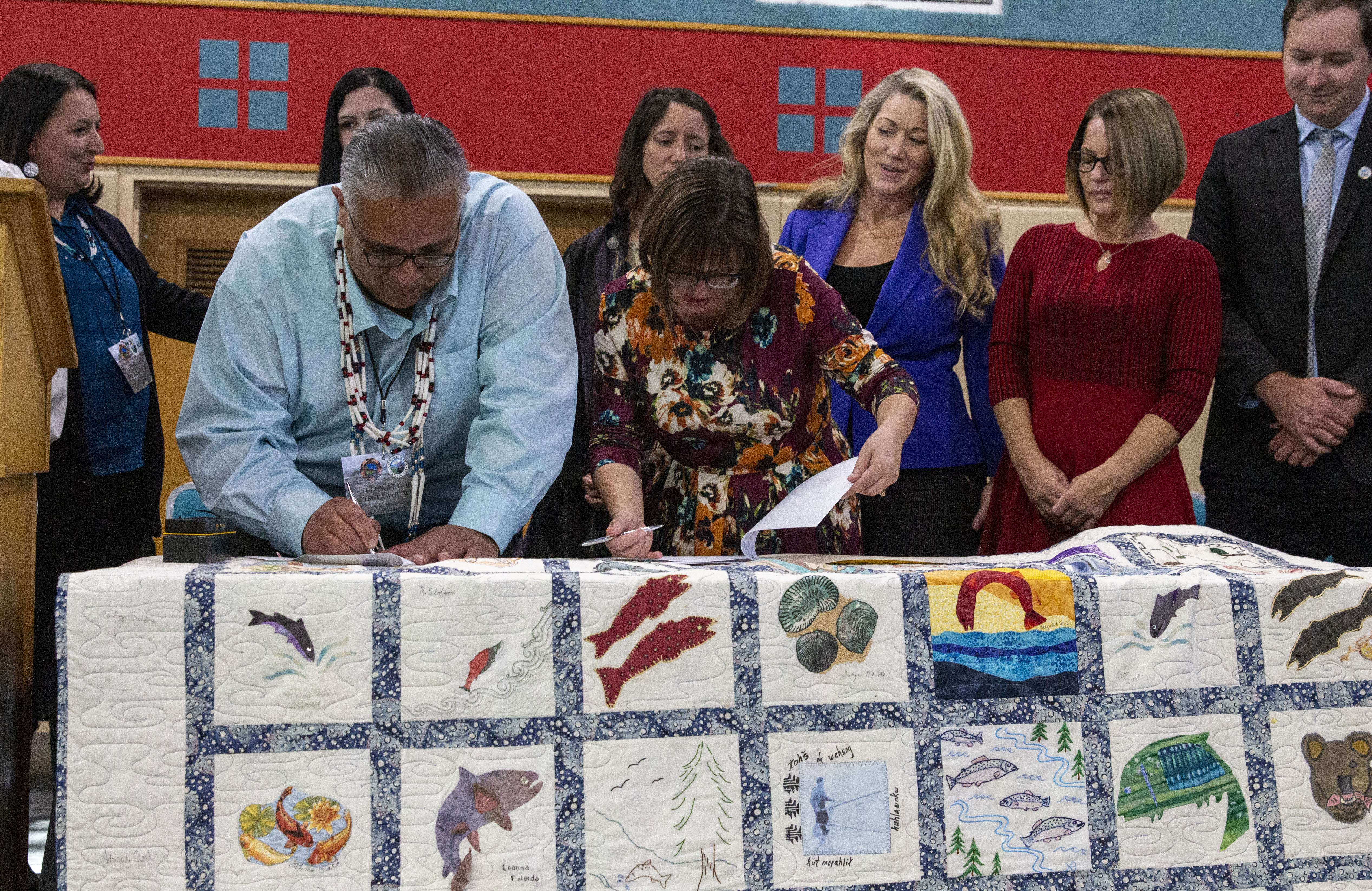
The signed documents with the signature of Wiyot Tribal Chairman Ted Hernandez after the Eureka City Council Meeting to return Tuluwat Island to the Wiyot tribe at the Adorni Center on Oct. 21. | Photo by Thomas Lal 
Cheryl A. Seidner sings “Coming Home” at the end of the Eureka City Council meeting to return Tuluwat Island to the Wiyot tribe at the Adorni Center on Oct. 21. | Photo by Thomas Lal
Applause erupted from the audience. The crowd stood on their feet to clap and shout in joy.
Seidner invited her family to the front of the auditorium to sing a song to the people gathered in the room. Seidner welcomed everyone in the audience and invited them to sing the song “Coming Home.”
“I know that our ancestors knew this day would come,” Baldy said. “I think that we need to consider it an opportunity to think about our next steps in the future. People stand up and ask me, ‘What can I do?’ And I have one answer for them: you can start by giving all the land back. And now we know it’s possible.”
The signing of the deed marked the end of the meeting. Seidner placed a quilt representing all who could not be present on the table, and the council people huddled around to officially return Tuluwat to its ancient owners.

Baldy concluded her address with honest praise. With the Wiyot land reparation, the people in the room could now envision a radical future.
“A future with no dams, a future with salmon that are healthy, a future with our children that are singing, a future where we are dancing all the time,” Baldy said. “I know we’ve seen it and I know we’ve felt it, and I look forward to how amazing that is going to be. And I know that we can do it, and I look forward to how everyone in this room is going to make that happen.”