The Lumberjack


Students Serving The Cal Poly Humboldt Campus and Community Since 1929

Tag: masters

  • Online Social Work ranked best in the nation

    Online Social Work ranked best in the nation

    By | Charlotte Rutigliano

    The Online Social Work Bachelors program and the Master’s program have been ranked 13th and 12th by College Choice, an online source dedicated to helping students find the best schools for their academic and career goals.

    Alyssa Koh, managing editor from College Choice said that the team she works with often says that figuring out what college to attend can be like drinking from a fire hose.

    “We have all been through the process of researching, applying and choosing a school,” Koh said, “we really are coming at this from experience.”

    According to Koh, the ranking criterion is a question that they got a lot, and one that is very important to them and that they feel confident about.

    “Our methodology is always data-driven and as scientific as possible,” Koh said. “We collect data points from trustworthy sources.”

    Sources that include university and college websites, PayScale, U.S. News & World Report, and the National Center for Education Statistics Integrated Postsecondary Education Data System (IPEDS).

    Koh said that what they’ve done is come up with a way to measure quality, reputation, affordability, value, and satisfaction.

    “Going to college isn’t just books and tests,” Koh said, “it’s a whole host of factors, and we take that into account.”

    According to Koh, the methodology College Choice uses first looks at what students want, what they are looking for and what they can help them with. The data gathered is aggregated into different criteria that composite scores.

    “Most of our lists use three composite scores for determining the ranking,” Koh said, “institutional excellence, student satisfaction and return on investment.”

    Jamie Jensen, assistant professor and director of distributed learning programs for the online Bachelor’s and Master’s, said while she’s less concerned about the ranking of the programs, and that it feels good to see the department and the university out there.

    According to Jensen, the social work programs are generalist programs that teach students to work on issues, populations and system levels. The online Bachelor’s program is set up just like the on-campus program, and the online Master’s program is a part-time year round option that has a new cohort starting every January.

    “The Master’s program model is targeted at providing educational opportunities to those already living and working in rural or Indigenous Communities,” Jensen said.

    Geneva Shaw, lecturer and the Master of Social Work director, said that the online programs allow students who work full time, have families or are currently working in the field to stay rooted where they are and continue their education.

    According to Jensen, these online programs first got started because of an expressed need to bring a pathway to education for people in the surrounding rural and tribal communities who were already doing great work but didn’t have the privilege to attend the program on campus.

    “We graduated our first Bachelor’s in social work distributed learning (BASW DL) in 2013,” Jensen said, “and the first Master’s in social work distributed learned (MSW DL) in 2016.”

    Jensen said that as of May 2017 the program had graduated 68 new BASW and 38 new MSW into underserved rural areas of Northern California, as well as 54 students in both the BASW and MSW scattered across California, Idaho, Oregon, Washington state, Rhode Island and Alaska.

    Shaw said that though she’s also unsure of the ranking process, it gives acknowledgment to programs both on campus and online, and the connections made not only in our own community, but also in the students’ home communities.
  • HSU graduate making a name for himself

    HSU graduate making a name for himself

    By Morgan Brizee

    At just 2 years old Eddie Medrano and his four siblings were forced into the foster care system. Medrano is now a 22-year-old Humboldt State graduate, and soon to be USC masters graduate, who created and owns his own business. Medrano was in and out of eight foster homes between the ages of 2 to 5, and diagnosed with Langerhans Cell Histiocytosis tumors. He is now graduating from the University of Southern California with a master’s in business.

    “My mother had a drug addiction and was an alcoholic,” Medrano said. “My father was nowhere to be found.”

    They were taken into the foster care system after their mother left them home alone for three days. When Medrano was 6 years old, he and his oldest brother Jorge were adopted by the Medrano family. He finally felt like a normal kid after being adopted.

    “They gave me my first holidays, birthdays but best of all they gave me the feeling of unconditional love,” Medrano said. “They helped me with my PTSD, depression, ADHD and so many other things that I was finally living my dream childhood.”

    Medrano lost contact with his oldest sister Bonnie. His second oldest sister Lupita committed suicide at 23. Angel, his second oldest brother, was adopted to a separate family.

    Then, when Medrano was 9 years old, he was diagnosed with Langerhans cell histiocytosis tumors.

    Photo by Eddie Medrano

    According to the National Cancer Institute’s website, “Langerhans cell histiocytosis is a type of cancer that can damage tissue or cause lesions to form in one or more places in the body. Langerhans cell histiocytosis is a rare cancer that begins in LCH cells [a type of dendritic cell which fights infection].”

    Medrano’s basketball coach was the one who helped catch the signs of cancer by noticing that Medrano was limping during a game. The doctors found tumors in Medrano’s hips and skull after performing x-rays and Magnetic Resonance Images.

    “I went through countless radiation treatments, surgeries and chemotherapy treatments,” Medrano said.  “I felt cheated and because I was brought up with Catholicism, the only person I could ask why me, was God.”

    Medrano didn’t understand why get got cancer. He was afraid of everything being taken away from him after finally getting the life he wanted.

    “I had no control of what was going on but luckily I started improving slowly through countless treatments and surgeries, I was on my way to remission,” Medrano said. “When I was young I was blinded by the pain and anger to see the amount of support I had throughout my battle.”

    After graduating high school Medrano went on to Cuyamaca Community College in San Diego. He was on their track team and received an AA degree in communication. He then transferred to Humboldt State and joined the track team, but his major changed.

    “After one semester, my passion for business directed me to work more in class in hopes of attending USC Marshall’s MSEI [Master of Science In Entrepreneurship & Innovation] Program,” Medrano said.  “Whether it was selling things on craigslist, working as a marketing employee or starting my own company, business was something that has always been in my life.”

    Medrano had a love for skateboarding and figured that he could find a way to make a business out of it. Hunter Fine, Humboldt State communication instructor, was not only an instructor to Medrano but also a friend. Fine also loved skateboarding like Medrano.

    “He gifted me a poster of Eazy-E that featured him with a local venice brand deck,” Medrano said. “I knew right then and there that I had to continue my dream of starting a skate brand company.”

    Medrano saw skateboarding not just as a hobby but a business venture. It wasn’t until after he graduated HSU and started at USC Marshall’s MSEI program that he learned how hard it was going to be to turn his dream into a reality.

    “It wasn’t that easy, yeah I had all these great ideas and designs, but as my professor for the feasibility class at USC, Albert Napoli would say, what problem are you solving?” Medrano said. “I took a step back, visited some local skate parks in Long Beach, where I currently live and just watched the skaters until something enlightened me.”

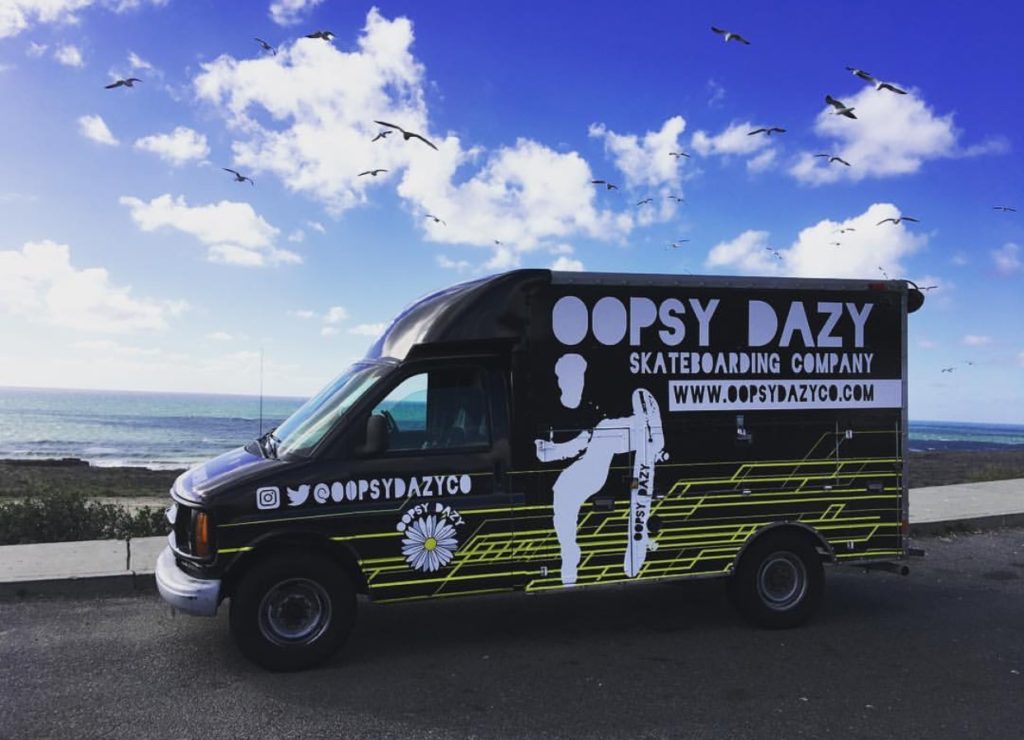
    Medrano learned after watching the skaters for hours that the skaters boards were snapping or getting damaged. The skaters would have to stop skating until they found a shop to get their skate boards fixed. His business would be a mobile truck to help the skaters fix their boards and get back to skating. The mobile truck is available in Los Angeles and San Diego at skate parks.

    “This is where OOPSY DAZY Co. comes in,” Medrano said. “We provide on-site products through our mobile store but overall we fill that huge gap and problem of distribution that typical skate-shops create.”

    Medrano saw skaters needing a place to fix their boards on the spot immediately at the skate parks so they don’t have to wait to get back on their boards. He noticed that boards can break down easily after hours of skating and that wax for the boards were hard to find also.