McKinleyville plans its first Christmas lights, house decorations and door decorating contest.
McKinleyville will host their first Christmas lighting contest. The contest consists of Christmas lights and Christmas decorations on McKinleyville houses. The contestants are judged based on inflatables, Christmas lights and Christmas decorations.
The Christmas lighting contest, will have a map drawn out of all participating homes. There will be first, second and third placements with prizes. Participating in the event is free and the event itself will take place Dec. 23, 24, and 25 from 6 to 9 p.m.
Keith Ownsbey was the first to launch the idea and hopes the event can become an annual tradition. Ownsbey started a Facebook page dedicated to the idea and posted his contact information for those interested in participating and volunteering.
“I was bored,” Ownsbey said. “I decided to make a post on the local Facebook page and said ‘hey this is who I am, my family and I are lucky enough to call this community our home and I plan on decorating a lot this year and I wanted to put on a Christmas lighting decorating contest.’”
The event will be following COVID-19 protocol by looking at Christmas lights within the McKinleyville area. The event is being held over a three-day span, rather than one giant event on a single day, as another COVID-19 safety precaution.
The Christmas light contest is only happening locally in McKinleyville, but the Christmas door decorating contest is available throughout Humboldt County, so more people can participate.
“Not everybody can drop two or three grand on a bunch of stuff,” Ownsby said. “But almost everybody can decorate a door and send in a picture.”
Local community members and businesses who wished to contribute to the event offered prize money and donations.
“All the prize money coming solely from the community members, business and donations,” Ownsbey said. “That’s what we are gonna use for the awards.”
Cyndi Bainbridge, the treasurer for McKinleyville’s Lions Club, is excited about participating in the event. The Lions Club is a community and worldwide known club that partnered with Ownsbey to help out with the Christmas event.
“I talked to the Lions Club,” Bainbridge said. “The president felt it was a really good idea to get behind something like that.”
The Lions Club, by partnering, has helped with donations and credibility regarding the event. COVID-19 has taken a lot from communities this last year, Bainbridge is hopeful the outcome of this event can change that.
“The community needs this,” Bainbridge said. “It’s been a hard year, we are the type of community that likes to come together and be involved.”
Kacy Tonkin is a participants in both the Christmas lights and door decorating contest. Once she found out about the event, she messaged Ownsbey asking to participate because she enjoys the Christmas season a lot.
“I am super excited,” Tonkin said. “Personally I really enjoy driving around at Christmas time looking at lights, and I think less and less people were decorating, so this kind of gives them the incentive for people to decorate.”
Tonkin mostly decorates inside her home, she’s excited to decorate the outside and help bring cheer regardless of the contest.
“Gives people something to do,” Tonkin said. “I think that more than any monetary gain, I think just the joy or the happiness it brings people.”
The deadline to sign up for the event is Dec. 15. The deadline for door decoration contest will be Dec. 22. To participate or ask any questions, reach out to the Facebook page, 1st Annual Mckinleyville Lighting Contest.
Looking to the past to learn about the present pandemic
There’s a saying that goes something like, “In order to prevent future mistakes, we should look to the past for guidance.” While this current pandemic may be new to all of us, humans have gone through this before. Some of the more recent pandemics include the SARS virus, the H1N1 virus, Ebola and HIV.
The term pandemic is defined as something “occurring over a wide geographic area and affecting an exceptionally high proportion of the population.” Obviously, the current COVID-19 virus fits into this category. While some of the aforementioned pandemics did not enact a devastating, history-altering toll on Humboldt County, another pandemic did.
From 1918 to 1920, the Spanish flu swept across America, resulting in an estimated 675,000 deaths according to the U.S. Department of Health and Human Services. The first official report of the Spanish flu in California was reported Sept. 27, 1918, just two weeks after an outbreak on the East Coast. By November 1918, the total cases throughout the state hit about 115,000—overwhelming doctors and government officials from north to south.
One of three doctors that helped Spanish flu patients in the Ferndale area.
Although Humboldt County sits in an isolated area protected by the “Redwood Curtain,” the area was soon amassed in its own troubles combatting the illness. Humboldt County had a population of about 37,000 people with Eureka holding around 12,000. The Spanish flu resulted in around 200 deaths (although it is thought to be much higher) and thousands grew ill.
In 2012, Humboldt State alumnus and McKinleyville native Jeff Benedetti-Coomber wrote a detailed history of the impact the Spanish flu had on Humboldt County. For it, he was awarded the Charles R. Barnum History Award by HSU’s history department. For his research he scoured through old newspaper clippings for primary source documentation. He read academic analysis on how the Spanish flu affected the entire nation and he cited Matina Kilkenny, a researcher and local author for the Humboldt Historical Society who also wrote about the impacts the Spanish flu had on Humboldt County.
What prompted Benedetti-Coomber to focus on the Spanish flu was its lack of local research. As his peers decided to look into European history, he decided to focus his attention on the effects locally.
“I was walking through the graveyard in Arcata and noticed a family of graves, not necessarily related to the [Spanish] influenza but it got me thinking about what effects the flu may have had because it was around the same time,” he told me over the phone from his place in Los Angeles. “Once I started researching it I saw how it did affect the county and I was pretty amazed.”
Benedetti-Coomber’s senior thesis, titled “Death In the Redwoods: The Effects of the Spanish Influenza on Humboldt County,” spans 30 pages and breaks down how each town dealt with the outbreak. He highlights what preventative measures seem to have worked and where officials, the public and the media went wrong and what they got right.
“It’s just like today when you tell people to do something and they kind of resist. A lot of people had that with the Spanish influenza and it was a reason a lot of people died, because they didn’t take it seriously.”
Jeff Benedetti-Coomber
Some of the highlights from his research that still stand out to him are how Eureka initially closed all schools, which flooded the streets with children. They soon changed their minds and brought the kids back into the school to try to quarantine the children. Another nugget of research that sticks out in his mind has to do with masks and the public’s initial reluctance to wear them.
“It’s just like today,” Benedetti-Coomber said, “when you tell people to do something and they kind of resist. A lot of people had that with the Spanish influenza and it was a reason a lot of people died, because they didn’t take it seriously.”
When the Spanish flu hit Humboldt, the United States was in the middle of World War I and young men from Humboldt were signing up to join the war effort. There were war rallies and large gatherings of people throughout the towns in Humboldt in the fall of 1918 as the Spanish flu began to creep in.
“Although the Great War was still the main focus in Humboldt County, more and more citizens were beginning to take notice of the spreading pandemic,” Benedetti-Coomber wrote.
Some of the newspapers in Humboldt at that time seem to have downplayed the seriousness of the Spanish flu. Benedetti-Coomber points to an ad that was in the Humboldt Standard by Vicks VapoRub that was “disguised as an article… and it assured readers that the [Spanish flu] was ‘Nothing new simply the Old Grippe and la Grippe that was the epidemic in 1889-90.’”
Benedetti-Coomber wrote that it is believed the Spanish flu was brought to Humboldt County by locals traveling to other parts of the state to help care for sick family members and then returning before symptoms started to show. By mid-October 1918, reports of the Spanish flu were starting to pop up in the local newspapers.
“The Humboldt Times also reported that there were roughly 150 cases in Eureka by [Oct. 22] and hospitals were short staffed. Doctors were so busy they did not have the time to report new cases or treat the majority of their patients.”
Jeff Benedetti-Coomber
“The Humboldt Times and Humboldt Standard newspapers offered daily accounts of what was happening,” he said, adding that they also seemed to not care about the Spanish flu at first.
On Oct. 12, 1918, four cases were reported in the Humboldt Times and those infected were quarantined in a “‘safe house’” on 8th Street where they could be quarantined and cared for,” Benedetti-Coomber wrote.
At first, the mayor of Eureka downplayed the danger to the public, but two days later, five more people were infected. By Oct. 22, 1918 there would be more than 150 cases and one death.
“According to the Humboldt Times, Mrs. Garber Dahle was the first person in Humboldt County to die from the deadly virus,” Benedetti-Coomber wrote. “The Humboldt Times also reported that there were roughly 150 cases in Eureka by [Oct. 22] and hospitals were short staffed. Doctors were so busy they did not have the time to report new cases or treat the majority of their patients.”
Action to combat the Spanish flu across the county began to take root. Arcata was the first town to pass a requirement that all residents had to wear a mask while out in public, and by Nov. 7, 1918, the entire county was required to do so. Emergency hospitals were soon established across the county with some residents offering up their homes for the infected.
Arcata escaped the pandemic with only four deaths, but the same can’t be said for Eureka and especially for the logging camps in the remote areas of the county. The number of cases grew in the urban areas, and by Oct. 23, 1918, the logging camps were left to fend for themselves.
“Logging camps and small towns were informed by the newspapers and from local physicians that they would have to face the Spanish Influenza on their own as all of the county hospitals were completely full,” Benedetti-Coomber wrote while citing a Humboldt Times article titled “Influenza Increases Alarmingly in Two Days.”
Young women wearing masks in Humboldt County.
But one logging camp was able to escape the pandemic with no cases at all. In her article, “Missing Faces,” Matina Kilkenny reported how Carl Munther set up a quarantine system for his workers who decided to go into town. (Kilkenny’s article has a number of great photographs of life in Humboldt County during the Spanish flu.)
“Munther required every person returning to camp… to stay four days in a tent he’d pitched some distance from the workers’ cabin,” Kilkenny wrote, adding that the returning workers were also required to work and eat separately from their peers. “Thanks to their boss, very few men chose to leave the Barrel Company camp and not one case of influenza occurred there.”
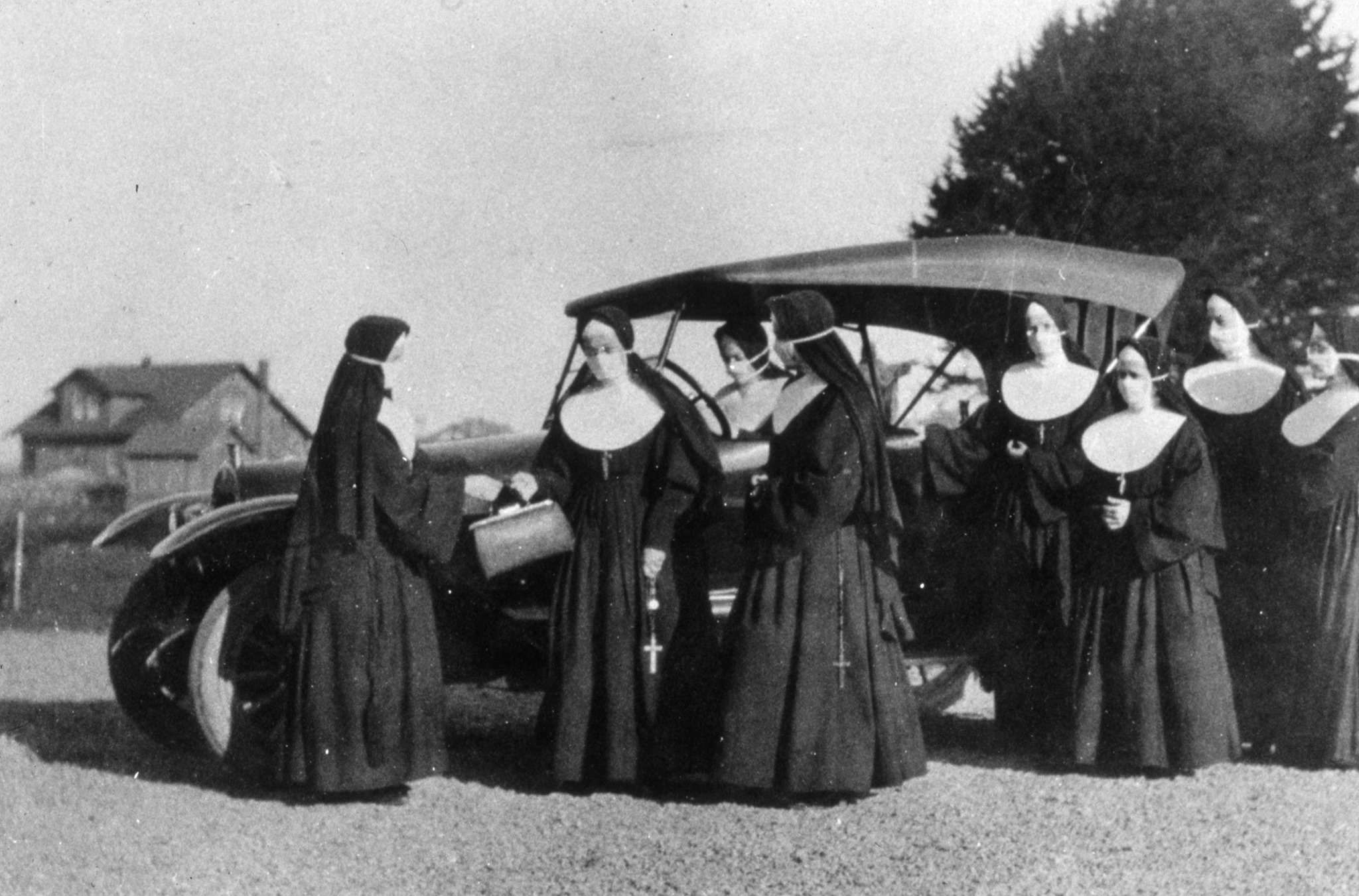
Sisters of St. Joseph wearing masks during the Spanish flu. The sisters helped many patients in Humboldt from 1918-1920.
Throughout her research, Kilkenny was able to find where a number of hospitals were set up across Humboldt. There was a Red Cross Hospital in Korbel, Arcata, Blue Lake and Eureka. Kilkenny also came across an interview between a member of the Sisters of St. Joseph of Orange in Eureka and a man named Brad Geagly. Kilkenny wrote the following:
“[Mother Bernard] sent [the Sisters] out in twos, in cars provided by the Red Cross. She armed each Sister with a kit containing camphor and sweet oil, castor oil, and mustard plasters. Into the homes… the sisters came, arriving at seven o’clock and leaving at the end of a 12-hour shift, to be replaced by two other Sisters. They would attend first to the adults….They would bathe the delirious victims completely, rubbing their chests deeply with the camphorated oil. Mustard plasters would be applied, and then the sisters would wrap the sick tightly in whatever woolen material they could find; then they would tend the children. Once they had been bathed and medicated, the sisters turned to washing linens or cleaning house. They fed their charges warmed milk and broth prepared from the food furnished by the Red Cross.”
Kilkenny noted that, generally, it was the poor who were admitted into the hospitals, while the more well-off were cared for in their homes. Because of this the actual tally for those infected and the deaths attributed to the Spanish flu is unknown. Kilkenny also points out how the Native American tribes were hit hard by the Spanish Flu as well.
“Of the [11] Native Americans whose deaths are on record at the County Courthouse, five were from Table Bluff, two from Hoopa, one from Miranda, one from Orleans, one from Requa, and one was a laborer at Korbel,” Kilkenny wrote. She also noted evidence that many Native Americans often refused treatment by White settlers around this time period.
Kilkenny was also able to find county death records from that time and noted that between Sept. 1, 1918 and April 1919, 175 Humboldt residents died with 91 of them between the ages of 20 and 40.
And so what can we learn from this history?
There is evidence that social distancing works by the example set by Carl Munther at his logging camp and how travel throughout the state can spread the virus. We can see how hospitals were eventually inundated with those infected with the Spanish flu and how staff were stretched thin. We can also see how it is important to get ahead of a pandemic and try to prepare as much as possible.
Humboldt County seems to be doing just that. They have recently distributed around 30,000 pieces of personal protective equipment to first responders and medical staff across the county. Humboldt State chipped in and prepared 1,250 COVID-19 test kits. Also, as I’m sure you are aware, we are in a “shelter in place” order that was enacted to help stop the spread of the virus and to give medical staff the ability to fight the virus without being overwhelmed.
Towns across Humboldt are also doing their part to help prevent an outbreak. Trinidad passed a moratorium on all short-term rentals and added some pretty forceful consequences to anyone who breaks it.
“Over the course of the meeting, council members added some teeth to the resolution with language saying that a single violation may result in the City revoking a proprietor’s short-term rental license for up to a year,” the Lost Coast Outpost’s Ryan Burns recently reported, adding that the county may consider a similar measure.
A stained glass piece by Humboldt artist Colleen Clifford.
As this thing progresses, we are all going to have to make some sacrifices, but we’ll get through it. Help out the elderly and the immunocompromised if you can. Help out each other by not going out or attending pretty much any gathering of any number of people.
Let’s all work together — but at least six apart — to help “flatten the curve.”
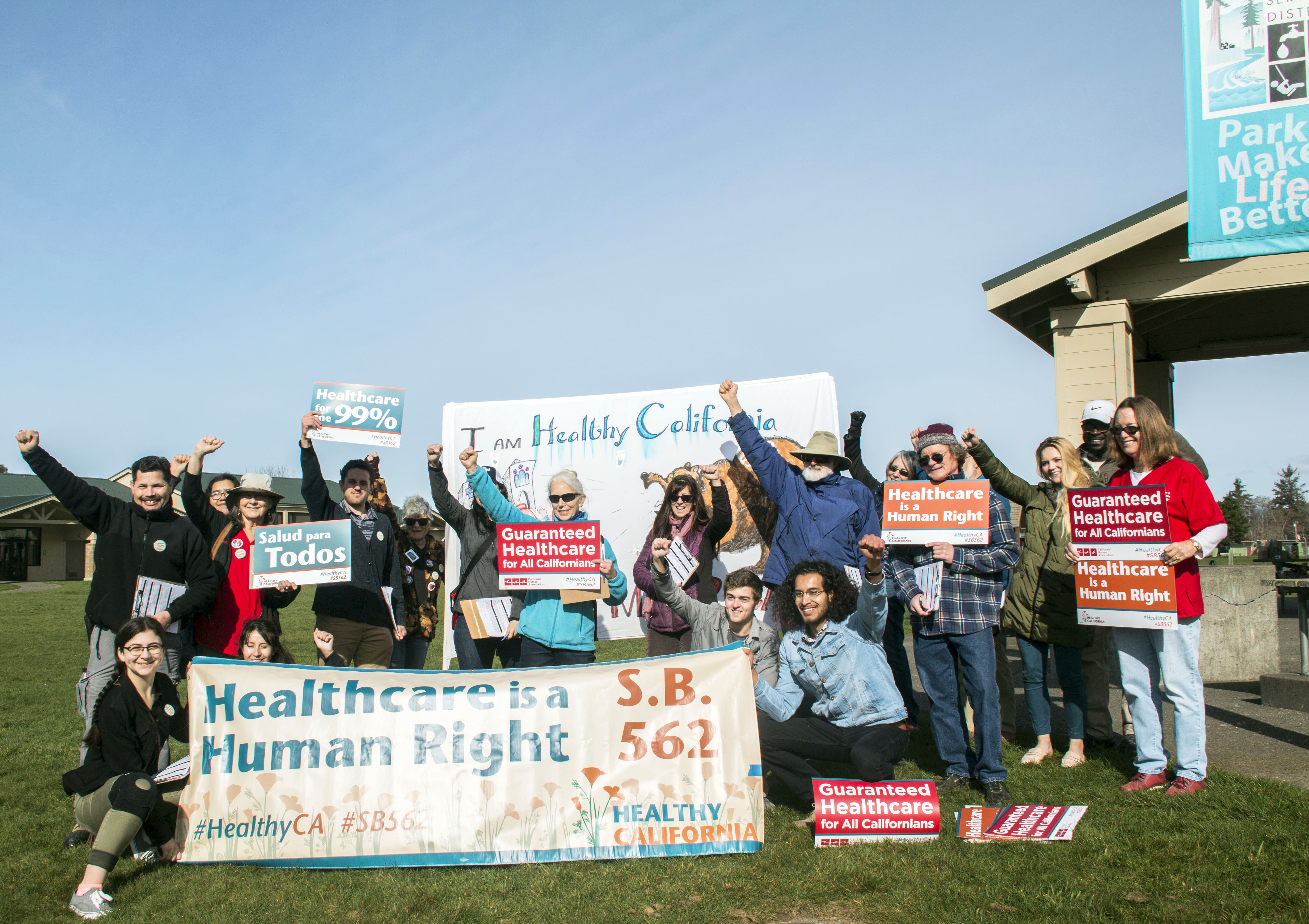
Members of the California Nurses Association and volunteers gathered at Pierson Park in Mckinleyville on Feb. 10 to inform residents about the Healthy California Act SB 562, and urge them to call state assemblyman Jim Wood.
The bill guarantees healthcare coverage to all California residents, but was shelved by assembly speaker Anthony Rendon.
Humboldt State University student Jacob Stockwell is having trouble getting health insurance. He needs PPO insurance, but his is HMO.
“I have a polyp in the brain,” Stockwell said. “I have to get an MRI and go down to Santa Cruz. It’s an eight-hour drive… it’s not even worth it.”
Member of California Nurses Association Patricia Kanzler has openly criticized Wood on different committees before for not taking action on SB 562.
“He’s a hypocrite,” Kanzler said. “He says he’s for single-payer healthcare, but there’s a bill right out there. If he’s so enthusiastic on single-payer, then why the hell isn’t he working on it? That really pisses me off.”
Political science professor Kevin Murray volunteered in support of the California Nurses Association.
“We’re not selling anything,” Murray said to residents after hesitantly opening their doors. “If we all share our horror stories, we’d realize this system is rigged.”
Canvass volunteer Margy Emerson wore a metal button on her jacket that read ‘Healthcare is a human right’ in support of the cause. Emerson said the bill is important morally and economically.
“I’m convinced that if one state gets it, the rest of the states will follow,” Emerson said.
Volunteers met Mckinleyville resident Wilford Ward in his driveway while he worked on his car.
“This needs to be fixed,” Ward said. “I’m paying $1,000 a month. It’s unconstitutional. There is something wrong when you’re talking about inequities. The rule of government is to protect its citizens. I’m getting screwed over.”
Originally, Fred Brewster thought he signed up to volunteer, but ended up hosting a canvass. Brewster has been able to have health insurance on and off by working seasonal jobs.
“I’ll have health insurance for part of the year, and then not for part of the year,” Brewster said. “It’s always a constant fight and worry to make sure I had asthma medicine.”
Canvass host and College of the Redwoods journalism major Fred Brewster assigning volunteer Margy Emerson door-to-door SB 562 campaigns in McKinleyville on Feb. 10. Photo by Bailey Tennery.
Brewster created a petition in the past to stop Starbucks from opening in Yosemite National Park, but he has never hosted a canvass before.
“Going door to door puts a face to the movement,” Brewster said. “It allows [for] a more personal interaction with the people. It is not some distanced thing.”
Organizer Phil Kim used Territory Helper, a website created by Jehovah’s Witness congregations for their canvassing, to print maps of Mckinleyville neighborhoods for volunteers.
“They do a lot of door-knocking,” Kim said. “It’s kind of funny they’re helping us out, [because] we’re using the program they created. It helps to coordinate where everyone is walking, so people aren’t knocking on the same doors. It’s a way of dividing the maps in little sections.”
Healthy California Act volunteers speaking with a McKinleyville resident. Photo by Bailey Tennery.
Anne Olivia Eldred is a part of the California Nurses Association. She said it’s better to take care of people before they get sick, rather than waiting until they need immediate treatment that is expensive.
“I see what not having access to healthcare looks like,” Eldred said. “There are people who are dying every day, because of lack of access, and that’s ridiculous.”
The tap tilts forward. Fresh alcoholic refreshment begins to flow out. Twelve ounces later, you have yourself a glass of Humboldt Regeneration’s Red Jay craft beer.
Pressey is the owner and brewmaster of Humboldt Regeneration Brewery and Farm, a sustainable farmhouse brewery.
Humboldt Regeneration Brewery off Central Avenue in McKinleyville, California. Follow the “Beer to Go” sign | Carlos Olloqui
“The concept built overtime,” Pressey said. “We are one of the first breweries in the country, and the first in California, to grow and malt our own grains since prohibition.”
The wheat and barley they grow is floor-malted on site at their brew house located at the north end of McKinleyville, California. Humboldt Regeneration Brewery and Farm also grows their own grains and hops. They produce everything from seed to sip.
“This was something that was pretty normal in the old days,” Pressey said. “But nowadays, the reason it’s not as normal is because a lot of the agriculture industries got scaled up after the Green Revolution. Everything became really mechanized.”
Pressey grew up in Napa one of the biggest wine counties in California.
“I worked in the wine industry during high school,” Pressey said. “During the summer time I’d bottle. My friends family owned the winery so, after I graduated, they ask me to stay on for crush. That’s when you actually make the wine.”
He then moved to Humboldt County to attend College of the Redwoods before he transferred to Humboldt State University.
“I was always interested in plants and sustainable agriculture,” Pressey said. “When I got to college I knew I needed a job to pay rent, so I basically just started applying at all the breweries here.”
Humboldt Regeneration’s Red Jay craft beer | Carlos Olloqui
In 2001, Pressey was hired on at Eel River Brewery as an assistant brewer.
“I pretty much just got lucky with the timing, they needed someone,” Pressey said. “I started off just doing cellar work and night brewing, but I got trained up pretty fast.”
Pressey graduated HSU in 2010 with a degree in environmental science, focusing on soils and alternative agriculture.
He worked at Eel River Brewery for over seven years before trying to brew his own.
“I just wondered why aren’t there truly local breweries anymore,” Pressey said. “Why aren’t people using local ingredients?”
That was when he realized that it was because of the malting process. In comparison to some of these other beverages such as wine or cider, beer requires an intermediate step.
“For wines and ciders you are just growing the raw ingredient, such as the grapes or the pear and apples,” Pressey said. “With beer, your growing barley and other grapes – but you can’t just make beer out of that.”
Pressey began to put his degree to work and Humboldt Regeneration Brewery and Farm was born.
Upon arrival at his brew house, after you take a left at the “Beer to Go” sign off Central Avenue, you’ll notice the some of the “sustainable” aspect of the operation. A barbecue grill turned into a roaster, solar panels on the side of the building, and a malting table which he built himself.
Jacob Pressey speaking to a customer about his newest brew | Carlos Olloqui
“We dry farm all our grains,” Pressey said. “This means you plant in the Spring and use the Spring rains. There’s no irrigation.”
Humboldt Regeneration Brewery has been up and running since 2012. The operation is currently a two man team that consists of Pressey and his partner Matt Kruskamp.
“I was a customer here, I used to come around here regularly when he first opened,” Kruskamp said. “I asked him if he needed an intern, I told him he wouldn’t have to pay anything since it was through HSU.”
Kruskamp was hired on full time after he graduated in 2014.
“It’s great to be such a big part of this and to be able to say I contributed so much of the ideas and effort towards it,” Kruskamp said.
You can find over 100 different house recipes being filtered through the brewery Wednesday through Sunday from 11 a.m. to 7 p.m.. A new flavor comes out every week.
Pressey transforms his labor into alcoholic beverages and serves it to a growing clientele. Sean von Devlin is one of the many fans of Humboldt Regeneration Brewery. He is amazed by Pressey’s passion for the product.
“The beer is great, I used to live just across the street. It truly epitomizes the local handmade blue collar mindset,” von Devlin said. “I have spoken with Jacob only a few times and he always is excited to share his story. It amazes me to see how everything operates.”
Humboldt Regeneration’s weekly beers on tap | Carlos Olloqui
Humboldt Regeneration is not only Humboldt’s first locally grown beer, they also offer a community supported brewery program. This program gives community members the opportunity to purchase shares that will allow them to a free weekly growler fill-up.
“I have a new beer come out every week, you can miss weeks and not lose your credit,” Pressey said. “We fill our growlers on a bottling machine. They are fully carbonated, just like a store-bought beer.”
The principle is simple, sustainability.
“Right now we are just on tap at a handful of spots in Northern Humboldt,” Pressey said. “But no distribution and no bottling, the whole concept is to reduce waste.”
With a brewery, your main waste products are water and spent grains.
“After you’ve extracted all your sugars and proteins from the grain you got all the wet solid grains left over,” Pressey said. “Most breweries will give that to a rancher as feed in exchange for them taking it off site.”
Unlike other breweries, Pressey grows a mixture of bacteria and mixes his spent grain in with it. This ferments into a soil amendment.
“There’s a similar process called Bokashi, I call it Beerkashi,” Pressey said. “We spray that [soil amendment] pretty heavy twice a year in the fields, this basically makes the soil extra healthy.”
From seed in the field, to the malt floor, to the brewing process, and then back out to the fields, an entire lifecycle of a foamy pint of beer is what you can expect at Humboldt Regeneration Brewery and Farm.
“In the future I hope to establish a larger brewery and have the farm all in the same location,” Pressey said. “We could give tours and have a full beer garden.”
This website uses cookies to improve your experience. We'll assume you're ok with this, but you can opt-out if you wish. Cookie settingsACCEPT
Privacy & Cookies Policy
Privacy Overview
This website uses cookies to improve your experience while you navigate through the website. Out of these cookies, the cookies that are categorized as necessary are stored on your browser as they are essential for the working of basic functionalities of the website. We also use third-party cookies that help us analyze and understand how you use this website. These cookies will be stored in your browser only with your consent. You also have the option to opt-out of these cookies. But opting out of some of these cookies may have an effect on your browsing experience.
Necessary cookies are absolutely essential for the website to function properly. This category only includes cookies that ensures basic functionalities and security features of the website. These cookies do not store any personal information.
Any cookies that may not be particularly necessary for the website to function and is used specifically to collect user personal data via analytics, ads, other embedded contents are termed as non-necessary cookies. It is mandatory to procure user consent prior to running these cookies on your website.