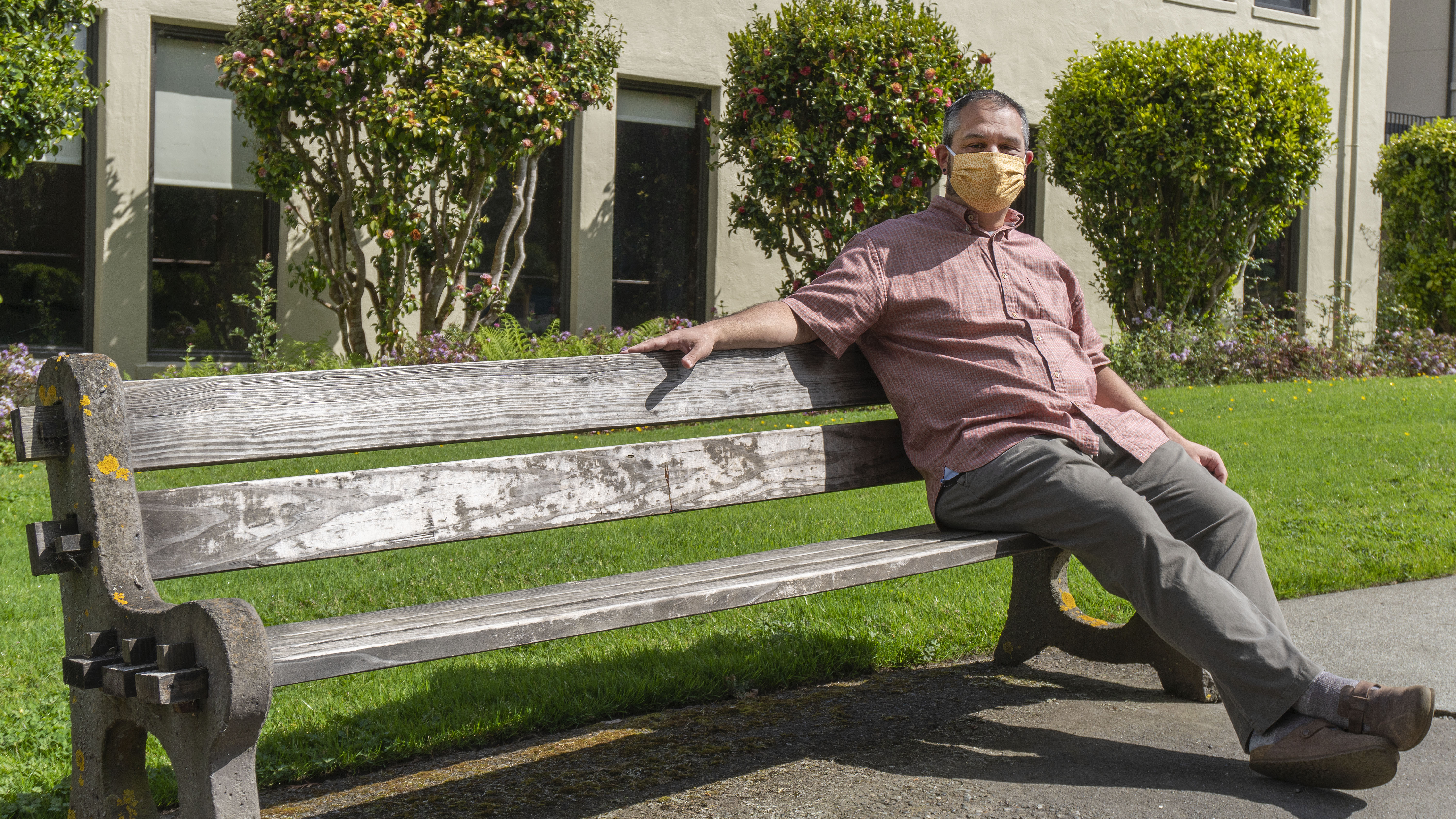
With life disrupted, lecturer Kerri Malloy perseveres with flexibility and humor
A professor noticed students often left Kerri Malloy’s class laughing. One day the professor asked what he was teaching.
“Oh, that’s my genocide class,” Malloy said.
Malloy teaches courses in the Humboldt State Native American studies department on colonialism and genocide. With such somber subjects, Malloy relies on humor and honesty to engage students. Now that classes have gone online during the pandemic, Malloy has employed those traits, alongside plenty of flexibility, to keep students connected.
“The hurdle is going to be maintaining that connection with the students,” he said.
He created class blogs for students to post what they want—questions, memes, dog or cat or reptile pictures. Glance through Malloy’s Instagram, Twitter or Snapchat accounts, and you’ll find lots of memes, like one he posted April 3 on Instagram:
“The year 2020. Brought to you by the letters W, T & F.”
“I think you have to walk into it—at least my plan is to walk into it—with an incredible amount of flexibility.”
Kerri Malloy
“I love a good meme,” he said in one of two Zoom interviews. He sat in his home office. Behind him, family photos and a Star Wars Yoda action figure topped a bookshelf. He wore glasses and a button-up shirt.
Memes dominate Malloy’s social media accounts, but there’s more to the accounts than humor. They make him accessible to students. He receives messages on those accounts about class, and he replies happily.
“There are times where I’m like, ‘Why am I doing this?’” he said. “And then I realize, I’m getting to see a different side of students, and my colleagues, too.”
Malloy also emphasized the importance of flexibility.
“I think you have to walk into it—at least my plan is to walk into it—with an incredible amount of flexibility,” he said. “And let them—let the students—help guide where we’re going to go.”
Yurok and Karuk by heritage, Malloy was born on the Oglala Lakota Reservation in South Dakota, but he grew up on the Quinault Indian Nation Reservation in Washington.
Marlon Sherman, chair of the HSU NAS department, knew Malloy from working together for the Yurok tribe. Sherman and Malloy have a family connection, as Sherman grew up on the Oglala Lakota Reservation where Malloy was born.
“If it wasn’t for Kerri, there might not be a NAS department right now.”
Marlon Sherman, chair of the Native American studies department at Humboldt State
After working together for the Yurok tribe, Sherman and Malloy parted. About six years ago, Sherman asked Malloy to come to HSU to teach two courses for a semester.
Shortly after Malloy came on board, Sherman had to take time off. He had cancer. Sherman returned in about a year, but Malloy became program leader and helped steer the department. Sherman said Malloy basically did all the work and helped the department hire two professors.
“If it wasn’t for Kerri, there might not be a NAS department right now,” Sherman said over the phone.
Malloy said Sherman was too generous, but there’s no doubt that Malloy works, a lot—so much so that Sherman joked it might be illegal.
Malloy wakes up around 4:30 a.m. every day. He gets up so early partly because he finds those early hours productive, and partly because his back is built on metal rods and pins that make lying flat for too long unbearable. He’s not exactly sure how he damaged his back—maybe a car accident—but he had to have surgery that put him out of commission for three years.
He estimated he’s on eight to 10 HSU committees, from the University Resources Planning Committee to the Diversity, Equity and Inclusion Committee. Malloy does this while teaching multiple classes as a lecturer—a position with an uncertain future amid HSU’s projected enrollment decline and budget cuts. He joked when asked how he has the time.
“People usually don’t like my answer,” he said. “How do I have the time? A calendar.”
Kumi Watanabe-Schock, a 23-year HSU employee, works in public programming and as the library media coordinator. She first met Malloy when he was an HSU student getting degrees in economics and Native American studies.
Since then, Watanabe-Schock has worked with Malloy on committees and for classes. Every time she talks to Malloy, he seems to be attending workshops or giving talks around the world. She praised his willingness to help out.
“He’s not good at saying, ‘No,’” she said over the phone. “I don’t know if he’s that way with everybody, but when you ask him to do a favor he always follows through and he always says, ‘Yes.’ So I really am appreciative, yeah. He’s a good person.”
When not working, Malloy is more private. He has a husband and three dogs. He has two sisters and 14 nieces and nephews he tries to see every year. Around 8 p.m. every night, he tries to unwind. Maybe he’ll watch some TV, or maybe he’ll read a book about genocide. Fun.
While COVID-19 has pushed teaching online, Malloy has found his courses as relevant as ever.
A key concept in Native American studies is survivance, a portmanteau of survival and resistance. Survivance is about the living of Native American lives in the present tense. By surviving, Natives resist, and by resisting, Natives survive.
Malloy said people must fight right now to have their voices heard, like many Natives must do at all times. He said individual voices humanize current events and prevent people from kicking the ball of reality down the road.
On that note, Malloy told a story. Last summer, he taught Native history in a program that spent two days in Auschwitz I, the main site of the Nazi concentration camp. One day he stopped and looked out a window. The bizarreness of the situation dawned on him. Here they were, decades later, standing in a place of horror and trying to learn from it.

Later that night he received an email from then-HSU President Lisa Rossbacher. She was checking in, so he wrote back.
“If we can educate in such a place of incredible horror and death, we have the ability to change the world,” he remembered writing. “We really do. If we can actually go into these places and find this incredible darkness and turn it into something that allows us to reach out to other human beings and get us to talk to each other and push the things that really don’t matter aside, I think we can do this.”
To get people to talk, Malloy uses humor, which he said can get us past anything—and Malloy does seem capable of getting past anything. It seems strange to call research on genocide a passion, but Malloy approved the descriptor.
“Passion’s a good word for it, actually,” he said. “You’ll find that for those of that this is what we do, it is a passion.”
Every student interviewed for this story agreed on a few descriptions of Malloy. He’s open and funny, they said, and he can be brutally honest. They warned against getting into an argument with him.
“If you’re gonna have an argument with him, you better have good stats and have all your ducks in a row, because you’re not gonna win Kerri in an argument—I’ve tried,” HSU biology major Michelle Navarette said over the phone.
“And he told me, like, ‘You can’t let the system fuck you up and throw you down.’”
Michelle Navarette, Humboldt State biology major
Navarette, a senior, first had Malloy for a 9 a.m. general education course. Once she got to know him, she tried not to miss his class. Since that first course, she’s tried to have a course with him every semester.
Navarette’s appreciation of Malloy goes beyond the classroom. She said she was losing her job last semester due to discrimination from her boss. She didn’t know what to do, so she went to Malloy.
“He sat me down and was like, ‘You know what, this is just a portion of how life is,’” she said. “’You’re gonna have these obstacles all the time.’ And he told me, like, ‘You can’t let the system fuck you up and throw you down.’”
When she thinks of Malloy, she remembers his honesty.
“I think he was like the first person to tell me, ‘This shit is going to be hard.’”
As a lecturer of general education courses, he usually has to work for the attention of students. He goes into his courses hoping for students to leave with more questions than answers. Students have told him he gives too many assignments, but no interviewed students said Malloy graded harshly.
“My philosophy,” he said, “is if I can get one brain cell to function per student on an assignment, we’ve succeeded.”
Malloy once had a student he didn’t think he had triggered any brain cells in. Malloy said the student believed everyone should be committed to a single belief. Malloy respected the devotion, but he worried about the implications.
About a year after the student left his class, Malloy received a message on one of his social media accounts. The student wanted to know if a site he shopped on looked like a hate group.
“I went and checked the site out and went, ‘Yeah, this is definitely an organization that supports anti-Islam—very Islamophobic,’” he said.
The student thanked him and decided to shop elsewhere. Malloy remembered that as a success.
“It’s when you see those little things, you’re like OK,” he said. “Even at some small level, we were able to plant some idea, some seed that is getting people to think differently, or at least question.”
Like many of Malloy’s students, Joshua Overington, an HSU environmental science senior, only took Malloy’s introductory Native American studies course for a general education requirement.
The class was so good Overington signed up for more. He eventually worked with Malloy on the Northwest Genocide Project, an online archive Malloy manages.
Overington also worked with Malloy on a research project on Tuluwat Island for HSU’s IdeaFest, which led into a research paper Overington is now finishing.
“He is incredibly passionate in what he does and he is uncompromising in his views,” Overington said over the phone. ”If Kerri feels something or has an opinion, he always speaks his mind and really, he’s always the one who’s honest and puts himself out there. And that’s not something I see at all in other teachers.”
“If we can make those connections on that level, this is much more understandable. And then we get to be more willing to go, ‘Alright, maybe I need to look in the mirror.’”
Kerri Malloy
Malloy likes to tell people teaching about genocide is fun. People usually give him a blank stare and change the subject. But if asked, Malloy will elaborate.
“And what it means is not fun as in, ‘Yay, happy stuff.’ It means that it’s fundamental,” he said. “Atrocity is a fundamental part of the human existence. Peace is a fundamental part of the human experience. It’s understandable—we can understand why it happened, how it happened, what needs to be done to prevent it. And it’s necessary.”
Malloy knows most people don’t want to talk about atrocities all day. To get past that, Malloy said we have to be willing to look at ourselves.
Malloy tries to relate concepts directly to his students. He sometimes asks if students curate their social media profiles—do they post every photo they take? They admit they do some curating, and he suggested history books do the same.
“If we can make those connections on that level, this is much more understandable,” he said. “And then we get to be more willing to go, ‘Alright, maybe I need to look in the mirror.’”
Malloy teaches because he believes we’re all here to learn. He admits his own ignorance and encourages others to do the same. That openness to learning is perhaps what makes Malloy love his job. His willingness to let students guide his classes is perhaps what makes students love him.
“I tell my students this directly: ‘This is not my class,’” he said. “’This is yours. You guys are the ones who are paying for it. I am just the tour guide on this expedition.’”
Malloy always ends each of his classes—each chapter of the expedition—with the same message.
“Go out and learn something,” he tells his students. “Go out and breathe.”