The Lumberjack


Students Serving The Cal Poly Humboldt Campus and Community Since 1929

Tag: Narcan

  • Preventing death

    Preventing death

    HSU is taking the initiative to prevent opioid overdoses with Narcan training

    Hold it like a cigarette, shove it up the nostril as far as you can and blast the plunger. These are the directions on how to properly administer Narcan nasal spray to a person overdosing on opioids.

    Ocean Capewell, masters of social work and intern for HSU Health and Well Being, and Mira Friedman, lead for Health Education and Medical Clinic Support Services at HSU, hosted the second-ever Narcan training at HSU on March 11.

    “As far as we know there are no other CSU campuses that offer this type of training,” Capewell said. “This is new to Humboldt and very exciting.”

    IMG_9021.jpg
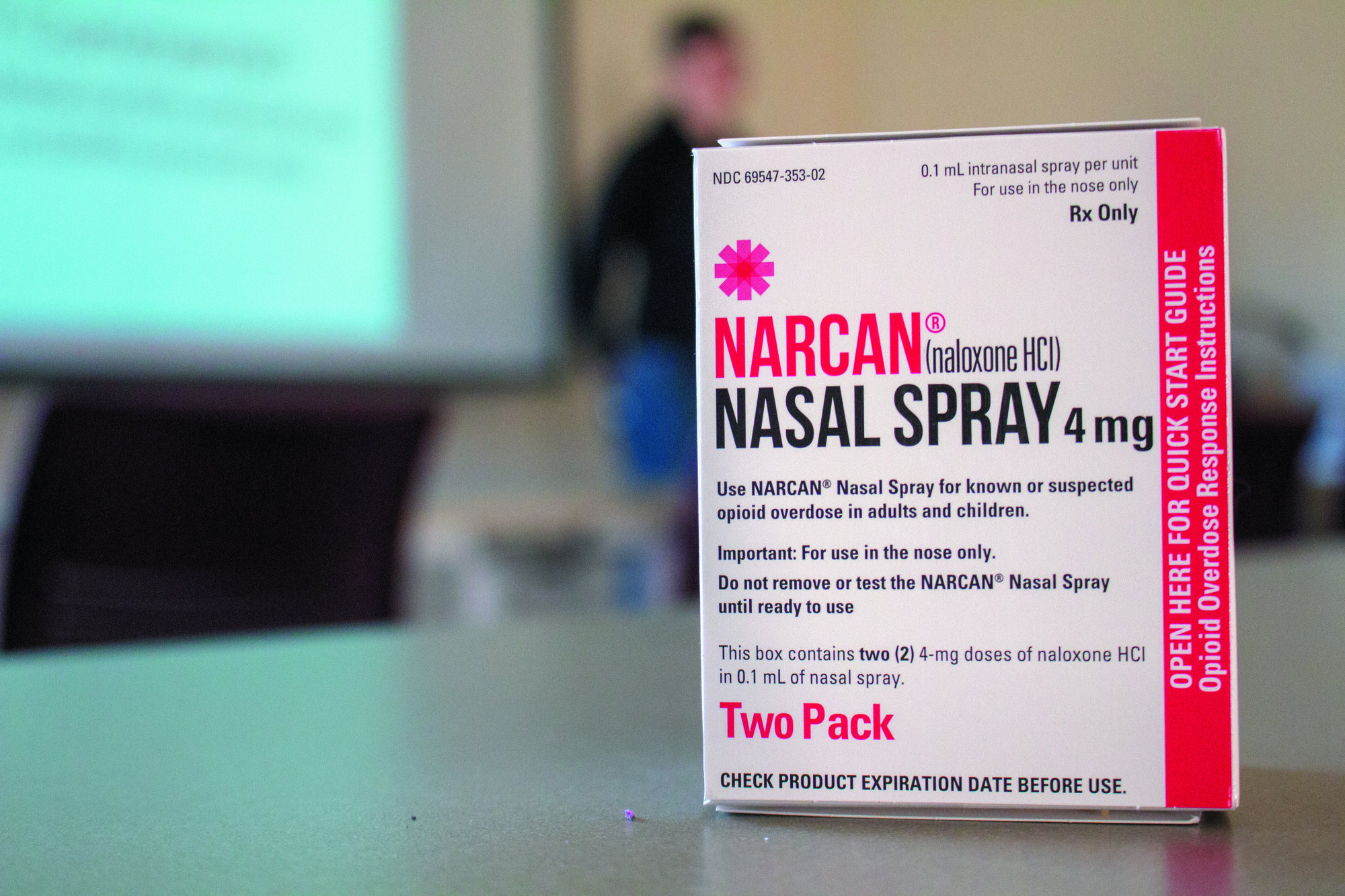
    Ocean Capewell, masters of social work intern for HSU health and well being, and Mira Friedman, Lead for Health Education and Medical Clinic Support Services at HSU, hold a box of Narcan nasal spray at the second ever Narcan training at HSU on March 11 2019. | Photo by T.William Wallin

    Narcan is generic for the drug Naloxone which Capewell said is an opioid antagonist. Capewell said our brains have opioid receptors and Naloxone confuses the receptors so they do not attach to opioids coming into the brain. The easiest form of Naloxone, demonstrated by Capewell and Friedman during the training, is through a nasal spray. Capewell said they wanted to have “the lowest barrier form” on campus so anybody can use it.

    “It is very safe and has had no problems for people using it,” Capewell said. “It is only useful for people using opioids but more important it’s for loved ones, house mates and friends to have. Once you overdose you wont be able to administer it yourself.”

    IMG_9010.jpg
    Narcan nasal spray is a safe and easy preventative of death for those overdosing from opioid. | Photo by T.William Wallin

    Capewell instructed those at the training on what to do when someone is overdosing. Capewell said to first call 911 and then hold the Narcan nasal spray in between two fingers so you don’t accidentally deploy it. Next you place the spray as far up the nostril as you can and hit the button. Capewell said “they don’t have to be breathing” for the spray to work because it gets in the mucous membrane. Afterwards lay them on their back and apply rescue breathing, which is two quick breaths and then one breath every five seconds for the next two minutes.

    [perfectpullquote align=”right” bordertop=”false” cite=”Mira Friedman” link=”” color=”” class=”” size=”17″]“Eureka police just got Narcan and saved someone over the weekend. The Eureka library has saved someone recently who was using in the bathroom. It’s pretty amazing.”[/perfectpullquote]

    “They are going to feel terrible when they wake up,” Capewell said. “They will most likely be withdrawing, which is one of the worst experiences a person can have. They may be vomiting, shaking and unable to control their bowel movements but they’ll be alive.”

    Friedman said Naloxene distribution began in 2003, and within the first year overdose deaths decreased by 42 percent. Friedman said local distributors in Humboldt County include Public Health North Coast Aids Project, Redwoods Rural Health Center, Humboldt Area Center for Harm Reduction (HACHR), and Cloney’s Pharmacy.

    “Eureka police just got Narcan and saved someone over the weekend,” Friedman said. “The Eureka library has saved someone recently who was using in the bathroom. It’s pretty amazing.”

    IMG_9002.jpg
    Ocean Capewell, masters of social work intern for HSU health and well being, during the second Narcan training at HSU. | Photo by T.William Wallin

    Friedman said that there is a stereotype of people who use opioids as all needle users or living on the street. She said that 40 percent of opioid overdoses involved a prescription drug and that really challenges the myths and stigmas revolving around opioid addiction. Friedman also said that Naloxene is not treatment but something used to prevent death.

    “We’re interested in giving people information on harm reduction like data and statistics,” Friedman said. “Especially being in Humboldt because this issue is so great.”

    Psychology senior Victor Ahumada was one of the attendees at the training and said he was there because he knows there is an opioid crisis, especially in Humboldt. Ahumada said when there are available trainings he wants to take advantage of them. Although he has never dealt with anybody overdosing, Ahumada now carries Narcan with him just in case.

    “I think this is something everyone should know about,” Ahumada said. “Everyone may not necessarily have to carry Narcan but they should know this is a huge problem. It’s important to be aware and be a part of the prevention.”

    The next Narcan trainings will be held in April:

    Tuesday, April 6 at 12 p.m. Nelson Hall room 106

    Tuesday, April 23 at 5 p.m. Library Fishbowl
  • No more opioid deaths

    No more opioid deaths

    Lifesaving drug, Narcan will be given out for free starting this semester

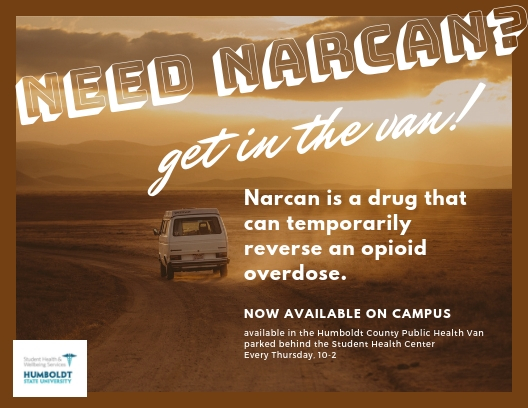
    Starting this semester students, faculty, and members of the community will be able to obtain Naloxone, the lifesaving drug that reverses opioid overdoses, for free and without a prescription on campus. Every Thursday from 10 a.m. to 2 p.m. the Humboldt County Public Health Van will be parked behind the Student Health Center where people can pick up Naloxone, also known as Narcan, as well as access other services.

    “Narcan is a preventative measure used to prevent overdoses, it is a lifesaving medication,” said Mira Friedman, lead for Health Education and Clinic Support Services. “The van has been offering HIV and hepatitis testing, as well as PREP navigation services for a couple years now. They recently added Narcan.”

    Humboldt county is in the midst of an opioid epidemic and the Narcan services are part of a growing outreach to prevent overdoses. According to a report by the County Administrative Office, “In 2016 there were 156,444 opioid prescriptions, or more than 114 prescriptions per 100 residents.” The two following years saw a slight drop in numbers, with 2017 having 135,617 prescriptions issued and 2018 having 123,616 prescriptions written out to a population of about 136,000, according to statistics from California Department of Public Health.

    Heroin seizures are also on the rise in Humboldt. In 2018 there were about 35 pounds of heroin seized in Humboldt county, compared to 2017 when only 10 pounds were seized. So far in 2019, one recent drug bust resulted in the seizure of six pounds of heroin along with $6,000 in cash on Jan. 28.

    According to a public records request there were 57 deaths due to drugs and alcohol in 2018 in all of Humboldt, and 22 of them were linked to opioids. So far, Narcan is the only drug approved by the FDA that has the ability to be administered as a nasal spray and is designed to be used without any sort of significant training. However, Friedman and a social work intern will be leading training sessions on the use of Narcan later this semester. Friedman said that the sessions will teach students and other attendees about opioids and provide more background knowledge about Narcan. The trainings that Friedman will be leading are in collaboration with the Humboldt County Public Health Department.

    “They have been wonderful collaborators,” Friedman said. “They’ve worked with the library and the police departments.”

    Brian Ahearn, Chief of Police for the city of Arcata, said that his officers do not carry Narcan, but said that a few officers have gone through training.

    “The preservation of life takes precedent over any other outcome,” Chief Ahearn said, “including law enforcement.”

    Opioid use affects people of all backgrounds and can plague the general public. Jessica Smith, the program director at the Humboldt Area Center for Harm Reduction located in Eureka, said that they offer Narcan services and a clean needle exchange among other services to a large number of people, some of whom come in multiple times a week.

    “We see on average 20-35 people a day,” Smith said. “In a week, we can see upwards of 200 people. We provide our services because we understand that we are amidst an epidemic and overdose prevention is the first step.”

    Smith said that they have experienced some push back from the local residents because of their needle exchange program, but felt that it was unjust since they are one of the few places in the county that have programs where addicts can access clean syringes. Smith also said that they keep track of how many people come back for more Narcan and ask them if they had to use it to prevent an overdose.

    “Having the proper tools to stay alive is the first step in making better life choices,” Smith said. “By empowering them, we believe they will become the most effective tool at preventing overdoses.”

    A previous version of this article listed the Humboldt Area Center for Harm Reduction as the only place in Humboldt County that provides clean syringes. (Updated: 1:42am 02/06/19)