The Lumberjack


Students Serving The Cal Poly Humboldt Campus and Community Since 1929

Tag: Native American Forum

  • Signs of Passage: Nostalgia and New Beginnings

    Signs of Passage: Nostalgia and New Beginnings

    By Christina Mehr

    Signs of Passage: Nostalgia and New Beginnings debuted in the Reese Bullen Gallery at Cal Poly Humboldt on Nov 8. The exhibition runs through Dec. 9 [2023] in the Art Building. 

    The Reese Bullen Gallery is named in honor of a founding professor of the Art Department and has been an addition to Humboldt since 1970. The gallery usually contains the university’s permanent collection of art and sponsors exhibitions of works by professional artists related to many different areas of instruction. The Reese Bullen Gallery also presents an annual exhibition of student art in May, the Graduating Student Exhibition.

    The mission of the Reese Bullen Gallery is to offer free and publicly accessible exhibitions representing artists from all demographics. Extending beyond Humboldt, the Gallery seeks to strengthen partnerships with local communities as well as stimulate support and participation in the arts. 

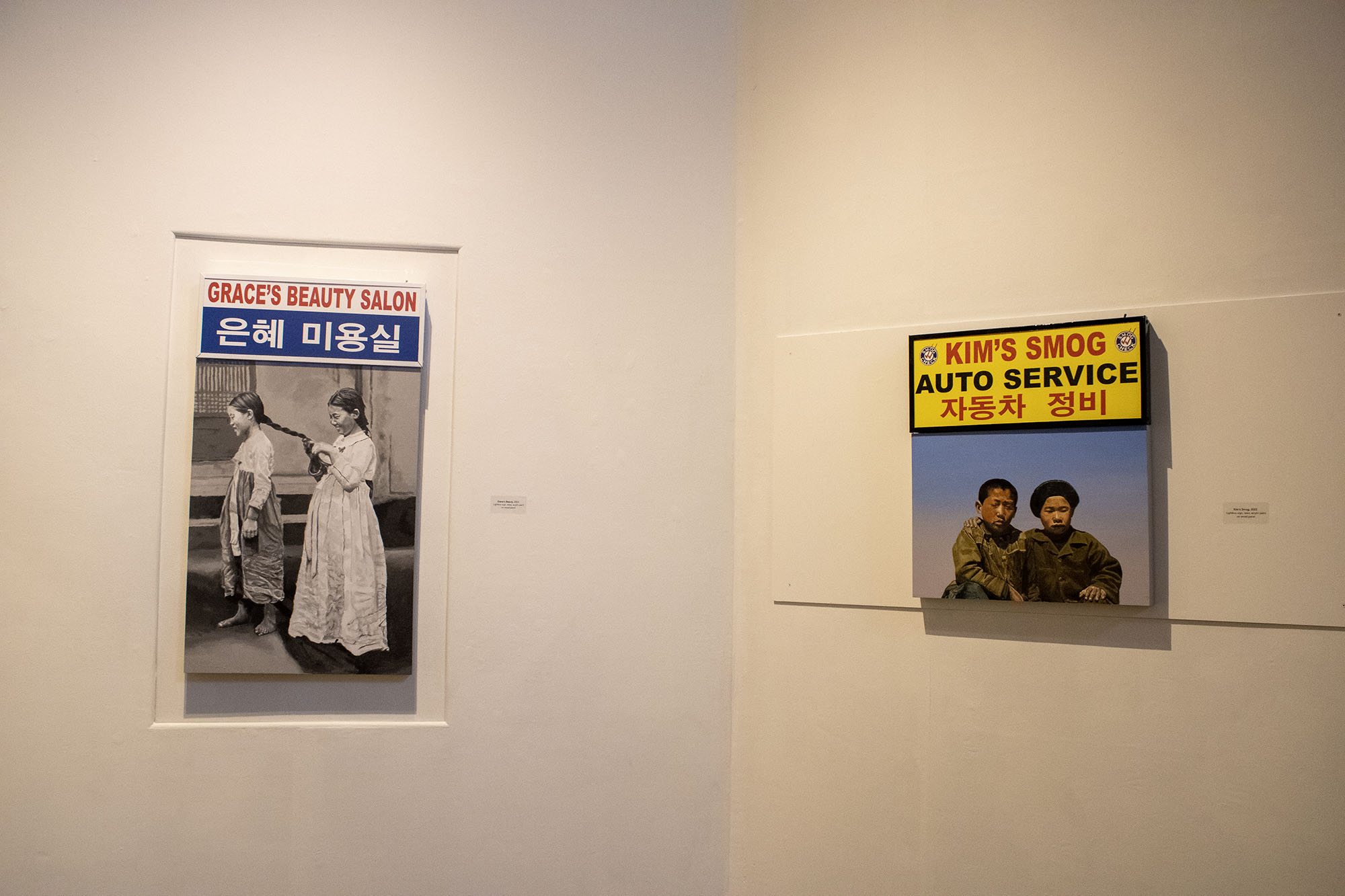
    This new body of work presented by Dave Young Kim at the Reese Bullen Gallery uses latex paint on wood panels. 

    Dave Young Kim is a Los-Angeles based artist who visited Humboldt County with a newly created body of work for his solo exhibition at the Cal Poly Humboldt Reese Bullen Gallery. Kim is a fine artist, born and raised in Los Angeles. He received his Bachelors of Fine Arts Degree in Studio Art from the University of California, Davis, and a Master of Fine Arts in Studio Art from Mills College. 

    His current display of work engages with the quality of home and explores themes of nostalgia, war, conflict and displacement. Through his work, Kim explores the unifying search for belonging across disparate conditions. In 2020, he co-founded the Korean American Artist Collective (KAAC), which is a group of artists building a community around work rooted in the Korean-American experience. In 2021, he was a selected muralist for the Eureka Street Art Fest and in connection with the Eureka Chinatown Project to paint a mural named Fowl. 

    “My work plays with that idea of manufacturing nostalgia as integrated with my family history, memory, and identity,” Kim said. “My artistic approach is drawn from a sense of loss or longing, looking for a place to belong.”

    His online portfolio can be found at https://www.daveyoungkim.com

    Goudi’ni Native American Arts Gallery displays “Tintah: Amongst The Trails” 

    Robert Benson’s Redwood Sculptures and Watercolor Studies

    By Christina Mehr

    In collaboration with Cal Poly Humboldt, Robert Benson presents his work in “Tintah: Amongst The Trails” at the bottom floor of the Behavioral & Social Sciences Building.

    The art installations of Native art used the mediums of watercolor and wood pieces. Focusing on a new body of work, Tintah, Hupa language for amongst the trails, features newly carved salvaged old-growth redwood sculptures and watercolor studies. Robert Benson, is a leading figure among artists in the NorthWest California art world. He has worked as a teacher for more than 30 years at the College of the Redwoods, as well as being a curator of Native art.

    Tall sculptural wooden carvings adorn the exhibit and viewers must make their way through the art, almost like walking amongst the trails. Redwood slabs carved into beautiful sculptures lined the room. 

    His current paintings and sculptures are filled with imagery of trails, both of the literal kind and suggested. With Benson’s deep connections to the environment and land, those motifs clearly shine throughout his work. 

    “There is the trail into our family hunting camp that I traveled for more than 50 years, there are trails handed down through stories and mythologies, and there are the trails of imagination,” Benson says. “When we consider that at the most basic level, a trail is just something connecting two points, even the ladder and stairway forms that populate my work can be viewed as kinds of trails. To be amongst the trails is to find your rhythm, your place and to discover the interplay between that rhythm and the melody of the universe.” 

    This solo exhibition was installed by the Art + Film Department Museum & Gallery Practices class under the direction of Assistant Professor Berit Potter and Gallery Director Brittany Britton. This exhibition was partially funded by Instructionally Related Activity Fees. 

    Photo courtesy of Goudi’ni Native American Arts Gallery
  • Indigenous Environmentalists Connect Environment and People

    Indigenous Environmentalists Connect Environment and People

    Campus discussion touches on importance of traditional knowledge

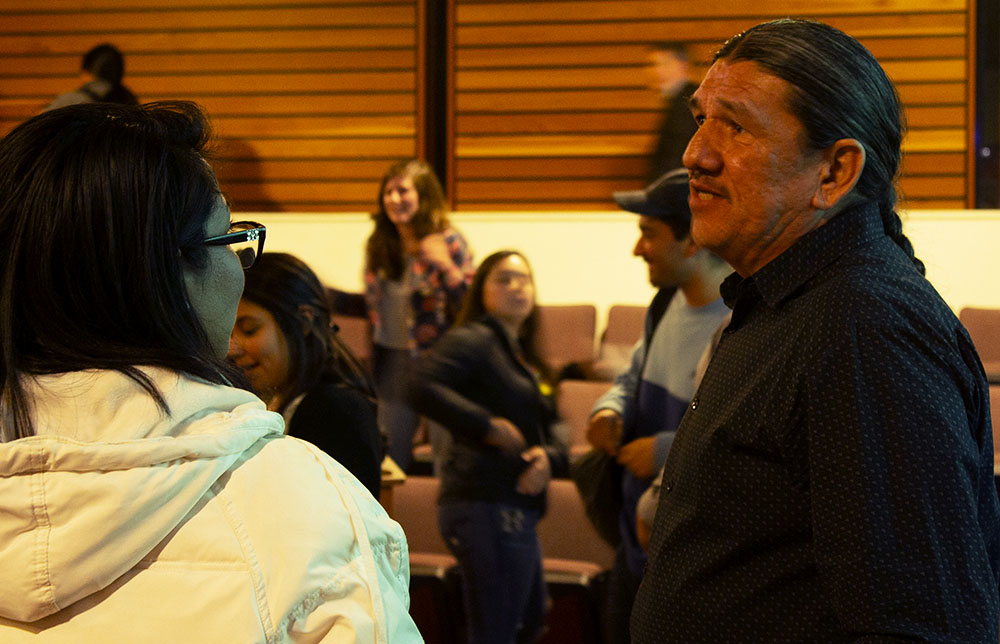
    Students, faculty, friends and family packed the Native American Forum March 5 to listen to author Kari Norgaard and Karuk environmentalist Ron Reed discuss Norgaard’s most recent book, “Salmon and Acorns Feed our People: Colonialism, Nature, and Social Action.”

    Before the speakers began, Cutcha Risling Baldy, assistant professor of Native American studies, announced the NAS department’s 25th anniversary at Humboldt State University.

    An introduction followed, led by Reed’s son, Charlie. Charlie Reed, a recent alumni from HSU’s NAS program, has continued as an environmentalist to help battle climate change. Before the talk began, Reed said it was important to give proper acknowledgement to the lands of Indigenous peoples. HSU sits on ancestral Wiyot land, and recognizing the land’s history is of utmost importance.

    “There is a symbiotic relationship between our environment and our people.”

    Charlie Reed

    “Whether you are a faculty member or student or just a community member, it starts with a conversation,” Charlie Reed said. “You never know who is in the room who has something to offer or give back the things that have been taken from Indigenous people.”

    Growing up with his father, Reed learned about his culture and the traditional ceremonies that tied in not just physically, but spiritually with the environment.

    “There is a symbiotic relationship between our environment and our people,” Charlie Reed said.

    With a warm thank you to the Reed family and the community, the floor was given to author Norgaard and Ron Reed. Reed introduced himself and what he learned as a child. Reed said learning the traditional ways of his people at a young age taught him how to sustain the environment.

    “That’s where it all begins, ladies and gentlemen, when you have the ability to be taught things that you don’t even know you’re being taught,” Ron Reed said. “That will stay with you the rest of your life.”

    In one of Norgaard’s chapters, she mentions an Indigenous tradition of using fire to cleanse or manage the land. Western science has given us the narrative that fire is dangerous and destructive. Thanks to “Smokey the Bear” and other forms of wildfire prevention advertisements, fire is seen as something to fear.

    Even though fire can be seen as scary, Norgaard argued it’s also a way to help manage landscapes by getting rid of invasive species and even enhancing plant growth. Indigenous peoples used fire to help the environments they lived on, not to destroy or cause damage. Reed stressed the importance of bringing that narrative to our attention.

    “We’re trying to get back to an intact world. Climate change can be a vehicle for that because of the awareness it brings to so many.”

    Kari Norgaard

    “We Native Americans—we the family—cannot let that narrative go,” Ron Reed said. “I don’t need some lone ranger to tell me the way. I know the way.”

    With Indigenous knowledge and science being pushed to the side when it comes to environmental issues, Norgaard said settler colonialism is still causing misinformation about the knowledge base of Indigenous peoples. Norgaard said this is changing.

    “Indigenous concepts and ideas have been making their way into academic spaces,” Norgaard said.

    Climate change is perhaps the most pressing modern issue, but Norgaard and Ron Reed agreed it would help bring more awareness in our communities.

    “We’re trying to get back to an intact world,” Norgaard said. “Climate change can be a vehicle for that because of the awareness it brings to so many.”

    The consensus of the talk was that combining Indigenous knowledge with western science can change the way we view the world as well as how we take care of it. Coming together and working with each other on both sides of science can also help combat climate change. From the ways of the rivers to the fires of the forests, Indigenous knowledge can teach us more about our world.

    “We need all the community on the river, but don’t forget us,” Ron Reed said. “Don’t forget the first people on this nation, on this ground that has created the environment that we’re trying to reestablish in this world today.”