The Lumberjack


Students Serving The Cal Poly Humboldt Campus and Community Since 1929

Tag: Native Americans

  • Culture Connects with Nature and Wellbeing

    Culture Connects with Nature and Wellbeing

    United Indian Health Services provides health and wellness services for Native Americans throughout Del Norte and Humboldt County

    When you’re sick with cold sweats, a cough and a runny nose, being home with someone who loves and cares for you is the ideal situation. Those feelings of comfort, security and warmth are at the core of the United Indian Health Services and their mission of healing the mind, body and spirit.

    Elizabeth Lara-O’Rourke, the community health and wellness division director for the Potawot Health Village in Arcata, talks about the different realms of wellness UIHS strives for when treating their clients.

    “Being able to meet the many needs of our clients is really important for overall wellness,” Lara-O’Rourke said. “It’s not just physical wellness, but also spiritual wellness and we really try to include a strong cultural component in the services that we provide.”

    UIHS is a collaborative program between various local tribes within the Humboldt and Del Norte counties that provide medical services along with community and wellness outreach specifically for Native Americans, whether they are local tribe members or not.

    “We work to heal mind, body and spirit. Culture is a part of that. Art can support the healing process.”

    Andre Cramblit

    There are seven clinics – Xaa-wan’-k’wvt Clinic in Smith River, Taa-’at-dvn in Crescent City, Elk Valley Office in Crescent City, Hop’-ew Puel in Klamath, Weitchpec Libby Nix Community Health Center, Potawot in Arcata and Tish-non in Fortuna that collectively serve 1,200 active clients. However, Tish-non is closing down its Fortuna location on Oct. 25 and relocating to Eureka where they will reopen their clinic on Dec. 2.

    “The environment here is about bringing people home, making people feel comfortable and offering an environment that offers a family atmosphere,” Lara-O’ Rourke said. “So we really try to have that not just with our clients but also with our staff.”

    Twenty-three-year-old Winona Vigil is a front office assistant for Potawot. She graduated from Humboldt State in 2018 with a bachelors degree in psychology and a minor in kinesiology. She works as the receptionist and is the first face and voice that clients meet and greet upon entrance. Vigil says she likes the work and also appreciates helping out clients that come through the doors or those who call seeking aid.

    “All my coworkers and everyone who works here is super supportive,” Vigil said. “And working with the clients, they are all usually friendly. They’ve got life stories and it’s interesting getting to hear them.”

    UIHS offers basic medical, dental, vision, behavioral health and pharmacy services. The availability of health services differs from each clinic and programs such as Title IV Elder Nutrition help deliver food to American Indian elders.

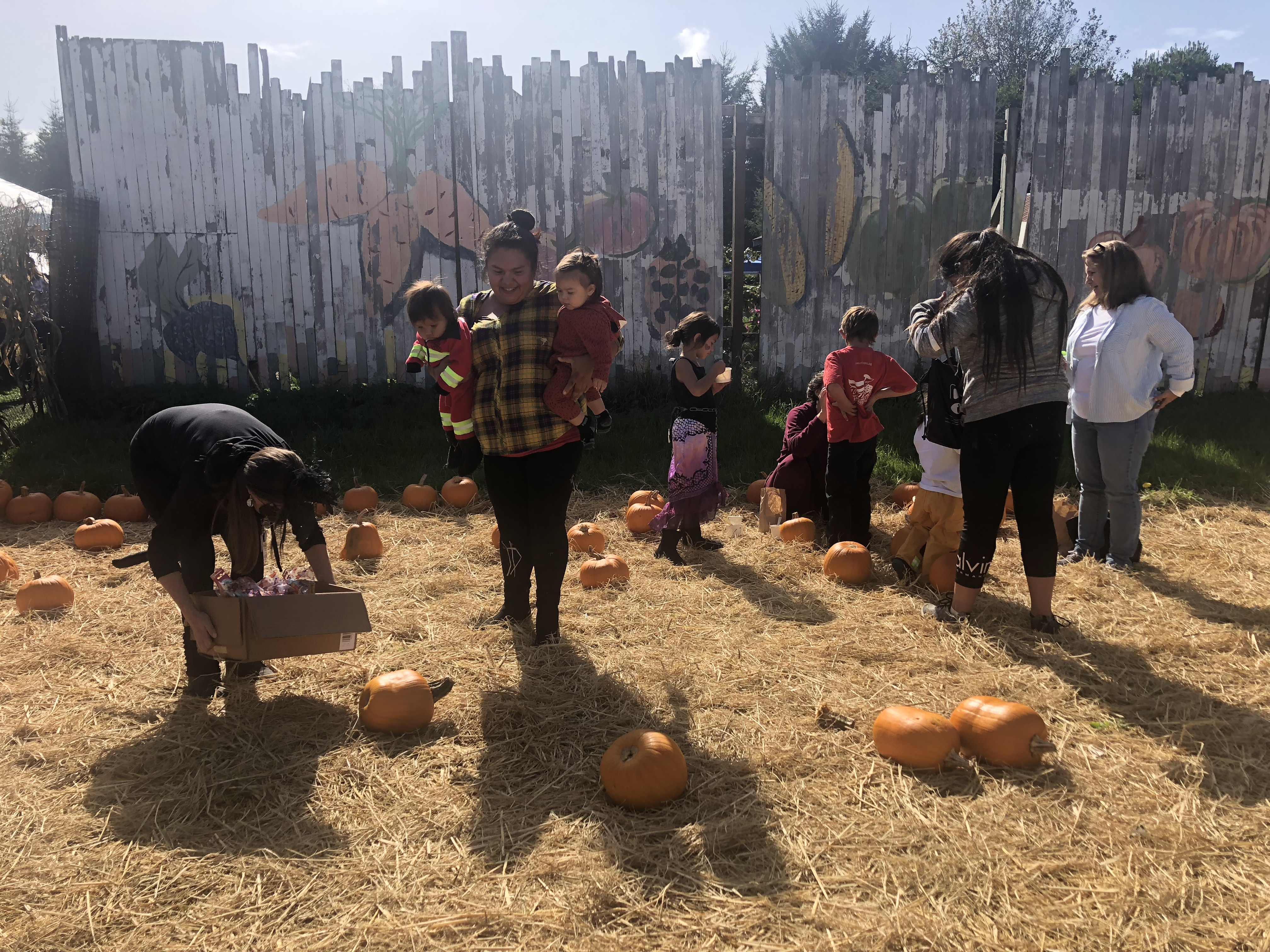
    Andre Cramblit, traditional resources specialist for the Potawot Health Village, says that by including cultural components, whether it’s through art, displaying traditional items or hosting cultural events, like the Harvest Party and youth summer camps, there are opportunities for Native Americans to connect with their heritage.

    “We work to heal mind, body and spirit,” Cramblit said. “Culture is a part of that. Art can support the healing process.”

    “People need to make decisions that are right for them. Not necessarily what the provider thinks is right, but what that client feels is the right decision for them because in healthcare sometimes there isn’t a right answer.

    Elizabeth Lara-O’Rourke

    Other traditional resources include various methods of recovery such as inviting traditional healers, sweats and supporting language classes.

    Lara-O’ Rourke says that another theme of UIHS is that health of the environment equals the health of the people. The organization highly values and honors the connection that Natives have with the earth, water, plants and animals.

    Whereas other health facilities or healthcare providers might separate mind, body and spirit, Lara-O’ Rourke said that for UIHS it’s interconnected and that knowledge is important for their clients to make the best decisions.

    “People need to make decisions that are right for them,” Lara-O’Rourke said. “Not necessarily what the provider thinks is right, but what that client feels is the right decision for them because in healthcare sometimes there isn’t a right answer. It is what is best for that person, and only that person can decide that.”
  • Coming Home: Sacred Land Returned to Wiyot Tribe

    Coming Home: Sacred Land Returned to Wiyot Tribe

    After nearly 160 years in the hands of Eureka, Tuluwat, briefly known as Indian Island, returns to its rightful owners

    Wiyot Tribal members and Eureka community members were joyful, yet solemn, at the Eureka City Council meeting to officially return Tuluwat Island to the Wiyot people.

    Wiyot tribal elder Cheryl A. Seidner blessed the room in a prayer of welcome. In the prayer, Seidner welcomed people from the East and from all directions as she turned in a circle, speaking in her native language. The crowd was silent and respectful, and tribal members let out emotional “ho’s.” Seidner thanked everybody in the audience and asked them to rise.

    Wiyot tribal elder Cheryl A. Seidner speaks during the public comment section of the city meeting to return Tuluwat Island to the Wiyot Tribe while she is surrounded by supporters and tribe members at the Adorni Center in Eureka on Oct. 21. | Photo by Thomas Lal

    “This is something I’ve always wanted since I was a kid,” Seidner said. “I thought the island was always ours, not anybody else’s. So we came together and said, ‘Let’s do this, let’s make it ours.’ So I decided to be bold and ask the new mayor to give us the island they owned.”

    In 2004, 40 acres of Tuluwat were returned to the Wiyot Tribe. Oct. 21 marked the return of the remaining 202 acres. The tribe has been working with the City of Eureka for the last five years to make this happen, and this action marks the first step to repairing the damage caused to the tribe that began 100 years ago.

    Cutcha Risling Baldy, Ph.D, the Native American Studies department chair at Humboldt State University, delivered one of many moving speeches to the hundreds of assembled community members. Baldy talked about the future of the Wiyot people and how she knew, one day, they would come back.

    “I realized that native people were always making plans for our future and that we never gave up on our land or where we came from,” Baldy said. “That is the story I want people to know. I know that the story of Tuluwat, which people often refer to as Indian Island, has been one of a massacre for most people, but for me it has only been a place for world renewal.”

    Baldy once read a book about stories gathered from people about Tuluwat. One particular story was about a woman who was stuck in the mud after the violence on the island. While it may be a story of sadness, Baldy said it was a moment of strength and hope. The woman sang a mourning song because she knew she had to send her tribe off properly. Her strength showed she knew her kin would one day return to Tuluwat.

    HSU anthropology professor Gordon Ulmer acknowledged the significance of the day. Ulmer said the day should be a celebration of time immemorial, and that it displayed the vibrancy of the Wiyot tribe, despite the dark history.

    “What we see here is a very vibrant thriving community that lives in the shadow of genocide,” Ulmer said. “People remember the genocide, but what is rarely acknowledged -or at least to a much lesser extent- is that people are still here, the Wiyot are thriving. There’s a lot to celebrate here.”

    Eureka Mayor Susan Seaman began official proceedings by declaring the day as a moment in time that should forge strong bonds going into the future to create a long sought-after vision. Seaman prepared to take a vote from the council people while tension in the air grew as the crowd waited.

    “I move to authorize the transfer of Tuluwat Island to the Wiyot Tribe and I authorize the vote,” Seaman said.

    The Eureka City Council spoke on behalf of the motion, each member contributing a unique perspective to the magnanimity of the event. HSU Lecturer and Eureka City Council Member Natalie Arroyo wasn’t physically present, but she FaceTimed in and a representative shared a letter penned by her about Tuluwat.

    “This is the first known transfer of land from a city to a tribe of this kind,” Arroyo said. “We are all responsible to do what we can to actively participate in healing. I will be so bold to say under current conditions Eureka owns the land, but it was never truly ours.”

    The tension began to ease as Seaman’s voice fell over the crowd.

    “The vote to return the Tuluwat island to the Wiyot Tribe was unanimous and the motion passed,” Seaman said.

    Applause erupted from the audience. The crowd stood on their feet to clap and shout in joy.

    Seidner invited her family to the front of the auditorium to sing a song to the people gathered in the room. Seidner welcomed everyone in the audience and invited them to sing the song “Coming Home.”

    “I know that our ancestors knew this day would come,” Baldy said. “I think that we need to consider it an opportunity to think about our next steps in the future. People stand up and ask me, ‘What can I do?’ And I have one answer for them: you can start by giving all the land back. And now we know it’s possible.”

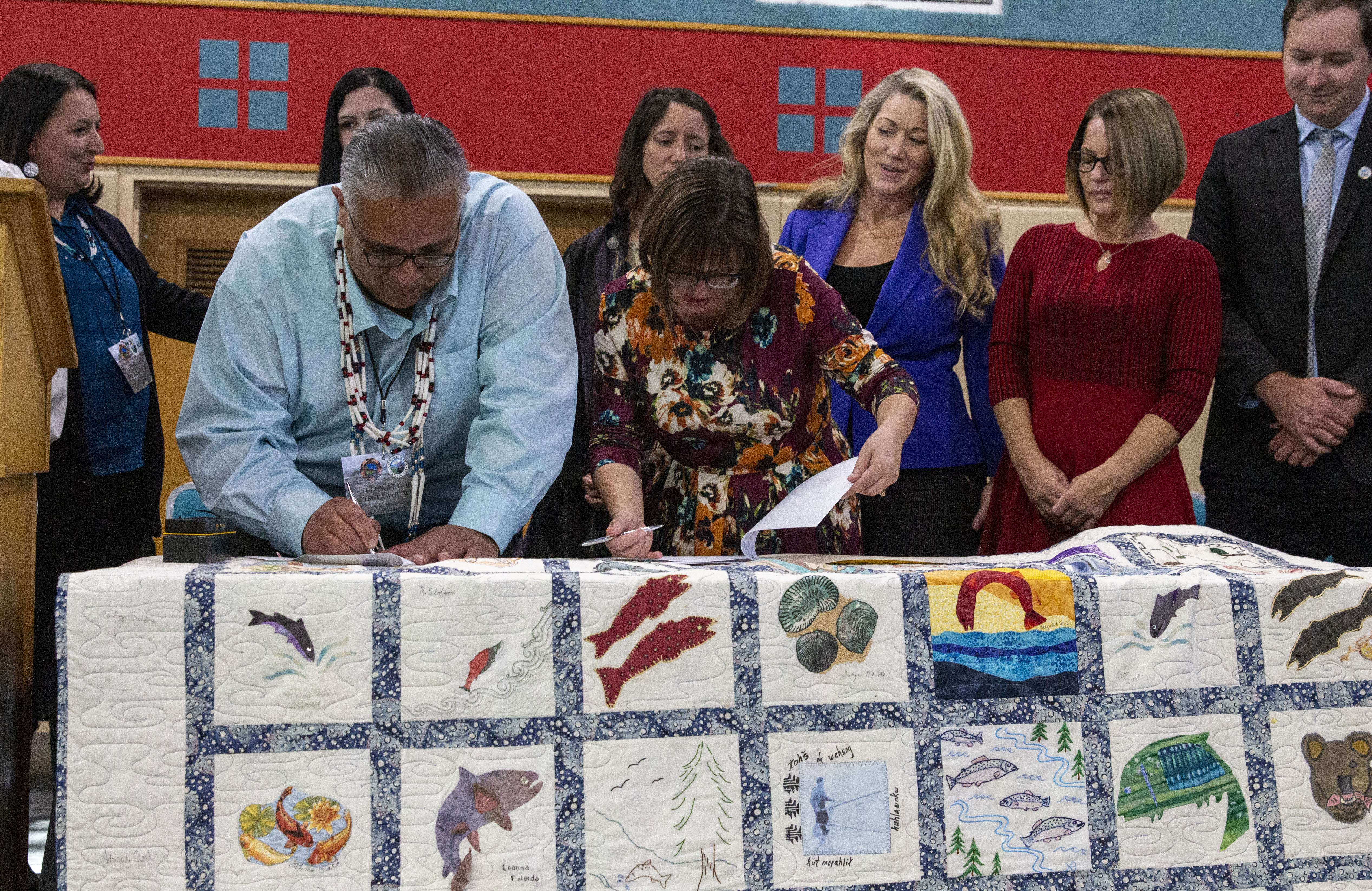
    The signing of the deed marked the end of the meeting. Seidner placed a quilt representing all who could not be present on the table, and the council people huddled around to officially return Tuluwat to its ancient owners.

    Wiyot Tribal Chairman Ted Hernandez and Eureka Mayor Susan Seaman embrace after signing the papers to officially return Tuluwat Island to the Wiyot Tribe at the Adorni Center on Oct. 21. | Photo by Thomas Lal

    Baldy concluded her address with honest praise. With the Wiyot land reparation, the people in the room could now envision a radical future.

    “A future with no dams, a future with salmon that are healthy, a future with our children that are singing, a future where we are dancing all the time,” Baldy said. “I know we’ve seen it and I know we’ve felt it, and I look forward to how amazing that is going to be. And I know that we can do it, and I look forward to how everyone in this room is going to make that happen.”

  • Working to Correct History

    Working to Correct History

    Home Away From Home potluck kicks off Indigenous Peoples’ Week

    Arcata is home to the Wiyot Tribe and Humboldt State University sits on Wiyot land. The Home Away From Home Potluck is one example of the community’s attempt to welcome all members to interact and is a fun, inclusive way to start Indigenous Peoples’ Week.

    The second Monday of October has become an opportunity to counter-protest Columbus Day. Along with a celebration of Native Americans, their history on this land and their culture, Indigenous Peoples’ Week highlights the customs of indigenous peoples and acknowledges the years suffering.

    Arcata Mayor Brett Watson spoke on some of the actions the city has taken in order to support local Native Americans. Watson spoke of a proclamation from 2016 where Arcata officially recognized Indigenous Peoples’ Day.

    “The university is our lifeblood and we see the diversity of the student body as a positive. We welcome students of all backgrounds.”

    Wesley Chesbro

    “Just on October 2, we did a resolution affirming our support for a United Nations resolution,” Watson said. “Acknowledging the rights of Indigenous people around the world.”

    The inclusion and acceptance of Native Americans’ history is one way that the community is attempting to reach out to students of all ethnicities. Wesley Chesbro, local volunteer and HSU alumnus, believes the potluck is inviting and feels like home for students.

    “What we hope happens is students will sit down with community members and develop relationships,” Chesbro said. “The university is our lifeblood and we see the diversity of the student body as a positive. We welcome students of all backgrounds.”

    The Home Away from Home potluck is more than it’s food, it’s about a sense of welcome. The goal, according to Equitable Arcata’s Communications Chair Cati Gallardo, is racial equity.

    “The Home Away From Home potluck started as a way to let students know they’re loved by the community,” Gallardo said. “We love our students and some of the feedback we received stated how we need to make a change in Arcata. Folks were feeling it wasn’t a racially equitable community and we wanted to change that.”

    Skits from based off the 1490s were performed by a Native American comedy group. The potluck consists of community members coming together to donate food and local businesses offer gifts for raffle prizes as well as warm winter clothing donated by locals for students who may need them.

    Other events for Indigenous Peoples’ Week include highlights of HSU’s Native American programs. The Native Forum provided guests with a geographical exposure to local tribes on Monday. Professor Rain Archambeau-Marshall is hosting a showing of Dodging Bullets followed by a post-film discussion on Wed., Oct. 16. The Native American Center will also hold an open house Friday, Oct. 18, where they will play Cards for Decolonization. To find out more information go to humboldt.edu or itepp.humboldt.edu.

  • Salmon and us, tied to the health of the Klamath River

    Salmon and us, tied to the health of the Klamath River

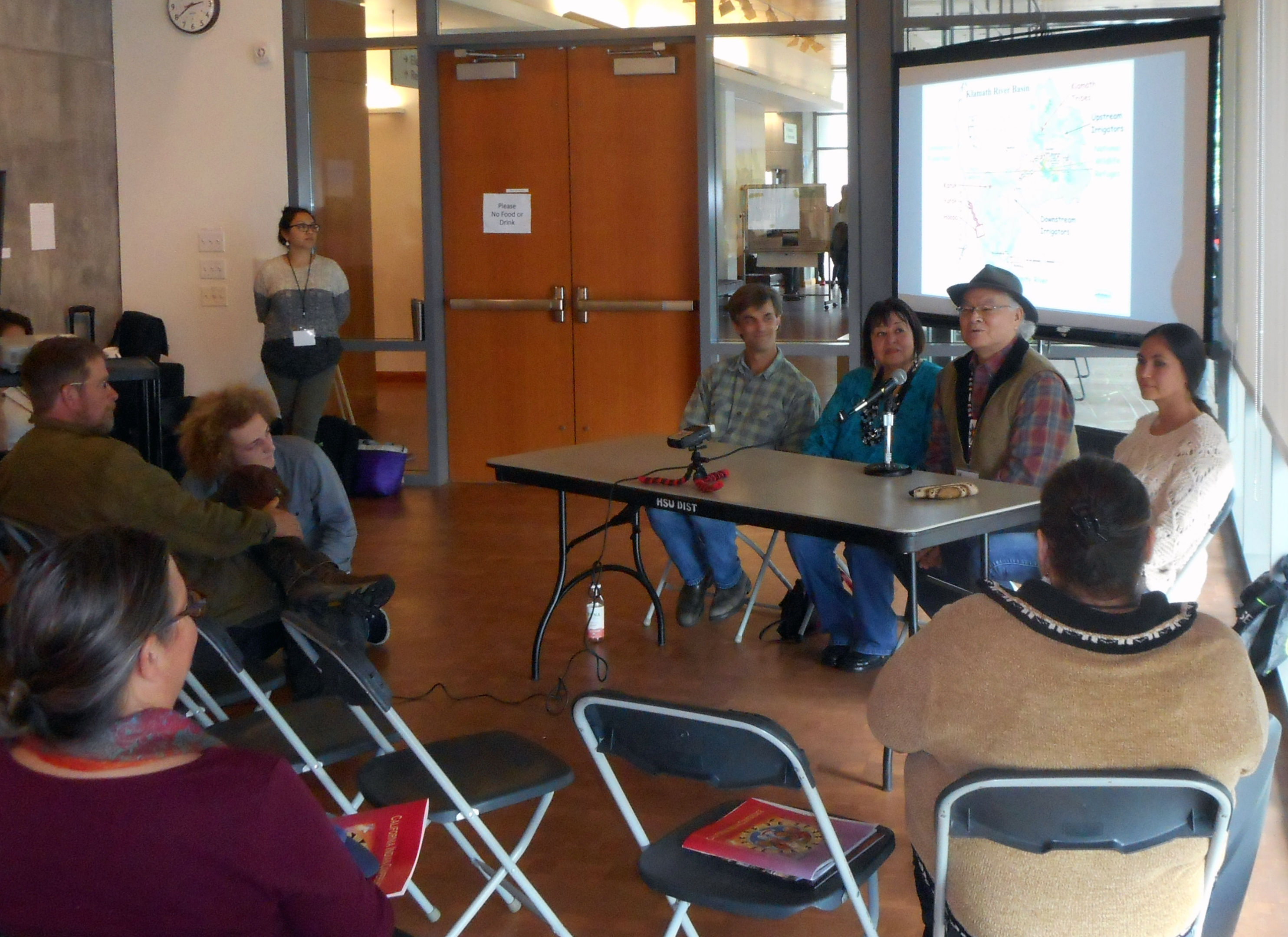
    The We Are the River: Connecting River Health to Community Health panel met to discuss the state of the Klamath River, and the communities whose lives are tied to the health of the river.

    The discussion was held in the Goudi’ni Gallery at Humboldt State during the 32nd Annual California Indian Conference on April 6.

    Dale Ann Sherman, a Yurok Tribe member and retired HSU professor of Native American Studies, was one of the four panelists.

    “I come from the Klamath and Smith Rivers. I belong to those rivers,” Dale Ann Sherman said. “In our blood runs the rivers and with that blood runs the salmon. We were born to go through time together. The salmon and us.”

    There were four panelists for the We Are the River: Connecting River Health to Community Health discussion: Dale Ann Sherman, Louise McCovey, Marlon Sherman and Konrad Fisher.

    Marlon Sherman is a Lakota tribal member, as well as the HSU department chair of Native American Studies.

    “The people on the Klamath River depend upon the salmon, and other fish,” Marlon Sherman said. “That’s their sustenance and their livelihood. That’s their spirituality. It is what their ceremonies are based on. Everything flows around the salmon, and if those salmon don’t have sufficient water, they will not come back any more. It is fairly obvious.”

    The salmon are at their lowest all time in returns due to problems with the river itself.

    “Dams, diversions and pollution sums up what is wrong with the river,” Fisher said.

    Fisher is a water protector who described the factors plaguing the Klamath River.

    “Dams are the biggest source of blue-green toxic algae build up, nasty stuff that will make humans very sick,” Fisher said. “Naturally occurring toxic blue-green algae production is dramatically elevated by dam water restriction. Some of the highest levels [of blue-green algae toxicity] ever recorded on Earth were collected behind the dams on the Klamath River.”

    A few years ago, a decades-long lawsuit by the Klamath tribes of the upper Klamath River went to the United States Supreme Court.

    “They finally were able to get the U.S. Supreme Court to realize that they had water rights to the Klamath River based on as far back as what they called time immemorial,” Marlon Sherman said.

    “Something exciting is happening very soon,” Fisher said. “We are on track for dam removal. Maybe not quite 2020, but 2021. Let’s continue to be hopeful.”

    “The [Klamath River Renewal Corporation] is the entity that will essentially take ownership of the dams, and take them out. Go to one of their meetings if you can. It is on their website,” Fisher said.

    “The salmon right now are at their bottom ebb. What they need now is plenty of clean, cold water,” Marlon Sherman said. “Water allocation is what the salmon need right now. This needs to be approached right now before the salmon are all gone. When the salmon go, who knows what’s next?”

    Water allocation rights and diversions are Fisher’s specialty, and water in the Trinity River that would run into the Klamath River is currently being diverted.

    “Water laws say there is a certain amount of water that should be left in the streams to meet certain needs,” Fisher said. “By and large they [the government] don’t [do their job] unless they are being forced, especially when it comes to telling people to use less water,” Fisher said.

    The needs of the communities most affected by the destruction of the Klamath have gone unheard.

    “The local laws of the people who have always lived there, and know the river, are never acknowledged,” Marlon Sherman said.

    “Ceremony is law. Culture is law. Very few people recognize that fact,” Marlon Sherman said. “The tribal attorneys need to be paying more attention to the tribal imperatives of spirituality, culture and tribal knowledges of their indigenous localities.”

    “Our people are fix-the-world people, that is what we do in our ceremonies,” McCovey said.

    McCovey is the Yurok Tribe environmental director and HSU environmental science alumnus who was on the panel.

    “There has been a rash of suicides in our community,” McCovey said. “For me in my job, I try to eliminate the environmental threats so that people can maintain their identity as river people, and feel safe in it.”

  • HSU hosts CSU Native American Initiative council

    HSU hosts CSU Native American Initiative council

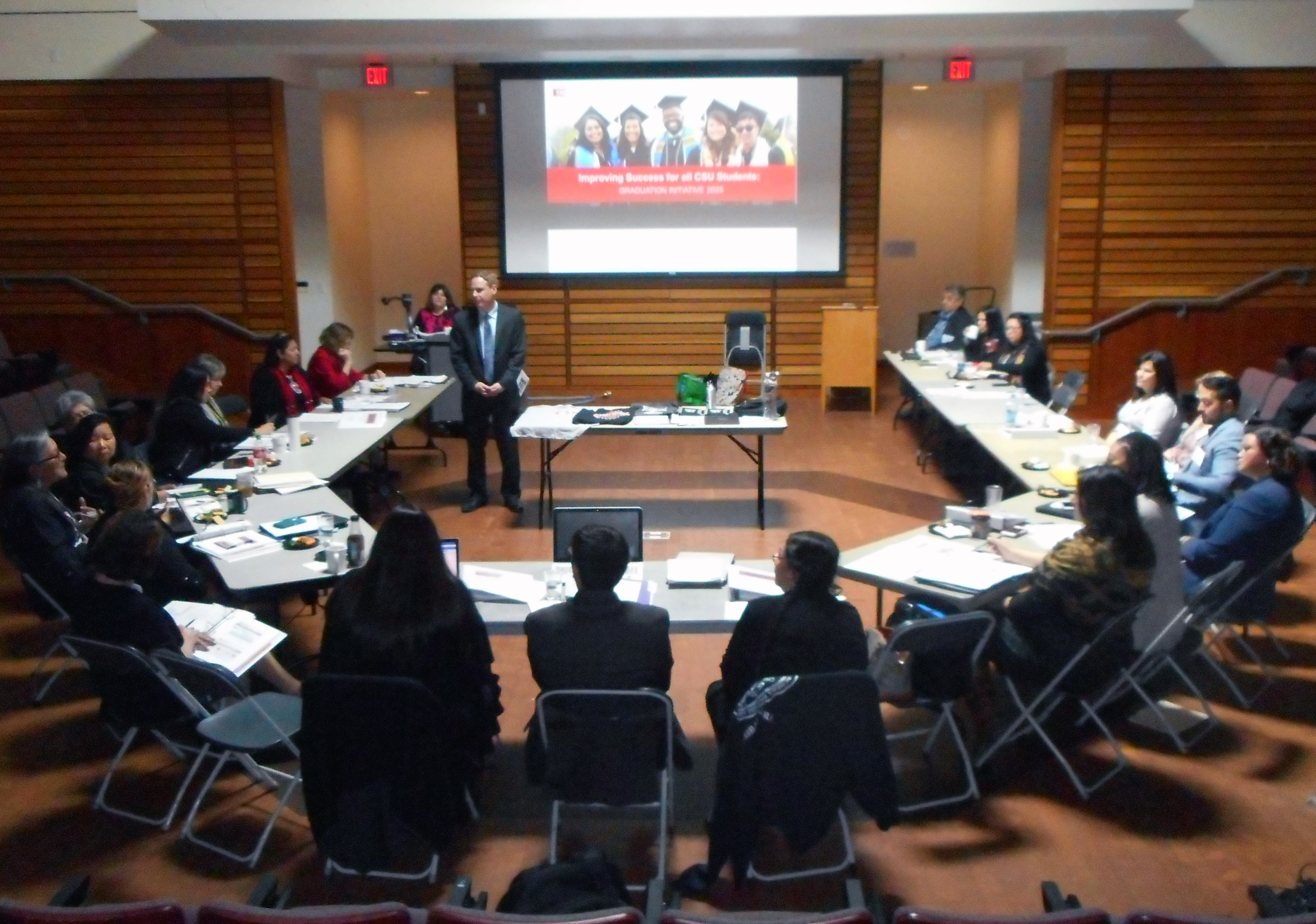
    The California State University Native American Initiative began in March 2006 as the result of a CSU summit with the representing leaders of 40 California Tribes discussing strategies to instill a pathway to higher education for Native American families. Humboldt State President Lisa Rossbacher will lead the Native American Initiative council.

    Last week, HSU hosted the California State University Native American Initiative statewide meeting in the Native American Forum on campus. Representatives from the California State University Chancellor’s Office, along with representatives from 19 of the 23 California State Universities, met with Rossbacher.

    Former HSU president Rollin Richmond was chair of the initiative, too. During that time, there were two summit meetings.

    Rossbacher was appointed by CSU Chancellor Timothy White to lead this initiative in February.

    “I am truly honored to be asked to serve as the presidential liaison with this council,” Rossbacher said.

    During the summit, Rossbacher laid out the overall goals of the Native American Initiative council.

    “One of our overall goals is to identify, share and support strategies that will help the graduation initiative [of 2025] and [Native American] student success. Strategies that will help us recruit students, retain students and graduate Native American students, and help them be successful beyond their time in the CSU,” Rossbacher said.

    Item two on the agenda was to support Native American studies research.

    “One of our goals is to engage and support faculty, staff and student research into the wide variety of fields related to Native Americans in the state and national Native American studies,” Rossbacher said.

    Another subject Rossbacher wanted to focus on was sharing information.

    “How can we share information that we are discussing and coming up with to support [Native American] student success? How do we share that with the tribal leaders throughout the state and the tribal communities? How do we share that critical information with the chancellor, his staff and the presidents throughout the CSU system?” Rossbacher said.

    The goals of the April 4 meeting were different than the overall goals of the Native American Initiative.

    The first goal of the April 4 meeting was to learn about updates and current CSU data on Native American student success, including recruitment, retention and graduation.

    “Look at the achievement gap or the opportunity gap that may be affecting Native American students on our campuses,” Rossbacher said.

    The third goal on the agenda was learning about some of the trends, practices and successes of the K-12 level and how that assists Native American students moving on to the California State system.

    The fourth goal of the meeting is developing strength.

    “Because I am the campus president, I want to be sure that you all know that there is something we are doing here at Humboldt State to accomplish those goals,” Rossbacher said.

    There are funds available from the Chancellor’s Office to support academic programming.

    “We do have funds that were established through the president’s council for underserved communities. It is a grant to the campus for academic preparation to strengthen the graduation initiative,” Maryann Jackmon of the CSU Chancellor’s Office said.

    “Funds can help students travel and see what is out in the world waiting for them after graduation,” Theresa Gregor, CSU Long Beach faculty said.

    The Tribal Liaison from the California State University of San Marcos, Tishmall Turner, is also the vice-chair of the Rincon Tribe.

    “President Rossbacher seems really genuine and sincere and she will do a good job of leading the Initiative,” Turner said.

    “President Rossbacher has been very supportive of Native American studies since she came to HSU,” Dale Ann Sherman, retired HSU Native American studies faculty said.

    The initiative will provide support to Native American faculty and students.

    “It gives you that lift to do the work. You don’t have to fight just to get to the point where someone will say go ahead,” Leece Lee-Oliver, CSU Fresno director of American Indian studies program and department of women’s studies said.

  • Arkley I call bullshit

    Arkley I call bullshit

    By | Phil Santos

    Only a sick mind believes you can give something that you have stolen. To give something, it must be yours in the first place. When you steal something, the status of your possession is always illegitimate. You can’t give something you’ve stolen because it was never yours, to begin with. This elementary concept is one that many fail to grasp or disregard completely.

    One of those people is Rob Arkley. He has recently pledged to “buy” Tuluwat, the site of the 1860 massacre of Wiyot women, children and men from the city of Eureka. This is in direct conflict with Eureka’s plan to transfer the land back to the Wiyot tribe.

    Regarding the outcry against Arkley’s proposal, Arkley said, “I am stunned by this whole thing. I don’t get it.”

    Tuluwat is stolen land, but it’s in the process of being returned. Why would anyone pay money to stop that process? My answer is as stated above: their mind is sick.

    However, Arkley says that he’s “concerned about what public access to the island will be like if the land transfer goes through.” He also says that “if [my] offer is taken up, [I] will set up a charity, similar to how Friends of the Dunes operates, [which is] to provide stewardship to the land [and that] it will remain open for public use like it is today.”

    I call bullshit. In 2005, Friends of the Dunes tried to purchase land to preserve and Arkley pulled the same move on them!

    An article in the North Coast Journal wrote, “‘they got in second place,’ Arkley said, making no effort to conceal his glee. ‘And it’ll never, ever, ever, ever, ever be sold to them. I’m not going to give it to the government agencies. I believe there’s far too much government land.’ Arkley has no specific plans for the parcel, which also includes a house. But he made it clear the land would be fenced off and not open to the public.”

    Wiyot tribal administrator Michelle Vassel wrote in an email regarding the transfer of Tuluwat, “The Wiyot Tribe is a government which by nature is a public, not a private entity… the tribe has no intention of excluding people. We have worked long and hard with the city of Eureka and other government agencies, local native and non-native, people and organizations in this community to come together to work toward these goals.”

    It seems like Arkley is afraid that the Wiyot would bar anyone from stepping foot on Tuluwat after it is returned to them. Where does that fear come from? It sounds like something that he would do. It’s an irrational fear of being subject to his own practices. By disregarding the statements of Michelle Vassel, Arkley is practicing the historic American tradition of distorting Indigenous practices. The Indigenous nations on this continent are historically stereotyped as “savage,” “uncivilized” and “unsophisticated.” The list goes on. The common element is that it’s all fabricated for the sake of telling a story to justify the genocide and theft which founded the settler society called The United States of America.

    Arkley’s unfounded concerns promote an irrational fear of exclusion. This mobilizes the public to buy into his perspective – to believe the Wiyot will exclude the public from Tuluwat. He invokes classic tropes that are used to justify the theft of Indigenous land such as giving things back to Indigenous communities, or how Indigenous peoples aren’t using Tuluwat. This is representative of a deep divide in the way that American settler society sees history and the modern reality of contemporary life. As polarized as these viewpoints may be, there is hope because there might be one place where Arkley and the Wiyot see eye to eye.

    This is best said by Arkley himself “I don’t get how they can take one of our assets and give it.”


  • Indigenous People’s Week at HSU

    Indigenous People’s Week at HSU

    By | Robert Brown


    The American Indian community of HSU hosted the 24th annual Indigenous People’s Week from Oct. 9 thru Oct. 16, with many free events held on campus.

    The eight day event began on Monday, Oct. 9, with a celebration on the Quad. Throughout the week, workshops, film screenings, a community-building reception and cultural sharing events were held around campus. Professors of the Native American Studies program hosted the event, as well as guest speakers from the Seventh Generation Fund, and Native American activist YoNasDa LoneWolf Hill.

    BROWN.INDIGENOUS.10.9.2017.IMG_4623.jpg
    Children gather on the Quad at Humboldt State University during a protest that began Indigenous People’s Week Oct. 9-16, 2017. Photo credit: Robert Brown

    An Indigenous Voices Forum titled, “Columbus, The Doctrine of Discovery and Indigenous People’s Rights,” hosted by HSU Professor Cutcha Risling Baldy, and Lorna Bryant from Race Beat on KHSU was held in the Kate Buchanan Room on Wednesday night. HSU Professors Marlon Sherman and Kayla Begay, Chris Peters and Tia Oros-Peters of the Seventh Generation Fund, and Cynthia Boshell of the Environment and Community program at HSU took part in a discussion on the Doctrine of Discovery and how it continues to impact society to this day.

    “Columbus is a figment of people’s imagination,” Oros-Peters said. “He is a construct of a dominating colonizing society that’s become a caricature of what the aspiration of colonization is. He is used as a weapon against people’s minds and their capacity to think freely.”

    “Columbus is part of this nation’s origin story, Columbus Day is really a celebration of White supremacy, Christian superiority, the genocide of indigenous people. The state needs to erase indigenous people in order to legitimize its claim of sovereignty over us.”

    A reception was held on campus Thursday to honor Native American women who have notoriously been murdered at more than 10 times the national average. Participants were asked to wear red in honor of the missing and dead indigenous women.

    “Indigenous women have remained for more than 500 years, the most targeted, exploited, trafficked, raped, murdered, tortured, brutalized, and torn apart group of people on the face of this planet,” Oros-Peters said. “We are the embodiment of Mother Earth. The assault against indigenous women is how they treat the Earth. We are the echo of the Earth within our bodies, and she within us.”

    “Columbus began the sex trafficking trade in America, he gave women away as slaves and prostitutes,” Sherman said.

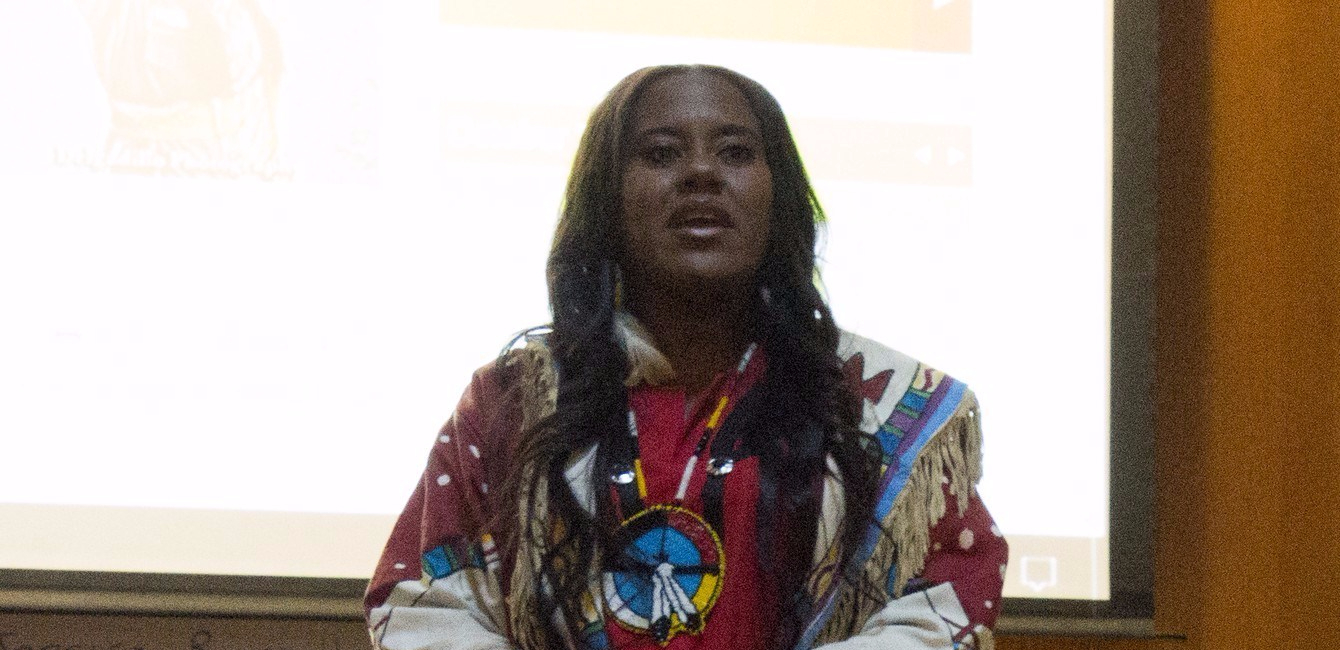
    Also on Thursday, a conversation with YoNasDa LoneWolf Hill was held in the Behavioral & Social Sciences building. Hill is a Lakota and African-American activist, speaker, and published writer of social and environmental justice issues. She was adopted and raised by Minister Louis Farrakhan, leader of the Nation of Islam.

    “The truth is coming out, and the truth hurts, everyone is looking at the truth. There is a separation of good and evil taking place at this time,” Hill said.

    “Women are at the heart of this movement, as mothers, we feel pain, we bear pain when we give birth,” Hill said. “Even if you’re not able to give birth, you still feel it in your blood. It’s all in everything that we are made of as women. In this way, we connect with and feel Mother Earth.”