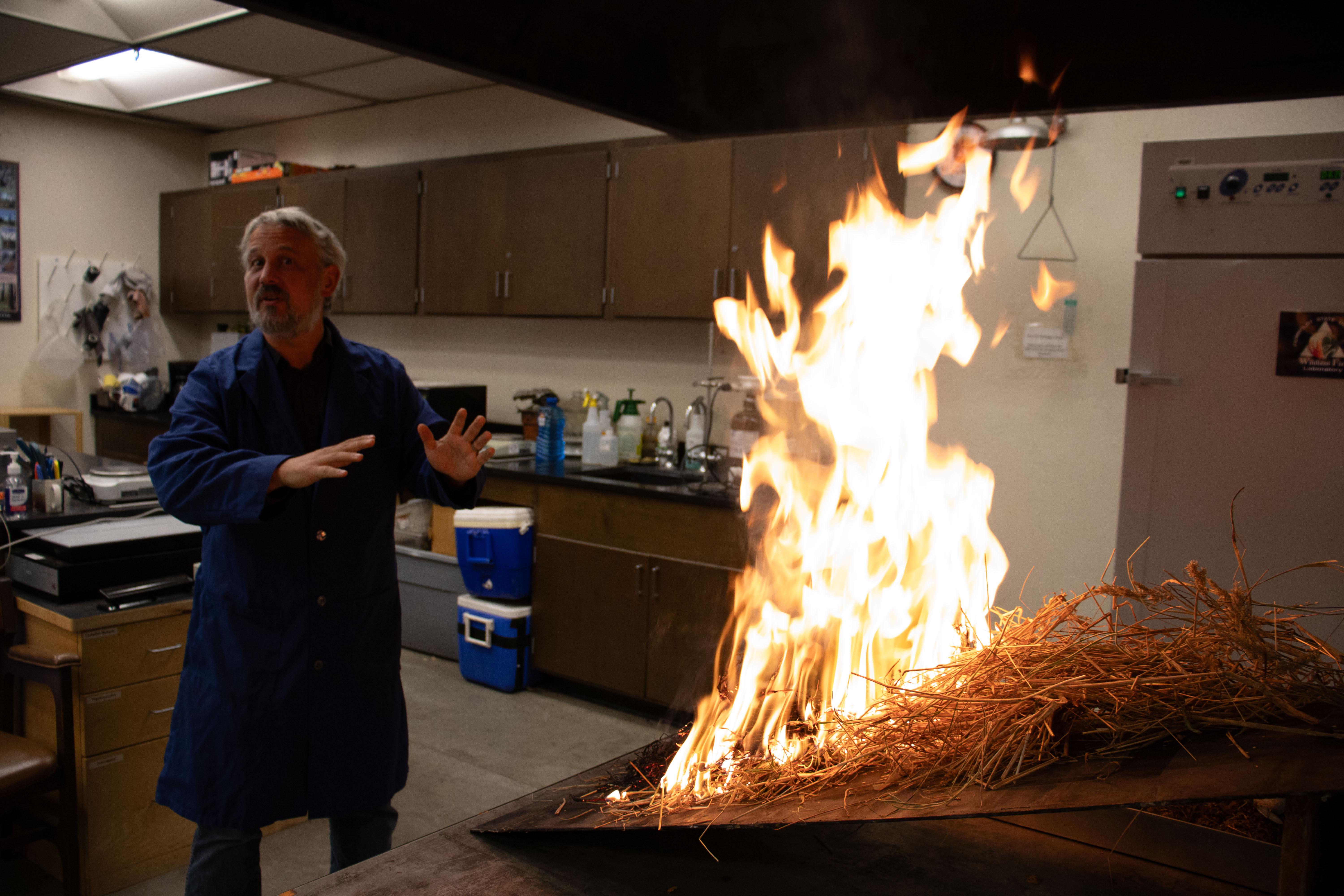
By: Griffin Mancuso and Emma Wilson
Anti-fire policies and climate change have resulted in wildfires running widespread in Northern California. Forests are in need of experts who can understand the power of fire and its beneficial effects, and channel them into sustainable practices. Cal Poly Humboldt’s polytechnic transformation has resulted in a new addition to the Forestry, Fire and Rangeland Department to meet this need: applied fire science and management, B.S.
The major explores multiple disciplines and perspectives of fire management, including local Indigenous knowledge and practices. Students will learn about prescribed burnings, how fire exclusion policies have impacted forests and how to use fire to promote biodiversity.
This major can lead to careers in fire ecology, fire departments, prescribed burning organizations and more. Students in fire science can also expect a plethora of summer jobs and internships to be available to them.
However, students who are applied fire science majors do not qualify to take the Registered Professional Forester exam in the state of California.
Erin Kelly has been the department chair of Cal Poly Humboldt’s Forestry Fire and Range Land Management since the start of the 2023 fall semester. She emphasized the high demand for foresters and fire ecologists in California.
“Employers are looking for natural resource managers, people who can apply their scientific knowledge to the ground and also people who can educate others about things like fire management,” Kelly said. “So, we are really in the position of meeting California’s needs in terms of land management, and I think that’s a really cool thing.”
Fundamentals of Fuel and Fire and Fire Ecology existed prior to the new fire science major, but Fire Behavior and Effects and Fire Weather have been made into their own classes this semester. Additionally, an applied fire internship class will be available.
Jeffery Kane is a faculty member in the forestry department and has been working as a professor at Cal Poly Humboldt for 12 years. He described the possible careers students can explore with the internship program.
“Most folks will work for the Forest Service, either fighting fires or doing prescribed burning fuels management stuff, or some will work for CalFire,” Kane said. “Others have worked for nonprofit organizations that are involved with fuels management or prescribed burning…it’s basically, ‘Go out, get experience.’”
David Greene, a professor who has researched plant regeneration for several decades, teaches the fire ecology class. Students in fire science classes can expect to go on field trips that allow for hands-on learning and explore the different aspects of the field. Students in Applied Fire Use and Policy will have the opportunity to participate in prescribed burnings.

“There’s lots of tribes around here that don’t have the capacity to run their own burn. Some like the Karuk and the Yurok can, but others like Bear River – they just don’t have anybody, so they’re often inviting us to go up and do one for them,” Greene said. “Jeff [Kane’s] happy to go do it because he wants the students to get as much training as possible, because California’s embarking on a prescribed burning campaign.”
Mykie Root, a freshman and forestry major with a concentration in wildland fire management, has enjoyed the practical learning approach and field trips in their fire science courses, compared to reading textbooks in high school.
“Coming out here and being able to go on these field trips and be able to actually, you know, get into the stuff and be hands on and actually be able to see the trees, you know, take the bark apart, be able to look at all of the rings individually and count them,” Root said. “It’s a lot easier to learn when you’re actually out in it than in a classroom, which is what I prefer. I don’t like being in a classroom. It makes me antsy.”
Recently, students in Fire Ecology visited the 2022 Six Rivers Forest fire site to document conifer germinates and pine cones in the area that had appeared since the fire. Grayson Voorhees, a freshman majoring in forestry with a minor in fire ecology, took on the task of climbing a steep slope to gather data.
“Initially we were trying to document the distance from the road to the first green tree to measure the density of the fire, like how far it spread uphill, and that was roughly 150 meters,” Voorhees said. “And that also spread along a transect line, and along the transect we were counting germinate gray pine species.”
Faculty and students in applied fire science are hoping to destigmatize fire, promote sustainable fire management practices, and combat anti-fire sentiments and policies.
Root explained how banning prescribed burns entirely allows for leaves to build up and ruin seed beds, resulting in deforestation.
“When fires come through and actively get rid of all the bad, dead leaves and things that just pile and pile up, leaving for, you know, plants to be able to grow,” Root said. “The fires will come through, burn everything and there’ll be wonderful plant beds for seeds to just be able to pop up and come back. So, fires are really good for us. They’re actually, they’re really good for the forests, and we need them.”