The Lumberjack


Students Serving The Cal Poly Humboldt Campus and Community Since 1929

Tag: november

  • Prop 27 explained

    by Tucker Caraway and Camille Delany

    Proposition 27, on the ballot this November, would legalize online and mobile sports betting outside tribal lands. Despite record spending on the campaigns for and against the proposition, widespread advertisements do not make this clear. 

    Yes on 27, funded by online gaming companies, claims that the proposition is primarily a “solution” to “California’s homelessness and mental health crises.” No on 27, funded by tribal organizations, counters those claims and asserts that the proposition puts more Californians at risk for gambling addiction and infringes on tribal sovereignty. 

    The Yes on 27 campaign ads vary widely in their messaging. “Vote yes on online sports betting, and protect tribal sovereignty, and help Californians that need help the most,” one video promoting Prop 27 states, a wide-ranging claim. 

    Cal Poly Humboldt political science professor Dr. Stephanie Burkhalter describes the Prop 27 ads as “very sophisticated.” She said that she has overheard students expressing confusion about their messaging. According to Burkhalter, “Their inclination is to support tribal sovereignty,” but the mixed messages from the advertisements don’t make it clear whether supporting or opposing the proposition is the best way to do so. 

    The situation is made more confusing for voters by the fact that there are two different initiatives on the ballot this November to legalize sports betting in California. Prop 26 would legalize sports betting only at tribal casinos and California’s four horse racetracks, and is less contentious than 27. Many tribes oppose or remain neutral on Prop 26, while Prop 27 is firmly opposed by the majority of tribes. 

    Burkhalter explained that if Prop 27 passes, not just any online gambling would be legal in California. For a company to offer online betting under Prop 27, it must pay $100 million for a license, and must partner with a tribe that holds a tribal-state gambling compact. 

    “Because [online gambling licenses] can only be offered through federally recognized tribes, the sponsors [of Prop 27] had to partner with certain tribes,” Burkhalter said. “So those tribes, while supportive, are a small minority of all the tribes in California.” 

    CPH Native American Studies (NAS) and Critical Race, Gender, & Sexualiy Studies (CRGS) professor Dr. Rain Marshall explained that each tribe has a different, confidential contract with the state of California for revenue profit sharing. If Prop 26 were to pass, it would require tribes to renegotiate these contracts, a long and arduous process that many mistrust. 

    “Negotiating a new contract is timely and costly,” Marshall said. “The tribes are probably like, ‘You know what, we’re good how we are, it took us forever to negotiate this contract with the state.’” 

    Additionally, the $100 million necessary to secure a license guarantees that the online gaming companies that will benefit from Prop 27’s passage are already large and well-funded, with many headquartered out-of-state. Prop 26 doesn’t involve the corporations that support Prop 27, which is a reason why it’s preferred by some, including certain tribes. 

    “By far Prop 26 would support native sovereignty because it doesn’t involve these corporate conglomerates,” Marshall said. But it has still failed to gain resounding support from tribes, with many still remaining neutral or saying “No” on 26.
  • Turkey Doomsday

    Turkey Doomsday

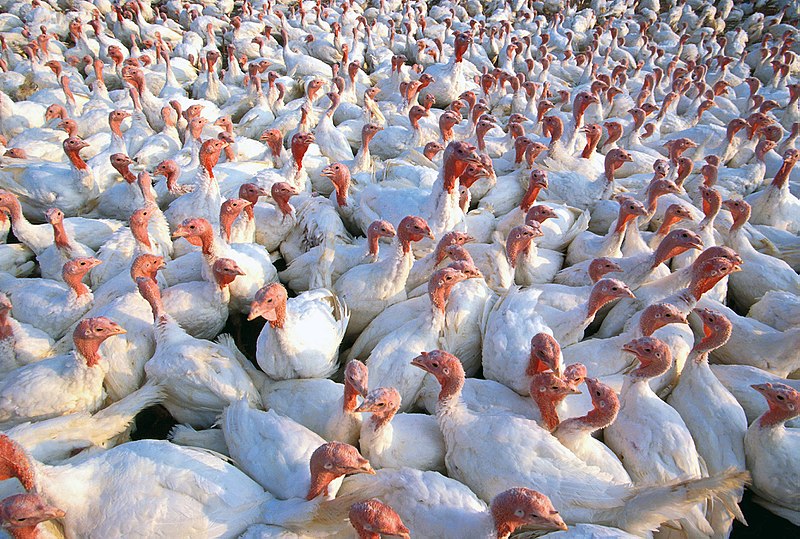
    Investigations have found that many large-scale poultry farms keep their birds intentionally overweight and injected with hormones

    Turkey Day is tomorrow, but people don’t always take the time to think about the farm to table process that leads to the birds ending up on our dinner plates.

    According to The American Society for the Prevention of Cruelty to Animals, “95% of farm animals in the U.S. are raised in factory farms,” with other sources, such as the Huffington Post, claiming numbers to be up to 99%.

    Factory farming has proven to be a profitable business, with the United States Department of Agriculture stating that there are approximately 2 million farms in operation.

    Poultry makes up a significant size of the income from animals, second only to calves and cattle.

    “Cash receipts for animals and animal products totaled 176.5 billion in 2018,” the USDA’s site says. “Cattle/calf receipts accounted for 38 percent of that total, while poultry/egg receipts accounted for 26 percent and dairy receipts 20 percent.”

    Some of the problems associated with factory farming include the health of the animals and their living arrangements.

    Investigations have found that many large-scale poultry farms keep their birds intentionally overweight and injected with hormones, only to be forced into tight cages until they are killed.

    “Due to selective breeding, commercial male turkeys rapidly grow to a weight 3 times larger than wild male turkeys in only 4 months,” Farm Sanctuary, an animal protections agency formed in 1986, states on their website. “Rapid growth and resulting heavy body weight can lead to heart problems and painful leg issues, which can eventually lead to crippling.”

    In 2017, The New York Times’ Editorial Board took a stand against factory-farmed poultry.

    “No animals raised on factory farms are kept and killed under worse conditions than turkeys and chickens, which make up most of the animals raised for food in the U.S.,” the editorial said. “Nearly 9 billion chickens are slaughtered each year for food. And because poultry is exempt from the federal Humane Methods of Slaughter Act, which the U.S. Department of Agriculture enforces, there are not even minimum federal standards governing how they live or die.”

    The Times continued their editorial, detailing how the “so-called broiler chickens” are genetically bred to grow fast, due to the demand for breast meat. According to the Times, these chickens grow so large that they can barely walk, suffering from painful skeletal disorders and deformities before they are killed.

    “The vast majority spend their short lives (about 47 days for chickens) in artificially lit, windowless, barren warehouse barns,” the editorial said. “So that turkeys won’t peck one another in these crowded barns, their beaks are painfully trimmed.”

    In Humboldt County, if you’re looking to avoid commercial, warehouse-raised poultry, one option is the Shakefork Community Farm. The farm raises small batches of turkeys every summer and fall.

    According to their site, Shakefork’s poultry is raised and slaughtered sustainably; raising their birds in open ranges as opposed to tight cages, believing in a more humane approach to raising animals.

    “We provide certified organic laying feed, but our hens provide for much of their own nutrition by foraging for seeds, bugs, and pasture,” the site says. “Our healthy and contented birds make for some of the best eating ever.”