The Lumberjack


Students Serving The Cal Poly Humboldt Campus and Community Since 1929

Tag: Parking shortage

  • Parking problems perpetuated by parking pass sales

    Parking problems perpetuated by parking pass sales

    by Nina Hufman and Cash Rion

    Every day, Cal Poly Humboldt students drive through full parking lots past rows and rows of parked cars as they desperately and often fruitlessly search for the rare and elusive open parking spot. This is the result of the university selling an excess of both general and residential parking passes in tandem with an increase in students due to the school’s new polytechnic status. There are more active passes than there are permitted parking spaces on campus, with active passes including both semester and year-long parking passes.

    “I’ve heard from a lot of students that don’t live on campus that it can be hard to find parking unless you get here really early,” said Evan Vieira, a wildlife and conservation major. “I’ve known students who have gotten here only as late as 9 or 10 am and have not found parking.”  

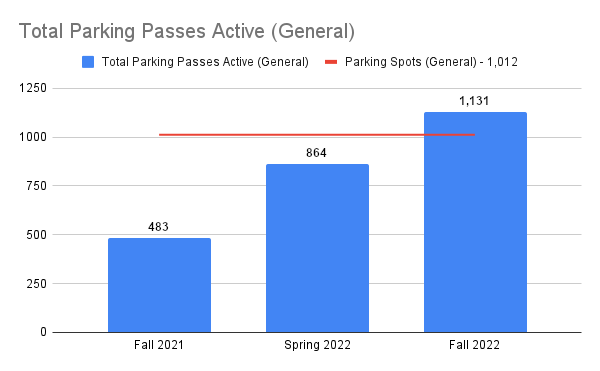
    A public records request revealed that, this semester, Cal Poly Humboldt oversold parking passes for both general and residential parking. As shown in the graphs, overselling parking is a growing trend across semesters, with 119 more general passes sold than there were parking spots, and 431 excess residential passes.

    “It sucks total ass,” said art education major Mikayla Nicholas. “I don’t personally drive but I have friends who do and it takes them at least 20-40 minutes [to find parking.] They sell way too many parking passes than they have spaces.” 

    The number of general parking passes sold has increased from last year. The number of active general parking passes increased by 79% from fall 2021 to spring 2022. The number of active general parking passes for fall 2022 has more than doubled since fall 2021, but the number of general parking spaces has remained the same. 

    Total active residential parking passes

    Meanwhile, sales of residential parking permits have stayed relatively consistent, being oversold each semester. In fall 2021 and fall 2022, 431 more passes were sold than there were spots for, and in spring 2021 the number rose to 579 oversold. Anyone with a residential permit that cannot find a space in resident-specific lots overflows into general parking lots. This further contributes to the lack of general parking.

    “I think it’s alright most of the time if you live on campus,” Vieira said. “I live in campus apartments so my car doesn’t move that often, so I’m typically in a parking spot.”

    While those who live on campus can generally find parking, students who drive to campus are becoming increasingly upset at the lack of available parking.

    “Horrible, absolutely horrible,” said Harrison McDonald, a wildlife management and conservation major. “Since I have an 8 am, I get pretty lucky, but when I don’t, it takes me anywhere from 10 to sometimes even 40 minutes if I can even find parking.”

    Many students are frustrated that they pay for general parking passes, only to have to pay for metered parking or to be unable to park on campus.

    “Humboldt for the year, you pay over 300 dollars for [a parking pass] and you’re not guaranteed a spot and you still have to pay for parking meters,” McDonald said. 

    Other students are frustrated by the message that they feel overselling parking passes sends. The university profits from parking pass sales, but has nowhere to put the extra vehicles. 

    “I did not know that [parking was oversold],” Vieira said. “I feel like that’s not great because then you’re kind of saying to a lot of students, ‘you can all park here,’ but then not actually having the spaces to give them parking.”
  • Parking Pain Persists

    Parking Pain Persists

    For me, the start of the spring semester means the return of the eternal struggle to find a parking space. Many Cal Poly Humboldt students, both on and off campus, are finding it difficult to find a parking space. Even those of us who usually walk to campus are impacted by a lack of parking.

    The parking situation on and around campus is absolutely abysmal. Campus parking permits and metered parking are expensive and purchasing a campus permit does not guarantee that you will find an open parking space. $157 a semester is a lot of money to pay to not be guaranteed a spot to park. I know students who live on campus who can’t even park outside of their own dorms. I’ve talked to commuter students who have to move their cars multiple times a day to avoid being ticketed.

    You would think that living in an off campus house within a short walking distance of the school would resolve any parking issues. However, parking is still a huge problem for my roommates and I. One side of our street is 4-hour parking from 7 am to 5 pm, intended for students to be able to park off campus and walk if they don’t have a campus parking permit or if campus parking is full. The other side of the street is reserved for vehicles with residential parking permits. I have four roommates and we all have cars. That’s five vehicles that we have to try and fit in our parking zone, which we also share with our neighbors.

    Photo by Nina Hufman | The parking zone in an off campus neighborhood in Arcata, California.

    We can usually fit four of our cars in front of our house if we park as close to the edges of the residential zone as possible. Because my neighborhood is so close to campus, there are usually several student vehicles parked in the 4-hour zone. I often come home to find that our residential parking is full. I am then forced to parallel park, very poorly might I add, across the street from my house.

    Parking, specifically parking enforcement, is something my roommates and I commiserate about almost daily. We sit in our kitchen, talking about how much we hate the guy who enforces parking on our street. He’s a jerk, he takes his job way too seriously, and I honestly think he has it out for my brother. It feels like he targets our street, and my brother’s car specifically.

    He literally stopped my brother in the street to ask him which car was his and tell him that it’s illegal to remove chalk from the tires of your car. He kept moving his little, three-wheeled car in front of my brother to prevent him from walking away. During this interaction, he was in the way of one of my other roommates who was trying to park. Imagine being a middle aged man having beef with a 21-year-old who’s just trying to park in front of his house. That feels like an inappropriate interaction to have with an “authority” figure. As a college student who is just trying to get an education, the last thing on my mind is fighting with parking enforcement.

    I can’t help but think, if I’m fed up with the parking situation, it must be absolutely enraging to have purchased a campus parking permit, but never be able to park. It’s not the students’ fault that they’re parking in my neighborhood. To be honest, it’s a very convenient distance from campus, especially if you can’t park any closer. The real problem is that campus parking is so scarce.

    Cal Poly Humboldt students pay a lot of money for parking to only be able to park on campus sometimes. The issue doesn’t only impact the campus. Student vehicles overflow into the surrounding neighborhoods, creating a lack of parking for everyone who lives nearby.

  • No Parking, No Progress

    No Parking, No Progress

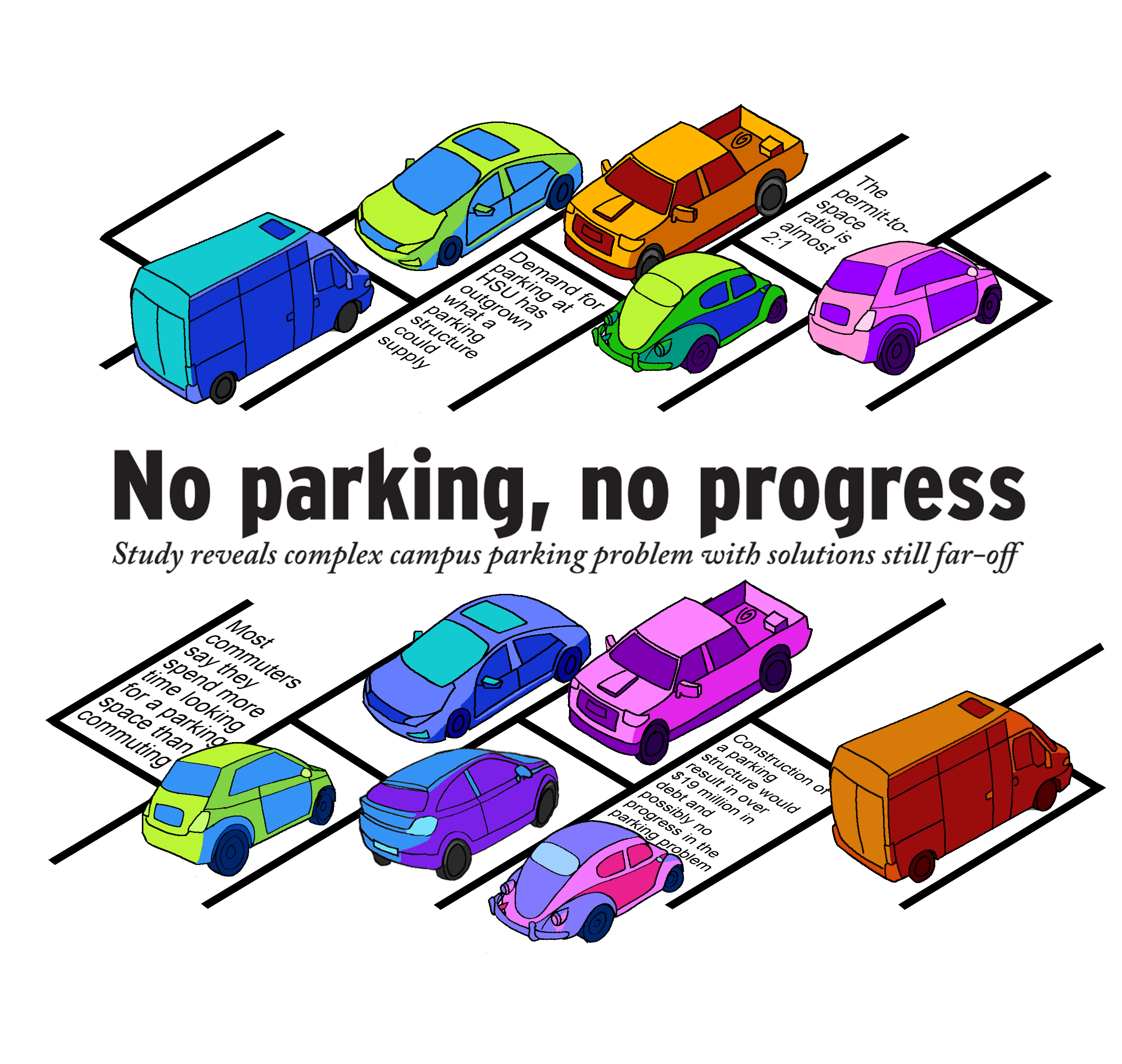
    Study reveals complex campus parking problem with solutions still far-off

    In 2017, Humboldt State University commissioned a parking market demand study which found exactly what commuters knew—there is a problem with parking on campus.

    HSU has a total of 2,162 spaces, about 1,000 of which are general parking. These spaces are shared among more than 9,000 students, staff, faculty, visitors and administrators. The study found solving the parking problem might be harder than adding more spaces. Terrain is challenging, space is limited and HSU has a finite budget.

    Film student Alice Peterson had a panic attack the first time she had to park on campus.

    “It was raining really hard, I was late to class, it was the second or third week, there were no spaces and there was a lot of over-stimulation,” Peterson said. “My fight or flight kind of kicked in and I left.”

    Peterson has needed to drive to class more and more ever since. A load of heavy, expensive film equipment makes walking every day impossible. During her time at HSU, she has racked up almost $500 in parking violations because she is forced to park illegally or in spaces meant for visitors.

    David Lieb is the national director of higher education mobility planning at Walker Consultants, the parking consultant firm that HSU contracted to conduct the market demand study. Lieb worked on the study personally and said that although universities are a group of people sharing a common parking problem, HSU faces some unique issues.

    “You have a challenging topography,” Lieb said. “Everybody wants to park in a space that’s convenient to where they go, but there’s a limit to the number of spaces.”

    There is barely any room on or near campus to add a significant amount of spaces, which is why many students are advocating for a parking structure. But Lieb did not recommend a structure.

    “The shortage at this point is such that we don’t believe it would solve the problem,” Lieb said. “The survey suggested that there was more demand out there, but people were saying, ‘Why would I buy a permit if I’m not going to get a space?’ So if you increased the number of spaces, the people who are currently saying, ‘I’m not going to buy one,’ are going to buy one.”

    This process means the parking situation would remain the same if a structure was built, but the parking prices would have to increase to pay for the construction.

    “By what we calculated, parking prices would at least double or possibly triple,” Lieb said. “Our company provides design services for parking structures. We would be delighted to design a parking structure for you, but we’re not going to recommend it if we don’t think it’s the right solution.”

    Alternative transportation and ride share programs are already available through HSU.

    Jeanne Rynne, the associate vice president of Facilities Management, and Krista Paddock, HSU’s Parking and Commuter Services program coordinator, are working together to alleviate parking demand. All plans are in preliminary stages of development, but the long-term goal is to limit the number of cars that are brought to campus instead of adding more parking spaces.

    “We are looking at potential park-and-ride lots in the area,” Paddock said.

    There are parking lots in Eureka and McKinleyville that stand nearly empty during HSU’s busiest times. Those lots could be used as off-campus parking. HSU could then provide buses to and from the designated lots to limit the number of cars coming to campus daily.

    “We’re always trying to promote ride share with the Zip Cars and the Zagster bikes and the Jack Pass program,” Rynne said.

    Alternative transportation and ride share programs are already available through HSU. Both Paddock and Rynne said there are no concrete solutions on the table yet. For the time being, they plan on heavily marketing the programs that already exist.

    “We’re always open to feedback,” Rynne said. “We have the Parking and Transportation Committee and there’s two student vacancies.”

    Rynne, Paddock and Lieb all agree that parking is an incredibly emotional issue. Finding a space can take a long time. The study noted many commuters take longer to find a space than to travel to and from HSU, and HSU’s lots fill to 100% capacity during peak hours.

    Parking is stressful in a special way. No one studying or working at HSU needs additional stress, but money and topography appear to be blocking all the solutions.