By Dezmond Remington
The sun is setting and people are hollering.
There’s a group of about 20 students parked outside of the Reese Bullen Gallery screaming their best chants at the university administrators and jet-setting donors who are supposedly inside. None of the protestors have seen them in the hours they’ve been there, and the windows are covered in cardboard anyway.
At the top of 12 stone stairs facing the buildings opposite stand a few people with a megaphone speaking to those down below — and across the quad, and across the street, too. Their megaphone is crackly, but effective.
“All he cares about is getting more students and then fucking them over by making us pay more tuition and more in housing!” Mary Mangubat said, clad in a blue surgical mask and an undone black zip-up hoodie. The protestors nod, as does student Richard Toledo, who is holding the megaphone for her.
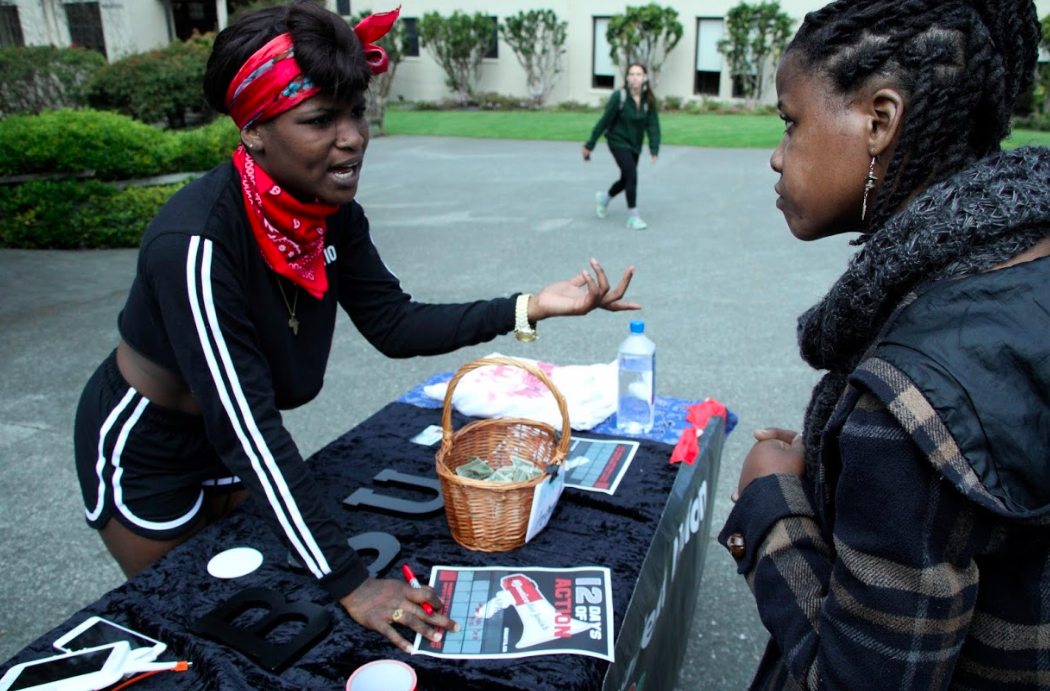
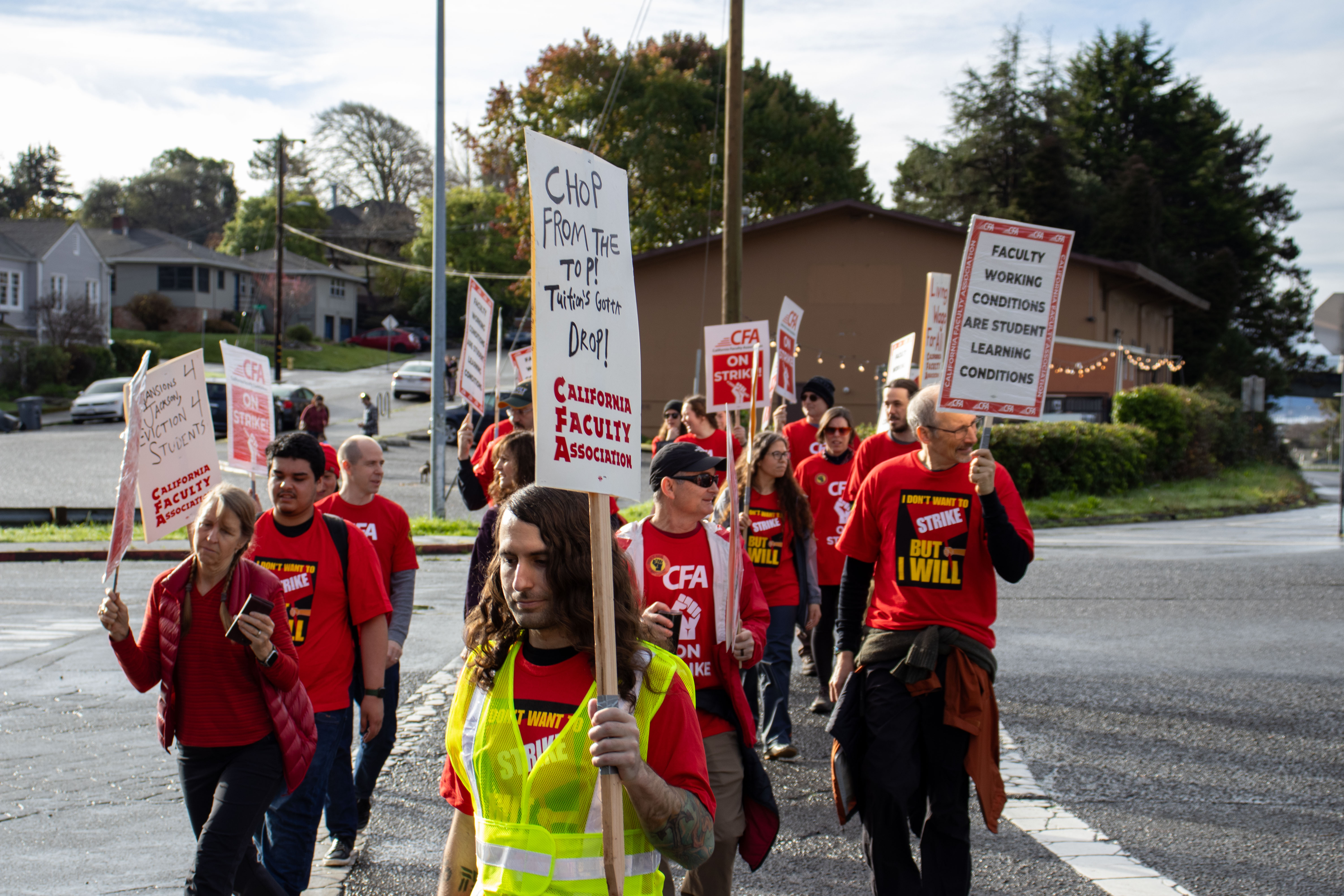
Mangubat and Toledo are constant presences at protests in and around campus. They’ve supported everything from Palestinians in Gaza to professors striking this semester. Mangubat even got a protest in her honor when the megaphone usage and other violations of the university’s Time, Place, and Manner restrictions on free speech at the Reese Bullen Gallery on Jan. 23 got her and Toledo yanked into a meeting with Dean of Students Mitch Mitchell and handed a “deferred probation”— in other words, a slap on the wrist. The next time one of them breaks the rules, they may face measures such as expulsion. As it was, they had to write a reflection essay on how to be a better organizer.

Though many of the things people see Mangubat and Toledo do are similar, such as leading protests and showing up to meetings, how they approach those actions contrast heavily.
Mangubat, 20, started protesting when she was attending high school in San Francisco’s SoMa district, where she said there were issues with things like outdoors accessibility. Mangubat, a Filipina, said she had an early awareness of concepts like intersectionality when she noticed the other students working to raise awareness of those issues were richer and went to private schools.
She occupies many roles on campus. She’s the environmental educator at the Women’s Resource Center. She interns for the Student for Quality Education chapter at Cal Poly Humboldt. She works for the Environmental Science and Management department on their Justice Equity Diversity Inclusion committee. All of these titles add up, but at the end of it, Mangubat sees herself as a coordinator, setting people up with resources they need.
Toledo, 32, defines his role on campus similarly. However, the route he took to get to Humboldt was vastly different than Mangubat’s.
He developed an early sense of the unfairness in the world after watching his mom struggle to afford to house them while he was growing up. When Toledo was 18, he tore his ACL skateboarding a few days after his insurance provider dropped him and got thousands of dollars worth of debt when he couldn’t afford to pay it all. He hopes others can avoid that fate.
“I find purpose in anything that I can tell is making a difference of some kind,” Toledo said. “That’s why I want to work in restoration science as well. I think that being on the ground and watching those seeds literally grow – not even just metaphorically, but watching the seeds that I’ve planted grow, the things that I’ve done, develop. That makes me happy. Seeing an actual difference from my actions is something I really enjoy.”
Now in his third semester at Humboldt, Toledo is in his second go-round through a university. He got a multimedia production degree from CSU Northridge in 2020, but after a few years of working as a web developer, he decided to quit and get a degree in environmental studies.
“It turned out that I was pretty good at coding and there was a lot of money in it,” Toledo said. “So, I just kind of fell into it, and I ended up despising it. Something about just how tedious the work was, and seeing the news everyday, and watching what was happening outside of my bubble at work, and wanting to do something about it as well and not just be sitting behind the computer. After a certain point, you see enough climate headlines that the pay doesn’t really matter anymore, and you just want to do something good.”
Toledo, a self-described “de-colonial Marxist,” is deeply into studying leftist theory, and idolizes people such as Marxist revolutionary Thomas Sankara and Black Panther Fred Hampton. He’s currently working on organizing a chapter of the Students for a Democratic Society. His earliest memory at a protest was during the Occupy protests back in 2012, when he was 20 years old. Toledo met everyone from garden-variety Democratic Socialists, to anarchists, to socialists to full-blooded commies. The experience left a large impact on him. Now, he has too many books to store them all on the dorm bookshelves and leaves them in piles on his floor.
Mangubat’s style tends to be more accessible, not founded on turgid leftist musings or obscure revolutionaries. Though these self-appointed guardians of campus operate on distinct levels, what does make them come to the forefront of every anti-something shindig on campus is a love of disruption.
It’s what Toledo and Mangubat use to explain college students protesting events happening both half the globe away and close to home. Student activists get a lot of flak from the general student body because of the perceived irrelevance and disconnect from Arcata to places like Gaza or Washington D.C. They argue that that’s part of the point.
“The only avenue that people have is disruption,” Toledo said. “And if you disrupt as many things as possible, even if they may not be wholly related, it’s going to cause more problems for the people at the top. They’re going to take notice of that. If you have whole businesses shut down, if you have schools that are shut down on certain days, if you have more and more people that are sympathetic to the cause and getting out there in the streets, making noise and demanding things on the local level, that reaches up to the top. They realize that and they start to change their narrative, and they might even start to change things.”
Both Mangubat and Toledo feel the Time, Place, and Manner (TPM) restrictions they violated are excessive and defeat the point of protesting and organizing. One of the TPM restrictions requires organizers to make it clear to administration when and where they plan to protest, a rule Mangubat hates.
“The rule of protesting is that you’re disrupting systems,” Mangubat said. “You’re disrupting the place and the people who are oppressing you, so it’s not productive or efficient to just be like ‘Hey, here’s everything I’m doing,’ and then, admin will be like, ‘OK, now we know what they’re saying…’ They have every step to prepare to cover their own asses if they had to.”
Both Toledo and Mangubat do not have mixed feelings when it comes to Cal Poly Humboldt’s administration, which they characterize as aloof from campus and not held accountable often enough for things like last semester’s eviction of the van lifers. At the Jan. 23 protest, Dean of Students Mitch Mitchell called the university police department on them — something campus employees are supposed to do when there’s a protest on campus. It wasn’t a move that went over well with the students that were there, especially after he talked to some of the protestors there in a way many of them thought was overly confrontational. Mitchell left when protestors booed him and chanted the word “Shame” at him over and over again. Mangubat feels that outburst was reasonable because of his position as an administrator.
“From my perspective, I think it’s justified because every step that they had taken since my disciplinary notice to the students trying to put on this protest, they had been escalating everything …” Mangubat said. “So, I think in some way, it was needed for admin to see what students are capable of doing. Not in a harmful way, but in a human way, like a human response type of way … it’s a complicated situation because, you know, at the end of the day, people are human, they have feelings, but your hierarchy stands out so much more. And you’re acting in that position.”
“I’m proud of what we set out to try to do to try to get the attention of Tom Jackson,” Toledo said. “I’m not proud of exactly how it turned out.”