The Lumberjack


Students Serving The Cal Poly Humboldt Campus and Community Since 1929

Tag: Piano

  • Final Fantasy Music Rendition Fills Fulkerson

    Final Fantasy Music Rendition Fills Fulkerson

    Pianist Ryan McGaughey performs fan-favorite tunes from Final Fantasy VII

    In the intimate waiting area of Fulkerson Recital Hall, long-time fans of the Final Fantasy games and their parents or children milled around Feb. 21 waiting to hear piano renditions of the iconic music of “Final Fantasy VII” performed by pianist Ryan McGaughey. The game’s original music was written by Nobuo Uematsu, but the particular arrangements for piano were written by Shiro Hamaguchi.

    Mark Castro, an archaeologist for the Cultural Research Center at Humboldt State University, made a habit of attending orchestral concerts at Sonoma State University while he was working on his master’s degree. Castro said he hadn’t played Final Fantasy VII since high school, but he was excited to go to the concert and reminisce on forgotten songs.

    “Those are always the ones I gravitate towards,” Castro said. “The ones with a story.”

    Ushers collected raffle tickets for a giveaway of the new Final Fantasy VII remake set to come out in April. As everyone found their seats, the lights dimmed and silence fell upon the room like a blanket.

    “It’s like watching a really good film or reading a really good book, but you’re actually able to interact in it.”

    Ryan McGaughey

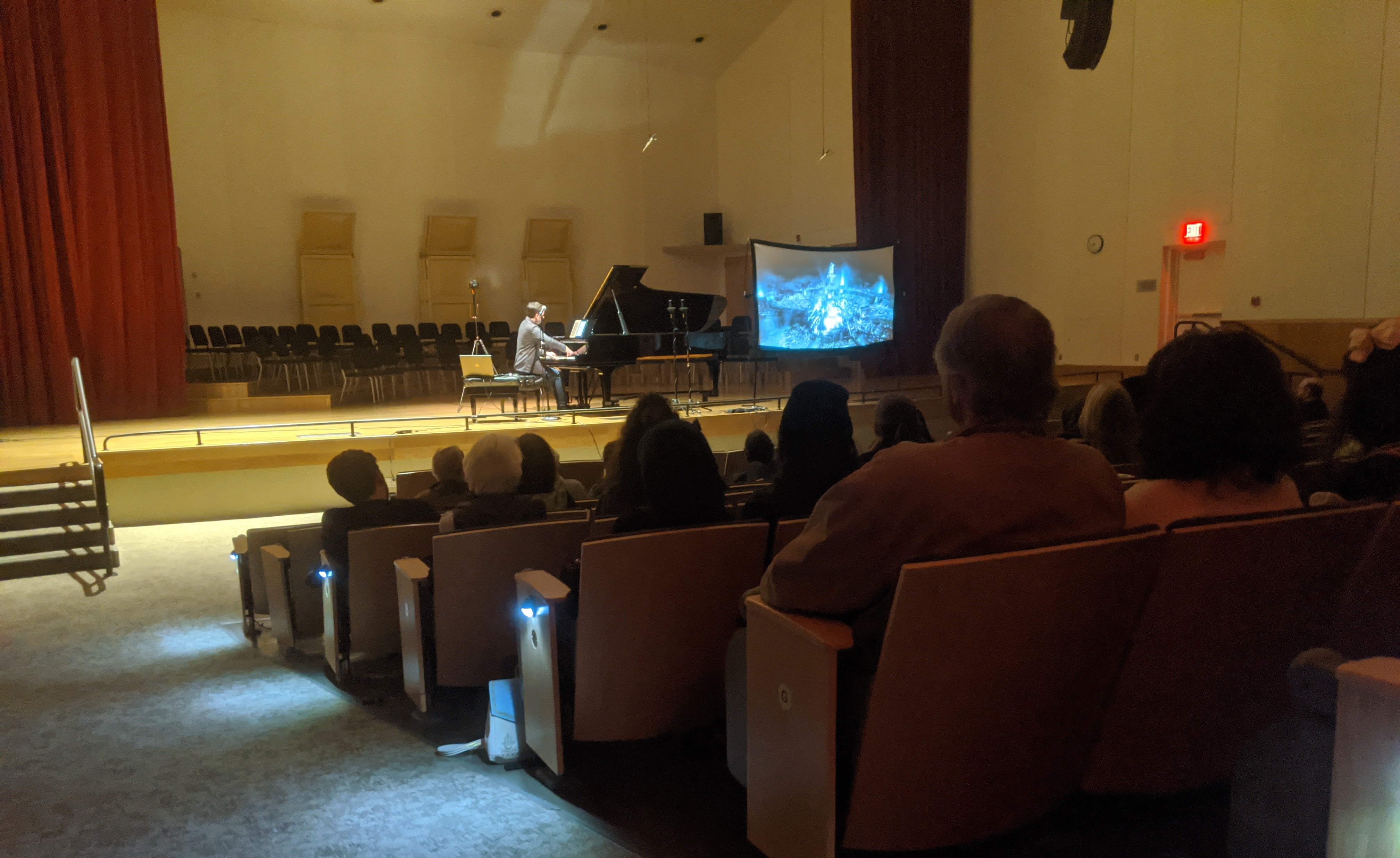
    McGaughey took the stage and dove into the familiar runs of “Prelude,” a song that begins almost every Final Fantasy game. A projector screen beside his piano ran through a compilation of footage from the Final Fantasy games as well as the 2005 animated movie.

    The projector depicted a depressing, industrialized world with pollution and machinery as the piano fluttered along with the hopeful brightness of “Prelude.” “Main Theme” was a more intense, swelling piece accented by intense battle sequences between vigilantes and armed guards of this alternative future city.

    In between songs, McGaughey took to the microphone with a charming, slight stutter, thanking everyone for coming out to see him perform. Using an online survey he created and his own powerpoint slides, he had audience members participate in a contest that mirrored the game’s turn-based combat system.

    McGaughey brought the event to a close with a fan-favorite, “One Winged Angel,” a song accompanied by a battle with the main antagonist played at the end of Final Fantasy VII. It is a technical, epic and anxiety-inducing battle march with twinkling runs interspersed throughout.

    In an exclusive interview with The Lumberjack, McGaughey talked about why he enjoys playing video games and their music.

    “It’s like watching a really good film or reading a really good book, but you’re actually able to interact in it,” McGaughey said.

    Before he left the stage, McGaughey picked out a winner of the raffle for the Final Fantasy VII remake.

    Psalms Palmer, a music major at HSU and longtime fan of the Final Fantasy games, won. She remembered loving the music from the moment she heard it. Throughout the performance, Palmer reflected on playing the game with her sisters when she was a kid.

    “If you can tell the story through music,” Palmer said, “you don’t have to do anything else.”
  • Polish Professor Melds Magic and Music

    Polish Professor Melds Magic and Music

    A dream of illusions and piano prowess with Igor Lapinski

    I know a little about magic. And by the end of Polish pianist and magician Igor Lapinski’s Feb. 22 show, I knew I had witnessed something good.

    “Your free will,” Lapinski said in an almost-cliché line that sounded much more convincing with his Polish accent and navy suit, “is just an illusion. A dream.”

    He then pulled a signed dollar bill out of an unopened kiwi.

    Lapinski interlaced illusions with piano pieces by Frédéric François Chopin, the Polish composer. Lapinski, originally from Poland, teaches as an assistant music professor at the University of Oklahoma.

    “He’s going to do something I think we haven’t seen in Humboldt,” music Professor Daniela Mineva and former teacher of Lapinski said before he took the stage. “I’ve been waiting 18 years to bring him here.”

    Hands, he said, are capable of both the sublime and the violent.

    The crowd of mostly older locals sat in a semicircle on the Fulkerson Recital Hall stage around Lapinski and his piano. Rather than have the crowd sit in the hall seats, Lapinski had chairs arranged around him for an intimate experience.

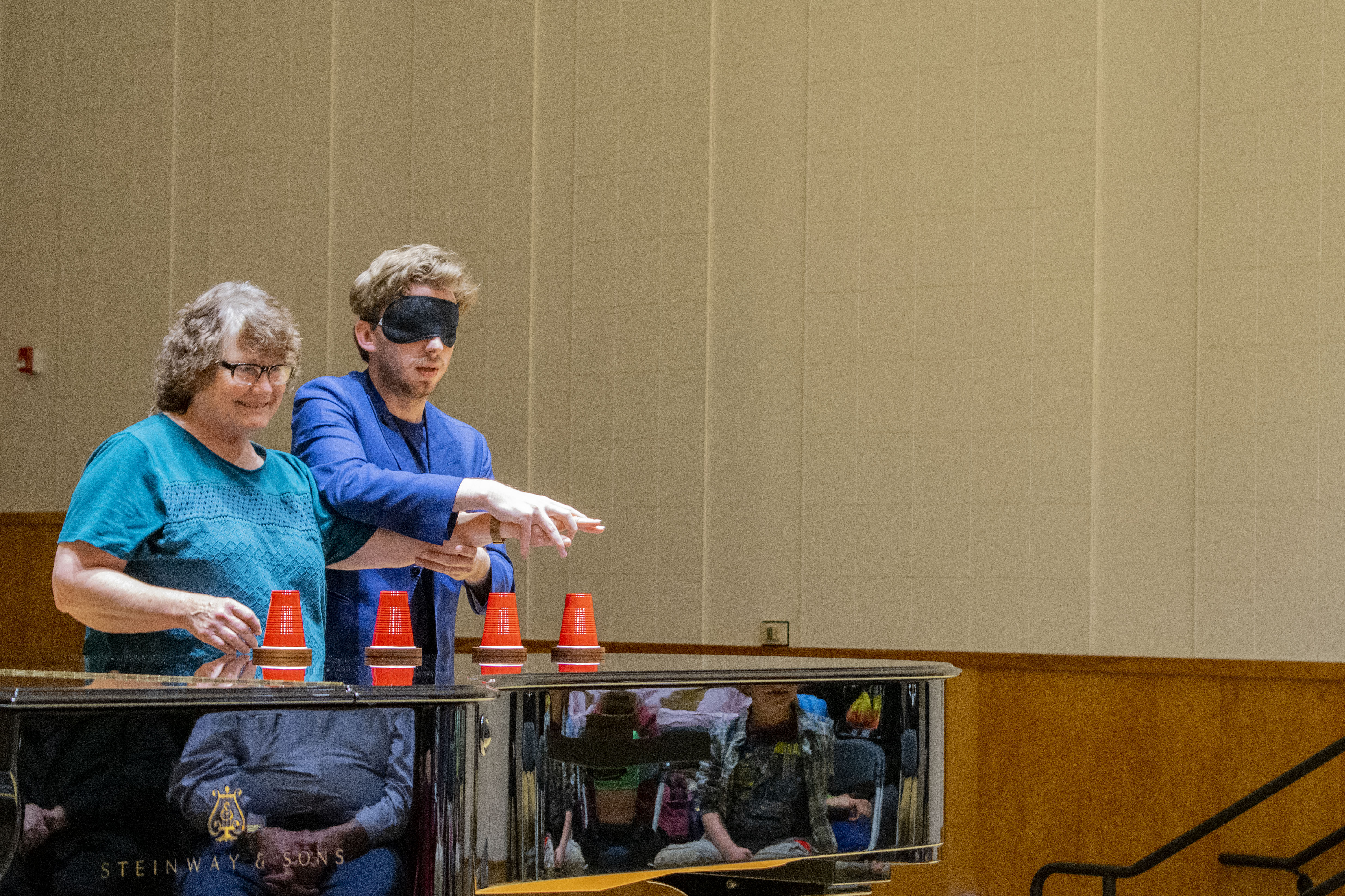
    Lapinski fluctuated between musical pieces of chaos and pieces of order. He rapped on “a haunting desire to belong.” In a three card monte-style routine with red solo cups and a single metal spike, he noted the opposing potentials within people.

    Hands, he said, are capable of both the sublime and the violent.

    He then shrugged off the thought and smashed his and an audience member’s hands down onto the cups in a game of Russian roulette.

    Multiple effects relied on the appearance and disappearance of letters—mostly written by Lapinski, with one supposedly written by his mother. The letters framed the performance in the idea of belonging, as Lapinski brought the audience along on an imaginary plane ride and read letters from home.

    I have to confess, because I know a bit about magic, I’m not a good judge of it. I spent about two of my teenage years learning magic tricks. I know the basics, and I can recognize standard sleight-of-hand moves.

    I’m no longer what magicians call a layperson. Even when I don’t know exactly how a trick is performed, it’s conceivable. It’s rare for me to see something inexplicable. But it does happen.

    Any attendee of Lapinski’s show can expect to exit with a smile on their face, or at least, a warm feeling in their mind. I can deduce how Lapinski performed his effects—but several of them I can only grasp loosely. For a layperson, his performance may be miraculous, not just puzzling.

    Magicians ultimately seek to produce miracles. The central argument of “Designing Miracles,” a well-regarded book by magician Darwin Ortiz, is that a magician should seek to produce an effect that doesn’t make the audience ask, “How do they do it?” Instead, the goal is, “How is that possible?”

    It’s slight, but this marks the difference between a trick and a miracle. A trick is a matter of deception that can be explained by a magician’s actions. A miracle is just that: pure magic that a magician merely facilitated. In the ideal, the performance transcends trickery and becomes magic.

    In the moments after Lapinski’s show, the audience agreed on his excellence.

    “He’s totally amazing,” a woman behind me said.

    “He’s a delight,” Mineva, the professor, said.

    “He’s hilarious,” a man beside me said. “He’s great.”

    At the very least, you can escape into a dream for just over 60 minutes. Lapinski finished with one last letter and one last piece by Chopin.

    “And so with this piece,” he said, “I wish you all a good night.”

    The night, indeed, was good.

  • The man behind the music

    The man behind the music

    Football and classical romantic music, an unlikely pair of passions

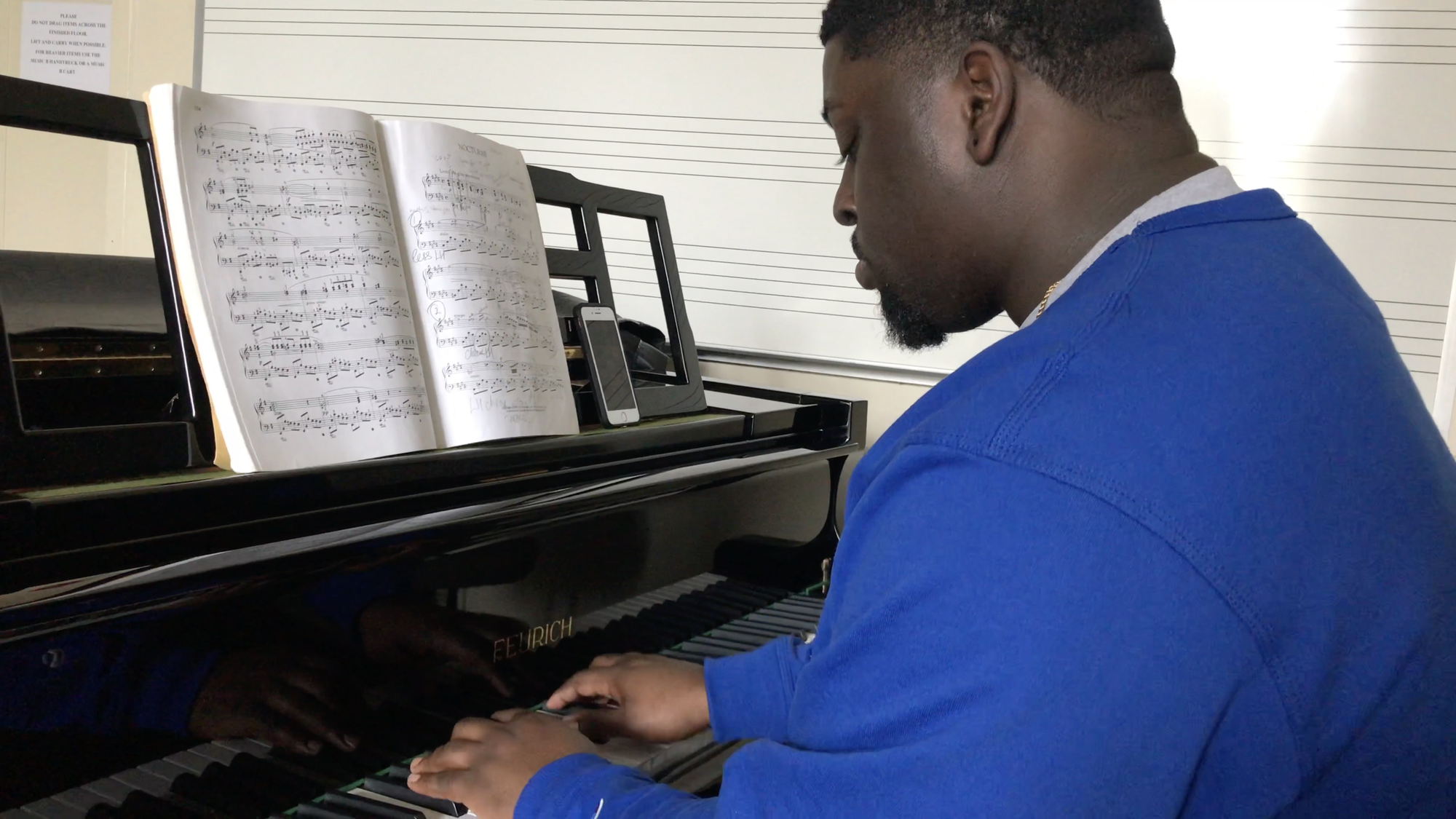
    Born into a family of musical influence, Job René, grew up touring the country with his dad’s reggae band, Phase 2. Continuing the family’s musical legacy, René plays both the piano, and cello skillfully as well as pursuing a music major at HSU.

    “Music has been a part of me since childhood,” René said. “I started piano when I was six or seven and my dad’s a musician. He kind of said you’re playing music, I don’t care what you say, you’re playing.”

    René continued playing the piano up until high school, deciding a break was best for himself.

    “That’s when I said, I’m done with the piano for now,” René said. “I want to play sports, I want to do high school things.”

    After quitting music, René played basketball and a year of football. With a lack of funding, the football program closed and René was pulled back into the world of music, where he decided this time he would learn a new instrument.

    “I always wanted to continue to play music, that never went away,” René said. “What jump started it was in high school, around 10th grade I started playing the cello. A music program came to the school and I thought, I have to get back on this, this is a calling. I told myself I’m doing this and I’m learning a new instrument.”

    Even though René went back to music and started learning a new instrument, he felt discouraged to pursue music as a major.

    “There’s no money in music, I was set on broadening my horizons,” René said. “I did settle for a minor in piano because I knew I had to do something with music.”

    René explored departments and opportunities outside of music to see what else he was interested in.

    “I was undeclared for a good two and a half years,” René said. “At the end of that semester I changed my major to music and started that spring.”

    René decided to embrace the musical aspect of his life and pursue it as a career.

    “I am very happy with my music major,” René said. “I mainly play classical music, it’s what I was brought up on since I was seven. It’s really what I lean towards and I actually like it!”

    René takes pride in his passion for romantic classical music, having dealt with judgements and push back over his preferred music choice in the past.

    [perfectpullquote align=”right” bordertop=”false” cite=”Job René” link=”” color=”” class=”” size=”16″]“My mom is my biggest supporter. She was really proud I was learning piano… It was the fact that she could see a future in it.”[/perfectpullquote]

    “Me being a black person, I get it all the time,” René said. “Like, bruh, why are you listening to classical music? “I connect with it, it was destined for me to like [classical music].”

    Regardless of the judgement, René continues. He said his biggest supporter keeps him motivated.

    “My mom is my biggest supporter,” René said. “She was really proud I was learning piano. I was doing something that a lot of other kids weren’t really doing. It was the fact that she could see a future in it.”

    Mae René, lives 13 hours south of her son in Los Angeles, but still takes time off work and drives to see every recital.

    “I try to be a supportive parent in the audience,” Mae René said. “To me, it’s not a 13 hour drive, it’s me seeing my child.”

    Mae René has trusted her son’s music abilities since a young age and saw a future for him in it early.

    “He picked up music right away,” Mae René said. “To be honest, I wanted him to be a music major from the beginning but I allowed him to step out, and now he knows, mom knows best!”

    Mae René isn’t the only supporter in the audience, fellow Brothers United members also strive to support René.

    IMG_0476.jpg
    Brandin Thomas (left) and Ronald Taylor (right) stand in front of Brothers United table in the HSU quad. | Photo by Grace Caswell

    Ronald Taylor, a third year kinesiology major, and fellow member of BU, described his first experience watching René perform.

    “I went to one recital at the end of last year,” Taylor said. “It was really nice, he did well, no mess ups.”

    Bradin Thomas, a fourth year kinesiology major and member of BU, is a fan of René’s romantic classical music interest.

    “It’s nice,” Thomas said. “I like his music, it soothes you.”

    With support from friends and family, René embraces his musical interest more seriously, and is considering sharing his interest with young kids.

    [perfectpullquote align=”left” bordertop=”false” cite=”Job René” link=”” color=”” class=”” size=”19″]”If I have to stop music, it’d be like taking a piece of my soul.”[/perfectpullquote]

    “Right now, I’m taking a pedagogy class that teaches you how to start your own business,” René said. “Like how to start your piano studio and teach students how to play piano.”

    Wanting to share his musical interest, René emphasizes the impact music has had on his life.

    “If I have to stop music, it’d be like taking a piece of my soul,” René said.