The Lumberjack


Students Serving The Cal Poly Humboldt Campus and Community Since 1929

Tag: pigs

  • CCAT Poised to Pig Out

    CCAT Poised to Pig Out

    CCAT plans to keep pigs on campus to reduce food waste

    Humboldt State University’s Campus Center for Appropriate Technology plans to house two pigs on campus as soon as next week.

    CCAT will loan the pigs from the Tule Fog Farm in Arcata for the duration of the fall semester. CCAT plans to feed the pigs food waste from HSU’s J dining hall.

    Jacob Gellatly, environmental resources engineering major and former CCAT Co-Director, helped lead the project from concept to reality.

    “We want to show how animals can be raised in a residential environment, and how you can use urban byproducts such as food waste to raise animals in an urban setting,” Gellatly said.

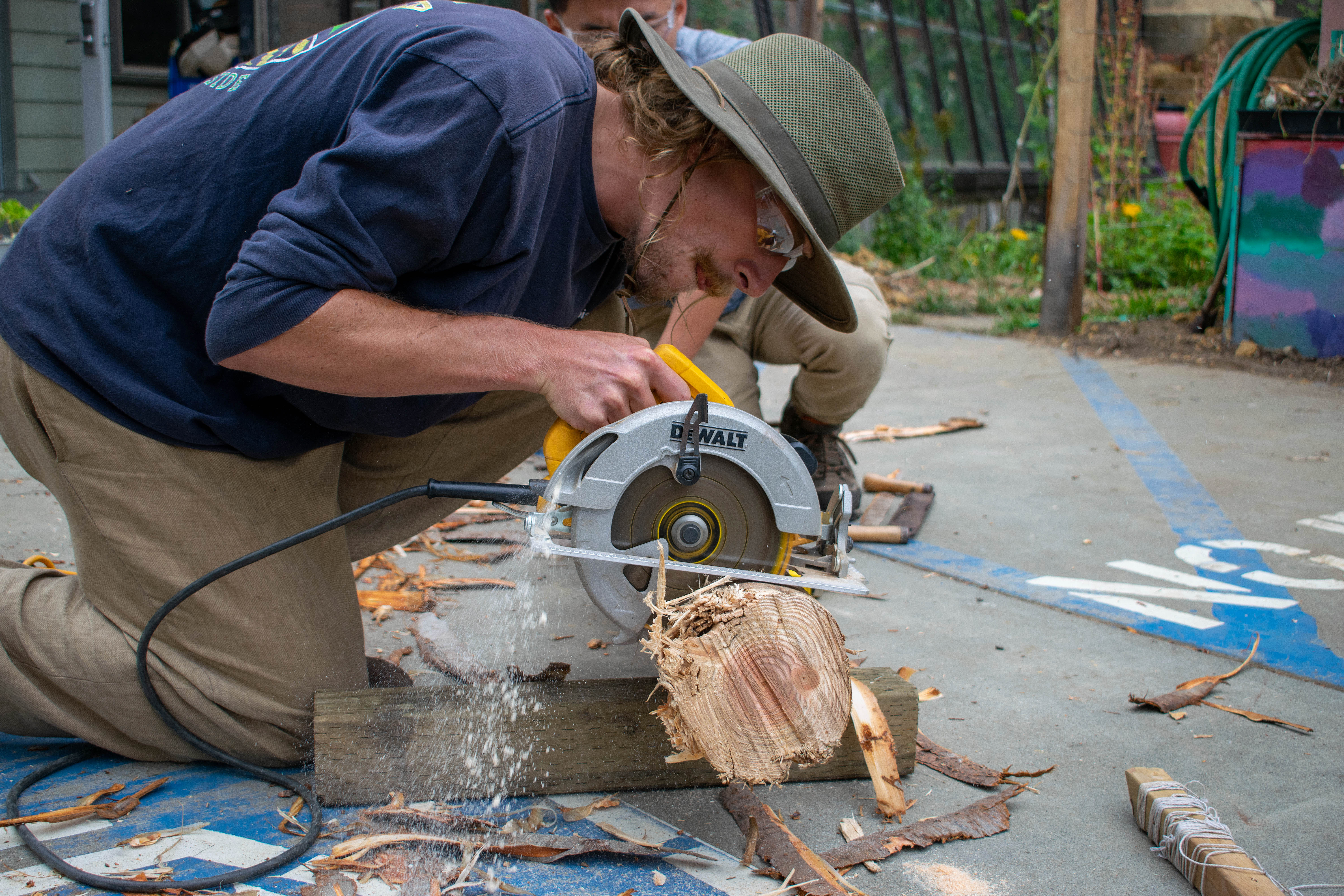
    EnvironmentalRresource Engineering majors Jacob Gellatly (right) and Kong Vang (left) prepare a log on Sept. 6 to be used for the roof of a pig pen. | Photo by James Wilde

    The plan to house the pigs began last fall when students in the CCAT Student Club vocalized interest in keeping animals on campus. CCAT contacted Shail Pec-Crouse from the Tule Fog Farm in Arcata. Pec-Crouse recommended pigs as the most viable animal.

    “The easiest animal for us to raise would be pigs,” Gellatly said. “The reasoning for that is—a big thing is predators. So it’s a lot harder for something to come and get a hold of a pig as opposed to a chicken.”

    As part of their plan, CCAT realized they could feed the pigs food waste from the J. While CCAT couldn’t feed the pigs food thrown away by customers of the J, CCAT could feed the pigs pre-consumer waste, such as food trimmings or spoiled foods not suitable for people.

    “Another goal with the project was how can we divert food waste on campus,” Gellatly said. “And with that we can feed almost, and in some cases, their entire diet from food waste that’s at the school here.”

    Once CCAT decided to loan the pigs from the Tule Fog Farm it needed approval from HSU’s Associated Students, Institutional Animal Care and Use Committee, Facilities Management, Risk Management and an environmental health and safety specialist.

    The pig pen-in-progress on Sept. 6. CCAT plans to house two pigs in the pen for the duration of the fall semester. | Photo by James Wilde

    Humboldt State’s IACUC reviews the use of animals on campus to ensure the animals are treated humanely under the requirements of federal and state law. College of Natural Resources Associate Dean Rick Zechman, who chairs IACUC, said the IACUC proactively reviews and inspects over 100 animal-involved projects on campus each year.

    “There’s varying kinds of emotional feelings about the use of animals, and that’s respected and honored in the system of review,” Zechman said. “And that’s why the Animal Welfare Act was developed, to prevent mistreatment of animals. And I think, you know, in our committee, that’s sort of our first principle.”

    While Zechman could not comment on the details of CCAT’s proposal, which is still pending, CCAT has worked over the last year to assuage concerns raised by various HSU faculty.

    CCAT started by building a pig pen out of reclaimed wood from a local logging operation in Fieldbrook. CCAT has since integrated plans for a roof to prevent flooding of the pen and security to prevent people from getting harmed by the pigs.

    In the long run, Gellatly hopes the project might convince the University to keep animals around for good.

    “Big picture, I would like the school to see this and see, with what we’re having to deal with—getting rid of all this food—we could be raising meat for the school and have locally-produced meat with a byproduct of our current dining system,” Gellatly said.

    Environmental Rresource Engineering majors Jacob Gellatly (right) and Kong Vang (left) working with a log for the pen. | Photo by James Wilde

    CCAT’s plan to house pigs has only recently become known to the wider HSU campus. Saraí Escalante, psychology graduate student and president of HSU’s Vegan Club, sees the value of reducing food waste but wonders about the sustainability of the project.

    “I think the underlying problem is that we see them as a convenience, as objects, so we see them as a tool to help us fix a problem or make our problems or our lives easier,” Escalante said. “And from a sustainability point of view, you still waste a lot of water in all of the slaughter process and the cleaning up of the meat. In that way, it wouldn’t be sustainable.”

    Escalante said she’s considering starting a fundraiser to purchase the pigs and send them to a sanctuary instead of a slaughterhouse. However, Escalante said she plans to talk with CCAT to exchange thoughts, as she does like the idea of reducing food waste on campus.

    Gellatly, for his part, noted that the current plan as registered with Tule Fog Farm and IACUC is for CCAT to house the pigs only for the rest of the semester.

    “I think it’s, in theory, possible for them to buy the animals from the farmer if that’s something they’re inclined to do,” Gellatly said. “But, as far as our scope goes with the IACUC, once the project’s done, we’re taking the animals back to the farm and that’s where it ends for us.”

    The project’s beginnings are dependent on approval from IACUC, but the pigs could arrive at CCAT as early as the week of Sept. 8 through 14.

  • This week in science (Jan. 25 – Feb. 1)

    This week in science (Jan. 25 – Feb. 1)

    By | Claire Roth

    “When we became the climate changers” Illustration. | Claire Roth

    Climate – When we became the climate changers

    When it comes to conversations surrounding climate change, there seems to be more agreeing to disagree than flat-out agreement. It’s a strange phenomenon for a topic having to do with the existence of our planet as we know it. A group of scientists recently set out to create a starting point for this pivotal discussion, effectively creating a timeline for climate change and its origins. The group published an article in the American Meteorological Society outlining estimations of climatic variation since before the industrial age. The goal of this was to contain better conversations of what is considered to be a “normal” climate for our earth within a definition of where the age of industry began. The group was spurred into action after analysis of ice cores displayed a spike in carbon dioxide emissions much earlier than the previously agreed upon beginning of industry. This means humans were affecting the global climate far earlier than originally believed. Research on this topic could prove hopeful in political spheres as well, helping policy makers to better perceive humanity’s impact on the planet.

    Source: BBC, American Meteorological Society

    “>0.001 percent human, ~0.999 percent pig” Illustration. | Claire Roth

    Cellular – >0.001 percent human, ~0.999 percent pig

    A new type of fetus has crossed the known boundaries of what is human and what is pig. Researchers at the Salk Institute of Biological Studies in San Diego were recently successful in their efforts to grow human tissue within a pig fetus. Human cells were inserted into a pig embryo, which was then implanted in a sow to attempt growth for 28 days. The purpose of this endeavor is to eventually find a way to propagate human organs within another animal. Many obstacles lie in the way between this team of scientists and success. Some of these obstacles include questions of morality by outside entities, a five-month difference in gestation time between humans and pigs and also the fact that the majority of embryos in the study did not make it even close to existing for the 28-day goal of the study. The scientific importance and significance of the study persists in the fact that healthy, available organs could one day save the lives of those in need of transplants.

    “Cat, Ph.D” Illustration. | Claire Roth

    Source: BBC, Cell Journal

    Wildlife – Cat, Ph.D.

    There is one question that can oftentimes make or break any relationship: are you a dog person or a cat person? If you’re a dog person and your first argument is to claim canine intelligence superior to feline intelligence, think again. Researchers at Kyoto University in Kyoto, Japan subjected cats to a series of harmless tests of intelligence. They found that cats are conscious of past enjoyable experiences, such as where a tasty treat was located. This means that cats, like dogs, may be able to associate certain human sounds and gestures with specific meanings.

    Source: BBC, Behavioural Processes Journal

    “Saccorhytus “R” Us” Illustration. | Claire Roth

    Evolution – Saccorhytus “R” Us

    Scientists have pinpointed the earliest known human ancestor. One thing is for certain: you are guaranteed to look nothing alike, unless you happen to be around 540 million years old and resemble an alien football. Researchers have identified fossilized remains of a millimeter-sized creature known as Saccorhytus that is currently the earliest known placeholder on the evolutionary timeline of humanity and numerous other species of vertebrates. Saccorhytus likely spent its days on the ocean floor hanging out between grains of sand, consuming lifeforms smaller than itself. Perhaps it also contemplated the millions of years it would take for evolution to take it through the stages of being a fish and into the millions more years it would take for evolution to finally craft it into a human.

    Source: BBC, Nature Journal

    “Plant some pollination” Illustration | Claire Roth

    Ecology – Plant some pollination

    A sharp decline in bee populations has resulted in many farmers resorting to hand-pollination, such as apple farmers in China. However, a recent international study may hold part of the key to saving the world’s key pollinators, maintaining agricultural wellbeing and improving the ecological health of our natural landscapes. Researchers from global locations studied the effect of removing exotic plants from secluded mountaintop landscapes on the success rate of pollination in those areas. They found that areas where there were more native plants displayed a wealth of pollinators, flowers and fruit. This was linked to the possibility of an interconnected web of life in these areas and stands as a testament to the importance of ecological restoration efforts around the world.

    Source: BBC, China Dialogue, Nature Journal