The Lumberjack


Students Serving The Cal Poly Humboldt Campus and Community Since 1929

Tag: planet

  • Community blooms during Humboldt Orchid Society show

    Community blooms during Humboldt Orchid Society show

    by Harrison Smith

    Originally printed April 26, 2023

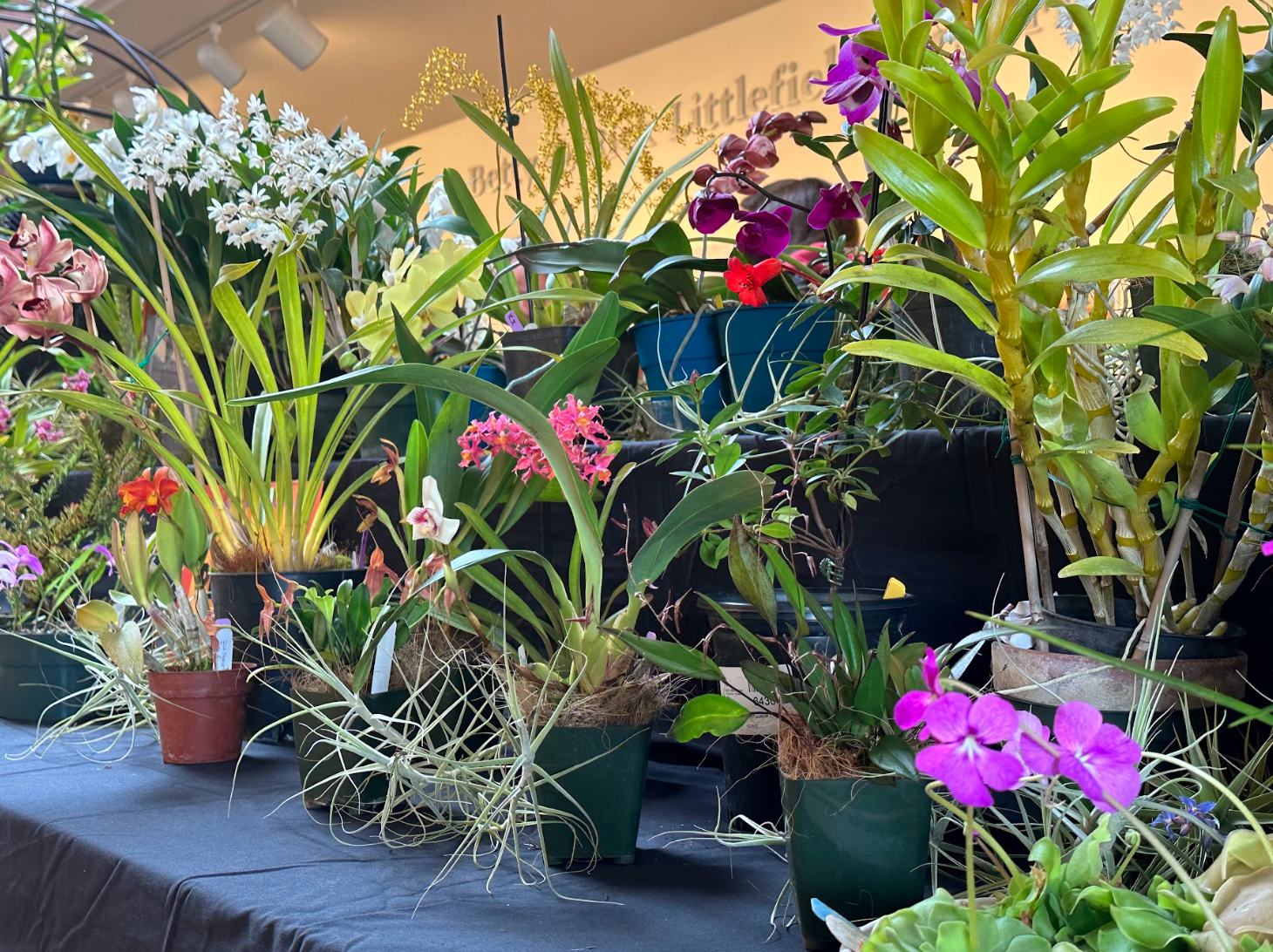
    On Saturday, April 22, the Redwood Art Association in Eureka was packed. The gallery usually displays the work of local artists, but on Saturday, almost every free surface was dripping with shining leaves and fragrant petals. The hum of conversation was electric and the sense of shared delight in the flowers was palpable. The Humboldt Orchid Society’s spring flower show and sale was a scientific and sensory delight. 

    Orchids can be found on every continent. An extremely diverse family of organisms like orchids living over far-spread habitats is usually an old one, evolutionarily speaking. Flowering plants, also called angiosperms, first appeared around 150 million years ago during the Jurassic period. Pangea was still in the process of breaking up. The first species of orchids appeared 112 million years ago, early in the history of angiosperms. This early evolution allowed them to fill up a huge variety of ecological niches.

    “Most orchid seed is dustlike, so it spreads by the wind. The seed of vanilla is very heavy, and cannot be dispersed by the wind,” said Mike. “There are species in Eastern Africa that are the same as in Florida, because the seed was carried by the winds coming from Africa.” 

    The dustlike seeds of orchids younger than vanilla have allowed them to spread into diverse, far-flung habitats. Various species of orchids have adapted to bloom at the crests of sand dunes, grow free-floating in icy streams, or thrive in piles of humus on the forest floor.

    “The really unique thing about orchids at that level is that orchids don’t produce a traditional seed,” said Blaine Maynor, owner of Orchids for the People. “A seed by definition is an embryo and a food source. Orchids don’t include that food source. It’s basically what we call a naked zygote, and it’s basically just 13 cells and a veneer on it.” 

    When seeds are dispersed from a plant, they require a source of energy to begin the expensive process of germination. By not including the food source, orchids are able to produce more seeds by an order of magnitude.

    “In some of these bigger flowers over here,” said Maynor, gesturing to the beautiful array of orchids on the table before him, “a seed pod may have 2 million seeds.“

    Orchids are able to adopt this highly successful strategy due to their unusual (though not unique) symbiosis with mycorrhizal fungi.  

    “When they’re germinated they need to have a fungus presence, because what they do is they basically intermesh with each other. The orchid gives the fungus sugar, and the fungus gives the orchid micronutrients,” said Maynor. “A lot of times the fungus actually has an apparatus that will go into the tissue and weave its way through the cells.” 

    Humboldt county is home to 33 native orchid species, more than any other county in California. Mycorrhizal fungi thrive in the coastal rainforest environment, where organic matter accumulates quickly in the wet understory. Readers are advised not to attempt digging up a wild orchid for their garden, however beautiful the plant is. Without its supporting fungus, the orchid will quickly lose its ability to uptake nutrients and die. 

    Readers are advised, however, to bring any ailing orchid they may have to the monthly meetings of the Humboldt Orchid Society, which are open to the public.  Meetings are held every third Wednesday of the month at the Redwood Art Association.

  • Voices of student science

    Voices of student science

    By | Kelly Bessem

    ____________________________________________________

    Voices of student science aims to highlight individual Humboldt State students majoring within the widespread realm of the sciences.

    ____________________________________________________________

    Alycia Padilla is a 27-year-old wildlife major from Bakersfield, Calif.

    Alycia Padilla, wildlife major. Photo by Kelly Bessem.

    Padilla’s desire to protect and take care of animals helped her choose her major.

    “When I was a child I was only allowed to watch television like National Geographic and Discovery Channel,” Padilla said. “That became all I wanted to watch and I fell in love with animals.”

    Last summer, Padilla set camera traps and collected recordings of bat sounds as part of a decade-long ecological survey. She worked with the California Department of Fish and in the mountains near Sacramento, Calif. 

    Though Padilla wants to get a job in Arcata after graduating, she has considered moving back to Bakersfield because she believes the area needs more wildlife expertise.

    “I feel like I could make some sort of change there,” Padilla said.

    ____________________________________________________________

    Sarah Franzen, 26, is a senior marine biology major. She’s originally from Lake Havasu, Ariz.

    Sarah Franzen, marine biology major, holding sea fan coral. Photo by Kelly Bessem.

    Franzen’s love for the ocean began with television shows such as “Planet Earth.”

    “That’s when I first decided that I wanted to learn how to scuba dive,” Franzen said. “So I got certified when I was 14.”

    It wasn’t until Franzen’s freshman year in college that she saw the ocean for herself. It was during a dive trip for Dixie State University in St. George, Utah.

    “That’s when I really fell in love with the ocean,” Franzen said.

    Last semester, Franzen worked in HSU’s Paul E. Bourdeau Lab making wax snails that are used for crab surveys.

    After graduating, Franzen will study manta rays in Australia and contemplate applying to masters programs.

    ____________________________________________________________

    Erica Siepker, 27, is a wildlife major and scientific diving minor from Long Beach, Calif.

    Erica Siepker, wildlife major and scientific diving minor. Photo by Kelly Bessem.

    Siepker was originally a zoology major but switched to wildlife after discussing her interests with a Humboldt State advisor. 

    “For me the wildlife degree had more practical, hands-on aspects that would take me beyond taxonomy and lab,” Siepker said. “Little did I know that HSU’s wildlife program was so widely known.”

    Siepker experiences many hands-on wildlife studies within her classes. These include the use of raptor perches to combat gopher problems, the relation between crows and human food sources and the habitat selection of salamanders in the Arcata Community Forest.

    Siepker plans to apply for an internship at Disney’s Animal Kingdom after graduating.

    “With an internship there I can study animal behavior, wildlife education and research,” Siepker said.