The Lumberjack


Students Serving The Cal Poly Humboldt Campus and Community Since 1929

Tag: plant science

  • The Campus Collector 

    The Campus Collector 

    by Alana Hackman

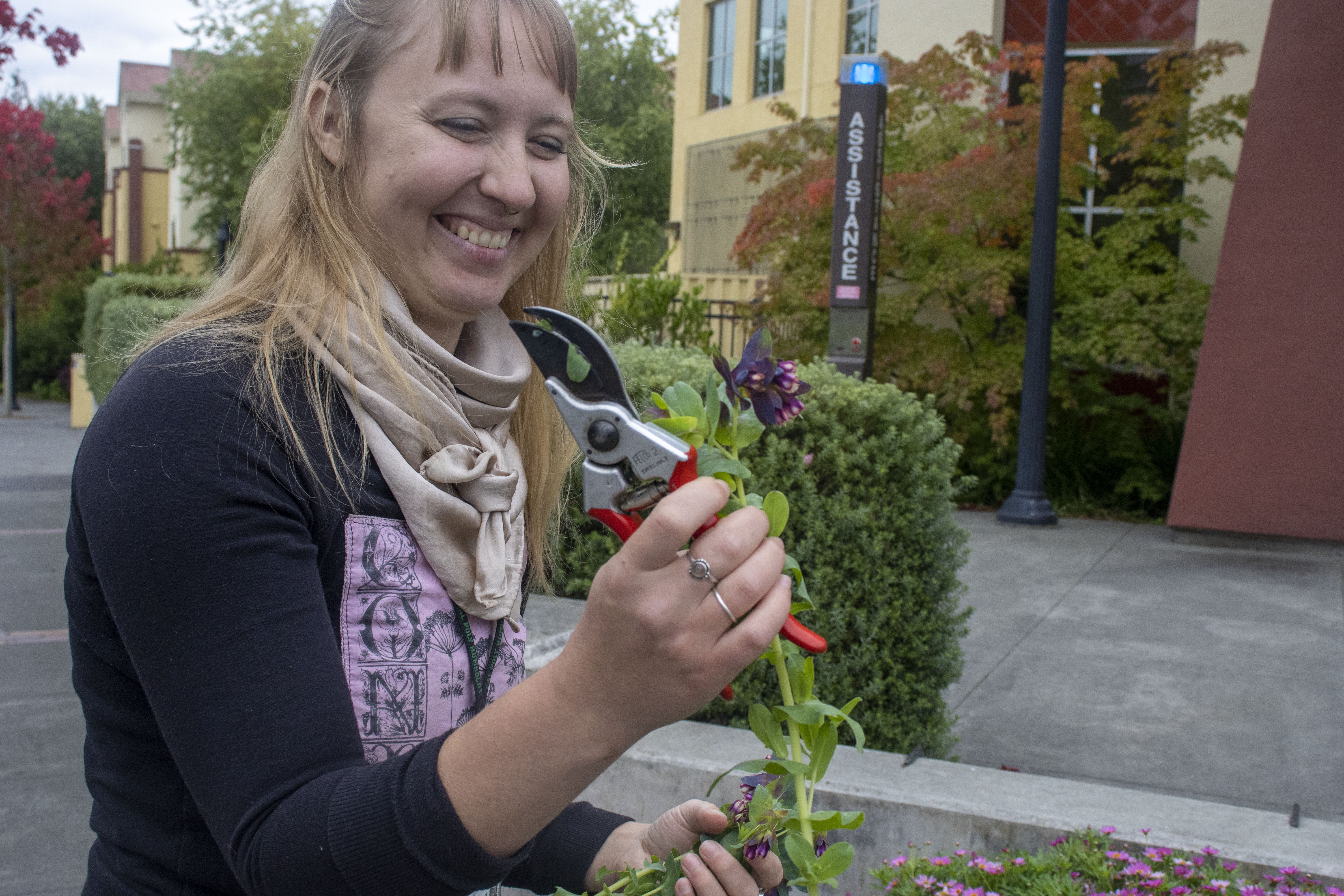
    Sunday mornings, you’ll find most college students tucked away in their beds catching up on sleep, or maybe packing away their notes for a long day at the library.  Nearly every Sunday morning you can find Heather Davis perusing campus bushes and trees; wielding red Felco pruners, or “snips” as she likes to call them, in one hand and a clump of wrinkly brown paper grocery bags in the other. 

    Davis isn’t going on a big grocery trip or planning to do any landscaping, rather she is harvesting plant specimens around campus for botany majors and BOT 350 (Plant Taxonomy) students. Davis is the plant collector for Dr. Oscar Vargas’s Plant Taxonomy class this year. 

    “The labs are Monday, Tuesday, Wednesday, and Thursday,” said Davis. “So I usually collect Sunday for Monday and Tuesday labs and then I collect Tuesday for Wednesday and Thursday labs. 

    With over 120 students enrolled in plant taxonomy this semester, Davis has her hands full nearly every week. On top of being a botany student herself, the Tulsa, Oklahoma native is balancing her two children with the 16 units she’s taking this semester. She made her way to Humboldt county nearly a decade ago in the pursuit of organic farming and decided to start studying for her degree in botany in 2019.

    “I was really interested in organic farming and more natural practices, everything in the Midwest is super mono-cropped and sprayed and really gnarly,” said Davis. “A friend was here in Willow Creek working for a farmer and they were like you should come check it out and like, be a part of the community here so we came out here and worked for that farmer for two seasons.”  

    Davis’s passion for plant collecting shows. She comes to Science D nearly every Sunday around 9:30 a.m, bringing along her infectious smile and a bright blue stainless steel mug decorated with an artistic owl sticker. There are dried leaves carefully placed in the back of her iPhone case, and she sports a black long sleeve shirt printed with various weeds and flowers as her uniform of choice. 

    Davis usually begins her collection process by making her way into the Plant Taxonomy storage room located in room 153 in Science D, to prepare large clear bins with moist paper towels for collection storage. The room has rows of labeled jars filled with dried leaves, stems, and clippings. Some are simple masking tape categories, but there are also some printed skulls and crossbones, warning handlers of the plant’s poisonous properties. 

    Davis was inspired by her previous botany professors to pursue this job, Dr. Oscar Vargas and Stefani Brandt. She was especially interested after taking the plant taxonomy lab for herself.

    “Both of them are amazing instructors, they were super inspiring, Stephanie especially,” said Davis. “I was like ‘aw I wanna be a part of this but I didn’t realize there was a plant collector until they offered the job up to the students in the class”

    Davis isn’t afraid to dive headfirst into her collecting job, she haphazardly snips away different flowers and shrubs surrounding the Natural Resources building and College Creek Marketplace. She climbs trees to collect specific branches and tastes the tart huckleberries around campus before collecting them for storage. Most of her collecting is done on campus, but she sometimes can make her way up to Trinidad for specific specimens.

    “I collect all over the place,” said Davis. “Campus mostly cause there’s a lot of really awesome plants already growing here but there’s a few like invasive or cultivars that they need for the lab, so I’ll end up going to the marsh or sometimes random people’s yards around town, a little reconnaissance.”

    Davis appreciates this position for allowing her to explore the nooks and crannies on campus and doesn’t seem to mind the business it brings into her already hectic schedule of being a mom and student in STEM.

    “I think it’s really cool to walk around campus and see how many plants are here. Before I started the position I was like ‘it’s going to be so hard to find all these plants, like campus is all Rhododendrons,’ said Davis. “Then I started walking around and these plants are everywhere, it’s so cool to be like ‘Oh Hey I didn’t see you before.’” 

    Davis also mentioned sharing her love of plants with her children as well.

    “My kids get involved, if you come in here you’ll definitely see them walking around with giant plants, said Davis. “They really love it, they’re inspired by science so it’s really fun to bring them in, they can look at the microscopes and see all the jarred plant specimens in the prep room and stuff.”

    Davis is the embodiment of finding joy in your career. Her bubbly personality and vast knowledge of native plants, grasses, and even weeds is hard to ignore in any conversation with her. She’s become an expert at balancing work and play in her jam packed schedule.

    “It’s definitely a ton of work being a botany major or a stem major in general but it’s so worth it,” said Davis. “I think it’s really cool to see that there’s plant collecting happening, and that there are these really fun jobs that you can do on campus and I’m inspired and love it.”
  • Red Rhododendrons rustle in Spring breeze

    Red Rhododendrons rustle in Spring breeze

    by Nina Hufman

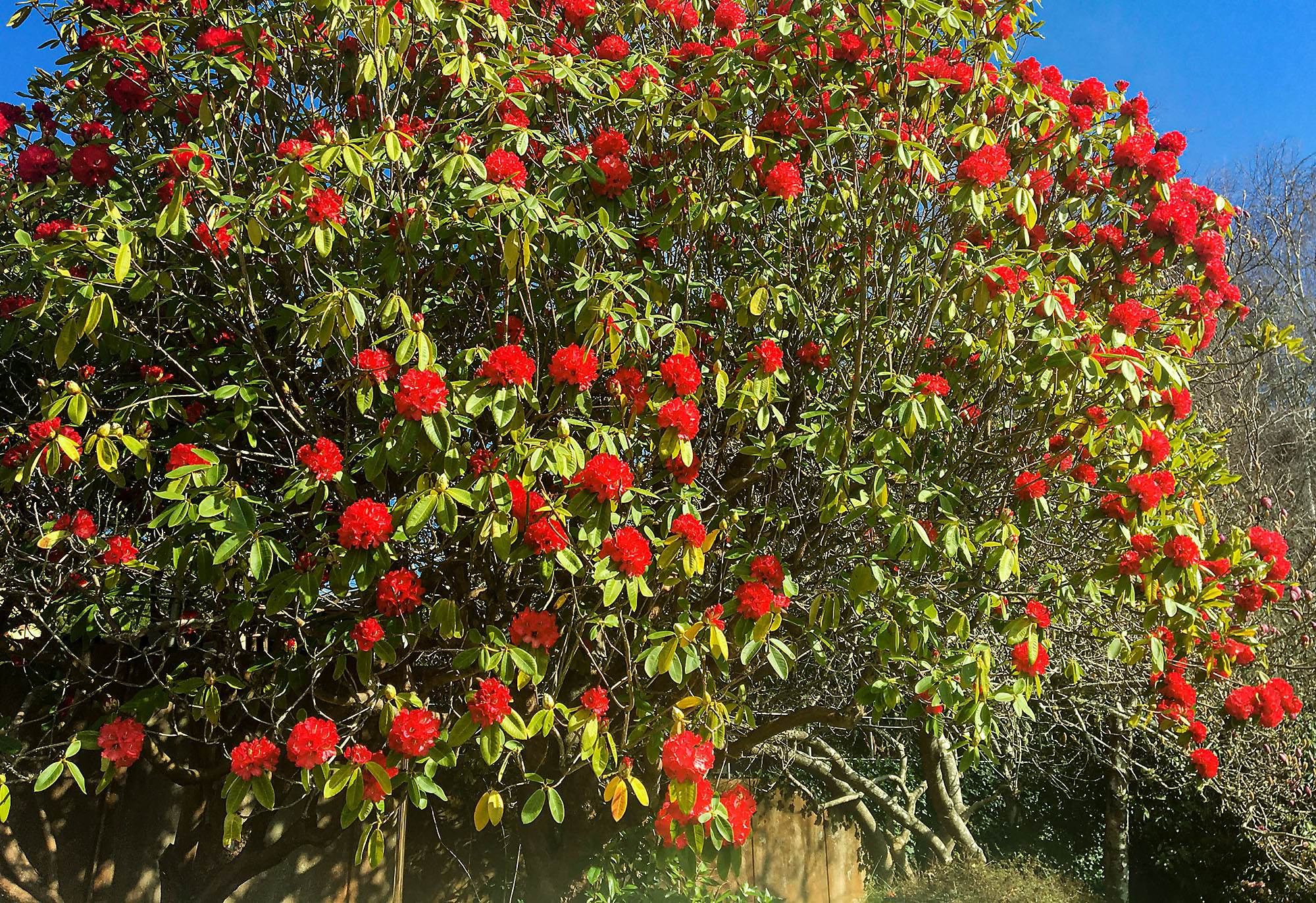
    One of the most noticeable flowers on the beautiful CPH campus is the Rhododendron. The scientific name of this particular species is Rhododendron delavayi. According to the American Rhododendron society, the plants are native to India, Burma, China, Thailand, and other regions of Eastern Asia. This species of tree is identifiable by its bright red blossoms and elliptical-shaped leaves.

    Dense indumentum, or hairlike structures, cover the underside of the plant’s leaves. These help the plant to absorb water and discourage predation by insects.

    Photo by Nina Hufman. Bright red Rhododendron blossoms on the tree between the theatre and art buildings on Feb. 15, 2022.

    Rhododendrons are members of the Ericaceae, an expansive family which also encompasses cranberries, blueberries, and huckleberries.

    Despite the inclusion of these common edible fruits, many other members of this family are known to contain toxic compounds. According to the study ‘Phytochemicals and Biological Activities of Poisonous Genera of Ericaceae in China,’ “the toxic ingredients in the poisonous genera are mainly tetracyclic diterpenes, which exhibit toxic effects on the digestive, cardiovascular and nervous systems.”

    The study also states that these poisonous plants’ traditional use in Chinese medicine makes them a good candidate for further scientific study.

    According to the National Capital Poison Center, honey produced by bees from rhododendron nectar can concentrate the various toxic chemicals. The effects of poisoning by this method include disorientation, mouth irritation, nausea, and vomiting, leading to it’s colloquial name, “Mad Honey.”

    Rhododendron trees can be seen in multiple places on the Cal Poly Humboldt campus including the area between the theater and art buildings, where the above photos were taken. They are considered early bloomers, usually producing flowers from late February to May. Go out while they’re still blooming and enjoy the beautiful, bright red rhododendron.

  • Green Thumbs at the Greenhouse

    Green Thumbs at the Greenhouse

    Dennis K. Walker Greenhouse provides a haven for a diversity of plant species

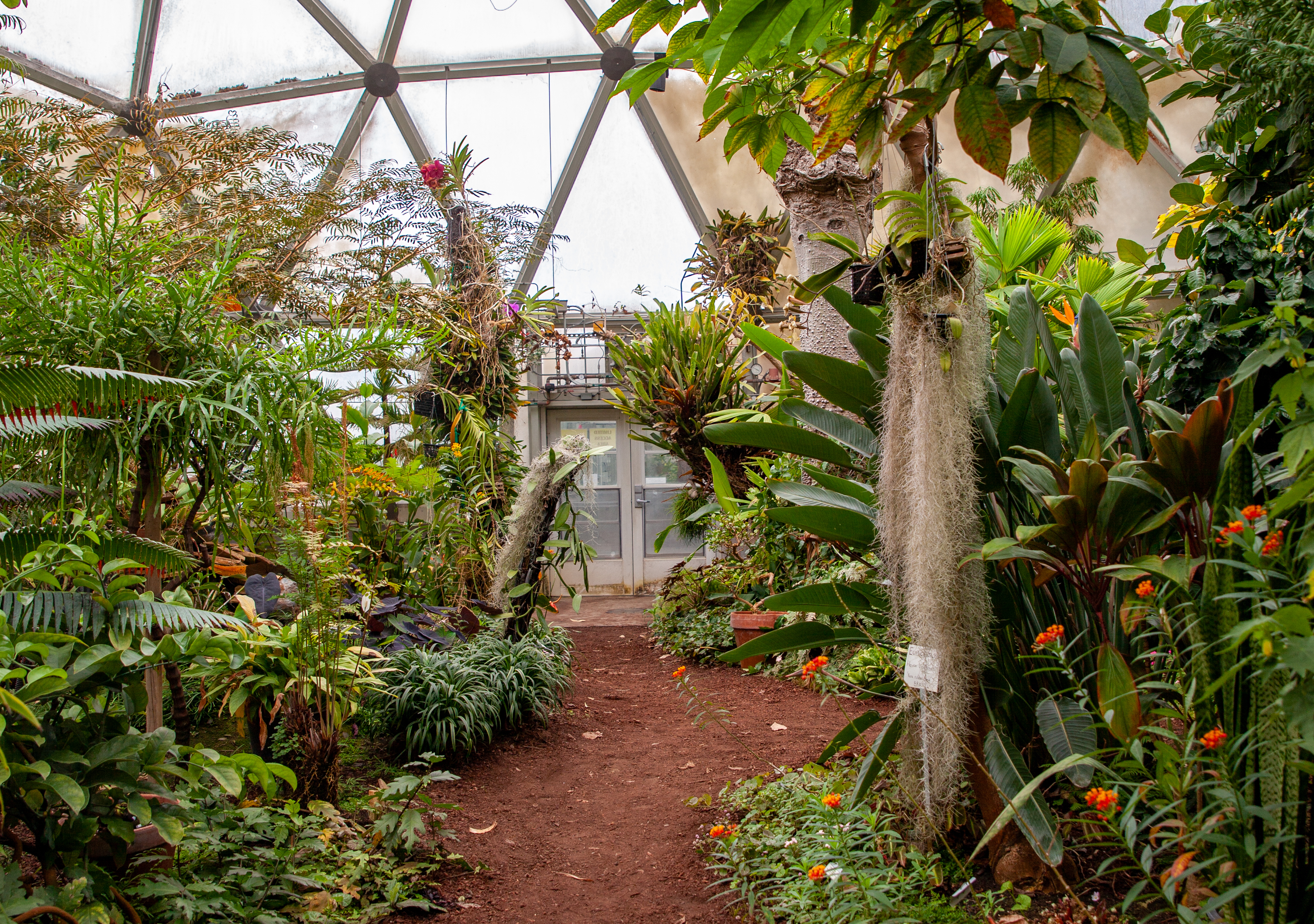
    A sky full of grey clouds smothers the sun and with a chilling breeze even the most layered person shivers down to their toes. One step into the Dennis K. Walker Greenhouse transports you away from the cold into a world of warm, enticing, vivacious plants.

    There are six rooms in the greenhouse: temperate, tropical, desert, fern, aquatic and the subtropical dome. Each room has an appropriate climate and a resident community of plants. Greenhouse manager Brianne Lee, along with student assistants Dabid Garcia and Courtney Harris, maintain the greenhouse at Humboldt State.

    “Essentially, the greenhouse is a living museum,” Harris said. “It’s something that we are trying to preserve here and not kill with love.”

    The large botanical collection contains more than 1,000 species of plants belonging to 187 families. According to the Department of Biological Sciences website, students and faculty studying botany and biology use the greenhouse and its plant life to research and learn.

    Harris, a botany major, said the greenhouse is a magical place, especially since there are only two student positions. After transfering from the College of the Redwoods in 2017 Harris was hired as an assistant.

    “It feels like a unique experience being that this is such a cool staple and an important part of the botany program,” Harris said.

    The job of a greenhouse assistant consists of maintaining the facility and its residents residents, which means sweeping the rooms, hand watering plants, managing pests and propagating plants.

    “Essentially, the greenhouse is a living museum. It’s something that we are trying to preserve here and not kill with love.”

    Courtney Harris

    Garcia, a rangeland resource science major, said that there’s a lot of care and research that goes into the plants, but the goal is to make sure the plants are happy and thriving.

    “Every species needs their own little formula of fertilizer,” Garcia said. “Some require more nitrogen than phosphorus and some others more potassium. We have to do our own research and sometimes that research isn’t available, so we’ll give the plant fertilizer and see how the plant reacts to it. A lot of our plants are really rare in the wild.”

    The trio look out for signs indicating whether something might be wrong, such as droopy leaves and discoloration. The team also checks soil moisture levels, but all plants indicate issues to caretakers in unique ways.

    “The biggest challenge is understanding how each plant reacts and responds to the care that we give it, and adjusting our behavior accordingly,” Harris said. “It requires a tremendous amount of teamwork and communication between us.”

    Harris added that some plants don’t like attention while others, if left alone, will wilt and die.

    Mihai Tomescu teaches plant morphology, plant anatomy, paleobotany and general botany. The trio’s work supports Tomescu in the botany department, as well as supporting the biological sciences. Faculty often use plant specimens during lectures and labs.

    “Plants don’t move, and yet they are exposed to pretty much the same challenges that we are exposed to in terms of surviving. There’s all sorts of stressors. They have to procure their food and because of that, just like other types of organisms, have to have some type of behavior.”

    Mihai Tomescu

    Tomescu said his area of expertise and research is plant structure, including topics like how plants are put together, how they grow, how they look and how their features evolve over generations. Some of his methods include digging deep into geologic time.

    “I know how they grow at the cellular level,” Tomescu said. “So coming from that perspective, I realized that one of the most fascinating things about plants that people don’t realize is that compared to us animals, and compared to what we think of in our culture about aliens, is that plants are more alien to us than the craziest aliens that human imagination has come up with.”

    In his classes, Tomescu has his students visit the greenhouse three to four times a semester for assignments and brings live samples for labs when examining roots, leaves, stems, cells and other internal parts of plants.

    “If you have a big botany program that emphasizes organismal biology, the diversity of plant groups and so on, then it makes sense to have something like this,” Tomescu said. “How else are you to teach your students about the diversity of plants if you can’t show it to them alive.”

    Some people may question the general interest in plants because at the surface they seem not to do anything. But Tomescu said that if you are able to slow down and get pass the green blur of a forest of plants, you’ll come to find some interesting organisms.

    “Plants don’t move, and yet they are exposed to pretty much the same challenges that we are exposed to in terms of surviving,” Tomescu said. “There’s all sorts of stressors. They have to procure their food and because of that, just like other types of organisms, have to have some type of behavior.”

    Plant behavior is what a plant does, including how it grows. According to Tomescu, plants have control of their growth, from the depth of their roots to the direction of their leaves.

    “The plant makes a lot of choices because growing in one direction or another means spending energy,” Tomescu said. “It’s very calculated — not consciously calculated– but basically plants sense their environment very well.”

    In the broader sense, he said that plants make him think. Tomescu hopes more people will become interested in plants since they are so different compared to other life forms.

    “It’s kind of exhilarating to realize that we live next to these super weird organisms,” Tomescu said. “It maintains this fascination that there are these organisms that do the business of living in a very different way from us.”


    The Dennis K. Walker Greenhouse is available to instructors and students in the Department of Biological Sciences, and access is limited by the availability of instructors or greenhouse staff.

    It is open to the public by appointment or when greenhouse staff are available. If you are interested in making an appointment contact Brianne Lee at 707-826-3678 or schedule a visit via email at bms561@humboldt.edu.