The Lumberjack


Students Serving The Cal Poly Humboldt Campus and Community Since 1929

Tag: plants

  • Cal Poly Humboldt, Home of the World’s First 3D Herbarium

    Cal Poly Humboldt, Home of the World’s First 3D Herbarium

    By Griffin Mancuso and Savana Robinson

    Last Thursday, on the third floor of Cal Poly Humboldt’s library, a very important first birthday was celebrated. Students, faculty and community members gathered to enjoy cake, pizza, pie and refreshments to celebrate the launch of the world’s first 3D herbarium. 

    Hosted at 3dherbarium.org, the 3D herbarium has digitized 3D models of various plants with information on each species. At time of publication, 39 models are available to view. From the seaside daisy, Erigeron glaucus, to the coast redwood, Sequoia sempervirens, each plant’s page has a classification breakdown, profile and information on the model itself.

    Library Dean Cyril Oberlander started the opening speech for the event, thanking everyone for attending and emphasizing the project’s testament to hard work, dedication and collaborative efforts.

    “We chose 3D modeling of plants because, well, not really anybody was doing it,” Oberlander said. “You can imagine how hard it is to do a three-dimensional shape of a two-dimensional leaf. While creating the 3D digital herbarium has never been done — and because plants are so crucial to life on Earth, and for our understanding of plants — this was incredibly important.”

    The project has been in development for over a year and students have been anticipating its release, including botany major Juniper Beke.

    “Last semester, I believe it was teased at the end of a session on satellite information using satellite data,” Beke said. “[The teaser] had appeared there at the end and so I was hyped up for it.”

    Many students, like engineering and community practices major Filip Amborski, had ideas for what the program could accomplish. Amborski thinks the herbarium will be a great resource.

    “I’m hoping that they have notes on anything that’s been identified as culturally significant to Native tribes,” Amborski said.

    The seeds of inspiration

    The 3D herbarium was created by Team Flora, which is comprised of computer science and botany students. Botany graduate student Heather Davis, undergraduate botany student Grayson Prater and computer science major David Yaranon helped create the website under the management of computer science graduate AJ Bealum.

    AJ Bealum, computer science graduate and manager of Team Flora, credited the idea for the 3D herbarium to Oberlander. The university library was the sole sponsor for this project.

    “His main source of inspiration was the anatomage table downstairs and he thought, ‘Why isn’t anyone doing this with plants?’” Bealum said.

    Located on the second floor of the library, the anatomage table is a 3D human anatomy system where users can simulate cadaver dissection.

    Prater wanted to join Team Flora to bring botany to those unfamiliar with the topic and introduce them to scientific language. Through this project, he has learned about programming and the difficulties that come with scanning plants.

    “I really love writing about plants. This was a great job to start doing that and practicing that skill, especially science communication, making botany accessible to other non-botanists,” Prater said.

    Davis accepted the position on Team Flora to satiate her passion for bringing the joy of botany to others. Her decision to join the team was inspired by Oscar Vargas of the botany department. Vargas is an assistant professor at Cal Poly Humboldt and director of the university’s Vascular Plant Herbarium.

    “Dr. Oscar Vargas has been my professor, mentor and boss for the last couple of years,” Davis said. “Over the summer last year, the job got posted and he had been talking to AJ, so he reached out to me and sent me the link for the herbarium. I applied for it after that and joined the team.”

    Current growth

    The 3D herbarium website currently has a collection of 3D plant models, plant photos contributed from around the world and a plant identification component. 

    Each 3D model was created using a process called photogrammetry. Photogrammetry requires around 100 to 300 photos of a single plant from many different angles in order to convert it into a 3D model. Yaranon created many of the plant models for the 3D herbarium.

    “As you take more photos, the processing time increases exponentially,” Yaranon said. “In the beginning, we were running these off of rented laptops from the library, so we would have to wait a couple of days per model. Now we’re on a server, so we can put these out a lot quicker.” 

    Davis collaborated with the computer scientists on Team Flora to annotate each plant model. She collected plant specimens for Bealum and Yaranon to photograph and create a model from. Then, she annotated different parts of the plant model with information for people with all levels of experience.

    “It’s a really challenging subject for many people when they’re first introduced to it, especially with the names and all of the different scientific terms you have to learn,” Davis said. “So this project has been [a] really fun [way] to be able to give access to that knowledge and to make it a fun, engaging activity, instead of challenging and being afraid of a new topic.”

    The herbarium also adds to its database with photos from iNaturalist, a website that allows users to upload photos of plants and animals to create a public database. Visitors can search up the common or scientific name of a plant and peruse a gallery with hundreds of photos taken around the world.

    Additionally, the website has a plant identification program. Once a photo of a plant is uploaded, the program will provide a list of possible species and a short description. The program pulls from websites like Wikipedia, iNaturalist and the Global Biodiversity Information Facility.

    From left to right, Team Flora members Grayson Prater, Heater Davis, David Yaranon and AJ Bealum stand in front of a touchscreen monitor displaying the 3D herbarium in the Cal Poly Humboldt library on Jan. 25. Photo by Savana Robinson.

    Plan(ts) for the future

    During the opening speech, Oberlander announced a planned second version of the 3D herbarium. The day before the ceremony, Team Flora got approval to start a full grant proposal to the Institute for Museum Library Services to get funding for further development of the program. Version two will include models that are applicable for other majors like anthropology or zoology. Oberlander mentioned that Team Flora hopes to receive the funding this summer.

    “Our next version is going to be something that is anything that wants to be a 3D model, whether it’s art or something else. People can do all sorts of things with this 3D exhibit tool,” Oberlander said. “It’s either intended for students with projects or a classroom that wants to use this as a lab notebook, as opposed to the print version.”

    Team Flora also hopes for other groups on campus to contribute to the 3D herbarium. They plan to make the process of photogrammetry more accessible so that clubs or classes can add to the website’s model collection. Bealum described meeting with the mycology club to help them learn how to use photogrammetry software so they could produce a fungus model for the website.

    “Our ultimate goal with this [website] is to make it a school-incorporated tool,” Bealum said. “So that instead of us sitting in our office trying to pump out these 3D models and working with the botany students as assistants, the botany department can ultimately kind of take this over. [They can] make it a part of their classes, make it so that students can submit models as part of a class.”
  • Filling in the Fossil Record with Fungi

    Filling in the Fossil Record with Fungi

    Madison Lalica cracks open 400-million-year-old fossils

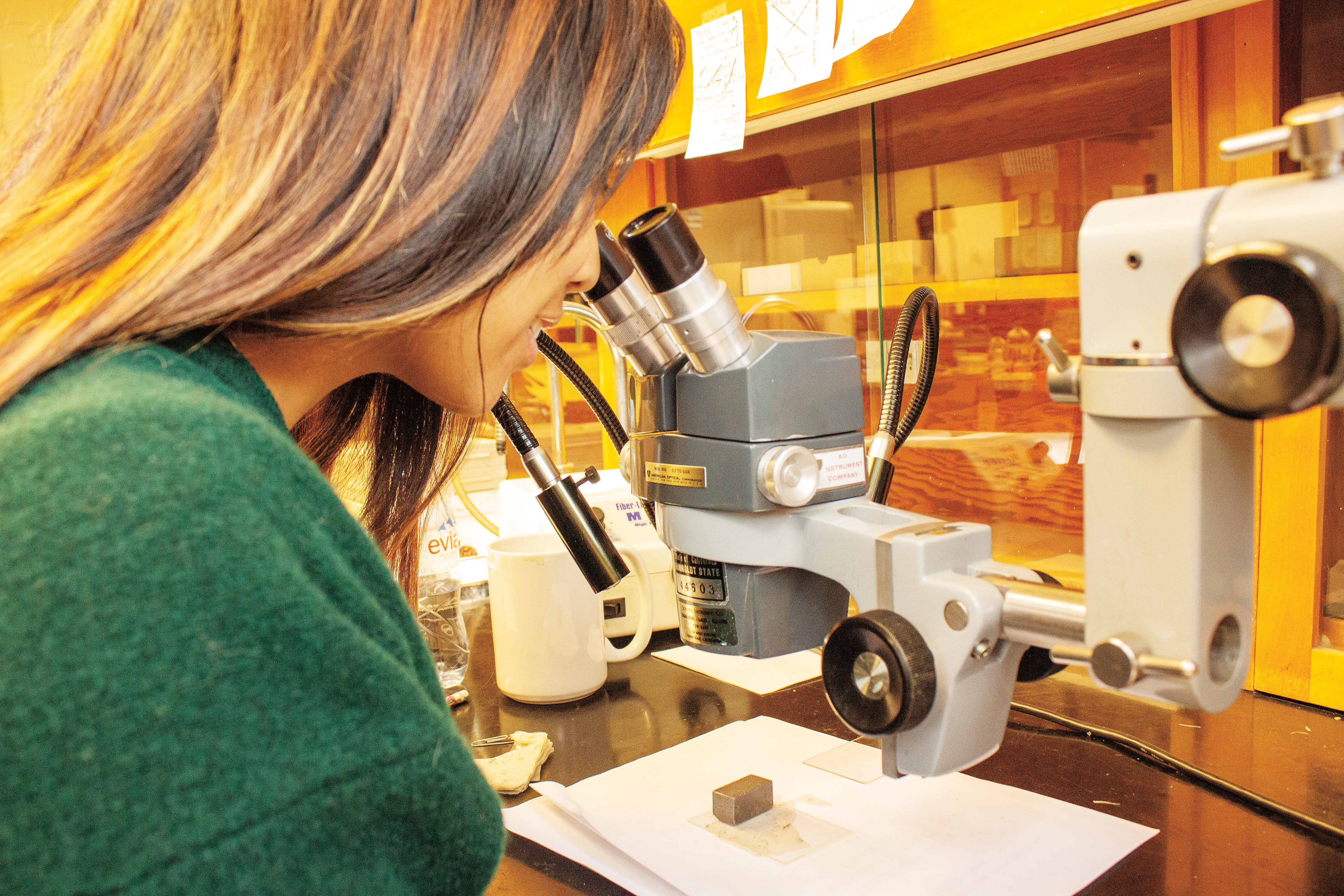
    Madison Lalica is a junior botany major researching ancient fungi in fossilized plants over 400 million years old. She is filling in the blanks of the fungi fossil record with her unique research.

    “Given their importance in current ecosystems, I support [that fungi] must have had such a fundamental role in ancient ecosystems,” Lalica said. “And that is what I’m trying to prove with fossil research.”

    Lalica said she had the privilege to work with a huge box of rocks on loan from the Smithsonian Museum filled with fossilized plants. The fossils came to Humboldt State University by way of the Smithsonian, but they were collected in the 1960s by a paleo botanist named Francis Huber at a rock formation called Battery Point in Canada.

    “We look at a bunch of plant fossils that are 400 million years old,” Lalica said. “They are preserved very beautifully and you can see all of their anatomical features.”

    Graduate botanist Megan Nibbellink works alongside Lalica. She is focusing on the anatomy and relationships of the host plants, called zosterophylls. The Battery Point fossils are preserved in a unique geologic formation that serves to make really good fossils.

    “It is a fluvial deposit,” Nibbellink said. “It was a bunch of pieces of fragments caught up in fine sediment at the end of a river. The reason why I like these fossils is because you can see the individual cells. And that’s also why Maddy is able to do what she does.”

    When the host plants were buried by fine river sediments all those millennia ago, their form was preserved as the sediment solidified over millions of years. The fine particles, though, essentially printed the fossils in high resolution with so much detail that Lalica found what she was looking for: ancient fungi.

    Lalica is scanning and investigating these plant fossils for any evidence of fungal material. Spores, fungal tendrils called hyphae and scars from fungal infection are some indicators she has found. Specifically, Lalica is working on identifying the fungi glomeromycota, a fungal group intimately symbiotic with plants today. She wants to learn how similar the ancient fungi are to modern fungi.

    “Why do you want to know about extinct life, then, one might ask. And to be honest, it is a pretty philosophical pursuit I guess. In the most direct sense, learning about extinct lifeforms helps us understand how the living lifeforms that we see around today evolved.”

    Alexandru “Mihai” Tomescu

    “The plant and animal fossil record is really well understood,” Lalica said. “Like they have a pretty clear timeline of ‘This happened and then this happened,’ but for fungi it is so sparse and incomplete that they have no idea what goes before what.”

    Lalica’s faculty advisor Alexandru “Mihai” Tomescu has made it his life’s work to figure out what goes before what. Tomescu explained that exploring the fossil record is important because fossils offer us the only way to look directly into life in the past.

    Tomescu was Lalica’s botany professor before she had switched majors, but she said she fell in love with the world of paleobotany after his instruction. Showing interest in the subject, Lalica took the opportunity to begin her own research as soon as Tomescu offered her the chance.

    “Why do you want to know about extinct life, then, one might ask,” Tomescu said. “And to be honest, it is a pretty philosophical pursuit I guess. In the most direct sense, learning about extinct lifeforms helps us understand how the living lifeforms that we see around today evolved.”

    The 400 million year old specimens are interesting to Tomescu and his team of researchers because the plants themselves represent the first wave of vascular plants, or plants that move water through special tissues, that evolved on Earth. Vascular plants constitute nearly every modern land plant, so these ancestors are significant. Fungi, too, are significant to life on Earth and may have been part of its foundation.

    “Fungi are probably, almost certainly I think, older than actual plants,” Tomescu said. “Fungi are a lot older. But because they’re just hyphae, since they’re flimsy, their fossil record is not that great.”

    Tomescu has been recruiting undergraduate students to research these fossils in his lab. Tomescu explained that HSU hosts a botany program that attracts a lot of students, but also that the students are enthusiastic to participate in research. He said HSU has students who are interested in the grey areas. Lalica was one of those students.

    Moving forward, Tomescu and Lalica are preparing to publish a paper about her year-long investigation into the fossils. This summer, she is presenting her research at the Botanical Society of America’s annual conference.

    “It seems like in Humboldt opportunities are like, if you talk to the right person or if you become friends with the right person, it just kinda happens,” Lalica said, “And it just so happened that I fell into the world of paleobotany.”

  • Green Thumbs at the Greenhouse

    Green Thumbs at the Greenhouse

    Dennis K. Walker Greenhouse provides a haven for a diversity of plant species

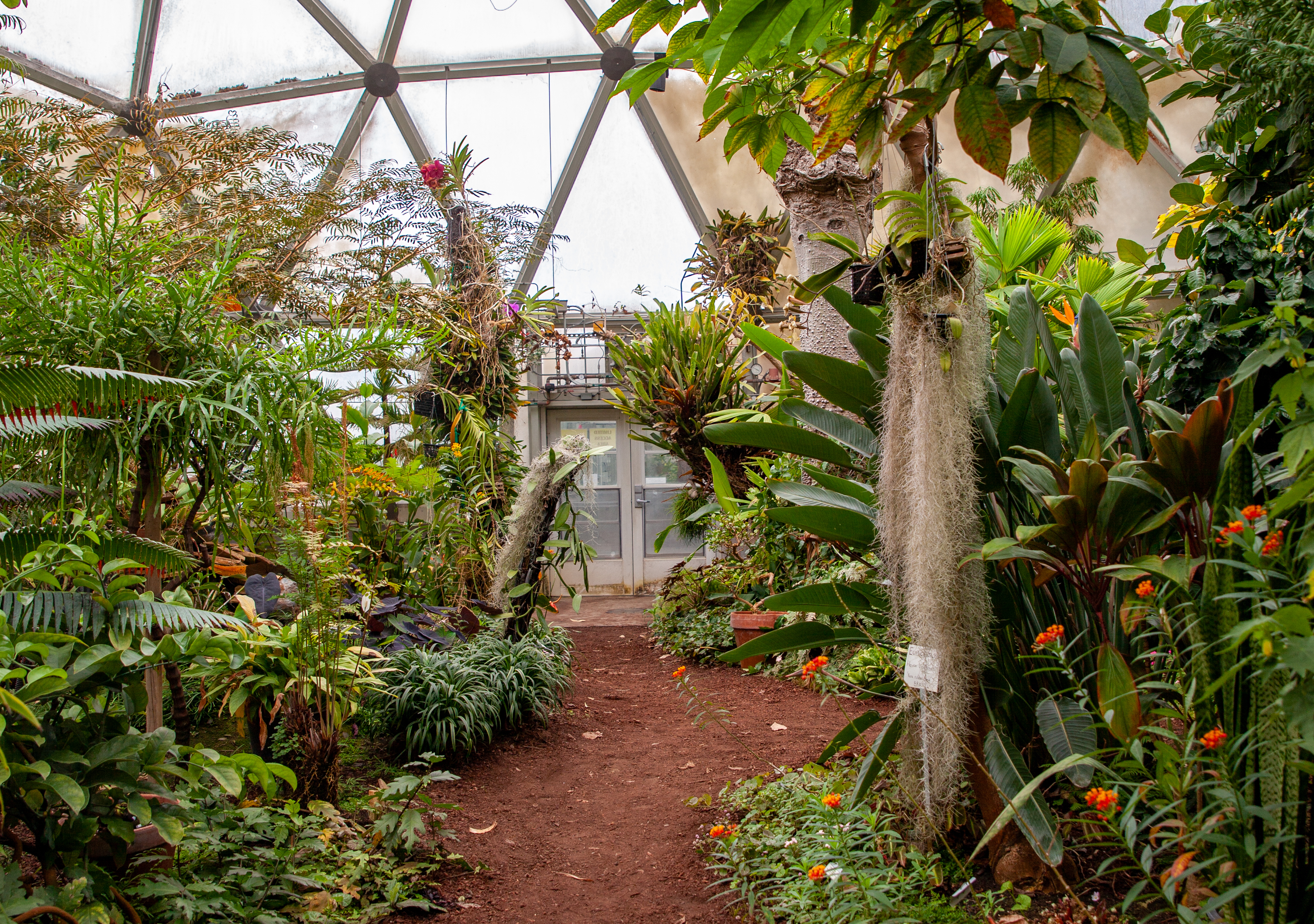
    A sky full of grey clouds smothers the sun and with a chilling breeze even the most layered person shivers down to their toes. One step into the Dennis K. Walker Greenhouse transports you away from the cold into a world of warm, enticing, vivacious plants.

    There are six rooms in the greenhouse: temperate, tropical, desert, fern, aquatic and the subtropical dome. Each room has an appropriate climate and a resident community of plants. Greenhouse manager Brianne Lee, along with student assistants Dabid Garcia and Courtney Harris, maintain the greenhouse at Humboldt State.

    “Essentially, the greenhouse is a living museum,” Harris said. “It’s something that we are trying to preserve here and not kill with love.”

    The large botanical collection contains more than 1,000 species of plants belonging to 187 families. According to the Department of Biological Sciences website, students and faculty studying botany and biology use the greenhouse and its plant life to research and learn.

    Harris, a botany major, said the greenhouse is a magical place, especially since there are only two student positions. After transfering from the College of the Redwoods in 2017 Harris was hired as an assistant.

    “It feels like a unique experience being that this is such a cool staple and an important part of the botany program,” Harris said.

    The job of a greenhouse assistant consists of maintaining the facility and its residents residents, which means sweeping the rooms, hand watering plants, managing pests and propagating plants.

    “Essentially, the greenhouse is a living museum. It’s something that we are trying to preserve here and not kill with love.”

    Courtney Harris

    Garcia, a rangeland resource science major, said that there’s a lot of care and research that goes into the plants, but the goal is to make sure the plants are happy and thriving.

    “Every species needs their own little formula of fertilizer,” Garcia said. “Some require more nitrogen than phosphorus and some others more potassium. We have to do our own research and sometimes that research isn’t available, so we’ll give the plant fertilizer and see how the plant reacts to it. A lot of our plants are really rare in the wild.”

    The trio look out for signs indicating whether something might be wrong, such as droopy leaves and discoloration. The team also checks soil moisture levels, but all plants indicate issues to caretakers in unique ways.

    “The biggest challenge is understanding how each plant reacts and responds to the care that we give it, and adjusting our behavior accordingly,” Harris said. “It requires a tremendous amount of teamwork and communication between us.”

    Harris added that some plants don’t like attention while others, if left alone, will wilt and die.

    Mihai Tomescu teaches plant morphology, plant anatomy, paleobotany and general botany. The trio’s work supports Tomescu in the botany department, as well as supporting the biological sciences. Faculty often use plant specimens during lectures and labs.

    “Plants don’t move, and yet they are exposed to pretty much the same challenges that we are exposed to in terms of surviving. There’s all sorts of stressors. They have to procure their food and because of that, just like other types of organisms, have to have some type of behavior.”

    Mihai Tomescu

    Tomescu said his area of expertise and research is plant structure, including topics like how plants are put together, how they grow, how they look and how their features evolve over generations. Some of his methods include digging deep into geologic time.

    “I know how they grow at the cellular level,” Tomescu said. “So coming from that perspective, I realized that one of the most fascinating things about plants that people don’t realize is that compared to us animals, and compared to what we think of in our culture about aliens, is that plants are more alien to us than the craziest aliens that human imagination has come up with.”

    In his classes, Tomescu has his students visit the greenhouse three to four times a semester for assignments and brings live samples for labs when examining roots, leaves, stems, cells and other internal parts of plants.

    “If you have a big botany program that emphasizes organismal biology, the diversity of plant groups and so on, then it makes sense to have something like this,” Tomescu said. “How else are you to teach your students about the diversity of plants if you can’t show it to them alive.”

    Some people may question the general interest in plants because at the surface they seem not to do anything. But Tomescu said that if you are able to slow down and get pass the green blur of a forest of plants, you’ll come to find some interesting organisms.

    “Plants don’t move, and yet they are exposed to pretty much the same challenges that we are exposed to in terms of surviving,” Tomescu said. “There’s all sorts of stressors. They have to procure their food and because of that, just like other types of organisms, have to have some type of behavior.”

    Plant behavior is what a plant does, including how it grows. According to Tomescu, plants have control of their growth, from the depth of their roots to the direction of their leaves.

    “The plant makes a lot of choices because growing in one direction or another means spending energy,” Tomescu said. “It’s very calculated — not consciously calculated– but basically plants sense their environment very well.”

    In the broader sense, he said that plants make him think. Tomescu hopes more people will become interested in plants since they are so different compared to other life forms.

    “It’s kind of exhilarating to realize that we live next to these super weird organisms,” Tomescu said. “It maintains this fascination that there are these organisms that do the business of living in a very different way from us.”


    The Dennis K. Walker Greenhouse is available to instructors and students in the Department of Biological Sciences, and access is limited by the availability of instructors or greenhouse staff.

    It is open to the public by appointment or when greenhouse staff are available. If you are interested in making an appointment contact Brianne Lee at 707-826-3678 or schedule a visit via email at bms561@humboldt.edu.