The Lumberjack


Students Serving The Cal Poly Humboldt Campus and Community Since 1929

Tag: political parties

  • Labor Day 2022

    Labor Day 2022

    by Camille Delany

    America is nearly unique in our celebration of Labor Day in September. We’re joined on the first Monday in September by Canada alone, while over 80 nations across the world hold their equivalent celebrations on May 1. The distinctive origins of the day were never, to my memory, discussed over the course of my public school education or during the hometown parades I’d attended as a child, leaving me surprised to learn the complicated history of Labor Day.

    If you enjoy weekends, a largely labor-free childhood, or having any free time to speak of, you owe a debt of gratitude to labor organizers of centuries past. Throughout the 1800s, the work day was typically dawn-til-dusk—in trials dating to around the turn of the 19th century, manufacturing laborers were found to be working as many as 18 hours in a day. Early unions focused on raising wages for laborers as well as reducing hours and defending workers’ right to organize. By the close of the century, the international labor movement had coalesced around the fight for the 8-hour workday.

    To this end, labor and trade unions across the nation went on strike on May 1, 1886. No city was more active in the movement than industrialized Chicago, where masses of laborers laid down their tools and exited their workplaces. However, their act of civil disobedience was met with  brutal backlash from bosses, who in the days following the May 1 strike joined forces with the police to violently disband peacefully protesting workers. 

    In the ensuing clashes, which came to be known as the Haymarket Incident, at least four civilians were shot to death by police and many others were injured. Police also suffered casualties, and in a trial that would later be considered a miscarriage of justice, seven union leaders were sentenced to death for a bombing that took place during the fallout, even though only two of those charged had even been present. Four were executed the following year; two had their sentence commuted to life in prison; one died in jail. In 1893, the governor of Illinois would conclude that the trial was not fair, and pardon the surviving defendants.

    The Haymarket Incident was one reason for celebrating International Workers’ Day on May 1, which remains the Labor Day for most of the world. It would also result in the declaration of two holidays in the US: Labor Day, on the first Monday in September, and Loyalty Day (also known as Americanization Day) on May 1. I hadn’t heard of that last one, either, but it turns out that while the rest of the world is rallying for workers’ rights and celebrating the accomplishments of laborers on the anniversary of the Haymarket Incident, US presidents give an annual proclamation extolling loyalty to America. 

    Loyalty Day was proposed during the Red Scare of the 1920s and adopted officially in the ‘50s with 36 U.S. Code § 115, which designates it as, “a special day for the reaffirmation of loyalty to the United States and for the recognition of the heritage of American freedom.” The holiday’s raison d’etre is obvious: to counter any demonstration of solidarity with workers of the world on May Day.

    Nevertheless, this past weekend we celebrated the American worker with parades, camping trips, and retail discounts. In fact, the latter seems to be the most prevalent angle in press coverage of this Labor Day; the majority of headlines claim to aggregate “Labor Day Sales” from big box stores or online retailers. Fittingly, the contemporary legacy of the September Labor Day does not honor production or labor. On this day conceived to quash solidarity between American workers and the international organized labor movement, we celebrate the consumption of goods.
  • Berning Green

    Berning Green

    Bernie supporters find political similarities with Jill Stein

    By Ali Osgood

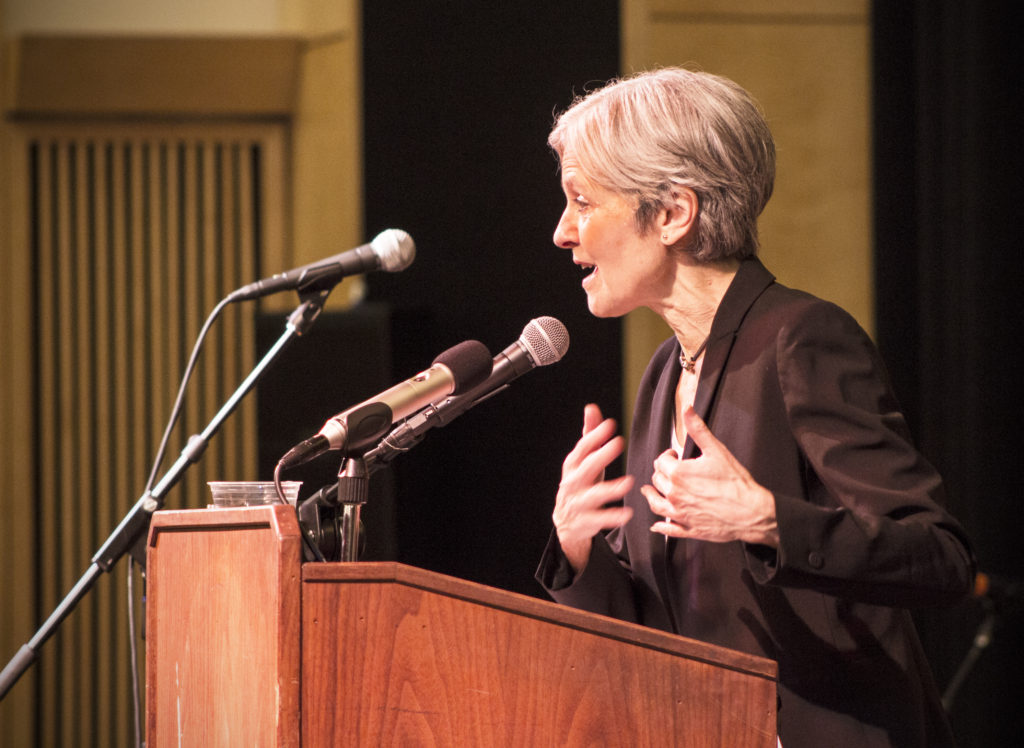
    Green Party presidential candidate Jill Stein spoke to an audience of nearly 400 Humboldt County community members on Wednesday night in HSU’s Kate Buchanan room. Among the crowd were human rights activists, environmentalists, future, past, and present politicians, and a large number of young people. Many of these audience members were also former Bernie Sanders supporters who looked toward Stein when Sanders was out of the running for president.

    “There are lots of Berners who are burning green,” Stein said (a Berner is another name for Bernie Sanders supporters). “The important thing here is not to close your eyes to what history is telling us…If you think we have more time to keep beating around the bush, stay in the Democratic Party. If you don’t? Move on, move forward. The more of us the better.”

    A crowd of nearly 400 gathered in the Kate Buchanan room on Wednesday Mar. 8 to watch 2016 Green Party presidential candidate Jill Stein speak. | Photo by Ali Osgood

    Throughout the night Stein, as well as audience members, tied in comparisons to Sanders’ platform. In the beginning of her speech, Stein addressed that she believes Sanders would have won the presidential election against Trump.

    For Humboldt, Sanders was the top democratic pick in the 2016 primary election with a 40% lead over Hillary Clinton according to the Humboldt County elections office. Clinton went on to become the democratic candidate and many Humboldt Berners went on to support Stein over Clinton. Stein had over 3,500 votes locally, a thousand more than she received when she ran for president in 2012. Clinton had a thousand less votes than president Obama received in 2012.

    Audience member Rob Jensen, Eureka, was one of the Berners who voted for Stein.

    “When the Democratic Party forced out Bernie, I felt that the Green Party had a similar platform to his,” Jensen said. “People have told me I wasted my vote, but for me, Clinton wasn’t a viable option.”

    As Stein covered topics including climate change and corrupt economics, she also discussed the problems with a two party system and how voters are more likely to vote against a candidate. Her campaign manager and 2004 Green Party presidential candidate, David Cobb, helped reiterate this concept.

    “[It’s] a voting system that forces people to feel like they have to vote against the candidate that they hate rather than for the one that they want,” Cobb said.

    Cobb, a Eureka local, saw a spike in Stein support after the 2016 Democratic National Convention(DNC) in Philadelphia where Bernie was beat out by Clinton for the nomination.

    “It’s worth pointing out that even with every single dirty trick that they did, Bernie almost won the Democratic nomination. So it’s really a testament to the hunger that so many people had for the kind of platform that Bernie represented,” Cobb said.

    According to both Sanders’ and Stein’s websites, they do have a lot of common ground in their political beliefs. Their policies on education, climate change, and a single payer health care system are nearly identical. This may have played a part in the 1000 percent fundraising increase Stein’s campaign saw after the DNC.

    Jill Stein covered an array of topics including healthcare, economic corruption, demilitarizing American foreign policy, and the flaws with the two party system. | Photo by Ali Osgood

    The spike in support for Stein, hitting as high as 20 percent in August in Colorado, according to MSNBC, helped get the Green Party ticket on 48 ballots of the 50 states.

    The HSU Greens, a student club of Green Party members, helped organize Stein’s event on Wednesday. The president of HSU Greens worked with Stein and Cobb during the 2016 campaign and helped get Stein to Humboldt State. Aaron Zvirman, HSU Greens treasurer, helped organize the grants for Steins visit and coordinated with other groups on campus for the event.

    “Having someone this high profile to the little town of Arcata is an excellent opportunity for people to play a more active role in politics and voice their opinions to someone with actual political standing,” Zvirman said.

    Audience members showed a great diversity of community members including students, activists, and even a city council member. Stein spoke for 50 minutes and answer audience questions for another hour and a half after her speech. | Photo by Ali Osgood

    After a 50 minute speech by Stein, the microphone was open to audience members to ask Stein questions. Stein was able to answer every person’s question, which went on for about an hour and a half. The crowd trickled out throughout the question panel, but about a quarter remained to see the evening through to its conclusion.

    Stein ended her speech to a standing ovation. She closed with a familiar call to action that’s been heard throughout her 2016 campaign trail.

    “We need a government that’s of, by, and for the people,” Stein said. “The power to create that world is not just in our hopes, it’s not just in our dreams. Right here and now, more than ever, it’s in our hands.”