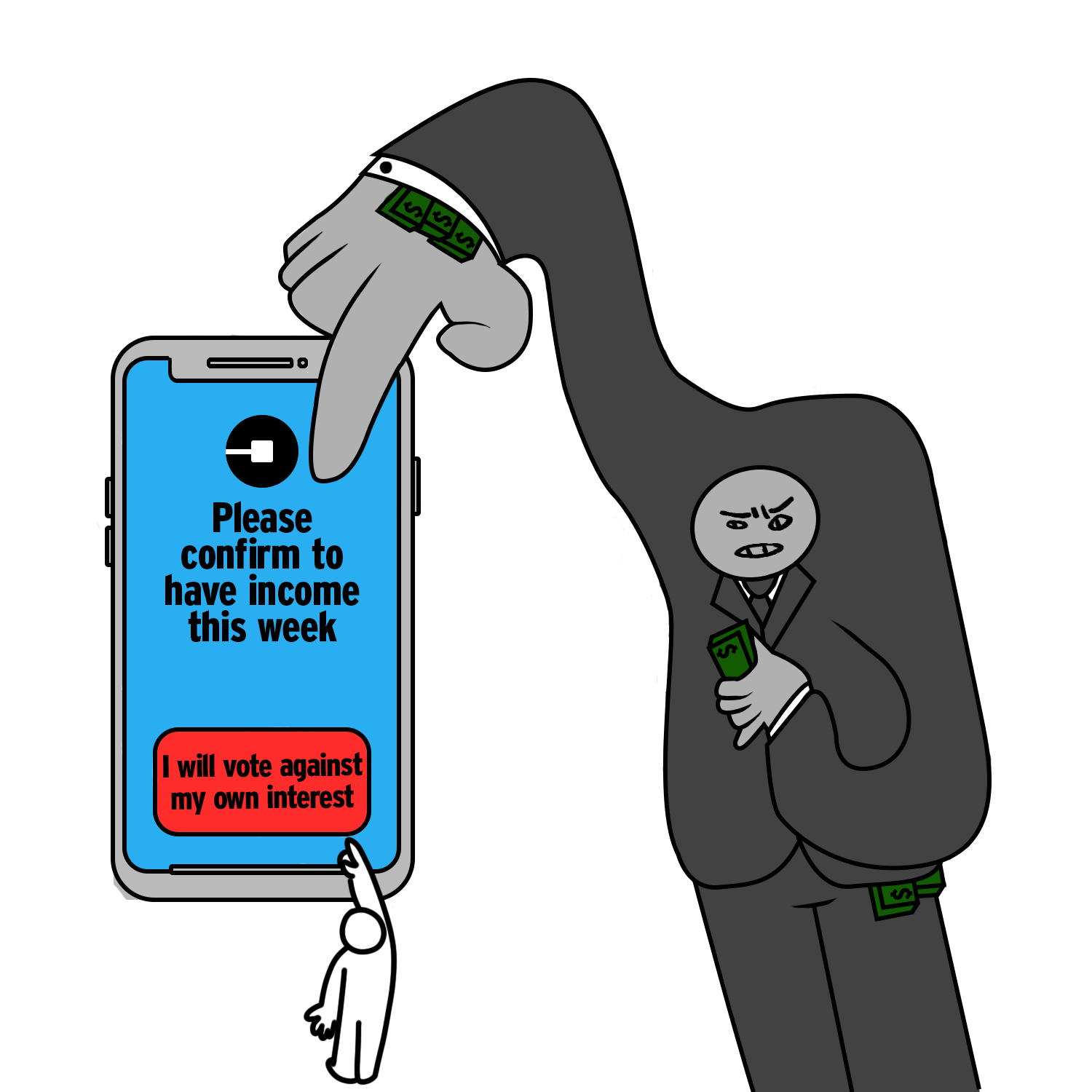
California’s passing of proposition 22 on Nov. 5 represents a frustrating history of workers’ rights being trampled by the overwhelming influence of greed in politics.
This proposition forces app-based workers to be classified as independent contractors, rather than employees. This classification allows companies like Uber, Lyft and Doordash to pay their workers significantly less than California’s guaranteed minimum as well as provide them with worse benefits than would be guaranteed as a full-time employee.
This proposition was vehemently opposed by labor unions that represented drivers. Unfortunately they were hugely outspent in advertising by the corporations that funded the ballot initiative for prop 22. Advertisements for a yes on prop 22 were incredibly misleading and placed on Amazon, YouTube and even inside of Uber’s app. They misleadingly claimed being an independent contractor provided workers with the freedom to receive benefits while driving on their own schedule.
In fact, under prop 22 drivers are only guaranteed benefits after 25 hours of engaged driving time. Engaged driving time is defined by prop 22 as time actively spent with a rider in the car, or a delivery in progress. With drivers reporting that they spend over half of their time waiting for a pickup, this could require workers to put in more than 40 hours a week for less benefits than a full-time California employee.
The reason that companies like Uber and Lyft are able to continuously influence political campaigns is due to the fact that within the US, companies enjoy and exercise the same level of freedom of speech granted by the First and Fourteenth Amendments that residents due.
In a 1886 Supreme Court case, Chief Justice Morrison Waite said that “the Court does not wish to hear argument on the question whether the provision in the Fourteenth Amendment to the Constitution which forbids a state to deny to any person within its jurisdiction the equal protection of the laws applies to these corporations. We are all of opinion that it does.”
Two years later, the Supreme Court made the ruling official stating, corporations had equal protection under the law as they were merely expressing and acting on behalf of the people that created and ran them.
These rulings are what set the stage for one of the most important court cases in the history of politics within the US, Citizens United v. FEC.
In the rulings of the case, Justice Anthony Andrews, joined by other Justices of the court, wrote that corporations were protected under the First Amendment to freely express their opinions on matters both domestic and political.
Furthermore, Justice Andrews wrote in the majority opinion that the US government was not responsible for creating an equal playing field regarding the use of money, changing the rules of campaign financing, leading to the rise of super Political Action Committees. These PACs could acquire an unlimited amount of funds from corporations, individuals and other PACs to use for supporting political candidates and proposals.
The consideration for corporations did not always extend to laborers. The US has a history of ruling against labor unions, going as far back as 1806, where the first case regarding a labor strike occurred with Commonwealth v. Pullis. The Philadelphia Mayor’s court ruled that leaders of a union strike were guilty of conspiring to raise their wages after labor strikes failed to do so. This established a precedent that labor unions were illegal, something that stood until 1842.
The consensus in academic literature is that unions shrink income inequality. Union members make, somewhere between 10 and 30 percent, and enjoy more benefits. Unions also drive worker solidarity and income equality across race and gender lines. The recent rise in income inequality in the US is partially attributable to shrinking union membership. The idea of collective bargaining only works if trade unions have the power of large numbers of workers standing in solidarity.
The ferocity companies and governments demonstrate when quelling labor organizations should be all the evidence needed that labor organizations are effective. The total number of workers murdered in response to labor organization in the United States is unknown, but the number of workers killed by law enforcement, company militias, and other anti-labor forces during labor disputes numbers in the thousands. If labor organizations did not work, no one would drop bombs on striking workers and, knowing the risk, no one would strike if it did not benefit them.
The US Government has often been hostile to labor organizations. During the early years of the industrial revolution, the legality of collective bargaining was uncertain, but often led to convictions and fines. Even when collective bargaining was legalized, the National Guard and local law enforcement were responsible for violence against labor organizers.
Resistance to collective bargaining should be expected from people who became as powerful as they did by appealing to moneyed interests. No one in a position of wealth and power can be relied upon to betray their source of power. Greed is bipartisan, and workers should not rely on institutions to grant them rights if those same institutions have proved hostile in the past.
Though the labor victories of the past still benefit workers immensely, companies are doing everything they can to undermine those victories. Prop 22 is one in a long line of examples. It undermines workers rights and chips away at our hard won standard of living. It should be a warning sign that no labor struggle is ever over. It will be an ongoing fight against corporate greed, but joining a union and standing in solidarity with workers across divisions of nationality, race, gender and economic background will benefit yourself and your community.